


Last updated: July 2026
- Re-checked the durability pattern across the newest owner feedback — the sole-separation and toe-seam complaints are still clustering in the same 2–6 month window that older reviews flagged.
- Re-verified the sizing story: the “runs narrow / order up” theme holds steady, and I re-read the happy long-term owners to confirm the insole-swap fix keeps coming up.
- Added the re-buyer paradox angle after noticing how many owners who criticize these boots still say they’d buy them again.
Affiliate disclosure: SturdyBoot.com is reader-supported. If you buy through links on this page, we may earn a small commission at no extra cost to you. It never changes what we report from owner feedback.
The boot everyone calls “light” and nobody agrees on
You’re standing on a jail floor, a school hallway, or a patrol beat for a twelve-hour shift, and your current boots feel like ankle weights by hour four. So you go looking for a genuinely light duty boot — and the Oakley Light Patrol keeps showing up, praised as “tennis-shoe light” by some owners and trashed as “cardboard on your feet” by others. That split is the whole story here, and it confuses buyers more than almost any boot in this category.
Quick answer: Is it worth it? Worth it if you want a featherweight, breathable indoor/warm-weather duty boot and you accept it as roughly a one-year boot — not if you need long-haul durability or all-day cushioning out of the box.
Everything below is a synthesis of real owner experience — the good, the ugly, and the patterns most single reviews miss. If you’re weighing this against the whole field first, our police boots buying guide frames how a light patrol boot fits (and doesn’t) into a duty rotation.
How this review was built (so you can trust it)
- Reviews analyzed: I went through a sample of roughly 140 verified-purchase text reviews across the critical and positive sides of the listing. That’s a slice of the product’s total ratings, not the whole pool — I read the ones with actual written feedback, not star-only entries.
- Time window: The feedback I read spans roughly late 2017 through mid-2026, so it covers current production. That matters here, because a recurring theme is longtime Oakley fans comparing these to older, softer Oakley boots they were issued years ago — some of that criticism is really a comparison to a discontinued feel, not a defect.
- How I synthesized it: I tagged feedback into buckets — comfort/fit, sizing, sole and construction durability, lace hardware, weight, heat/breathability, and warranty/return experience — then separated “use or fit-driven” complaints (wrong width, wrong climate, wrong expectation) from “likely product/design” issues (sole delamination, toe-seam splitting, lace-eyelet tearing).
- Important limitations:
- Reviews skew to extremes — thrilled owners and furious ones both write more than the indifferent middle.
- Wear intensity is wildly uneven: someone doing 16-mile days on a corrections floor is not testing the same boot as a weekend cosplayer.
- I weighted recurring patterns over one-off lemons (a single “received used boots” complaint is a fulfillment issue, not a design verdict).
For how the sole and upper choices here play out on the job, our breakdown of how work boot soles are built and behave pairs well with the durability section below.
Quick Verdict (TL;DR)
Best for
- Indoor duty — corrections, security, warehouse, school resource officers — on flat surfaces.
- Hot-weather and summer shifts where breathability beats insulation.
- Anyone who hates heavy boots and wants a “walking on air” feel.
Not for
- Wide feet, or anyone sensitive to a low, hard heel cup.
- Wet, icy, or rough outdoor terrain where you need waterproofing and grip.
- Buyers who need a boot to last multiple years of hard daily wear.
Standout win
- The weight. Owner after owner calls these the lightest duty boot they’ve worn, and several long-shift workers say it’s the difference that saves their feet.
Watch-outs
- Sole separation and toe-seam splitting that repeatedly show up in the 2–6 month range — often right after the return window closes.
Confidence Score: 8.5 / 10 🎯 This is a buyer-usefulness score, not a reliability rating. It’s high because the owner signal is unusually consistent about who this boot fits: light-duty, indoor, warm-weather wearers love it; heavy-use and outdoor wearers regret it. The comfort signal is strong but polarized (heel-cup and cushion complaints are real), and the durability signal is clearly the weak point. I’m confident telling you who should buy — less confident promising how long it’ll last you.
What This Boot Is (and What It Isn’t)
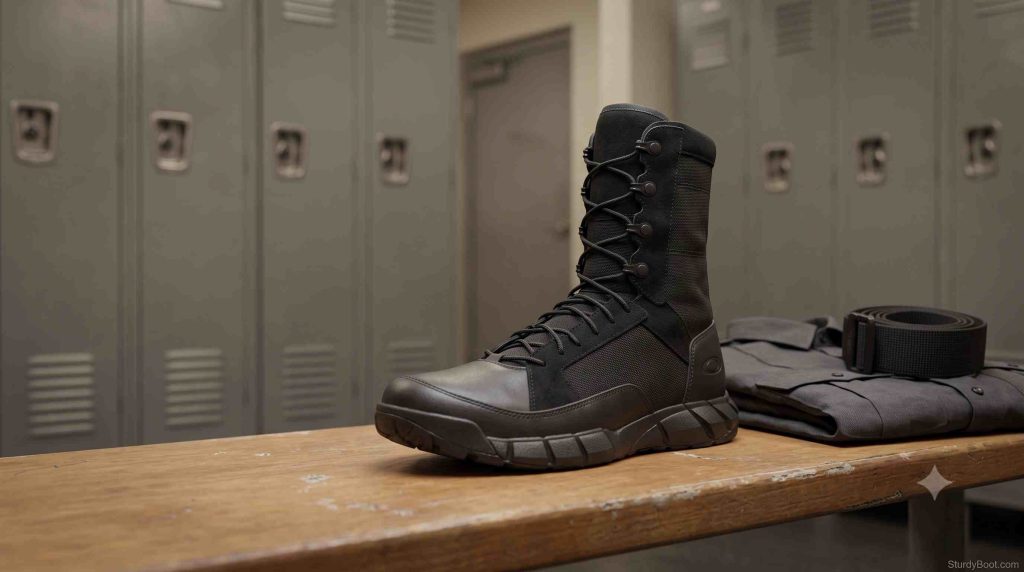
The Oakley Light Patrol is a tall, lace-up tactical/duty boot built around a leather-and-textile upper with a soft, flexible sole — designed to feel closer to a high-top athletic shoe than a traditional stiff combat boot. Owners consistently describe it as minimalist, low-profile, and extremely light.
Three misconceptions worth clearing up:
- It isn’t a heavy-duty protective boot. Across the feedback I analyzed, owners repeatedly note there’s no steel/safety toe and no shaft protection. It’s a comfort-and-mobility boot, not an impact-protection one. If your role requires protective footwear, verify against your employer’s PPE hazard assessment and OSHA’s foot protection standard (29 CFR 1910.136) before relying on any non-rated boot on the job.
- It isn’t waterproof or all-weather. Several owners who tried to treat it like a rugged outdoor boot were disappointed; the upper is thin and breathable by design.
- It isn’t the older Oakley boot. A recurring, emotionally loaded theme is veterans comparing it to Oakley boots they wore years ago and feeling the current version is thinner and less cushioned.
Key Specs That Actually Matter
I’m only listing what owner feedback actually supports, and why each one changes your day on the job:
- Weight (very light): The single most-praised trait. If you’re on your feet 10–12 hours, owners say this is the boot’s whole reason to exist.
- Breathable upper: Owners in hot climates rave; it’s described as airy, even “walking on air.” The flip side is zero insulation and no water resistance.
- Soft, flexible sole: Great for indoor flat surfaces and quick movement; repeatedly criticized as too soft on hard or uneven ground, with “no cushion” complaints from high-mileage wearers.
- Metal lace eyelets: One owner flagged that the metal eyelets set off metal detectors — a real problem if you work a facility where that matters. Worth knowing before you buy.
- Low heel cup: A repeated pain point (more below). It’s the design detail behind a lot of the blister and heel-rub reviews.
- Lace-only closure (no side zip): Even happy owners wish it had a zip; getting the floppy top on while standing is a common minor gripe.
Sizing & Fit — What Owners Actually Report
The short version: these run narrow, and a meaningful group says they run slightly small — many owners recommend ordering a half size up.
Here’s the pattern in detail:
- Width: The most consistent fit complaint by far is that the boot is narrow, with no wide option. Standard and narrow feet tend to be fine; wide-footed owners repeatedly report toe-box tightness and pain, and some returned for that reason alone.
- Length: Mixed but leaning small. Several owners say “true to size,” but a notable cluster says they run a half size small and advise sizing up. A few reported the opposite or received a mislabeled pair — so this isn’t unanimous, which is exactly why trying them early matters.
- The heel cup: Independent of size, owners describe the heel cup as cut low and sometimes hard, which rubs heels raw on some feet regardless of length. If you have a prominent heel, this is your risk factor.
For a foot-shape checklist that helps you predict whether a narrow last will fight your foot, our work boot fit and sizing guide is the thing to read before you order.
Feature-by-Feature Breakdown (Truth vs Marketing)
| Feature | What the Marketing Implies | What It Actually Means (Owner Experience) | Compared to Competitors |
|---|---|---|---|
| Lightweight build | Effortless all-day wear | Genuinely true — the #1 thing owners love | Lighter than most Bates/Belleville/Danner duty options owners name |
| Tactical durability | Tough duty boot | Polarized — many report sole separation and toe splitting within months | Owners repeatedly say 5.11 and Timberland PRO outlast it |
| Comfort | Broken-in feel | Split: “tennis shoe” comfort for some, low-heel-cup pain for others | Compared to sneakers when it works; to cardboard when it doesn’t |
| Breathability | Cool, ventilated | Strongly confirmed for heat; means no warmth or water resistance | Beats heavier all-leather duty boots in summer, loses in cold/wet |
| Cushioning | Ready to work | Thin factory insole; many owners swap it | Aftermarket insole closes much of the gap owners complain about |
Real-World Owner Experience (Deep Pattern Analysis)
The stories below are grounded in repeated patterns across owner feedback, not one-off reviews.
Pattern 1 — The durability cliff owners hit right after returns close (the one most reviews won’t tell you)
This is what buyers most need to know and what a quick star-glance hides. Across the feedback, the failures aren’t random — they cluster in time. Owners repeatedly report the sole separating from the upper, or the toe/lace area splitting, somewhere in the two-to-six-month range. Multiple people specifically note the problem surfaced after their return window had already closed, leaving them stuck.
- In a nutshell: The boot often performs fine for the first month, then fails in a predictable window — frequently just past the point where you can send it back.
- Hidden strength: When failure comes, it’s usually a clean, visible symptom (sole peeling, seam opening) rather than a slow mystery — so you can catch it if you’re watching.
- Hidden weakness: By the time it shows, you may be past both the return window and the honeymoon phase where you’d have noticed.
- What to do about it: Stress-test aggressively in week one (see the Return-Window check below). Flex the toe hard, tug the sole bond at heel and toe, and hammer the lace eyelets. Don’t wait for the boot to “settle in” before deciding.
Pattern 2 — The re-buyer paradox
Here’s the counterintuitive signal. A surprising number of owners who openly call the boot’s durability a problem still say they’ll buy it again — some are on their third or fourth pair. One long-time owner reports 19 months from a first pair and bought a second anyway; another buys a fresh pair yearly and calls it “honestly valid.”
- In a nutshell: For a specific worker — light-duty, high-comfort-need — the weight and comfort are worth treating this as a consumable, roughly annual boot.
- Hidden strength: That repeat-buy behavior is a stronger endorsement of the comfort than any five-star line, because it comes from people who know the downside.
- Hidden weakness: It quietly confirms the durability ceiling — these owners re-buy because the last pair didn’t last.
- What to do about it: Budget mentally for a yearly replacement. If that math works for your comfort payoff, this is a rational buy. If it doesn’t, walk.
Pattern 3 — The comfort split lives in the heel cup
The love-it/hate-it comfort divide isn’t random taste — it repeatedly traces to one design detail: a low, sometimes hard heel cup. Owners who fit it well call these the most comfortable boots they’ve owned; owners whose heel catches the low cup describe blisters within a single shift, sometimes within two blocks.
- In a nutshell: Your heel shape, more than the size you order, predicts whether you’ll love or hate these.
- Hidden strength: For the right foot, the low-profile design is exactly what makes them feel sneaker-like.
- Hidden weakness: There’s no easy fix if the heel cup is the problem — an insole helps cushion but won’t raise the cup.
- What to do about it: On day one, wear them a couple of hours indoors and watch the back of your heel specifically. Heel-rub is the earliest and clearest disqualifier.
Pattern 4 — The thin factory insole is fixable, and owners tell you exactly how
The most actionable positive pattern: many of the happiest long-term owners share the same move — they swapped the factory insole. People walking 16-mile days and 10–12 hour shifts report the boot went from “no cushion” to “pretty much perfect” after adding a gel or aftermarket insole.
- In a nutshell: A lot of the “no cushion” complaints have a cheap fix.
- Hidden strength: The boot’s light, flexible platform is a good base once you add support.
- Hidden weakness: You’re paying a duty-boot price and then buying insoles to make it comfortable.
- What to do about it: Plan to add a cushioned insole from the start, and factor that small cost into your decision.
Pattern 5 — The use-case threshold: indoor-flat vs outdoor-rough
Filtering out mismatched buyers reveals a cleaner picture. Owners who use these for indoor, flat-surface, warm-weather duty — corrections, security, school, warehouse — are overwhelmingly the happy camp. Owners who took them onto wet, icy, uneven, or rough outdoor ground hit slipping, soaking, and fast wear. Several explicitly note the sole is slick with any water.
- In a nutshell: This is a climate- and terrain-specific boot masquerading as a general duty boot.
- What to do about it: Match honestly. If your beat is outdoors and rough, this isn’t your boot — start from our top police boot picks instead.
The Good, The Bad & The Ugly
The Good (comfort & weight)
- Exceptionally light; the standout, near-universal praise.
- Breathable and cool for hot-weather and indoor shifts.
- Sneaker-like flexibility and mobility for the right foot.
- Sharp looks — works with uniform or business-casual.
The Bad (fit & setup)
- Runs narrow with no wide option.
- Thin factory insole most owners end up replacing.
- Floppy top and lace-only closure make them awkward to put on while standing.
The Ugly (durability & terrain)
- Sole separation and toe-seam splitting recurring in the 2–6 month window.
- Slick sole on any wet surface; not waterproof.
- Low heel cup that rubs some owners raw fast.
Mini Toolkit: Decide + Fix (Fast)
Issue-Tag Box #sole-separation · #toe-seam-split · #lace-eyelet-tear · #runs-narrow · #low-heel-cup · #slick-when-wet
Fit Mini-Matrix
| Foot type | Verdict |
|---|---|
| Narrow | Best match — order half size up if between sizes |
| Standard | Usually fine — watch the heel cup |
| Wide | Skip it — repeated toe-box pain, no wide option |
Mini Decision Tree
- If your shift is indoor + flat + warm → strong candidate.
- If you need waterproof or cold-weather → skip.
- If you have wide feet or a prominent heel → skip.
- If you’ll swap the insole and accept ~1-year life → buy.
- If you need multi-year durability → choose a heavier-duty rival.
Troubleshooting Quickflow
- Heel rubbing? → Re-lace with a heel-lock (surgeon’s knot at the ankle) before anything else.
- Still rubbing raw? → It’s the heel cup; this foot likely won’t fit — return now.
- Feet aching by mid-shift? → Swap in a cushioned/gel insole.
- Sole edge lifting? → Photograph it, stop wearing, and return if you’re still in window.
- Slipping on wet floors? → Treat as indoor-dry only; don’t rely on grip outdoors.
- Beyond basic care (resole, sole re-bond)? → Consult a cobbler or qualified repair rather than gluing it yourself for duty use.
Mini Return-Window Reality Check
Do these before your return window closes — because the most common failures show up right after it:
- Sole-bond tug test: Firmly pull the sole edge away from the upper at both heel and toe. Any lift or gap is an early separation warning.
- Toe-flex stress: Bend the toe box hard, repeatedly. Watch the toe seam and lace-area stitching for strain or opening.
- Heel-cup shift test: Wear them indoors for two hours and check the back of your heel for redness — the earliest fit disqualifier.
- Eyelet stress: Lace them tight and tug; the metal lace hardware and the fabric around it is a reported tear point.
- Wet-floor caution check: Test grip on a damp indoor surface before you commit to any wet-terrain use.
If any of these fail, send them back that week. For how a light patrol boot should slot into a full duty rotation, the complete police boots guide puts this boot’s tradeoffs in context.
Sizing & Insider Tips (Realistic)
- Order a half size up if you’re between sizes or wear thicker socks — the small-and-narrow pattern is consistent enough to plan around.
- If you have wide feet, don’t fight it — the narrow last is the top return reason.
- Plan to buy a cushioned or gel insole from day one; happy long-term owners nearly all did this.
- Use a heel-lock lacing technique to fight heel slip and rub before assuming they don’t fit.
- Don’t expect break-in to fix a low heel cup — that’s structural, not a wear-in issue.
- Keep them indoors and dry; the sole is repeatedly reported as slick on wet surfaces.
- If your facility uses metal detectors, confirm the metal eyelets won’t be a problem before you rely on them.
- Wrap the long laces around the ankle to take up slack — a common owner workaround for the extra-long laces.
- Treat these as a warm-weather boot; owners don’t recommend them for cold or wet seasons.
- For anything beyond basic cleaning and insole swaps — resoling, re-bonding a lifting sole, or any slip-hazard concern on duty — consult a cobbler or qualified repair, or verify against your employer’s PPE hazard assessment rather than improvising a fix.
Owner Stories
The stories below are composite scenarios reflecting repeated patterns across owner feedback.
- The happy indoor re-buyer: A corrections officer on flat floors all shift swaps in a gel insole, loves the featherweight feel through 12-hour days, gets roughly a year out of them, shrugs at the wear, and orders the same boot again. For this profile, the boot is a genuine win.
- The wrong-terrain mismatch: A patrol officer working outdoors takes them onto wet, uneven ground, hits slipping and soaking, and watches the sole start separating within a couple of months. Right boot, wrong job — the terrain, not a defect, drove the disappointment.
- The wide-foot returner: A buyer with wide feet orders true-to-size, feels toe-box pinch and heel rub on the first wear, and sends them back within the window. Nothing was wrong with the pair — the narrow last simply doesn’t fit that foot.
SEE MORE OWNER FEEDBACK ON AMAZON
Who This Is For (and Who Should Skip It)
Buy it if…
- You work indoors on flat surfaces (corrections, security, school, warehouse).
- Weight and breathability matter more to you than ruggedness.
- You’re in a hot climate or working summer shifts.
- You have narrow or standard-width feet.
- You’ll add a cushioned insole and accept roughly annual replacement.
Skip it if…
- You have wide feet or a prominent heel.
- Your work is outdoors, wet, icy, or on rough terrain.
- You need waterproofing, insulation, or a safety toe.
- You want a boot that lasts multiple years of hard use.
- You dislike lace-only closures and floppy boot tops.
If you’re comparing options, start here: Top Police Boot Picks
Alternatives (Quick Comparisons)
- Need max lightness and comfort, still indoor-focused? These Oakleys are hard to beat on weight — the question is durability, not feel.
- Need it to survive hard, multi-year use? Owners repeatedly name heavier-built duty boots as outlasting these; browse sturdier options in our most comfortable work boots roundup for cushioned all-day picks.
- Need cold or wet-season coverage? This isn’t it — see our best winter work boots for insulated, weather-ready alternatives.
- Want the lightest possible option regardless of category? Cross-shop our best lightweight work boots to see how the Oakley stacks up on weight alone.
Deep-Dive FAQ
What should I test immediately after delivery?
Stress the sole bond, toe seam, lace eyelets, and heel cup on day one. Pull the sole edge away from the upper at heel and toe, flex the toe box hard, tug the laced eyelets, and wear them indoors for two hours to check for heel rub. The most common failures cluster right after the return window, so catching a weakness early is the whole game.
What are the most common problems and fixes?
The big three are sole separation, a low/hard heel cup that rubs, and a too-thin factory insole. The insole is the easy fix — owners swap in a gel or cushioned insert and report a big comfort jump. Heel rub can sometimes be tamed with heel-lock lacing, but if the heel cup is the issue it’s often a fit dealbreaker. Sole separation isn’t fixable at home for duty use — return it in-window or see a cobbler.
Will these work with my foot type and my job?
Best for narrow-to-standard feet doing indoor, flat-surface, warm-weather work. If you have wide feet, a prominent heel, or you work outdoors in wet/cold/rough conditions, these will likely fight you. The boot is genuinely great for the right profile and genuinely wrong for the wrong one — there’s not much middle ground in the feedback.
How long do they really last?
Owner experience is polarized, but a common thread is roughly a year of hard daily wear, with sole separation and toe-seam issues frequently appearing in the 2–6 month range for heavy users. Some owners report well over a year and are on repeat pairs; others had failures within weeks. Light, indoor use stretches lifespan; heavy outdoor use shortens it sharply.
Are they actually waterproof or good in cold weather?
No. Owners consistently describe the upper as thin and breathable, not waterproof, and several warn the sole is slick on wet surfaces. It’s a warm-weather, dry-conditions boot — don’t count on it for rain, snow, or ice.
Oakley Light Patrol vs 5.11 Tactical — which should I pick?
If durability and rugged all-conditions use are your priority, owners repeatedly lean toward 5.11 (and Timberland PRO) as longer-lasting, at a higher price. If pure lightness and breathability for indoor or hot-weather shifts are what you’re after, the Oakley wins on feel. Put simply: 5.11 for longevity and toughness, Oakley for weight and comfort — the classic “you get what you pay for” tradeoff several owners describe firsthand.
Do they set off metal detectors?
At least one owner reported the metal lace eyelets set off a workplace metal detector. If you work a facility where you pass through detectors, confirm this before relying on them for duty.
Final Verdict
The Oakley Light Patrol is a specialist wearing a generalist’s uniform. For a narrow-to-standard-footed worker on indoor, flat, warm-weather duty who’s happy to swap the insole and treat the boot as a roughly annual purchase, it delivers a featherweight, breathable comfort that owners keep coming back for — literally, on their third and fourth pairs. For wide feet, wet or cold terrain, or anyone who needs a boot to survive years of abuse, the durability cliff and slick sole make it the wrong call. Know which one you are, and the decision is easy.