


Last updated: July 2026
- Re-checked the sizing pattern against the newest owner feedback: the “wide isn’t wide” complaint is still landing on pairs bought in 2026, so this isn’t old news that got fixed.
- Re-verified the country-of-origin storyline (owners comparing China-made pairs to newer Dominican Republic pairs) — it’s still the loudest quality theme longtime buyers raise.
- Re-checked the side-zipper failure reports; they continue to cluster a few months into ownership, and at least one 2026 owner notes the zipper’s inner construction was recently changed.
- Confirmed the re-buyer paradox holds: multiple owners who complain about decline still buy another pair, which reshapes the real-world verdict.
As an Amazon Associate, we earn from qualifying purchases. If you buy through links on this page, we may earn a small commission at no extra cost to you. It never changes what we report.
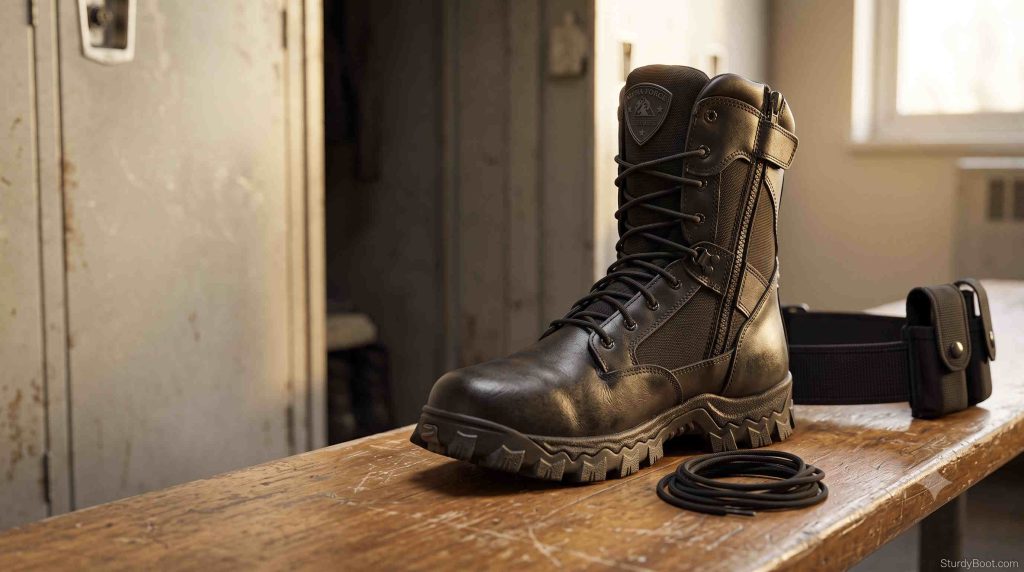
I went deep into owner feedback on the ROCKY Alpha Force because it’s the boot that confuses more law-enforcement, corrections, security, and EMS buyers than almost any patrol boot I’ve studied. On paper it’s a lightweight, waterproof, side-zip duty boot with a comfortable footbed and a loyal following stretching back decades. In practice, two owners can buy the exact same size a year apart and have completely different experiences — one calls it the best duty boot they’ve ever worn, the next says it crushed their feet in an hour. That gap is the whole story here.
Is it worth it? For normal-to-narrow feet doing patrol, security, EMS, or postal-style walking duty, it’s a comfortable, well-priced side-zip boot — but size up and expect roughly a year of hard-duty life, not the “buy it for a decade” reputation.
This review is a synthesis of real, verified-purchase owner experience — the happy long-timers and the furious returners — not a spec sheet. If you want the wider category view, our police boots buying guide breaks down how side-zip duty boots compare across brands before you commit to one model.
How this review was built (so you can trust it)
- Sample size: I analyzed a sample of roughly 190+ verified-purchase text reviews actually read across the critical and positive sides of the listing. That’s a slice of the boot’s several-thousand total ratings, not the whole population — I’m reporting what the readable written reviews say, not the headline star average.
- Time window: The feedback I read spans roughly late 2020 through mid-2026. That matters here more than for most boots, because a large share of owners are longtime buyers explicitly comparing current production against older pairs they owned years ago. So this review reflects the boot people are actually receiving today, with that historical contrast noted where owners raise it.
- Method: I tagged every review into categories — sizing/width, comfort/break-in, waterproofing, sole and toe-separation durability, zipper hardware, interior heel construction, heat/sweat, and country-of-origin/quality-decline themes — then separated use-and-fit-driven complaints (wrong width ordered, wrong job) from likely product or manufacturing issues (toe separation, zipper tearing, interior heel plastic breaking).
- Important limitations:
- Reviews skew toward extremes; delighted long-timers and furious returners both write more than the quietly-satisfied middle.
- Wear intensity is wildly different — a retired farmer and a correctional officer on 110 twenty-four-hour shifts a year are grading the same boot on different scales.
- I prioritized patterns that recurred across many owners over one-off lemons.
Quick Verdict (TL;DR)
Best for:
- Patrol, security, corrections, EMS, and postal/warehouse walkers who want easy on/off via a side zip.
- Normal-to-narrow feet (this is the single biggest predictor of a happy owner).
- Buyers who accept “solid one-year-ish duty boot at a fair price” rather than heirloom durability.
Not for:
- Genuinely wide feet — even the Wide runs narrow for many owners.
- Anyone who needs a safety toe (most pairs are a soft, non-safety toe).
- Heavy trades where the toe takes constant scuffing and abrasion.
Standout win: Genuinely comfortable footbed and easy side-zip on/off that patrol and EMS owners repeatedly praise, often for 12-hour-plus shifts.
Watch-outs: Width runs small, and toe-sole separation plus zipper/interior-heel failures cluster in the first several months for a vocal minority.
Confidence Score: 7.5/10 🎯 This reflects how confidently I can tell you who this boot fits — not a reliability percentage. It’s high because the signals are unusually consistent: comfort praise is strong and repeated, and the sizing verdict (runs narrow, size up) is near-unanimous. It’s held back from a 9 because durability is genuinely polarized — the same boot draws “12 years and going” and “fell apart in one day” — so I can’t promise your individual pair’s lifespan, only tell you which failure modes to watch.
What This Boot Is (and What It Isn’t)
The Alpha Force is a lightweight, side-zip, 8-inch waterproof public-service boot with a comfortable removable footbed and a soft (non-safety) toe on most pairs. It’s built for uniformed walking duty — patrol, security, corrections, EMS, postal — where you’re on your feet for long shifts and need to get boots on and off fast.
A few misconceptions worth clearing up:
- It isn’t a safety-toe boot by default. Several owners assumed they’d ordered a protective toe and discovered too late it wasn’t. If your job requires an ASTM-rated toe cap, this likely isn’t it — verify before buying.
- It isn’t a heavy-abrasion trade boot. The toe finish scuffs and, for a minority, the toe separates from the sole. It shines as a walking/duty boot, not a demolition boot.
- “Wide” isn’t wide. More on this below, because it’s the number-one reason people return it — the marketing width and the real-world width don’t match for a lot of feet.
Key Specs That Actually Matter
Only the features owners actually tie to good or bad outcomes made this list:
- Side zipper + laces: The signature feature. Lace to your preferred tightness once, then zip on and off. EMS and patrol owners love it for middle-of-the-night calls. But the zipper (and the fabric/leather web around it) is also a recurring failure point.
- Waterproofing: Works well for most in real rain and puddles; a minority report soak-through, sometimes only after the return window closed. Treat it as “water-resistant to genuinely waterproof depending on your pair and how well the leather’s maintained,” not a guarantee.
- Fit/last (runs narrow): The most outcome-changing spec of all. The last is narrow, especially through the heel and the ball of the foot.
- Comfortable footbed: Repeatedly singled out as better than the aftermarket insoles owners have tried. This is the boot’s real strength.
- Soft (non-safety) toe: Lightweight and comfortable, but no toe-cap protection on most pairs and prone to scuffing.
- Interior heel counter (plastic): A hard plastic piece that molds the heel. When it cracks or the lining wears through, owners report Achilles-area rubbing and blisters — a specific, recurring weakness.
For a plain-English tour of why last shape, heel counters, and outsoles change how a boot feels, the work boot anatomy and construction breakdown is a useful companion to this section.
Sizing & Fit — What Owners Actually Report
The verdict: it runs both narrow and about a half-size to a full size small. Size up, and if you have anything beyond a standard-width foot, think hard before buying.
This is the most consistent theme in the entire body of feedback, and it’s worth being blunt about:
- Width: Owner after owner reports the “Wide” fits like a standard D — sometimes narrower. People who have never needed a wide size in their life describe the toe box crushing their toes together. “Nothing wide about them” and “the W must stand for narrow” is a drumbeat across years of reviews.
- Length: Many say it runs a half-size to a full size short. Repeat buyers who wear a 12 report going to 13, and some wish they’d gone to 14 — especially for thick winter socks.
- Heel: Several owners describe a vice-grip heel and a hard interior piece near the Achilles that rubs. Narrow-heeled feet often love the lockdown; wider or bonier heels get blisters.
Who the fit suits: Normal-to-narrow feet, and people with narrow heels who want zero heel slop. For them, this boot frequently earns “fits like a glove.”
Who it fights: Anyone with a genuinely wide forefoot. Multiple wide-footed owners tried the Wide, then a size up in Wide, and still returned them. If that’s you, this is the single biggest reason to look elsewhere.
Before you gamble on a size, our work boot fit and sizing guide walks through measuring forefoot width and heel volume — exactly the two dimensions that decide whether this boot works for you.
Feature-by-Feature Breakdown (Truth vs Marketing)
| Feature | What the Manufacturer Suggests | What It Actually Means (Owner Experience) | Compared to Competitors |
|---|---|---|---|
| Width options (incl. Wide) | True-to-labeled widths | Runs narrow; “Wide” often fits like standard. Genuinely wide feet struggle even sizing up. | Narrower than many owners expect from Danner or 5.11 in comparable sizes |
| Waterproofing | Waterproof public-service boot | Works for most in rain/puddles; a minority soak through, sometimes past the return window | On par with mid-tier waterproof duty boots; less bulletproof than premium Gore-Tex builds owners cite |
| Side zipper | Fast on/off convenience | Beloved when it works; fabric/leather around it and the zipper itself can tear within months for some | The convenience is a real edge over lace-only rivals; the durability is the trade-off |
| Toe (soft/non-safety) | Lightweight tactical toe | Comfortable and light, but scuffs fast and can separate from the sole; not a safety toe | Rivals like the Danner Tachyon get named by owners for a more scuff-resistant/reinforced toe |
| Footbed/comfort | Comfortable duty footbed | A genuine strong point — repeatedly called better than aftermarket insoles | Among the better stock insoles in this price tier, per owners |
| Durability/lifespan | Rugged duty construction | Polarized: many get ~1 year of hard duty; some get many years; some fail in months | Longtime owners feel older pairs outlasted current production |
Real-World Owner Experience (Deep Pattern Analysis)
1. The “Wide-Isn’t-Wide” Fit Crisis (the pattern owners obsess over)
In a nutshell: The dominant story of this boot isn’t durability — it’s width. The Wide runs narrow, and it drives the largest share of returns.
Hidden strength: For narrow feet, that same snug last is a feature. Narrow-heeled owners get a locked-in, no-slop fit they can’t find elsewhere and become repeat buyers for life.
Hidden weakness: Wide-footed buyers can’t size their way out of it. Several went up a full size in Wide and still returned them, because going longer doesn’t fix a narrow forefoot — it just gives you a long, narrow boot.
What to do about it: If you’re standard-to-narrow, order your normal size and consider a half-size up, especially for thick socks. If you’re truly wide, treat this as probably-not-for-you and check width-friendlier options. This is a fit mismatch, not always a defect — but it’s so common it functions like one.
2. The Time-Machine Effect: “Not the same boot they used to be”
In a nutshell: A huge cluster of longtime owners — some on their 5th, 7th, even 9th pair over 10–20+ years — say current production doesn’t match the boots they loved. Many specifically tie the drop to a country-of-origin change, describing older pairs as China-made and newer pairs as Dominican Republic-made, with a tighter toe box, thinner-feeling leather, and faster interior wear.
What most reviews won’t tell you: This is the single highest-information pattern across all the owner feedback. It means your experience may depend less on the model and more on which production run you happen to receive — and buyers can’t reliably tell from the Amazon listing which one is coming.
Hidden strength: The loyalty is real for a reason. When these boots are good, they’re good enough that people buy them for a decade-plus and grade every replacement against a genuinely great original.
Hidden weakness: “Grading against an older pair” also means some 1-star reviews reflect a comparison to a discontinued build, not necessarily a bad boot in absolute terms. I weighed that when separating disappointment-from-nostalgia from true defects.
What to do about it: Inspect the pair you receive immediately — leather feel, toe-box width, stitching, interior heel — and use your return window as an actual quality-control check, not a formality.
3. Failure Timing: The Return-Window Trap
In a nutshell: Several of the most painful reviews share a structure — the boot fails just after the window to return it closes. Waterproofing that soaks through on the first wet day months in. Toe separation at the 3–7 month mark. Zipper tearing a few weeks past return eligibility.
What most reviews won’t tell you: Because the footbed is comfortable out of the box, some owners “save” the boots for when their current pair dies, then discover a defect only when it’s too late to return. That delay is itself a risk factor here.
Hidden weakness: A comfortable break-in lulls you into not stress-testing the boot early.
What to do about it: Stress-test on day one, not month three (see the Return-Window Reality Check below).
4. Toe & Sole Separation (the clearest product-side failure)
In a nutshell: The most consistent product complaint (as opposed to fit) is the toe separating from the sole — sometimes in months, occasionally in a single day of light yard work. Multiple owners report contact cement failing to hold it.
Hidden weakness: It appears across sizes and trades, which points to a manufacturing-consistency issue rather than user abuse — several sufferers explicitly note light, non-construction use.
What to do about it: If you see the toe welt starting to lift, stop wearing them and pursue a return/warranty immediately; a lifting toe only gets worse and takes the waterproofing with it. For anything beyond monitoring, consult a cobbler rather than DIY-gluing a structural bond.
5. Zipper & Interior-Heel Hardware Failures
In a nutshell: Two hardware weak points recur: the side zipper (and the fabric/leather web around it) tearing or jamming within a few months, and the hard plastic heel counter cracking or the heel lining shredding, causing Achilles blisters.
Hidden strength: At least one 2026 owner notes the inner zipper construction was recently upgraded, and some newer pairs report a smoother zipper — a sign the maker may be responding.
Hidden weakness: When the heel plastic breaks, the boot can become unwearable overnight, even on an otherwise-good pair.
What to do about it: Don’t rely on the zip alone — lace to fit, then use the zip for on/off, which several savvy owners say prevents the interior heel from ripping out.
6. The Re-Buyer Paradox
In a nutshell: Here’s the twist that reshapes the verdict: a striking number of owners complain bitterly about declining quality — and buy another pair anyway. “Rockies have gone downhill… I’m buying a second pair.” “Heel support broke… I am buying a second pair.”
What this reveals: For a lot of duty workers, the comfort and price still beat the alternatives they’ve tried, even after a failure. That’s a real-world endorsement more honest than any star rating — but it’s an endorsement of “good enough and comfortable,” not “bulletproof.”
7. Heat & Sweat (a smaller but real pattern)
In a nutshell: A recurring minority note the boots run hot and hold moisture — “clear the locker room” stink until broken in. Fine for temperate patrol; something to weigh for hot-climate or summer-heavy duty.
What to do about it: Moisture-wicking socks and rotating two pairs (a common long-timer habit here) both come up as fixes.
The Good, The Bad & The Ugly
The Good (comfort & convenience)
- Comfortable footbed that owners rate above aftermarket insoles.
- Side-zip on/off that patrol and EMS owners genuinely love.
- Good traction and slip resistance, including greasy/wet surfaces.
- Lightweight for a tactical boot; strong ankle support.
The Bad (fit & expectations)
- Runs narrow and short — near-universal “size up” guidance.
- Runs hot / holds moisture for some.
- Not a safety toe, despite some buyers assuming it is.
The Ugly (durability failures for a vocal minority)
- Toe/sole separation, sometimes within months.
- Zipper and fabric-around-zipper tearing.
- Interior heel plastic cracking or lining shredding into blisters.
- Waterproofing occasionally failing just past the return window.
Mini Toolkit: Decide + Fix (Fast)
Issue-Tag Box: #wide-runs-narrow · #toe-sole-separation · #zipper-tear · #heel-plastic-crack · #runs-hot · #return-window-trap
Fit Mini-Matrix
| Foot type | Verdict |
|---|---|
| Narrow foot / narrow heel | Strong match — snug, locked-in, size up a half |
| Standard/D width | Workable — order true-to-size to a half up, watch the forefoot |
| Genuinely wide (2E+) | Skip it — even the Wide runs narrow; sizing up won’t fix width |
Mini Decision Tree
- If you need a safety toe → skip this model (most pairs are soft-toe).
- If you have wide feet → skip, or expect a return.
- If you want fast on/off for EMS/patrol and have normal-to-narrow feet → strong buy, size up.
- If you want a decade of durability → temper expectations to ~1 year of hard duty.
- If your pair’s toe starts lifting or heel plastic cracks → return/warranty now, don’t wait.
Troubleshooting Quickflow (max 6 steps)
- Boots arrive → check leather feel, toe-box width, stitching, interior heel before wearing outside.
- Too narrow/short in the forefoot → return and size up (or switch models if truly wide).
- Heel rubs at the Achilles → lace-to-fit and use the zip only for on/off to protect the interior heel.
- Toe welt lifting → stop wearing, pursue return/warranty (don’t DIY structural glue).
- Zipper jams → work it gently, keep the web clear; if it tears, document for warranty.
- Runs hot → wicking socks + rotate a second pair.
Mini Return-Window Reality Check
Run these before your return window closes — this boot punishes people who wait:
- Forefoot squeeze test: Wear thick socks and walk 20+ minutes indoors; if toes crush together, it won’t “break wide.”
- Heel-rub check: Feel for the hard interior heel piece pressing your Achilles — that’s the blister zone owners report.
- Soak test the waterproofing: Don’t assume; stand in a shallow puddle or wet the toe and check for seepage now, not months later.
- Flex the toe seam: Bend the boot and inspect where the toe meets the sole for any early lifting or gapping.
- Work the zipper 20+ times: Zip and unzip repeatedly and watch the fabric/leather web around it for stress.
If you’re weighing this against other duty boots while you decide, the police boots buying guide lays out the trade-offs side-zip vs. lace-up across the category.
Sizing & Insider Tips (Realistic)
- Size up. Most owners land on a half-size to a full size larger than their street shoe; add room for thick winter socks.
- Don’t count on “Wide” being wide. If your forefoot is genuinely broad, this likely won’t work no matter the size.
- Lace-to-fit, zip for on/off. Owners who rip out the interior heel usually did it by relying on the zip under tension; lace to your fit and use the zip only to slip in and out.
- Break them in like slippers first. Several owners wore them around the house for a few days to avoid first-shift blisters — and to keep them returnable if the fit’s wrong.
- Treat the leather. It’s real leather that scuffs; an oil/wax treatment keeps the finish presentable and supports water resistance. This is basic care — for cracked or separating leather, consult a cobbler.
- Swap or supplement the insole only if needed — the stock footbed is a strength, so try it before replacing it.
- Rotate two pairs if you’re on hard duty; long-timers credit this for stretching lifespan.
- Inspect the interior heel early. If the lining is thin or the plastic edge is sharp, moleskin the spot before it shreds a sock — and factor a possible return.
- Watch the toe seam monthly. Early lifting is your cue to act while warranty/return may still help.
- Mind the calf chafe. A few owners note the shaft chafes bare calves; taller socks fix it.
- Don’t “save” a new pair for later. The comfortable break-in tempts people to shelve them until a defect surfaces past return eligibility — wear and stress-test them now.
- Confirm safety-toe requirements. If your job mandates a protective toe, verify the exact version; most Alpha Force pairs are soft-toe. For where a toe cap is legally relevant, the general rules under OSHA’s foot protection standard, 29 CFR 1910.136 are worth a read, and confirm against your employer’s PPE hazard assessment.
Owner Stories
The stories below are composite scenarios reflecting repeated patterns across owner feedback.
- The happy-fit re-buyer (security/patrol, narrow foot): A security officer on long shifts orders a half-size up, laces to fit, and uses the zip only for on/off. The snug heel locks in, the footbed feels great from day one, and roughly a year of hard duty later they simply buy the same boot again — comfort and price keep winning, defects or not.
- The wrong-width returner (wide forefoot): A buyer who’s never needed a Wide reads the reviews, orders the Wide anyway, and finds the toe box crushing after an hour. They size up in Wide, it’s now long and still narrow, and they return it — a textbook width mismatch this last simply can’t accommodate.
- The wrong-expectation long-timer (heavy trade, decade of loyalty): A veteran on their 6th-plus pair over many years gets a current-production boot, notices a tighter toe and thinner-feeling leather, and watches the toe start separating within months. Their disappointment is real — but it’s partly a comparison to an older, discontinued build, which is why inspecting the new pair on arrival matters so much.
SEE MORE OWNER FEEDBACK ON AMAZON
Who This Is For (and Who Should Skip It)
Buy it if…
- You have normal-to-narrow feet and want a locked-in heel.
- You’re patrol, security, corrections, EMS, postal, or a long-shift walker who values fast side-zip on/off.
- You want a comfortable footbed without buying aftermarket insoles.
- You accept ~1 year of hard-duty life at a fair price and will inspect your pair on arrival.
Skip it if…
- You have genuinely wide feet (even the Wide runs narrow).
- You need an ASTM safety toe.
- You’re in a heavy-abrasion trade that hammers the toe.
- You want guaranteed multi-year durability and can’t tolerate a polarized failure risk.
If you’re comparing options, start here: Top Police Boots Picks.
Alternatives (Quick Comparisons)
- If you need a tougher, scuff-resistant toe: Owners here repeatedly name the Danner Tachyon for a more reinforced toe that resists the scuffing and separation this boot’s soft toe suffers.
- If you have wide feet: Look toward brands with true wide lasts; this model’s narrow last is its dealbreaker. Our most comfortable work boots roundup flags width-friendly, all-day-comfort options.
- If you want lighter weight for long walking shifts: The lightweight work boots guide compares low-fatigue options for people logging serious daily mileage.
- If waterproofing is non-negotiable: Compare build quality in the waterproof work boots guide before trusting any single pair’s water claims.
Deep-Dive FAQ
What should I test immediately after delivery?
Stress-test on day one, because this boot’s failures often surface after the return window. Wear thick socks and walk indoors 20+ minutes to check forefoot width and heel rub, soak-test the waterproofing, flex the toe seam for early lifting, and cycle the zipper 20+ times. Inspect the leather feel and interior heel — current production varies enough that your specific pair is the real question.
What are the most common problems and fixes?
The big three are narrow fit, toe/sole separation, and zipper/interior-heel failure. Fix the fit by sizing up (and skipping it if you’re truly wide); protect the interior heel by lacing-to-fit and using the zip only for on/off; and act fast on any toe lifting via return or warranty rather than DIY glue. Running hot? Wicking socks and rotating two pairs both help.
Will these work with my foot type and my job?
Normal-to-narrow feet in patrol, security, corrections, EMS, or postal/warehouse walking duty are the sweet spot. Genuinely wide feet should skip it, and anyone needing a safety toe should verify the version — most are soft-toe. Heavy-abrasion trades will chew through the toe faster than duty walkers will.
How long do they really last?
Realistically, plan for around a year of hard, full-time duty use, though experiences are genuinely polarized. Many long-timers report multiple years per pair with rotation and care; a vocal minority report failures within months. Because current production quality varies, your individual pair matters more than a single average.
Are they actually waterproof?
Mostly yes, for most owners in rain and puddles — but not universally. A minority report soak-through, occasionally only after the return window closed, and waterproofing can fail once the toe starts separating. Maintain the leather and soak-test early rather than trusting the claim on faith.
ROCKY Alpha Force vs. Danner Tachyon — which should I pick?
Pick the Alpha Force if you want a comfortable, budget-friendlier side-zip duty boot and have normal-to-narrow feet; pick the Tachyon if toe durability is your priority. Owners specifically cite the Tachyon’s more reinforced toe as solving the scuffing and separation the Alpha Force’s soft toe is prone to. The Alpha Force counters with its beloved side-zip convenience and footbed comfort — it’s a comfort-and-convenience vs. toe-toughness trade-off.
Why do so many longtime buyers say quality dropped?
Because many are comparing current pairs to older ones they owned for years, and a large cluster ties the change to a country-of-origin shift (older China-made vs. newer Dominican Republic-made), reporting a tighter toe box and thinner-feeling leather. Some of this is real manufacturing variance; some is nostalgia for a discontinued build. Either way, inspect your pair on arrival — you can’t tell which run you’ll get from the listing.
Final Verdict
The ROCKY Alpha Force is a comfort-and-convenience duty boot with a fit problem and a durability lottery. If you have normal-to-narrow feet, work patrol, security, corrections, EMS, or postal-style walking duty, and you size up and inspect your pair on arrival, you’ll likely join the loyal owners who buy it again and again for the footbed and the side zip. If you have wide feet, need a safety toe, or expect guaranteed multi-year toughness, this isn’t your boot. The re-buyer paradox tells the real story: even people who complain keep coming back — because when it fits, it’s comfortable, fast on and off, and fairly priced. Buy it for what it actually is, not the decade-old reputation.