


Choosing Work Boots by Job Type: A Complete Guide to Matching Footwear to Real-World Hazards

Your work boots aren’t just footwear—they’re personal protective equipment that stands between you and workplace injuries that sideline thousands of workers every year. Whether you’re navigating a construction site, wiring a commercial building, or spending twelve hours on warehouse concrete, the boot on your foot needs to match the hazards you actually face.
This guide cuts through marketing noise to help you identify exactly what protection you need, understand safety standards that matter, and avoid paying for features you’ll never use. For a foundational overview, our Work Boots 101 primer ties features to jobsite risks. We’ve organized everything by job type so you can jump directly to your trade’s requirements.
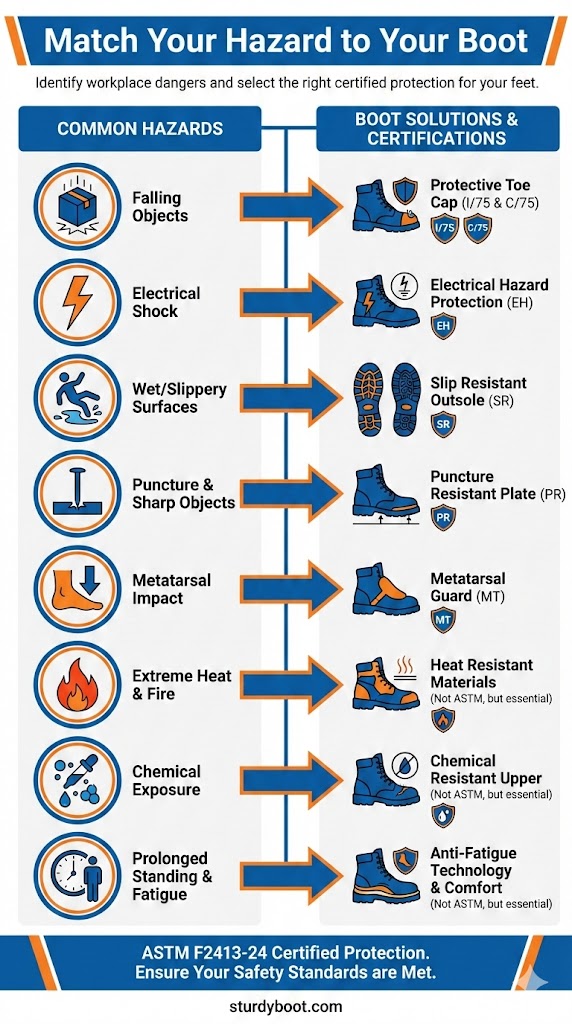
Quick Reference: Match Your Hazard to the Right Protection
Use this cheat sheet to identify your must-have features in 20 seconds:
| Hazard Type | Required Protection | Key Standard/Rating |
|---|---|---|
| Impact from falling/rolling objects | Safety toe | ASTM F2413-24 I/75 or C/75 |
| Live electrical work | EH-rated footwear | 18,000-volt protection |
| Greasy, wet, or oily floors | Slip-resistant sole | ASTM F3445-21 or SRC rating |
| Nails, scrap metal, sharp debris | Puncture-resistant midsole | PR rating |
| Top-of-foot impact risks | Metatarsal guard | MT certification |
| Extreme heat or molten metal | Heat-resistant leather | No exposed laces |
| Chemical exposure | Chemical-resistant materials | Sealed construction |
| All-day standing | Anti-fatigue midsole | Arch support, lightweight composite toe |
Pro Tip: Most workers need 2-3 features from this list, not all of them. Overbuying protection you don’t need adds weight, cost, and discomfort.
Assess Your Job Hazards Before You Buy

Why Risk Assessment Comes First
Before you compare brands or scroll through online reviews, you need to understand what you’re actually protecting yourself from. The most expensive boot on the market is worthless if it doesn’t address your specific workplace hazards.
Start with these questions:
- What objects could fall on your feet, and how heavy are they?
- Do you work near electrical systems or equipment?
- What surfaces do you walk on—concrete, metal grating, gravel, wet floors?
- Are there nails, scrap metal, or sharp debris on the ground?
- What temperature extremes do you face?
- Are chemicals, oils, or biological materials present?
Your answers determine your non-negotiable features—the protections you cannot compromise on.
Impact and Compression Risks: When Heavy Objects Are Part of Your Day
Impact hazards involve objects falling onto your foot from above. Compression hazards involve objects rolling over your foot or equipment pinching it.
Jobs with significant impact/compression risks include:
- Construction workers handling lumber, steel, and equipment
- Warehouse workers moving pallets and operating forklifts
- Manufacturing workers near heavy machinery
- Oil and gas workers handling pipe and drilling equipment
If you regularly handle objects over 25 pounds or work near mobile equipment, a safety toe rated I/75 C/75 is non-negotiable.
Electrical Hazards in Your Work Environment
Electrical hazard (EH) rated boots provide a secondary line of defense against accidental contact with live circuits. The key word is secondary—EH boots don’t replace proper lockout/tagout procedures or insulated tools.
Consider EH-rated boots if you:
- Work on or near exposed electrical circuits
- Handle electrical panels, junction boxes, or service equipment
- Work in environments where electrical grounding is uncertain
Important distinction: EH protection works in dry conditions only. Wet boots, damaged soles, or metal contamination compromise this protection entirely.
Slip, Trip, and Fall Dangers by Surface Type
Slip-and-fall incidents account for a massive portion of workplace injuries. Your floor surface determines your sole requirements—understanding how work boot soles are constructed helps you make smarter choices:
| Surface Type | Risk Level | Recommended Sole |
|---|---|---|
| Polished concrete | High | Slip-resistant rubber, fine tread |
| Greasy kitchen floors | Very High | ASTM F3445-21 rated outsole |
| Wet outdoor surfaces | Moderate-High | Deep lugged rubber sole |
| Metal grating | Moderate | Flat, flexible sole |
| Loose gravel/dirt | Variable | Aggressive outdoor tread |
Slip resistance degrades over time. Even excellent outsoles lose effectiveness as tread wears down.
Puncture and Penetration Risks from Sharp Objects
Puncture-resistant (PR) boots contain a protective plate or layer in the midsole that prevents nails, screws, and sharp debris from penetrating through the sole into your foot.
You need puncture resistance if you work in:
- Construction sites with exposed nails and scrap
- Demolition environments
- Recycling and waste management facilities
- Areas with broken glass or metal fragments
Modern puncture-resistant materials include steel plates, composite plates, and woven synthetic layers like Kevlar. Composite options offer flexibility advantages while meeting ASTM standards.
Temperature Extremes: Heat and Cold Exposure
Temperature hazards require specialized boot construction:
Hot environments (foundries, summer roofing, asphalt work):
- Heat-resistant leather uppers
- Outsoles rated for high temperatures (some withstand 300°F+ contact)
- Composite toe preferred—steel toes conduct heat to your foot
Cold environments (refrigeration, winter outdoor work):
- Insulated boots (Thinsulate, PrimaLoft rated by grams)
- Waterproof construction to prevent moisture freeze
- Steel toe acceptable—thermal socks provide adequate barrier
For extreme cold conditions, explore our guide to the best winter work boots for insulation recommendations.
Chemical and Biological Exposure Considerations
Workers in agriculture, waste management, healthcare, and industrial cleaning face chemical and biological hazards that require:
- Chemical-resistant uppers (not standard leather)
- Sealed construction without exposed stitching
- Easy-to-clean surfaces for decontamination
- Slip-resistant soles that won’t degrade with chemical contact
Rubber boots often provide the best chemical protection, but safety-toe rubber boots exist for combination hazards.
Understanding Work Boot Safety Standards and Labels
How to Read ASTM F2413-24 Safety Ratings
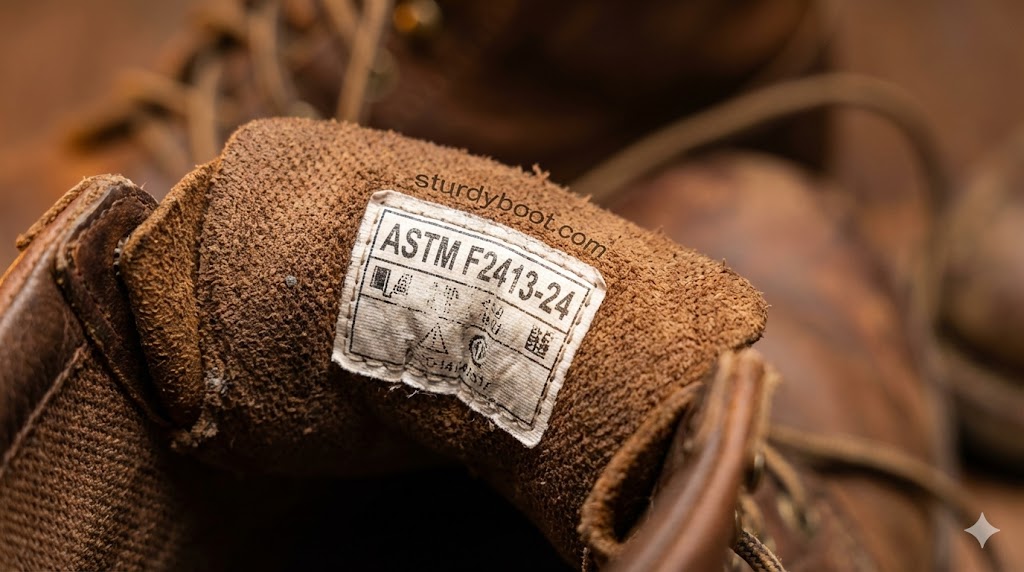
ASTM F2413-24 is the current American standard for protective footwear. When you see this designation, the boot has been tested and certified to specific protection levels. For a deep dive into what each code means, our ASTM F2413-24 explained guide breaks down every designation.
The label appears on the boot tongue and looks something like:
ASTM F2413-24
M I/75 C/75 EH PR
Here’s what each element means:
- M = Male sizing (F = Female sizing)
- I/75 = Impact protection level
- C/75 = Compression protection level
- EH = Electrical Hazard protection
- PR = Puncture Resistance
Not every boot carries all ratings—only the ones it’s been tested and certified for.
Impact Resistance Levels: I/75, I/50, and I/30 Explained
Impact resistance measures protection against falling objects. The number indicates the foot-pounds of impact energy the toe cap can withstand:
| Rating | Protection Level | Typical Use |
|---|---|---|
| I/75 | 75 foot-pounds | Heavy industry, construction, manufacturing |
| I/50 | 50 foot-pounds | Medium-duty industrial |
| I/30 | 30 foot-pounds | Light industrial, low-hazard environments |
For most trade workers, I/75 is the standard. Don’t downgrade to save weight unless your hazard assessment genuinely supports lower protection.
Compression Protection: C/75, C/50, and C/30 Standards
Compression resistance measures protection against objects rolling over or pinching your foot. Ratings indicate pounds of compressive force the toe cap withstands:
| Rating | Protection Level | Compressive Force |
|---|---|---|
| C/75 | High | 2,500 pounds |
| C/50 | Medium | 1,750 pounds |
| C/30 | Low | 1,000 pounds |
If forklifts, pallet jacks, or heavy wheeled equipment operate in your workspace, C/75 is essential.
What Electrical Hazard (EH) Rating Really Means
Electrical Hazard (EH) rated footwear provides insulation against accidental contact with live electrical circuits up to 18,000 volts under dry conditions.
Critical understanding points:
- EH is a secondary protection—it doesn’t replace safe work practices
- Protection is void when wet—moisture eliminates insulating properties
- Damaged soles compromise protection—cuts, punctures, or excessive wear create pathways
- EH boots aren’t designed for direct electrical work—they’re for incidental contact protection
If your primary job involves electrical work, EH-rated boots are non-negotiable, but never treat them as your only line of defense.
Slip Resistance Standards: ASTM F3445-21 and SRC Ratings Explained
Slip resistance has its own testing standard: ASTM F3445-21 in the United States and SRC ratings (European standard) internationally.
The ASTM F3445-21 standard tests outsoles on:
- Wet stainless steel surfaces
- Wet quarry tile surfaces
- Specific contaminants (water, glycerol)
SRC rating (commonly seen on imported boots) combines:
- SRA: Slip resistance on ceramic tile with diluted soap solution
- SRB: Slip resistance on steel with glycerin
- SRC: Passes both SRA and SRB tests
For wet, greasy, or oily work environments, look for boots specifically tested under ASTM F3445-21 or rated SRC.
Puncture Resistance (PR) and Metatarsal (MT) Certifications
Puncture Resistance (PR): Boots with PR certification contain a protective midsole layer tested to resist penetration by a standardized probe with at least 270 pounds of force.
Metatarsal Guard (MT): MT-rated boots protect the metatarsal bones (top of your foot between ankle and toes) from impact. This protection comes as:
- Internal guards: Built into the boot structure
- External guards: Visible protective shell on top of the boot
MT protection is required for foundry work, heavy fabrication, and jobs where objects regularly fall or roll toward the top of the foot.
OSHA Requirements and Employer Responsibilities
What Your Employer Must Provide Under OSHA 29 CFR 1910.136
Under OSHA regulation 29 CFR 1910.136, employers must ensure workers use protective footwear when working in areas where there’s danger of foot injuries from:
- Falling objects
- Rolling objects
- Objects piercing the sole
- Electrical hazards
The employer’s responsibilities include:
- Hazard assessment: Identifying foot hazards in each work area
- Selection: Choosing appropriate footwear types for identified hazards
- Training: Ensuring workers understand when and how to use protective footwear
- Provision: Paying for required PPE (with limited exceptions)
The January 2025 PPE Fit Mandate: Why Proper Sizing Is Now Required by Law
As of January 2025, OSHA’s PPE standards explicitly require that protective equipment—including footwear—properly fits each affected employee. This isn’t just about comfort; it’s a legal compliance requirement.
What this means in practice:
- Ill-fitting boots are non-compliant—boots that are too large, too small, or wrong width don’t meet the standard
- Employers must accommodate different sizes—one-size-fits-all approaches violate the mandate
- Documentation matters—fit verification should be part of PPE programs
For workers, this mandate gives you legal backing to request properly fitting boots rather than accepting whatever’s available in the supply room. Our work boot fit and sizing guide helps you measure and communicate your exact requirements.
How to Verify Your Boots Meet Compliance Standards
To verify your boots are OSHA-compliant:
✅ Check the ASTM F2413-24 label on the tongue or interior
✅ Confirm the ratings match your workplace hazard assessment
✅ Verify boots are in good condition (damaged boots may not provide rated protection)
✅ Ensure boots fit properly per the 2025 fit mandate
If your boots lack ASTM certification labels or the ratings don’t match identified hazards, they’re not compliant.
When Employers Must Pay for Your Work Boots
Under OSHA’s PPE payment rules, employers must pay for required protective footwear with these exceptions:
- Safety-toe footwear when the employer permits wearing off the job site: If you can wear your safety boots outside work, the employer isn’t required to pay (though many still do)
- Logging boots required by 29 CFR 1910.266: These are specifically exempted
In practice, many employers either:
- Provide boots directly
- Offer a boot allowance program
- Reimburse purchases up to a set amount
Document your workplace’s policy and don’t assume you must pay out-of-pocket for required safety footwear.
Workers’ Compensation and the Cost of Non-Compliance
When foot injuries occur due to inadequate footwear, the consequences cascade:
For workers:
- Foot injuries commonly result in extended time off work
- Recovery from crush injuries, fractures, or puncture wounds is often lengthy
- Some injuries cause permanent impairment
For employers:
- Workers’ compensation claims for foot injuries carry significant costs
- OSHA citations for PPE violations add fines and administrative burden
- Productivity losses from injured workers affect operations
The economic case for proper boots is overwhelming. Quality protective footwear costs far less than a single foot injury claim.
Choosing the Right Toe Protection for Your Job
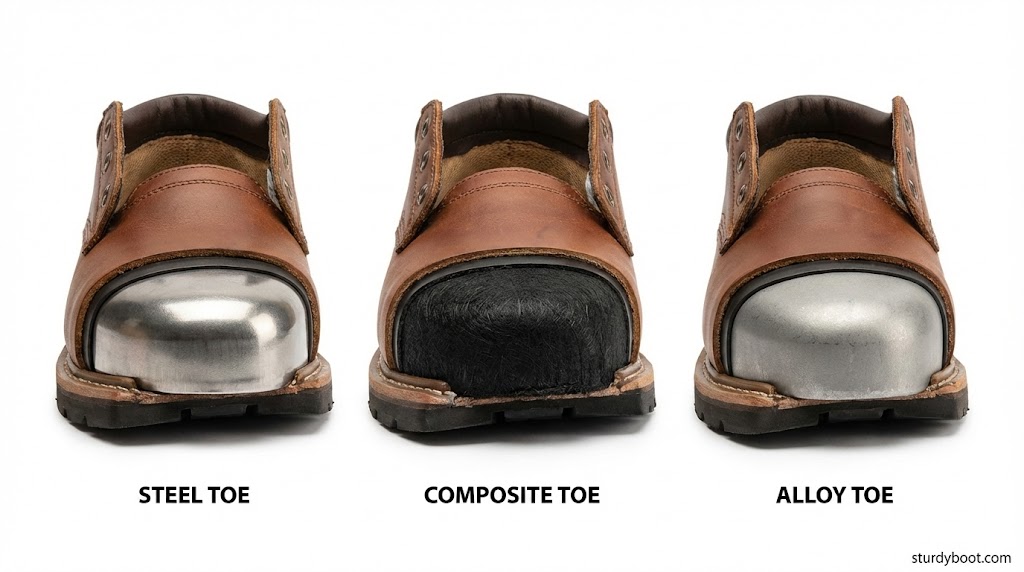
Steel Toe: Traditional Protection and When It’s Still the Best Choice
Steel toe caps have protected workers for over a century. They’re made from stamped steel shaped to cover the toe area and meet ASTM impact/compression standards.
Advantages of steel toe:
- Thinner profile: Steel’s strength allows thinner caps, preserving toe box room
- Proven durability: Extremely wear-resistant over boot lifetime
- Lower cost: Generally less expensive than composite options
- Consistent protection: Steel doesn’t degrade with UV exposure or age
Steel toe is best for:
- Construction workers who need maximum durability
- Manufacturing environments without metal detection
- Workers who prioritize long-term value over weight
- Cold weather applications (where temperature conductivity is less concern)
Composite Toe: Lightweight, Temperature-Neutral, and Non-Conductive
Composite toe caps use non-metallic materials (carbon fiber, Kevlar, fiberglass, plastic polymers) to achieve the same ASTM protection standards as steel.
Advantages of composite toe:
- Lighter weight: Commonly reported as 30% lighter than comparable steel
- Temperature neutral: Won’t conduct heat or cold to your foot
- Non-metallic: Passes through metal detectors
- Non-conductive: Won’t conduct electricity (important for EH applications)
Composite toe is best for:
- Workers passing through metal detectors daily
- Extreme temperature environments (hot or cold)
- Jobs requiring extensive walking or climbing
- Electrical workers seeking additional non-conductive safety
Nano Composite Technology: 15% Lighter with Trade-Offs
Nano composite toe caps represent the latest evolution in safety toe technology. These caps use advanced polymer matrices with nano-scale reinforcement to achieve protection in an even lighter package.
Commonly reported benefits:
- Approximately 15% lighter than standard composite
- Thinner profile similar to steel toe
- Temperature neutral like composite
Trade-offs to consider:
- Higher cost than both steel and standard composite
- Less long-term track record than established materials
- Availability limited to certain brands and models
Consider nano composite if: Weight reduction is a high priority and you’re willing to pay a premium for the latest technology.
Alloy Toe: The Middle Ground Between Steel and Composite
Alloy toe caps use lightweight metals (typically aluminum or titanium alloys) to split the difference between steel and composite.
Alloy toe characteristics:
- Lighter than steel, heavier than composite
- Thinner profile than composite (similar to steel)
- Metallic (will trigger metal detectors)
- Conducts temperature (though less than steel)
Alloy toe works well for:
- Workers who want steel’s slim profile with weight reduction
- Environments without metal detector concerns
- Those who find composite toe boxes too bulky
Soft Toe Boots: When Low-Hazard Jobs Don’t Require Safety Ratings
Soft toe boots lack protective toe caps entirely. They’re appropriate only when your hazard assessment confirms no impact or compression risks to the toe area.
Soft toe may be appropriate for:
- Light-duty supervisory roles with minimal floor exposure
- Office environments with occasional site visits
- Jobs where safety toe protection is specifically not required
Warning: Never substitute soft toe for safety toe based on comfort preference. If your workplace hazard assessment identifies impact/compression risks, safety toe is required—not optional.
Steel vs Composite Decision Matrix by Job Type
| Factor | Choose Steel | Choose Composite |
|---|---|---|
| Metal detectors | No daily screening | Daily screening required |
| Temperature extremes | Cold weather (with thermal socks) | Hot environments, cold environments |
| Weight priority | Durability over weight | Every ounce matters |
| Electrical work | Non-electrical trades | Electrical trades |
| Budget | Cost-conscious choice | Premium investment acceptable |
| Toe box space | Need slim profile | Can accommodate bulk |
Job-Type Quick Picker: Find Your Trade
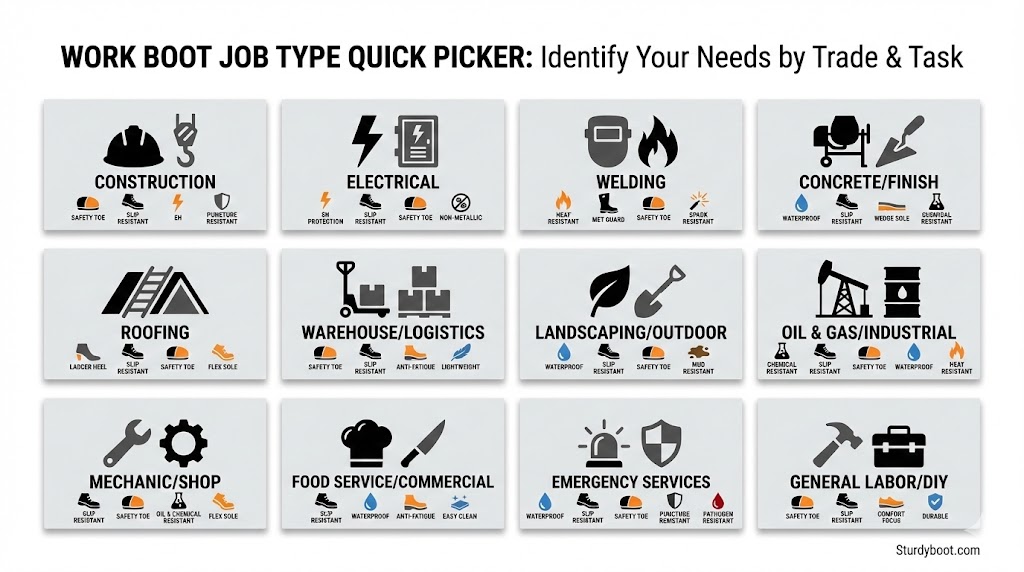
Jump directly to your job’s requirements:
| Job Type | Must-Have Features | Key Ratings |
|---|---|---|
| Construction / Heavy Industry | Safety toe, puncture resistance, slip resistance | I/75 C/75, PR, SRC |
| Electrician (Residential) | EH-rated, lightweight composite toe, ankle flexibility | EH, I/75 C/75 |
| Electrician (Industrial) | EH-rated, safety toe, puncture resistance, metatarsal guards | EH, I/75 C/75, PR, MT |
| Welder / Fabrication | Metatarsal guard, heat-resistant leather, covered/no laces | MT, heat-resistant |
| Warehouse / Logistics | Lightweight safety toe, slip resistance, anti-fatigue cushioning | I/75 C/75, slip-resistant |
| Oil & Gas | Safety toe, chemical resistance, metatarsal guard, extreme temp protection | I/75 C/75, MT, chemical-resistant |
| Food Service | Slip resistance, waterproof, easy-clean materials | ASTM F3445-21 |
| Healthcare | Slip resistance, fluid protection, anti-microbial, 12+ hour comfort | Slip-resistant, fluid-resistant |
| Roofing | Aggressive traction, ankle support, heat resistance, lightweight | Heat-resistant sole, composite toe |
| Landscaping | Waterproof, puncture resistance, breathability, uneven terrain soles | Waterproof, PR |
| Forestry / Logging | Chainsaw protection, logger heel, aggressive tread, waterproof insulation | Chainsaw-rated, insulated |
Construction and Heavy Industry Work Boots
Primary Hazards on Construction Sites
Construction workers face the full spectrum of foot hazards:
- Falling objects: Tools, materials, debris from overhead work
- Rolling objects: Wheeled equipment, pipes, lumber
- Puncture hazards: Nails, screws, scrap metal, broken glass
- Slip hazards: Wet surfaces, mud, loose materials
- Electrical exposure: Temporary wiring, power tools
- Uneven terrain: Excavations, scaffolding, incomplete flooring
The combination of hazards makes construction one of the most demanding environments for work boots.
Required Safety Features and Ratings
Non-negotiable features for construction:
✅ Safety toe rated I/75 C/75 (impact and compression protection) ✅ Puncture-resistant (PR) midsole (nail and scrap protection) ✅ Slip-resistant outsole (wet and debris-covered surfaces) ✅ Ankle support (minimum 6-inch shaft)
Strongly recommended:
- EH rating (electrical protection)
- Waterproof construction (outdoor exposure)
- Aggressive tread pattern (varied terrain)
Boot Styles That Work Best: Lace-Up vs Pull-On
Lace-up boots dominate construction for good reason:
- Adjustable fit: Tighten for support, loosen for comfort
- Ankle control: Essential for scaffolding and ladder work
- Secure heel lock: Prevents slippage on inclines
Pull-on boots work for specific construction roles:
- Iron workers who need quick on/off
- Workers in environments where laces could snag
- Personal preference when ankle support isn’t critical
For most construction workers, lace-up remains the safer choice.
Ankle Support for Scaffolding and Uneven Terrain
Six-inch boot height is the minimum for construction. This provides:
- Ankle stabilization on uneven surfaces
- Protection from debris entry
- Support during ladder climbing
Eight-inch boots offer additional benefits:
- Greater ankle protection during lateral movements
- More coverage when kneeling in debris
- Additional warmth in cold weather
Consider 8-inch boots if you frequently work on scaffolding, roofing, or highly uneven terrain.
Waterproofing for Outdoor Sites and Wet Concrete
Waterproof construction matters for outdoor work:
- Wet feet lose heat rapidly (cold weather safety issue)
- Moisture causes blisters and skin breakdown
- Wet leather degrades faster than dry leather
Look for:
- GORE-TEX or equivalent waterproof membranes
- Sealed seams and gusseted tongues
- Waterproof leather treatment
For comprehensive options, see our roundup of the best waterproof work boots tested in real conditions.
Note: Waterproof boots sacrifice some breathability. In hot weather, water-resistant (not waterproof) options may provide better comfort.
What to Avoid: Common Mistakes in Construction Footwear
❌ Soft toe boots on active job sites (hazard assessment almost always requires safety toe)
❌ Smooth-soled boots (concrete, mud, and debris require aggressive tread)
❌ Fashion work boots without ASTM certification (looking like a work boot doesn’t provide protection)
❌ Worn-out boots past replacement date (compromised protection isn’t protection)
❌ Boots that don’t fit properly (ill-fitting boots cause blisters, fatigue, and trip hazards)
Replacement Timeline for High-Wear Construction Jobs
Construction environments are brutal on boots. Expect to replace footwear:
- Heavy use (daily rough terrain): 6-12 months
- Moderate use (varied conditions): 12-18 months
- Light construction (supervision, finish work): 18-24 months
Replace immediately if:
- Sole tread is worn smooth
- Toe cap is damaged from impact
- Waterproofing has failed
- Midsole has collapsed
- Stitching or adhesive is failing
If you’re experiencing recurring issues, our work boot troubleshooting guide covers common problems and solutions.
Electrical and HVAC Trades
Understanding Electrical Hazard Protection: 18,000 Volts in Dry Conditions
EH-rated boots provide insulation against accidental contact with live electrical circuits up to 18,000 volts. This protection applies only under specific conditions:
- Dry conditions: Wet boots lose EH protection entirely
- Undamaged soles: Cuts, punctures, or wear create conductive pathways
- Secondary protection only: EH boots supplement—never replace—safe work practices
The 18,000-volt rating represents testing conditions, not a guarantee in real-world scenarios. Environmental variables affect actual protection levels.
Can Electricians Safely Wear Steel Toe Boots?
Yes, electricians can wear steel toe boots with EH ratings. This is a common misconception that deserves clarification:
- Steel toe caps are surrounded by insulating materials in EH-rated boots
- ASTM testing confirms EH protection regardless of toe cap material
- The toe cap doesn’t contact the ground or create an electrical pathway
That said, many electricians prefer composite toe boots because:
- No metal means one less conductive material present
- Eliminates any perception of risk
- Often lighter weight for climbing and mobility
Both options are safe when properly EH-rated. Choose based on personal preference and other job requirements.
Residential vs Industrial Electrician: Different Boots for Different Demands
Residential electricians typically need:
- EH rating (essential)
- Composite toe (lightweight, ladder-friendly)
- Flexibility for confined spaces
- 6-inch height (adequate ankle protection)
- Moderate slip resistance
Industrial electricians face additional hazards requiring:
- EH rating (essential)
- Safety toe I/75 C/75 (heavy equipment exposure)
- Puncture resistance (industrial floor debris)
- Metatarsal guards (high-voltage environments often have drop hazards)
- More aggressive slip resistance
- Potentially 8-inch height
Don’t over-spec residential work, but don’t under-protect industrial environments.
HVAC Technicians: Crawl Spaces, Rooftops, and Refrigerant Exposure
HVAC work combines multiple environment types in a single day:
Crawl spaces and attics:
- Flexibility for confined movement
- Lightweight construction reduces fatigue
- Puncture resistance (nail hazards common)
Rooftop units:
- Slip resistance on metal surfaces
- Heat resistance (summer roof work)
- Ankle support for pitch changes
Chemical considerations:
- Refrigerant exposure (potential chemical contact)
- Oil and lubricant resistance
HVAC boot recommendation: Lightweight composite toe with EH rating, flexible construction, and slip-resistant outsoles.
Lightweight Composite Options for Climbing and Agility
For electrical and HVAC workers who spend significant time climbing:
Weight matters for:
- Reduced fatigue during ladder work
- Better control during confined space navigation
- Less strain during long days
Look for these features:
- Composite toe (eliminates steel weight)
- Athletic-style construction
- Flexible forefoot
- Lighter outsole compounds (TPU instead of heavy rubber)
Trade-off awareness: Lighter boots may sacrifice durability. Balance weight savings against expected boot lifespan.
Anti-Static vs Electrical Hazard: Knowing the Difference
These two protections serve opposite purposes:
Electrical Hazard (EH):
- Insulates you from electrical current
- Prevents current from flowing through your body to ground
- Required for electrical work
Anti-Static (SD – Static Dissipating):
- Allows controlled discharge of static electricity
- Prevents static buildup that could damage electronics or ignite flammable materials
- Required for electronics manufacturing, explosive environments
These are incompatible protections. A boot can be EH or SD, not both simultaneously. Know which your job requires.
Features That Are Overkill for Light Electrical Work
Residential electricians often overbuy: Skip these unless your hazard assessment requires them:
- Metatarsal guards: Minimal drop hazard in residential settings
- Puncture-resistant plates: Finished homes rarely have nail hazards
- 8-inch boot height: 6-inch is sufficient for most residential work
- Heavy-duty construction: Adds weight without benefit
- Extreme insulation: Indoor work doesn’t require cold protection
Save money and weight by matching boots to actual—not imagined—hazards.
Welding and Fabrication
Spark and Molten Metal Protection Requirements
Welding creates unique foot hazards that standard safety boots don’t address:
- Sparks: Hot metal particles that can burn through standard materials
- Slag: Molten metal droplets that seek gravity paths (including boot openings)
- Spatter: Flying molten metal from welding operations
- UV radiation: From arc welding processes
Welder-specific boot requirements:
✅ Heat-resistant leather uppers (not fabric or synthetic materials) ✅ Metatarsal guard (protects top of foot from falling slag) ✅ Covered or no laces (prevents slag catching in lace loops) ✅ Snug fit at top (prevents molten material entry)
Why Welders Should Avoid Traditional Laces
Traditional lace eyelets create dangerous catch points:
- Molten slag collects in lace loops
- Burning material pressed against foot causes severe burns
- Quick removal becomes impossible
Safer alternatives for welders:
- Pull-on boots: No laces at all
- Covered lace systems: Leather flaps protect eyelets
- Side-zip with lace covers: Adjustability with protection
- Hook-and-loop closures: Quick release if needed
If your boots have exposed laces, they’re not welding boots.
Metatarsal Guards: Internal vs External for Welding Environments
External metatarsal guards:
- Visible protective shell on top of boot
- Easier to replace if damaged
- May catch on objects
- Commonly reported as slightly awkward for kneeling
Internal metatarsal guards:
- Protection built into boot structure
- Streamlined appearance
- Cannot be removed or replaced
- More comfortable for kneeling work
For welding: Either style provides adequate protection. Choose based on how much kneeling work you do and personal preference.
Heat-Resistant Leather and Fire-Retardant Materials
Full-grain leather is the gold standard for welding boots:
- Natural heat resistance
- Doesn’t melt like synthetic materials
- Resists spark penetration
- Can be treated for additional protection
Avoid these materials for welding:
- Synthetic uppers (can melt onto skin)
- Mesh panels (no spark protection)
- Fabric components (burn and ignite)
Look for: Boots specifically marketed for welding with heat-resistant ratings.
Wedge Soles for 360-Degree Positioning
Wedge sole construction benefits welders because:
- No heel gap: Slag can’t collect under raised heels
- Stable kneeling: Flat bottom provides support when kneeling
- 360-degree positioning: Easy to pivot and adjust stance
- Consistent contact: Full sole touches ground at any angle
Traditional heel boots can work for welding but require more attention to positioning and slag accumulation.
S3 or Higher Ratings for Foundry and Heavy Fabrication
European safety ratings (S1, S2, S3, etc.) are commonly seen on welding boots:
- S1: Safety toe, antistatic, energy-absorbing heel
- S2: S1 + water penetration resistance
- S3: S2 + puncture resistance + cleated outsole
For foundry and heavy fabrication work, S3 rating provides comprehensive protection. Combined with metatarsal guards and heat-resistant construction, this covers most welding environment hazards.
Warehouse and Logistics Workers
[IMAGE: warehouse-worker-boots-forklift-safety.jpg | Alt: Warehouse worker wearing lightweight composite toe boots operating near forklift and pallet jacks | Caption: Warehouse boots must balance safety protection with all-day comfort for high-step-count shifts.]
Hazards in Distribution Centers: Forklifts, Pallets, and Repetitive Motion
Warehouse environments present distinct hazards:
Impact and compression:
- Forklifts and pallet jacks
- Falling boxes and merchandise
- Dropped hand trucks and equipment
Slip hazards:
- Polished concrete floors
- Spilled liquids and packaging materials
- Loading dock transitions
Repetitive stress:
- High daily step counts (commonly reported as 15,000-25,000 steps)
- Constant standing on hard surfaces
- Ladder and stair climbing
The unique challenge: Warehouse boots must provide safety protection while remaining comfortable enough for extremely high activity levels.
Lightweight Safety Toe Options to Reduce Fatigue
Weight directly impacts fatigue over warehouse shift lengths:
- Heavy boots compound fatigue with every step
- Climbing and ladder work amplifies weight burden
- End-of-shift exhaustion increases injury risk
Look for:
- Composite toe instead of steel
- Athletic-inspired construction
- Lightweight outsole materials (TPU, EVA midsoles)
- Streamlined design without unnecessary bulk
Commonly reported weight difference: Composite toe boots often weigh 20-30% less than comparable steel toe options.
Slip Resistance on Polished Concrete Floors
Warehouse concrete is deceptively slippery:
- Polished surfaces reduce traction
- Dust and debris create slip layers
- Wet conditions from leaks or cleaning multiply risk
Effective warehouse slip resistance requires:
- Rubber outsoles with appropriate tread pattern
- Fine tread design (aggressive lugs can reduce contact on smooth surfaces)
- Outsole compounds formulated for hard indoor surfaces
Check for ASTM F3445-21 testing on warehouse-specific floor conditions.
Anti-Static Requirements for Electronics Warehouses
Electronics distribution centers often require anti-static (SD) footwear:
- Static discharge damages sensitive components
- ESD (electrostatic discharge) protocols mandate dissipating footwear
- Standard boots can accumulate dangerous static charges
Critical distinction: Anti-static boots are not electrical hazard boots. They serve opposite purposes:
- EH boots insulate you from electrical current
- SD boots allow controlled static discharge
Know your facility’s requirements before purchasing.
When Puncture Resistance Is Necessary (and When It’s Not)
Puncture resistance (PR) in warehouses depends on:
- Wooden pallets: Exposed nails, broken boards, staples
- Packaging debris: Staples, wire, broken materials
- Receiving areas: Higher debris concentration
PR may be unnecessary if:
- Your facility uses plastic pallets exclusively
- Floors are continuously cleaned
- Your role keeps you away from receiving/shipping areas
Default recommendation: Include PR unless your specific role clearly doesn’t require it. The weight penalty is minimal with modern composite plates.
Standing and Walking All Day: Comfort Technologies That Matter
For warehouse workers, comfort features directly impact safety:
- Fatigued workers make mistakes
- Foot pain causes gait changes that increase injury risk
- Inadequate support contributes to long-term joint problems
Priority comfort features:
| Feature | Benefit |
|---|---|
| EVA midsole | Lightweight cushioning |
| Anti-fatigue footbed | Energy return reduces fatigue |
| Arch support | Reduces strain on foot structure |
| Heel cushioning | Impact absorption for hard floors |
| Breathable lining | Moisture management for long shifts |
For all-day comfort priorities, our most comfortable work boots guide ranks options by cushioning and support.
Oil and Gas Operations
Rig Work and Platform Safety Requirements
Oil and gas operations combine extreme hazards:
- Heavy equipment: Drill pipe, tools, machinery
- Chemical exposure: Petroleum products, drilling fluids
- Environmental extremes: Desert heat, Arctic cold, offshore conditions
- Fire risk: Flammable materials throughout
Non-negotiable rig boot requirements:
✅ Safety toe I/75 C/75 (heavy impact hazards) ✅ Metatarsal guard (pipe and equipment drop risk) ✅ Slip resistance (oily, wet surfaces) ✅ Chemical-resistant materials (petroleum exposure) ✅ Flame-resistant construction (fire risk)
Chemical Resistance for Petroleum and Hydrocarbon Exposure
Standard leather degrades with petroleum contact:
- Oil penetrates untreated leather
- Chemical exposure weakens stitching
- Solvents break down adhesives
Oil and gas boots require:
- Oil-resistant leather or synthetic uppers
- Chemical-resistant outsoles (often nitrile compound)
- Sealed construction to limit chemical entry
- Easy-clean surfaces for decontamination
Look for boots specifically rated for hydrocarbon exposure.
Extreme Environment Protection: Heat, Cold, and Wet Conditions
Oil and gas workers face environmental extremes based on location:
Hot environments (desert, summer operations):
- Heat-resistant outsoles
- Breathable construction where safety allows
- Composite toe (temperature neutral)
Cold environments (Arctic, offshore winter):
- Insulated construction (400+ gram Thinsulate)
- Waterproof membranes
- Cold-rated outsoles that maintain flexibility
Wet environments (offshore, wet weather):
- Fully waterproof construction
- Quick-dry materials
- Aggressive slip resistance on wet metal
Metatarsal and Instep Protection for Heavy Equipment Operations
Metatarsal protection is standard in oil and gas because:
- Heavy pipe and tools create constant drop hazards
- Equipment movements threaten top-of-foot
- Standard safety toe doesn’t protect metatarsal area
Instep protection (less common) covers the top of the foot between toe cap and ankle for operations with specific crush hazards.
Logger-Style Boots with Climbing Heels for Rig Access
Logger-style boots are popular in oil and gas because:
- Raised heel: Provides purchase on ladder rungs and grating
- High shaft: Ankle support for climbing
- Aggressive tread: Traction on varied surfaces
- Durable construction: Withstands harsh conditions
The distinctive logger heel (typically 2+ inches) hooks onto ladder rungs during climbing—a significant safety benefit for rig access. For more on this style, see our best logger boots list.
Food Service and Kitchen Workers
Grease, Spills, and Wet Floor Slip Resistance
Commercial kitchens are slip hazard environments:
- Grease accumulation on floors
- Water from cooking, cleaning, and spills
- Food debris creating slippery surfaces
- Rapid movement increasing fall risk
Kitchen-appropriate slip resistance must handle:
- Vegetable oil and animal fats
- Soapy water
- Food particles
- Wet tile and concrete
Generic “slip-resistant” labels aren’t sufficient. Look for boots tested under kitchen-specific conditions.
Slip-Resistant Outsoles: ASTM F3445-21 Standards for Food Safety
ASTM F3445-21 testing includes conditions relevant to food service:
- Wet surfaces with various contaminants
- Oily surfaces replicating kitchen conditions
- Standardized testing methodology
What to look for:
- Specific ASTM F3445-21 certification
- SRC rating (European equivalent)
- Outsole designs with siping (thin slits) for liquid channeling
- Soft rubber compounds that grip smooth tile
Avoid: Boots with aggressive outdoor treads—they can trap grease and lose effectiveness on smooth kitchen floors.
Waterproof Uppers vs Water-Resistant: What You Really Need
Kitchen water exposure is constant but shallow:
- Splashes and spills
- Floor cleaning and mopping
- Standing water in high-traffic areas
Waterproof boots keep feet completely dry but may sacrifice breathability.
Water-resistant boots handle splashes without the breathability penalty.
For most food service: Water-resistant is often sufficient unless you’re regularly standing in water or working in wet processing environments.
Easy-Clean Materials for Sanitation Compliance
Food safety regulations require cleanable footwear:
- Smooth uppers: Easier to sanitize than textured materials
- Sealed seams: Prevent bacterial accumulation
- Non-absorbent materials: Don’t harbor pathogens
Avoid: Fabric panels, complex stitching patterns, or materials that can’t be properly sanitized.
Toe Protection for Heavy Pot and Equipment Handling
Kitchen impact hazards include:
- Heavy pots and pans (often filled with hot liquids)
- Kitchen equipment (mixers, food processors)
- Dropped knives (puncture hazard)
Safety toe consideration: Many food service workers benefit from safety toe protection, especially in back-of-house roles with heavy equipment handling.
Lightweight Options for Long Shifts on Hard Floors
Kitchen workers stand for extended periods:
- Shifts often exceed 8 hours
- Hard tile or concrete flooring
- Constant movement between stations
Comfort priorities:
- Lightweight construction
- Anti-fatigue cushioning
- Arch support
- Shock-absorbing midsole
Clogs vs boots: Many kitchen workers prefer clogs for quick on/off, but boots provide ankle protection if you’re moving between kitchen and other areas.
Healthcare Professionals
Hospital and Clinical Floor Slip Resistance
Healthcare facilities have varied flooring:
- Polished hospital corridors
- Clinical areas with potential fluid spills
- Outdoor areas and parking structures
- Emergency room high-traffic zones
Effective healthcare slip resistance:
- Fine tread pattern for smooth indoor floors
- Rubber compound optimized for polished surfaces
- Consistent performance across dry and wet conditions
Fluid and Biological Exposure Protection
Healthcare-specific exposure risks:
- Blood and bodily fluids
- IV fluids and medications
- Cleaning and disinfecting chemicals
Protective features needed:
- Fluid-resistant uppers (not fabric or mesh)
- Sealed construction to prevent fluid entry
- Materials compatible with healthcare disinfectants
- Smooth surfaces without crevices where fluids collect
Comfort Features for 12+ Hour Shifts
Healthcare shifts are demanding:
- 12+ hour shifts are common
- High step counts throughout the shift
- Standing for procedures and patient care
Essential comfort features:
- Superior cushioning systems
- Energy-return midsoles
- Excellent arch support
- Breathable, moisture-wicking linings
Don’t compromise on comfort—fatigued healthcare workers make errors that affect patient safety.
Easy On/Off Styles for Frequent Changes
Healthcare workers often change footwear:
- Entering and leaving clinical areas
- Changing after exposure incidents
- Switching between departments
Convenient styles:
- Slip-on clogs (most popular in healthcare)
- Easy-entry designs with back straps
- Quick-lace or elastic systems
Anti-Microbial and Easy-to-Sanitize Materials
Infection control extends to footwear:
- Anti-microbial linings: Reduce bacterial growth inside the shoe
- Smooth, sealed uppers: Allow proper disinfection
- Removable insoles: Can be replaced or sanitized separately
- Compatible with hospital disinfectants: Won’t degrade with regular cleaning
Roofing Specialists
Traction on Steep Slopes and Metal Roofing
Roofing surfaces require specialized traction:
- Asphalt shingles: Granular surface, varies when hot
- Metal roofing: Slippery when wet or dusty
- Tile: Curved surfaces, breakage risk
- Flat roofing: Smooth membrane materials
Roofing traction features:
- Soft rubber compounds that grip varied surfaces
- Flat or minimal heel for consistent contact
- Non-marking soles (required for some roofing materials)
- Specialized designs like Cougar Paws for extreme grip
Ankle Support for Pitch Work and Ladder Climbing
Roofing demands ankle stability:
- Working on angled surfaces constantly
- Transitioning between roof and ladder
- Moving across uneven roof surfaces
6-inch minimum height provides necessary support. Many roofers prefer mid-height boots that balance support with flexibility.
Heat Resistance for Summer Roofing (Reflective Surfaces)
Roof surfaces get extremely hot:
- Asphalt shingles absorb and radiate heat
- Metal roofing reflects heat while staying hot
- Summer temperatures compound with surface heat
Heat-resistant roofing boots need:
- Outsoles that won’t soften or degrade in heat (rated for high temperatures)
- Composite toe (doesn’t conduct heat like steel)
- Breathable construction where possible
Note: Some roofing-specific boots are designed to leave minimal marks on hot asphalt shingles.
Cougar Paws and Other Roofing-Specific Designs
Cougar Paws boots represent a specialized category with:
- Replaceable traction pads designed for roofing
- Extreme grip on steep pitches
- Lightweight construction for roof work
- Non-marking options available
Other roofing-specific features:
- Flat soles without aggressive lugs
- Flexible forefoot for positioning
- Snag-free design
For professional roofers: Roofing-specific boots are often worth the investment over general work boots.
Lightweight Construction to Reduce Fatigue in Elevated Work
Weight matters critically for roofing:
- Constantly climbing ladders
- Moving across roof surfaces
- Carrying materials while walking
Every ounce adds up over a roofing shift. Prioritize:
- Composite toe over steel
- Lightweight outsole materials
- Minimal bulk design
- Athletic-inspired construction
Landscaping and Groundskeeping
Mud, Turf, and Uneven Terrain Sole Requirements
Landscaping surfaces vary constantly:
- Soft turf and grass
- Mud and wet soil
- Gravel and mulch
- Uneven natural terrain
Effective landscaping outsoles:
- Aggressive tread pattern for soft surfaces
- Self-cleaning lugs that shed mud
- Stability features for uneven ground
- Flexible construction for varied movement
Waterproofing for All-Day Outdoor Exposure
Landscaping involves constant water contact:
- Morning dew on grass
- Irrigation system exposure
- Weather changes
- Working in wet conditions
Waterproof construction is essential:
- Full waterproof membrane
- Sealed seams
- Gusseted tongue
- Water-resistant leather treatment
Puncture Resistance from Hidden Debris
Ground-level work encounters hidden hazards:
- Buried nails and screws
- Broken glass
- Wire and metal debris
- Plant thorns and spines
Puncture-resistant (PR) boots provide protection against hazards you can’t see until you step on them.
Chainsaw and Power Tool Hazards
Some landscaping tasks require enhanced protection:
- Tree trimming with chainsaws
- Brush cutting
- Power tool operation
For chainsaw work: Consider chainsaw-rated boots with cut protection (see Forestry section for details).
Breathability and Moisture-Wicking for Hot Weather
Summer landscaping is demanding:
- Full sun exposure
- Physical exertion
- Waterproof boots can trap heat
Balance waterproofing with breathability:
- Look for waterproof-breathable membranes (GORE-TEX or equivalent)
- Moisture-wicking linings
- Ventilated designs where waterproofing allows
Forestry and Logging
Chainsaw-Rated Boots: Cut Protection Standards
Chainsaw boots contain protective materials designed to stop or slow a chainsaw chain before it reaches your foot:
- Cut-resistant fibers (Kevlar or similar) clog the chainsaw mechanism
- Multiple layers provide protection depth
- Coverage area typically includes front and sides of foot/lower leg
Chainsaw protection classes:
- Class 1: Up to 20 m/s chain speed
- Class 2: Up to 24 m/s chain speed
- Class 3: Up to 28 m/s chain speed
Match the class to your chainsaw’s specifications.
Logger Boot Design: High Heels and Elevated Shafts
Traditional logger boots feature:
- High heel (2+ inches): Hooks onto logs, provides purchase on uneven terrain, digs into slopes
- Tall shaft (8-10+ inches): Ankle protection, debris exclusion, cut protection coverage
- Aggressive tread: Grips bark, mud, and unstable surfaces
- Durable construction: Withstands extreme conditions
The logger heel is functional, not stylistic—it provides critical safety in timber operations.
Aggressive Tread Patterns for Mud and Logs
Forestry terrain demands aggressive outsoles:
- Deep lugs for soft ground penetration
- Self-cleaning design that sheds mud
- Bark-gripping capability
- Stable platform on logs and slash
Vibram and other premium outsole brands often appear on quality forestry boots.
Waterproofing and Insulation for Remote Work Environments
Forestry work happens in all conditions:
- Remote locations without shelter
- Weather exposure throughout the day
- Wet underbrush and streams
- Cold conditions (often starting before dawn)
Essential features:
- Full waterproof construction
- Insulation appropriate to climate (200-400+ gram)
- Gusseted tongue for debris and water exclusion
- Quick-dry capability
HAIX and Specialty Forestry Brands
Several brands specialize in forestry footwear:
- HAIX: European brand with strong forestry focus
- Husqvarna: Chainsaw manufacturer’s footwear line
- Stihl: Another chainsaw manufacturer offering protective boots
- Hoffman: American-made logger boots
Specialty forestry boots cost more but provide protection and durability general work boots can’t match.
Matching Boot Features to Daily Work Scenarios
Extreme Hot Environments: Foundries, Summer Roofing, Asphalt Work
Heat-specific boot requirements:
- Heat-resistant outsoles: Rated for high-temperature surface contact (300°F+)
- Composite toe: Doesn’t conduct heat to foot like steel
- Heat-resistant upper materials: Won’t degrade in heat
- Metatarsal guards (foundry): Protection from molten metal
Avoid in hot environments:
- Steel toe (conducts heat)
- Synthetic uppers that can melt
- Heavy insulation
Extreme Cold Work: Refrigeration, Winter Construction, Outdoor Utilities
Cold-specific boot requirements:
- Insulation: Rated by grams (200g for moderate cold, 400g+ for extreme)
- Waterproof construction: Moisture dramatically increases heat loss
- Flexible cold-rated outsoles: Standard rubber stiffens in cold
- Tall shaft: Protects ankles and excludes snow
Steel toe is acceptable in cold when combined with thermal socks—the temperature conduction concern is often overstated for cold environments.
Wet and Chemical Exposure: Agriculture, Waste Management, Industrial Cleaning
Wet/chemical environment requirements:
- Chemical-resistant uppers: Match to specific chemicals present
- Sealed construction: Prevents fluid entry
- Easy-clean materials: Allows decontamination
- Slip-resistant outsoles: Critical on wet, contaminated surfaces
Rubber boots often provide the best chemical protection for these environments.
Standing All Day vs Climbing vs Kneeling: Ergonomic Differences
Standing all day:
- Maximum cushioning
- Energy-return midsoles
- Arch support
- Shock-absorbing heels
Climbing (ladders, scaffolding):
- Lightweight construction
- Defined heel for rung purchase
- Ankle support
- Flexible forefoot
Kneeling work:
- Padded interior (no pressure points)
- Flexible construction
- Flat sole profile
- Comfortable toe box positioning
Indoor Controlled Environments vs Outdoor Variable Conditions
Indoor controlled environments:
- Fine tread for smooth floors
- Lighter construction acceptable
- Breathability prioritized
- Less weatherproofing needed
Outdoor variable conditions:
- Aggressive tread for terrain
- Waterproof construction essential
- Durable materials required
- Temperature-appropriate insulation
Smooth Flat Surfaces vs Uneven Rocky Terrain
Smooth flat surfaces (warehouse, factory):
- Fine tread pattern with high surface contact
- Slip-resistant compounds for polished floors
- Flexibility for walking efficiency
Uneven rocky terrain:
- Aggressive lugged outsoles
- Stable platform with torsional rigidity
- Ankle support from taller shaft
- Protective overlays
All-Day Comfort Without Compromising Safety
How Boot Weight Affects Fatigue and Career Longevity
Boot weight directly impacts:
- Daily fatigue accumulation
- Long-term joint stress
- Career sustainability
Commonly reported guideline: Every extra pound on your feet equals approximately five pounds of energy expenditure per mile walked. Over an 8-10 hour shift, those extra ounces compound significantly.
Prioritize weight reduction when:
- Step counts are high (15,000+ daily)
- Climbing is frequent
- Shifts are long (10+ hours)
The Whole-Body Impact: Linking Boot Choice to Back, Knee, and Hip Health
Feet are the foundation of your body’s kinetic chain:
- Poor foot support affects knee alignment
- Knee compensation affects hip positioning
- Hip imbalance affects lower back stress
Boots that contribute to whole-body health:
- Provide appropriate arch support
- Offer adequate cushioning for impact absorption
- Allow natural foot movement
- Maintain proper heel-to-toe alignment
Workers in physically demanding trades should consider boot comfort as an investment in career longevity.
Cushioning Technologies: EVA, Memory Foam, Poron, and Anti-Fatigue Systems
Common cushioning materials and their properties:
| Material | Characteristics | Best For |
|---|---|---|
| EVA (Ethylene Vinyl Acetate) | Lightweight, good cushioning, compresses over time | General use, weight-conscious workers |
| Memory Foam | Conforms to foot shape, moderate durability | Comfort priority, lower-impact environments |
| Poron | Maintains cushioning under repeated compression, durable | High-impact, long-shift workers |
| PU (Polyurethane) | Dense, durable, energy return | Heavy-duty environments |
Anti-fatigue systems typically combine multiple materials to provide cushioning, support, and energy return.
Arch Support and Orthotic Compatibility
Adequate arch support:
- Reduces strain on plantar fascia
- Distributes pressure across foot
- Maintains proper alignment
Orthotic compatibility matters if:
- You use custom orthotics
- You plan to replace factory insoles
- You have specific arch support needs
Look for:
- Removable factory insoles
- Adequate depth for aftermarket orthotics
- Width options that accommodate insole volume
Breathability and Moisture Management for Long Shifts
Wet feet inside boots cause:
- Blisters and skin breakdown
- Fungal infections
- Temperature regulation problems
- Discomfort that affects focus
Moisture management features:
- Breathable linings
- Moisture-wicking materials
- Ventilation where construction allows
- Quick-dry properties
Trade-off awareness: Waterproof boots sacrifice some breathability. Choose based on whether external water or internal moisture is your bigger concern.
Shock-Absorbing Heels and Energy-Return Midsoles
Heel strike absorbs significant force:
- Walking generates 1-1.5x body weight per step
- Hard surfaces amplify impact
- Thousands of daily steps compound stress
Shock-absorbing heels dissipate impact energy before it reaches your joints.
Energy-return midsoles capture impact energy and return it as forward propulsion, reducing fatigue.
Why Medical Professionals Recommend Premium Safety Footwear
Occupational health professionals consistently recommend quality footwear because:
- Foot problems compound into larger musculoskeletal issues
- Prevention is far more effective than treatment
- Boot investment is small compared to injury costs
- Comfort directly affects job performance and safety awareness
Boot Styles and Fastening Systems by Job Function
Lace-Up Boots: Maximum Adjustability and Ankle Support
Lace-up boots offer:
- Precise fit adjustment throughout the foot
- Customizable ankle support (tighter or looser as needed)
- Secure heel lock to prevent slippage
- Widest variety of styles and features
Best for:
- Construction and heavy industry
- Jobs requiring ladder climbing
- Workers who value fit adjustability
- Most general trade applications
Zip-Sided Boots: Quick On/Off for Emergency Responders and Inspectors
Zip-sided boots combine:
- Full lace adjustability (set once)
- Quick entry and exit via zipper
- Secure fit during wear
- Time savings for frequent on/off
Best for:
- Emergency responders
- Inspectors visiting multiple sites
- Workers who remove boots frequently
- Roles requiring rapid response
Pull-On Boots: Contaminated Environments and Speed
Pull-on boots provide:
- No laces to contaminate or catch
- Fastest on/off speed
- Easiest decontamination
- No adjustment needed
Best for:
- Contaminated environments (chemical, biological)
- Welding (no laces to catch sparks)
- Workers who value simplicity
- Roles with frequent boot changes
Slip-On Styles: Airport Workers and Metal Detector-Friendly Jobs
Slip-on work shoes offer:
- Metal detector passage without removal
- Easy on/off for security screening
- Professional appearance
- Lower ankle profile
Best for:
- Airport workers
- Roles requiring frequent metal detector passage
- Indoor environments without ankle hazards
- Workers who prioritize convenience
Covered Lacing and No-Lace Options for Welders
Lace protection for welding:
- Lace covers: Leather flaps shield eyelets from sparks
- Internal lacing: Laces hidden behind protective layer
- Alternative closures: Hook-and-loop, buckles, or elastic
Essential for welding to prevent molten metal collecting in lace loops.
BOA Lacing Systems: Micro-Adjustability and Snag-Free Performance
BOA systems use:
- Dial-controlled wire lacing
- Micro-adjustability for precise fit
- Snag-free profile (no exposed loops)
- Quick-release mechanism
Benefits of BOA:
- One-handed adjustment
- Consistent, even pressure
- No traditional lace wear or breakage
- Easy adjustment while wearing gloves
Increasingly popular in work boots for trades requiring precise fit and convenience.
Boot Construction Methods and What They Mean for Your Job
Goodyear Welt: Durability and Resolability for Heavy Use
Goodyear welt construction:
- Sole attached via a leather strip (welt) stitched to upper and outsole
- Most durable attachment method
- Can be resoled multiple times (extends boot life significantly)
- Water-resistant construction when done properly
Best for:
- Heavy industrial use
- Workers who value long-term investment
- Harsh environments
- Those willing to accept longer break-in
Trade-off: Requires break-in period; initially less flexible.
Understanding boot anatomy and construction materials helps you evaluate build quality before purchase.
Cement Construction: Lightweight and Flexible for Agility Jobs
Cement construction:
- Sole glued directly to upper
- Lighter weight
- Flexible from first wear
- Cannot typically be resoled
Best for:
- Jobs requiring agility and flexibility
- Lighter-duty applications
- Workers who prioritize immediate comfort
- Athletic-style work footwear
Trade-off: Limited lifespan; must replace entire boot when sole wears.
Direct Attach: Immediate Comfort for Warehouse and Logistics
Direct attach construction:
- Sole material injected directly onto upper
- Creates seamless bond
- Immediately comfortable
- Lightweight
Best for:
- Warehouse and distribution
- Jobs with high step counts
- Workers who need comfort without break-in
- Indoor environments
Trade-off: Cannot be resoled; predetermined lifespan.
Break-In Period by Construction Method: What to Expect
| Construction | Break-In Period | What to Expect |
|---|---|---|
| Goodyear welt | 1-4 weeks | Stiff initially, molds to foot over time |
| Cement | Minimal (days) | Flexible from start |
| Direct attach | None | Comfortable immediately |
During break-in:
- Wear boots for progressively longer periods
- Use thick socks to reduce friction
- Expect some initial stiffness
- Don’t judge final fit until break-in complete
For strategies to speed up this process, check our guide on easy ways to break in work boots faster.
Boot Materials That Matter for Your Work
Full-Grain Leather vs Nubuck vs Suede: Durability and Protection Differences
Full-grain leather:
- Complete outer hide surface intact
- Most durable and water-resistant
- Takes protective treatments well
- Premium option for heavy-duty use
Nubuck:
- Full-grain leather with buffed surface
- Soft, supple feel
- Less water-resistant than full-grain
- Requires more maintenance
Suede:
- Inner hide surface (less durable)
- Soft and flexible
- Poor water resistance
- Generally inappropriate for demanding work environments
For most trades: Full-grain leather provides the best combination of durability and protection.
Waterproofing Technologies: GORE-TEX, Membrane Systems, and Sealed Seams
Waterproof membrane systems:
- GORE-TEX: Industry standard waterproof-breathable membrane
- Brand-specific membranes: Various proprietary systems (often similar performance)
- Sealed seams: Prevents water entry at stitch points
- Gusseted tongues: Prevents water entry at tongue opening
Waterproofing works when:
- Membrane is intact (no punctures or wear)
- Seams are properly sealed
- Boot isn’t submerged above waterproof line
- Leather upper is properly treated
Water-Resistant (WR) vs Waterproof: Understanding the Difference
Water-resistant (WR):
- Repels light water contact
- May eventually soak through with sustained exposure
- Often more breathable
- Appropriate for occasional wet conditions
Waterproof:
- Blocks water penetration completely
- Uses membrane or sealed construction
- Less breathable than WR
- Required for regular wet conditions
Choose waterproof for regular outdoor work or wet environments. Choose water-resistant for occasional exposure or when breathability is priority.
Insulation Options: Thinsulate, PrimaLoft, and Temperature Ratings
Insulation is measured in grams:
| Insulation Amount | Temperature Range | Use Case |
|---|---|---|
| 200 grams | 30°F to 60°F | Cool weather, moderate activity |
| 400 grams | 0°F to 30°F | Cold weather, moderate activity |
| 600 grams | -25°F to 0°F | Very cold weather |
| 800+ grams | Below -25°F | Extreme cold |
Common insulation brands:
- Thinsulate: Consistent performer across conditions
- PrimaLoft: Maintains insulation when wet
- Aerogel: Thin, high-performance insulation
Activity level affects insulation needs—active work generates heat, reducing insulation requirements.
Sole Compounds by Hazard: Rubber, TPU, Nitrile, Polyurethane
| Material | Properties | Best For |
|---|---|---|
| Rubber | Durable, good traction, heat-resistant | General use, outdoor work |
| TPU (Thermoplastic Polyurethane) | Abrasion-resistant, flexible, lightweight | High-wear environments |
| Nitrile | Oil and chemical resistant | Oil/gas, industrial environments |
| Polyurethane (PU) | Lightweight, shock-absorbing | Warehouse, light industrial |
Match sole compound to your primary floor/ground hazards.
Fire-Retardant and Heat-Resistant Upper Materials
Heat-resistant options:
- Heat-treated full-grain leather
- Specialized synthetic heat-resistant materials
- Leather with fire-retardant treatment
Critical for:
- Welding and fabrication
- Foundry work
- Firefighting
- Any environment with spark or flame exposure
Abrasion-Resistant Overlays and Scuff Caps
High-wear areas benefit from reinforcement:
- Toe caps: Rubber or abrasion-resistant material over toe
- Heel counters: Reinforced heel area
- Overlays: Protective material in high-abrasion zones
Particularly valuable for construction, masonry, and jobs with frequent kneeling or abrasive contact.
Seasonal and Climate Adaptation Strategies

Summer Heat Management: Breathable Uppers and Composite Toes
Summer boot strategies:
- Composite toe: Doesn’t conduct heat like steel
- Breathable construction: Mesh panels where safety allows
- Moisture-wicking linings: Manages sweat
- Lighter colors: Absorb less heat (if available)
- Reduced insulation: Choose uninsulated options
Trade-off: Breathability often conflicts with waterproofing. In hot, dry climates, prioritize breathability.
Winter Insulation and Ice Traction Systems
Winter boot essentials:
- Insulation: Appropriate grams for your temperatures
- Waterproofing: Wet feet lose heat rapidly
- Ice traction: Aggressive tread or add-on traction systems
- Tall shaft: Keeps snow out, protects ankles
- Cold-rated outsoles: Maintain flexibility in freezing temperatures
Ice traction add-ons (cleats, studs) can supplement outsole traction for icy conditions.
Year-Round Outdoor Workers: Building a Two-Boot Rotation System
Owning two boot types extends lifespan and improves comfort:
Summer boot:
- Lighter weight
- Breathable construction
- Uninsulated
- Water-resistant (not necessarily waterproof)
Winter boot:
- Insulated
- Waterproof
- Ice-appropriate traction
- Taller shaft
Rotation benefits:
- Each boot dries completely between uses
- Appropriate protection for conditions
- Extended lifespan for both pairs
U.S. Regional Climate Considerations: Southwest Desert, Pacific Northwest, Midwest, Northeast, and Gulf Coast
Southwest Desert:
- Heat resistance priority
- Breathability essential
- Light colors preferable
- Minimal insulation
Pacific Northwest:
- Waterproofing essential
- Slip resistance for wet surfaces
- Moderate insulation
- Breathable waterproof membranes
Midwest:
- Seasonal extremes (hot summers, cold winters)
- Two-boot rotation recommended
- Versatile mid-weight options for shoulder seasons
Northeast:
- Cold winters require insulation
- Ice traction important
- Waterproofing for snow and rain
- Durable construction for varied conditions
Gulf Coast:
- Heat and humidity management
- Waterproofing for frequent rain
- Slip resistance for wet conditions
- Breathability to manage moisture
What’s New in Work Boot Technology (2025-2026)
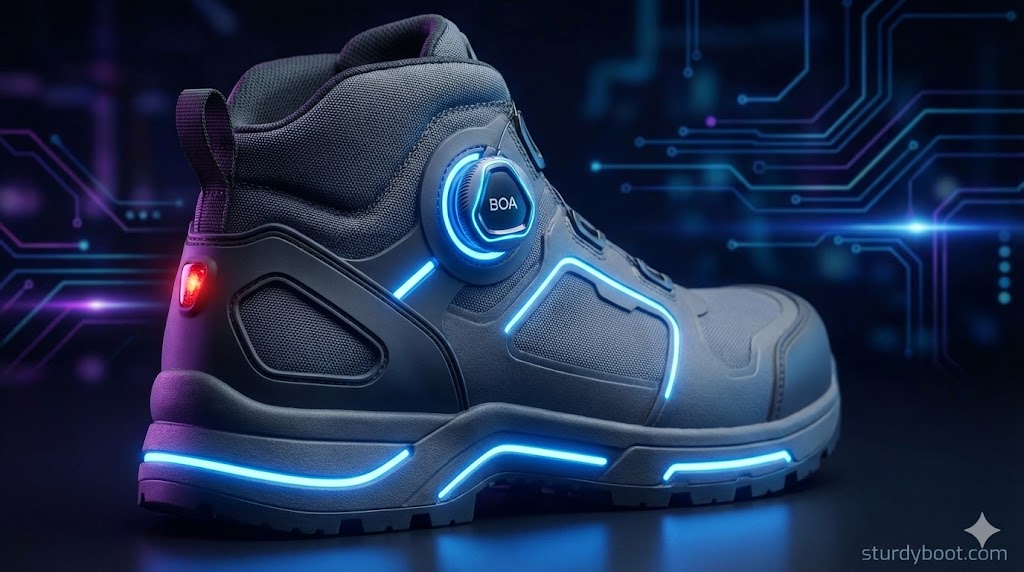
Smart and Connected Safety Boots: IoT Sensors and Fall Detection
Emerging smart boot technologies:
- Fall detection sensors: Alert supervisors to worker falls
- GPS tracking: Locate workers in remote or hazardous environments
- Activity monitoring: Track step counts, fatigue indicators
- Environmental sensors: Detect temperature, gas, or other hazards
Current state (2025-2026): Technology is improving but adoption remains limited. Most smart features add significant cost and require battery charging. Consider carefully whether the benefits justify the investment and maintenance requirements.
BOA Fit Systems Replacing Traditional Laces
BOA adoption is accelerating because:
- Micro-adjustability provides superior fit
- No laces to wear, break, or snag
- Easy adjustment with gloves
- Quick on/off with release mechanism
Trade considerations:
- Higher initial cost
- Repair requires brand-specific parts
- Some workers prefer traditional laces
BOA is now mainstream on premium work boots and increasingly available on mid-range options.
Nano Composite Toe Caps: Lighter Profile with Trade-Offs
Nano composite technology:
- Approximately 15% lighter than standard composite
- Thinner profile approaching steel toe dimensions
- Meets same ASTM protection standards
- Premium positioning in market
Considerations:
- Higher price point
- Less long-term track record
- Limited availability
Advanced Slip Resistance: ASTM F3445-21 Third-Party Testing
ASTM F3445-21 standardization means:
- Consistent testing methodology across brands
- Third-party verification of claims
- Comparable ratings between products
- More reliable slip-resistance information for buyers
Look for ASTM F3445-21 certification rather than vague “slip-resistant” marketing claims.
Sustainable Materials and Eco-Friendly Manufacturing
Sustainability trends in work boots:
- Recycled materials in components
- Reduced-impact manufacturing processes
- Bio-based alternatives to petroleum-based materials
- Longer-lasting construction reducing replacement frequency
Current reality: Sustainable options are growing but remain limited compared to traditional construction. Performance and safety should still drive purchase decisions.
Self-Charging Boots with GPS for Remote Workers
Self-charging technology:
- Kinetic energy from walking powers small electronics
- Can sustain GPS tracking and basic sensors
- Eliminates battery charging requirement
Applications: Remote workers (forestry, utilities, oil field) where communication and location tracking are safety-critical but charging infrastructure is unavailable.
The True Cost of Work Boots: Budget vs Premium Analysis

Replacement Frequency by Industry and Job Intensity
Expected boot lifespan by use intensity:
| Use Level | Environment | Expected Lifespan |
|---|---|---|
| Heavy | Construction, roofing, logging | 6-12 months |
| Moderate | Warehouse, manufacturing | 12-18 months |
| Light | Supervision, inspection | 18-24 months |
Premium boots often last 2-3x longer than budget options, significantly affecting total cost.
Total Cost of Ownership: Initial Price vs Longevity
Example comparison over 3 years:
| Boot Type | Initial Cost | Lifespan | 3-Year Cost |
|---|---|---|---|
| Budget ($80) | $80 | 6 months | $480 (6 pairs) |
| Mid-range ($180) | $180 | 12 months | $540 (3 pairs) |
| Premium ($320) | $320 | 18 months | $640 (2 pairs) |
The calculation shifts when you factor in comfort, safety, and time spent breaking in new boots.
The Hidden Costs of Cheap Boots: Injury, Downtime, and Productivity Loss
Beyond purchase price, cheap boots cost:
- Increased injury risk: Inadequate protection leads to preventable injuries
- Reduced productivity: Discomfort and fatigue reduce work output
- More frequent replacement: Time spent shopping and breaking in boots
- Long-term health impact: Poor support contributes to chronic problems
Average Foot Injury Costs: $27,893 and 13 Lost Workdays
Foot injury statistics from insurance and safety research:
- Average foot injury workers’ compensation claim: commonly reported around $27,893
- Average lost workdays per foot injury: commonly reported around 13 days
- Many foot injuries cause permanent impairment
A single prevented injury covers the cost difference between budget and premium boots many times over.
When Premium Boots Pay for Themselves: ROI by Job Type
Premium boots make most sense for:
- Heavy industrial environments (faster wear on cheap boots)
- High-hazard jobs (protection quality matters more)
- Long shift workers (comfort differences compound)
- Workers with foot or joint issues (support quality matters)
Budget boots may suffice for:
- Light-duty indoor work
- Short-term or temporary positions
- Jobs with low physical demand
- Situations where employer provides replacement frequently
Budget-Friendly Options That Don’t Sacrifice Safety ($140-$170 Range)
Quality boots exist at accessible price points:
- Look for ASTM-certified boots from reputable brands
- Consider previous-year models at discount
- Check employer boot programs for subsidies
- Don’t sacrifice required safety features for price
Key rule: All boots must meet your hazard assessment requirements regardless of price.
Mid-Range Sweet Spot ($180-$250) for Most Trades
The $180-$250 range typically offers:
- Full ASTM certification for required protections
- Quality materials and construction
- Reasonable comfort features
- Acceptable durability for most trades
This range works well for the majority of trade workers balancing quality and value. For curated options, see our best work boots roundup.
Premium Investment Boots ($280-$400+): Who Should Consider Them?
Premium boots make sense when:
- Your job demands maximum durability
- Comfort is essential for productivity
- You have specific fit or support needs
- You value resolability and long-term value
- Your hazard level demands highest-quality construction
Premium features to look for:
- Goodyear welt construction (resolable)
- Premium leather uppers
- Top-tier comfort systems
- Enhanced durability features
- Brand reputation for quality
Features You Don’t Need: Avoiding Over-Specification
The “Don’t Overbuy” Quick Check
Save money by skipping features you don’t actually need:
| Job Type | Features to Skip |
|---|---|
| Electricians (residential) | Metatarsal guards, puncture resistance |
| Warehouse workers (dry, flat floors) | Waterproofing, puncture resistance |
| Office/light industrial supervisors | Heavy-duty safety toe; composite or soft toe sufficient |
| Indoor-only workers | Extreme insulation, aggressive outdoor treads |
| Low-height work | 8-10 inch logger boots; 6-inch is enough |
| Jobs without top-of-foot impact | Metatarsal guards (unnecessary $40-80 expense) |
When Metatarsal Guards Are Unnecessary Expenses
Skip metatarsal guards unless:
- You work near heavy objects that could fall on top of your foot
- Your hazard assessment specifically identifies metatarsal risk
- Your employer requires MT protection
- You work in foundry, heavy fabrication, or similar environments
Metatarsal guards add:
- $40-80 to boot cost
- Weight and bulk
- Sometimes reduced flexibility
Electricians Who Don’t Need Puncture Resistance
Residential electricians rarely need PR boots because:
- Working in finished or near-finished buildings
- Floors are typically clear of debris
- Nail hazards are minimal
Industrial electricians may need PR when working in construction or renovation environments with floor debris.
Warehouse Workers Over-Buying Heavy Construction Boots
Common warehouse over-specification:
- Heavy construction boots when lightweight options work
- Aggressive outdoor treads when fine tread is better for concrete
- Waterproofing when floors are dry
- Excessive insulation for climate-controlled facilities
Warehouse-appropriate features:
- Lightweight safety toe
- Fine tread slip resistance for polished concrete
- Anti-fatigue cushioning
- Breathability
Matching Protection Level to Actual Risk Assessment
Your hazard assessment should drive boot selection:
- Identify actual hazards in your work environment
- Determine required protection for each hazard
- Select boots that meet—but don’t significantly exceed—requirements
- Save money and weight by avoiding unnecessary features
How to Identify Marketing Hype vs Real Job Requirements
Marketing hype red flags:
- Vague claims without specific standards (“super safe,” “ultra protective”)
- Features you can’t connect to actual job hazards
- Premium pricing without clear benefit for your application
- Claims that sound too good to be true
Focus on:
- ASTM certifications matching your requirements
- Features addressing your specific hazard assessment
- Reputation from workers in similar roles
- Value for protection level needed
Multi-Hazard and Hybrid Role Workers
Facility Maintenance: Balancing Electrical, Impact, and Slip Hazards
Facility maintenance workers encounter varied hazards:
- Electrical systems (EH protection needed)
- Equipment and materials (safety toe needed)
- Varied floor surfaces (slip resistance needed)
- Sometimes confined spaces (flexibility needed)
Recommended approach:
- EH-rated composite toe boots
- Good slip resistance
- Moderate weight for mobility
- Versatile construction
Multi-Trade Contractors: Conflicting Requirements in One Boot
Challenges for multi-trade contractors:
- Different sites have different requirements
- Can’t carry multiple boot pairs to every job
- Must meet strictest applicable standard
Strategy:
- Identify maximum protection level needed across job types
- Select boots meeting highest requirements
- Accept some over-specification for versatility
- Consider a secondary pair for specific high-demand situations
Inspectors and Supervisors: Light Duty with Multiple Site Types
Inspector and supervisor considerations:
- Usually not performing physical labor
- Must meet site PPE requirements for entry
- Visiting multiple sites with different standards
Options:
- Versatile boots meeting typical site requirements
- Lighter-duty construction acceptable
- Prioritize comfort for mobility
- Ensure compliance with strictest sites visited
Priority Matrix for Jobs with Three or More Simultaneous Hazards
When facing multiple hazards, prioritize:
- Life-safety hazards first: Electrical, fall, crush risks
- High-frequency hazards second: What you encounter most often
- Convenience features third: Weight, break-in, style
Document your prioritization to justify boot selection.
When You Need Two Pairs for Different Job Functions
Two pairs make sense when:
- Primary and secondary roles have incompatible requirements
- Seasonal conditions demand different boots
- Some tasks require specialized footwear (welding, chainsaw work)
- Boot rotation extends lifespan and improves hygiene
Common two-pair combinations:
- General work boot + specialized hazard boot
- Summer boot + winter boot
- Primary trade boot + secondary task boot
Career Stage Evolution: Apprentice to Journeyman to Master

Apprentice Level: Material Handling and Entry Tasks
Apprentice work typically involves:
- More material handling
- Entry-level tasks
- Learning the trade
- Following more experienced workers
Apprentice boot priorities:
- Meet all safety requirements (non-negotiable)
- Good value (tight budgets common)
- Durability for heavy material handling
- Comfort for long days of physical work
Journeyman Demands: Power Tools and Increased Complexity
Journeyman work involves:
- Full trade responsibilities
- Power tool operation
- Complex task execution
- Independent work
Journeyman boot considerations:
- All required safety features
- Better quality and comfort investment
- Features specific to trade specialization
- Balance of protection and performance
Master and Supervisory Roles: Lighter Duty with Site Mobility
Master and supervisor roles involve:
- Less physical labor
- More site mobility
- Overseeing others’ work
- Multi-site responsibilities
Boot considerations:
- Compliance with site requirements
- Lighter weight acceptable
- Comfort for walking and standing
- Professional appearance may matter
When to Upgrade Your Boots as Your Career Advances
Upgrade timing triggers:
- Increased income allows better investment
- Role changes alter hazard exposure
- Experience reveals what features matter most
- Career longevity becomes priority
Investment mindset: As career progresses, boot quality becomes more important for health and productivity.
Building a Boot Wardrobe Over Your Trade Career
Long-term footwear strategy:
- Early career: Solid basics meeting requirements
- Mid-career: Quality primary boots plus specialized pairs as needed
- Established career: Premium boots as investment in career longevity
Maintain multiple pairs to extend lifespan through rotation.
Proper Fit and Sizing for Safety and Comfort
How Safety Boots Should Fit: Toe Room, Width, and Heel Lock
Proper safety boot fit:
- Toe room: About a thumb’s width between longest toe and boot end
- Width: Snug but not tight across ball of foot
- Heel lock: Minimal slip in heel when walking
- Instep: Secure without pressure points
- Ankle: Supported without restriction
With safety toe: Ensure your toes never contact the toe cap during normal movement.
Why the 2025 OSHA Fit Mandate Matters (Compliance Now Required)
As of January 2025, OSHA explicitly requires that protective footwear properly fit each worker. This means:
- Ill-fitting boots are non-compliant
- Employers must provide appropriately sized options
- “Good enough” sizing doesn’t meet the standard
For workers: Use this mandate to advocate for properly fitting boots.
Sizing Differences Between Brands and Lasts
Important sizing reality:
- Work boot sizes vary significantly between brands
- Even within brands, different models may fit differently
- Lasts (foot forms) differ between manufacturers
- Always verify fit—don’t assume size consistency
Commonly reported brand sizing tendencies:
- Some brands tend to run large
- Some brands tend to run narrow
- Consult brand-specific sizing guides
- Try before you buy when possible
When to Size Up for Thick Socks or Orthotics
Size up if:
- You wear heavy work socks
- You use aftermarket orthotics
- You need extra toe room
- Your feet swell significantly during shifts
How much: Typically 1/2 size for heavy socks, 1/2 to full size for thick orthotics.
Trying Boots at End of Day When Feet Are Swollen
Best fitting practice:
- Try boots late in the day when feet are most swollen
- Wear the socks you’ll use at work
- Bring your orthotics if you use them
- Walk around extensively before deciding
Don’t fit boots: Early morning when feet are smallest.
Signs Your Boots Are Too Small or Too Large
Too small:
- Toes contact toe cap
- Pressure on sides of feet
- Numb toes during wear
- Blisters on toes
Too large:
- Heel slips when walking
- Foot slides forward
- Excess space in toe box
- Blisters on heels
Boot Care and Maintenance to Maximize Lifespan
Cleaning and Conditioning by Material Type
Full-grain leather:
- Remove dirt with brush or damp cloth
- Condition regularly with leather conditioner
- Allow to dry naturally (not near heat)
Nubuck/suede:
- Brush with specialized suede brush
- Use nubuck-specific cleaning products
- Protect with waterproofing spray
Synthetic materials:
- Wipe clean with damp cloth
- Mild soap for stubborn dirt
- Check manufacturer recommendations
Waterproofing Treatment Reapplication Schedules
Waterproofing maintenance:
- Full-grain leather: Reapply waterproofing every 3-6 months (more frequently with heavy exposure)
- Nubuck: Use spray-on waterproofing as directed
- Membranes (GORE-TEX): Treat outer material to maintain DWR finish
Signs waterproofing has failed:
- Water no longer beads on surface
- Leather darkens when wet
- Water penetrates during exposure
Insole Replacement for Extended Comfort
Replace insoles when:
- Cushioning has compressed and flattened
- Foot fatigue increases
- Insole material is worn through
- Odor can’t be eliminated
Consider aftermarket insoles for improved arch support and cushioning beyond factory options.
When to Resole vs Replace Entirely
Resole if:
- Upper leather is in good condition
- Boot is Goodyear welt construction
- Resole cost is less than 50% of replacement cost
- You value the broken-in fit
Replace if:
- Uppers are cracked, torn, or degraded
- Toe cap is damaged
- Waterproofing has failed throughout
- Boot construction doesn’t allow resoling
Rotation Strategies to Extend Boot Life
Rotating two pairs:
- Each boot fully dries between wears
- Extends lifespan of both pairs
- Reduces moisture-related deterioration
- Allows maintenance without downtime
Rotation schedule: Alternate daily or every few days.
Weekly Inspection Checklist: Soles, Toes, Support, and Seams
Weekly boot inspection:
✅ Soles: Check tread depth, separation, damage ✅ Toe caps: Verify no impact damage or exposure ✅ Heel cushioning: Press to check compression ✅ Stitching/seams: Look for separation or fraying ✅ Waterproofing: Note any water penetration ✅ Interior: Check insole condition, odor issues ✅ Laces/closures: Verify function and condition
When to Replace Your Work Boots: Safety Red Flags
Worn Tread Patterns Compromising Slip Resistance
Replace when:
- Tread depth is less than 2mm in walking areas
- Tread pattern is smooth or worn flat
- Outsole is harder or less grippy than when new
Test: Press fingernail into outsole—if rubber doesn’t give, it’s hardened.
Cracked or Split Leather Reducing Protection
Leather damage compromises:
- Water resistance
- Structural integrity
- Protection from hazards
Replace when: Cracks penetrate through leather or spread significantly.
Collapsed Midsoles and Lost Cushioning
Signs of midsole failure:
- Visible compression or thinning
- Reduced cushioning feel
- Increased foot fatigue
- Heel area noticeably flattened
Damaged Toe Caps After Impact Events
After significant impact:
- Visually inspect toe cap
- Check for deformation
- Test for cracks or damage
Replace if: Toe cap shows any damage—you can’t verify protection integrity.
Separated Soles and Failing Adhesive
Sole separation is a safety failure:
- Trip hazard from flapping sole
- Lost waterproofing
- Compromised structural integrity
Replace immediately if sole separation is occurring.
Water Penetration Through Failed Membranes
Waterproofing failure means:
- Wet feet in wet conditions
- Rapid heat loss in cold
- Accelerated interior deterioration
Replace when: Waterproofing treatments no longer restore water resistance.
Average Replacement Timelines: 6-12 Months (Heavy Use) vs 18-24 Months (Light Use)
| Use Level | Environment | Replace After |
|---|---|---|
| Heavy | Construction, logging, roofing | 6-12 months |
| Moderate | Warehouse, manufacturing | 12-18 months |
| Light | Supervision, inspection | 18-24 months |
These are guidelines—replace sooner if any safety red flags appear.
Popular Work Boot Brands by Trade and Specialty
All-Around Construction: Timberland PRO, Red Wing, Thorogood
Timberland PRO:
- Wide range of styles and protections
- Anti-fatigue technology focus
- Strong distribution and availability
Red Wing:
- Heritage brand with reputation for durability
- American manufacturing options
- Resolable construction on many models
For details on Red Wing’s repair and replacement policies, see our guide to Red Wing boots warranty coverage.
Thorogood:
- American-made options
- Union-made boots available
- Wedge sole popularity in construction
Electrical and HVAC: KEEN Utility, Wolverine, Danner
KEEN Utility:
- Athletic-inspired comfort
- Strong EH-rated options
- Lighter weight construction
Wolverine:
- Long heritage in work boots
- Good value proposition
- Wide range of EH options
Danner:
- Premium construction quality
- Strong EH and composite toe options
- American-made selections
Welding: Brunt, Georgia Boot, Irish Setter
Brunt:
- Modern brand with welding focus
- Metatarsal guard options
- Direct-to-consumer value
Georgia Boot:
- Strong welding-specific designs
- Metatarsal protection options
- Good value in category
Irish Setter:
- Red Wing subsidiary
- Welding-appropriate styles
- Heat-resistant options
Warehouse and Logistics: Reebok Work, Skechers Work, KEEN
Reebok Work:
- Athletic style and comfort
- Lightweight safety toe options
- Anti-fatigue focus
Skechers Work:
- Memory foam comfort
- Lightweight construction
- Value-oriented pricing
KEEN:
- Comfort-first design
- Lightweight composites
- Anti-fatigue technology
Oil and Gas: Ariat, Justin, Wolverine
Ariat:
- Western/work crossover
- Strong in oil field applications
- Durable construction
Justin:
- Heritage western brand
- Oil and gas focus
- Pull-on styles
Wolverine:
- Industrial-grade construction
- Chemical resistance options
- Metatarsal guard styles
Roofing: Cougar Paws, Timberland PRO, CAT
Cougar Paws:
- Roofing-specific design
- Replaceable traction pads
- Specialized for pitch work
Timberland PRO:
- Roofing-appropriate styles
- Lightweight options
- Heat-resistant soles
CAT (Caterpillar):
- Durable construction
- Heat-resistant options
- Value proposition
Forestry: HAIX, Husqvarna, Stihl
HAIX:
- European forestry specialist
- Chainsaw protection focus
- Premium quality
Husqvarna:
- Chainsaw manufacturer’s footwear
- Cut protection certified
- Integrated safety approach
Stihl:
- Chainsaw brand boots
- Professional forestry focus
- Cut-rated protection
Budget-Conscious Workers: Georgia Boot Core 37, Carhartt, Wolverine
Georgia Boot Core 37:
- Value-oriented safety boots
- Basic ASTM certifications
- Accessible pricing
Carhartt:
- Workwear brand boots
- Good value tier
- Durable construction
Wolverine:
- Range includes value options
- Entry-level safety boots
- Brand reliability
Premium Investment: Danner, Red Wing Heritage, Nicks Boots
Danner:
- Premium construction
- Resolable options
- Long-term value
Red Wing Heritage:
- Investment-grade craftsmanship
- American manufacturing
- Decades of lifespan potential
Nicks Boots:
- Handmade in USA
- Custom fit options
- Heirloom-quality construction
Special Considerations: Women’s Work Boots
Women in trades face unique challenges finding properly fitting safety footwear. Our dedicated guide to the best women’s work boots covers brands offering women-specific lasts and sizing, not just scaled-down men’s designs.
Carpenters and Finish Work
Carpenters need a specific combination of features: puncture resistance for nail hazards, flexibility for kneeling and detailed work, and all-day comfort. For trade-specific recommendations, see our best carpenter boots guide.
Frequently Asked Questions
What type of work boots do I need for construction work?
Construction workers need boots with:
- Safety toe rated I/75 C/75 (steel, composite, or alloy)
- Puncture-resistant (PR) midsole
- Slip-resistant outsole
- Ankle support (minimum 6-inch height)
- EH rating recommended for electrical protection
Waterproofing is strongly recommended for outdoor construction. Match additional features to your specific tasks and site conditions.
Can electricians wear steel toe boots safely?
Yes, electricians can safely wear steel-toe boots as long as the boots carry an EH (Electrical Hazard) rating. The steel toe cap is surrounded by insulating materials and doesn’t create an electrical pathway. ASTM testing confirms EH protection regardless of toe cap material.
Many electricians prefer composite toe boots for the psychological comfort of having no metal present, plus weight savings. Both options are safe when properly EH-rated.
Are composite toe boots as protective as steel toe boots?
Yes, composite toe boots meeting ASTM standards provide identical rated protection to steel toe boots. Both must pass the same I/75 C/75 impact and compression tests.
The differences are weight (composite is lighter), temperature conductivity (composite is neutral), and metal detection (composite passes through). Protection level is equivalent.
What does EH rated mean on work boots?
EH (Electrical Hazard) rated boots provide insulation against accidental contact with live electrical circuits up to 18,000 volts under dry conditions. This protection is:
- Secondary (supplements, never replaces, safe work practices)
- Valid only when boots are dry
- Compromised by sole damage
- Verified by ASTM testing
Do I need metatarsal guards for my job?
You need metatarsal guards if:
- Heavy objects could fall on the top of your foot
- You work in foundry or heavy fabrication
- Your employer or hazard assessment requires MT protection
You probably don’t need them if: Your work doesn’t involve drop hazards to the top of your foot. Skip them to save cost, weight, and bulk.
What is ASTM F2413 certification and why does it matter?
ASTM F2413-24 is the American standard for protective footwear. It establishes testing protocols for impact resistance, compression resistance, electrical hazard protection, puncture resistance, and metatarsal protection.
Boots displaying this certification have been tested and verified to meet specific protection levels. Without ASTM certification, you can’t verify that boots provide the protection they claim.
How do I know if my boots meet OSHA requirements?
To verify OSHA compliance:
- Confirm your workplace hazard assessment identifies foot hazards
- Check that boots carry ASTM F2413-24 certification
- Verify ratings match identified hazards (I/75, C/75, EH, PR, MT as needed)
- Ensure boots are in good condition
- Verify boots fit properly (now required under 2025 mandate)
How often should work boots be replaced?
Replace based on condition, not time alone:
- Heavy use (construction, logging): 6-12 months typically
- Moderate use (warehouse, manufacturing): 12-18 months typically
- Light use (supervision): 18-24 months typically
Replace immediately if: Sole separation occurs, toe cap is damaged, waterproofing fails completely, or any safety compromise is visible.
Do welders need special boots beyond standard safety footwear?
Yes, welders need boots specifically designed for welding hazards:
- Heat-resistant leather uppers
- Metatarsal guards (internal or external)
- Covered laces or pull-on design
- Heat-resistant outsoles
- No exposed synthetic materials
Standard safety boots don’t protect against sparks and molten metal.
What boots should warehouse workers wear for all-day standing?
Warehouse workers benefit from:
- Lightweight composite safety toe
- Slip-resistant outsoles for polished concrete
- Anti-fatigue midsoles with energy return
- Good arch support
- Breathable linings
Prioritize comfort features—warehouse workers take tens of thousands of steps daily.
Are waterproof work boots necessary for outdoor jobs?
Waterproof boots are necessary if:
- You work in wet conditions regularly
- Rain or standing water is common
- You can’t change boots during the workday
Water-resistant may suffice if: Exposure is occasional and brief. Water-resistant boots offer better breathability.
What’s the difference between water-resistant and waterproof boots?
Water-resistant: Repels light water contact but may eventually soak through with sustained exposure. Often more breathable.
Waterproof: Blocks water penetration completely using membranes or sealed construction. Less breathable than water-resistant options.
What are the best work boots for standing all day?
For all-day standing, prioritize:
- Anti-fatigue midsoles (EVA, Poron, or brand-specific systems)
- Energy-return cushioning
- Excellent arch support
- Shock-absorbing heels
- Appropriate weight (lighter reduces fatigue)
- Removable insoles for orthotic compatibility
Can you wear soft toe boots on a construction site?
Generally no. Most construction sites require safety-toe footwear. Your workplace hazard assessment determines requirements—construction sites almost always have impact and compression hazards requiring rated protection.
Some very light-duty construction roles (certain supervisory positions) might allow soft toe, but this is uncommon.
Do I need steel toe protection if I work in a warehouse?
Most warehouse environments require safety toe protection due to:
- Forklift and pallet jack operation
- Heavy material handling
- Falling box and merchandise risks
The protection can be steel, composite, or alloy—all provide equivalent ASTM-rated protection.
Why do logger boots have high heels?
Logger heels (typically 2+ inches) serve functional purposes:
- Hook onto ladder rungs for secure climbing
- Dig into hillsides for slope stability
- Provide purchase on uneven logging terrain
- Elevate foot above debris and mud
The distinctive heel is a safety feature, not a style choice.
What work boots are best for hot weather conditions?
For hot weather, prioritize:
- Composite toe (doesn’t conduct heat like steel)
- Breathable construction (mesh panels where safety allows)
- Moisture-wicking linings
- Lighter weight construction
- Uninsulated options
- Heat-resistant outsoles for hot surfaces
How long should quality work boots last?
Quality work boot lifespan varies by use:
- Premium boots (Goodyear welt): 3-5+ years with resoling
- Quality mid-range: 1-2 years typical
- Budget boots: 6-12 months typical
Durability depends on construction method, materials, use intensity, and maintenance.
What’s the difference between American-made and imported work boots?
American-made boots often feature:
- Higher labor costs reflected in price
- Often premium construction methods
- Some union-made options
- Perceived quality reputation
Imported boots:
- Generally lower price points
- Wide range of quality levels
- Most major brands import most models
Quality varies within both categories. Country of origin doesn’t guarantee quality—look at construction, materials, and ASTM certifications.
Final Thoughts: Your Boots Are an Investment in Your Career
Choosing work boots isn’t about finding the cheapest option that meets minimum requirements. It’s about protecting your feet, your comfort, and your long-term ability to work in your trade.
Key takeaways:
- Start with hazard assessment—know what you’re protecting against
- Match features to actual risks—don’t overbuy, don’t underbuy
- Understand the standards—ASTM certifications tell you what protection is verified
- Prioritize fit—the 2025 OSHA mandate makes proper fit a compliance requirement
- Consider total cost—premium boots often cost less over time
- Maintain your investment—care extends lifespan and maintains protection
Try these steps before you buy:
- Document your workplace hazards
- Identify required safety features
- Try boots on at day’s end with work socks
- Walk around extensively before deciding
- Verify ASTM certifications match your needs
Your feet carry you through your entire career. Protect them well.
This guide is intended for educational purposes. Always follow your employer’s specific PPE requirements and consult current OSHA regulations for compliance questions. When in doubt about safety requirements, consult your safety manager or OSHA resources.