Best Waterproof Work Boots 2026: 10 Picks Owners Actually Trust
Last updated: June 2026
- Across this cycle’s owner feedback, the “old pairs were better” theme grew louder on two heritage names — the Timberland PRO Boondock and the KEEN Pittsburgh — as repeat buyers with direct old-vs-new comparisons flagged faster sole failure and thinner laces.
- Lace-hardware failure (popping eye loops, snapping speed hooks) rose to become the single most-repeated mechanical complaint on the CAT Threshold, edging ahead of the sole-separation talk that usually dominates this category.
- A consistent, cross-brand pattern hardened this year: waterproofing rarely fails through the leather face — it fails when the sole-to-upper seam or a toe-crease flex point starts to go, so a sudden leak is usually a durability warning, not just a sealing one.
- No model variants were added; the field is the same 10 boots re-checked against fresh owner reports.
Buying a waterproof work boot in 2026 means walking straight into a contradiction: the most comfortable boots in this category are frequently the same ones owners lose to sole separation inside a year. The tension isn’t comfort or durability — it’s matching the right comfort-first boot to a job that won’t chew it up before it earns its keep. Get that match wrong and you’ll feel burned; get it right and you’ll re-buy the same boot for years.
Why trust this ranking: every placement below is synthesized from aggregated owner feedback across our individual boot reviews — not manufacturer claims, lab tests, or sponsored placement. We reflect what owners consistently report, warts and all.
Methodology Snapshot
Review coverage Multiple individual reviews plus aggregated owner feedback per boot (volume not specified for most; one review notes a deliberately balanced ~200-review slice). Feedback skews toward U.S. buyers, roughly late 2021 through mid-2026, reflecting current production.
How we ranked We tagged owner feedback into normalized buckets — comfort and fit, sizing, waterproofing, sole and construction durability, lace hardware, weight, heat and cold, traction, and warranty and support — then separated wrong-job and wrong-fit complaints from likely product-design failures. Ranking follows each boot’s inherited Confidence Score first; when scores tie, we rank by outcome consistency, then downside severity, then breadth of fit.
Confidence Score rubric (inherited from the full reviews, not calculated here):
| Score | What it means |
|---|---|
| 9+ | Very consistent positives |
| 8 – 8.9 | Strong, with manageable tradeoffs |
| 7 – 7.9 | Good, but install or quality variance matters |
| Under 7 | Niche fit / higher downside risk |
Click any Confidence Score in the tables below to open that boot’s full review and scoring context.
Affiliate disclosure: SturdyBoot is reader-supported. If you buy through links on this page, we may earn a small commission at no extra cost to you. It never changes what the owner feedback says or how we read it.
What you’ll learn and how to pick fast: Below you’ll find a quick-verdict award table, a one-glance summary, a decide-and-fix toolkit, two original owner-data artifacts (failure-mode frequency and a use-case fit matrix), and full per-boot breakdowns. If you already know your job is heavy-abuse, skip straight to the honest “who should skip all of these” block near the end.
Quick Verdict (TL;DR)
| Award | Product | Best For | Quick Reason |
|---|---|---|---|
| Best Overall | Carhartt Rugged Flex Waterproof | Light-to-medium trades wanting comfort + value | Clearest happy/unhappy dividing line and the strongest repeat-buyer loyalty in the field. |
| Best Value | CAT Threshold Waterproof Steel Toe | Budget buyers who prize day-one comfort | Comfort that repeatedly surprises owners at the price — if you accept weaker traction and lace hardware. |
| Best Premium / Heavy-Duty | Timberland PRO Boondock | Protection-first buyers in rough conditions | Warm composite toe and aggressive grip owners trust — the most boot on this list. |
| Best Lightweight | Wolverine Overpass Composite Toe | Walkers who want sneaker feel all shift | Near-universal comfort praise; even critics admit day-one it feels great. |
| Best for Wide Feet | Irish Setter Wingshooter ST | Wide/4E feet needing metal-detector-safe toe | “Memory-foam slipper” comfort with genuine wide/4E room. |
| Best Women’s Steel Toe | CAT Women’s Echo Waterproof Steel Toe | Narrow/standard women’s feet | A true women’s last that narrow feet report loving, with multi-year wear when fit is right. |
Bottom line in one sentence (per award):
- Best Overall — Carhartt: Buy it if your trade is light-to-medium and you want the safest comfort-per-dollar bet here.
- Best Value — CAT Threshold: Buy it if you want surprising out-of-box comfort cheaply and can live with slick traction and weak lace hardware.
- Best Premium — Boondock: Buy it if protection and grip matter more than shaving weight.
- Best Lightweight — Overpass: Buy it if all-day comfort and a sneaker feel outrank multi-year durability.
- Best for Wide Feet — Wingshooter ST: Buy it if you’re 4E/wide and need a non-metallic toe.
- Best Women’s — CAT Echo: Buy it if you have narrow-to-standard feet and want a boot built as a woman’s boot, not a shrunk-down men’s one.
Tip: Click a Confidence Score to see the full review and scoring context.
One-Glance Summary Table
| Product | Best For | Confidence Score |
|---|---|---|
| Carhartt Rugged Flex Waterproof | Light-medium trades, comfort + value | 8/10 |
| Wolverine Overpass Composite Toe | Walkers wanting sneaker feel | 8/10 |
| CAT Threshold Waterproof Steel Toe | Budget comfort | 8/10 |
| Irish Setter Wingshooter ST | Wide/4E feet | 8/10 |
| Timberland PRO Boondock | Protection-first, rough conditions | 8/10 |
| KEEN Cincinnati Composite Toe | Wide feet, standing trades | 7.5/10 |
| CAT Women’s Echo Steel Toe | Narrow/standard women’s feet | 7.5/10 |
| Timberland PRO Women’s Direct Attach | Women’s feet, size up half | 7.5/10 |
| KEEN Pittsburgh Steel Toe | Most comfort, wide feet, wet work | 7/10 |
| Wolverine Floorhand Steel Toe | Narrow feet, budget steel toe | 7/10 |
Toolkit (Decide + Fix)
Issue-Tag Box
| Issue Tag | What It Usually Means | First Fix / Check |
|---|---|---|
| #sole-separation | The outsole is unbonding from the upper, not wearing out | Flex the sole-to-upper seam hard; if you see a glue-only gap inside returns, exchange it |
| #seam-leak | Waterproofing failing at the seam, not the leather | Soak-test to the lower lace line; a sudden leak often signals the sole bond is going |
| #lace-hook-snap | Speed hooks/eyelets popping, sometimes while tying | Stress every hook and eyelet by hand; a cobbler can replace a single speed-hook cheaply |
| #toe-crease-crack | Upper cracking at the flex point behind the toe | Flex the toe crease repeatedly; early weakness shows here first |
| #wide-isnt-wide | Even “Wide”/”X-Wide” reads narrow for genuinely wide feet | Measure width before ordering; consider a different boot rather than sizing up into heel slop |
| #runs-small | Length runs short; toes jam the cap | For the women’s models especially, order a half-size up |
| #heel-slop | Foot slides in the heel pocket | Lock-lace the top hooks before trying a size change |
| #runs-slick-wet | Traction poor on wet tile/oil despite waterproofing | Don’t use where you need aggressive wet grip; waterproof does not mean grippy |
| #runs-hot | Fabric panels/warm build in heat or near sparks | Skip for hot-shop/spark work entirely |
| #return-window-timing | Failures cluster just after returns close | Treat the first 30 days as an active stress test, not a grace period |
Decision Tree
- If your trade is heavy daily concrete/masonry/weld work → most boots here fail early; skip to the “Who Should Skip All of These” block and look at heritage resoleable construction.
- If you want the safest all-round comfort-per-dollar bet → go to #1 Carhartt Rugged Flex.
- If you walk high mileage and want the lightest feel → go to #2 Wolverine Overpass.
- If your budget is tight and comfort matters most → go to #3 CAT Threshold (accept weak traction/hardware).
- If you have genuinely wide/4E feet → go to #4 Irish Setter Wingshooter ST; avoid the Wolverine Overpass and Floorhand (their “wide” reads narrow).
- If you need real protection and grip over low weight → upgrade path: #5 Timberland PRO Boondock in Wide.
- If you stand all day and want a roomy toe box → go to #6 KEEN Cincinnati (but not on wet/oily floors).
- If you’re a woman with narrow-to-standard feet → go to #7 CAT Echo; if you run between sizes, #8 Timberland Direct Attach, sized up half.
- If day-one comfort beats everything and you’re fine replacing yearly → #9 KEEN Pittsburgh for wide feet in wet, non-spark work.
Troubleshooting Quickflow
Panic symptom 1 — “My brand-new boots are leaking.”
- Symptom: wet socks with no obvious tear
- Check 1: soak-test to the lower lace line and locate where water enters (tongue, collar, or sole seam)
- Check 2: flex the sole-to-upper seam and toe crease, looking for any gap, lift, or hairline crack
- Fix: if the leather face is dry but the seam leaks, the sole bond is likely separating — that’s a durability failure, not a treatable seal
- Return-window escalation: if you’re inside returns, exchange now; a leak this early predicts worse later
Panic symptom 2 — “The sole is starting to peel/separate.”
- Symptom: heel flap, front-sole lift, or a visible gap at the outsole-to-upper line
- Check 1: press and flex both boots at the toe and heel; separation often starts on one and follows on the other
- Check 2: photograph the gap immediately with a date, in case of a warranty claim
- Fix: a flexible shoe adhesive can buy short-term time if caught very early; anything structural belongs with a cobbler, not a driveway epoxy job — and never field-repair a compromised safety boot before checking your employer’s PPE hazard assessment
- Return-window escalation: inside the window, return/exchange rather than repair; past it, document and escalate, noting “same defect” if a replacement fails identically
For the deeper version of these fixes across every common boot fault, our complete work-boot troubleshooting guide maps symptoms to causes and safe first fixes.
Unique-Data Section (Owner-Reported)
Failure-Mode Frequency Snapshot
The single most-reported complaint for each boot, normalized across the field. Nearly every boot’s dominant failure traces back to the sole bond — the exceptions are telling.
| Rank | Product | #1 Reported Failure Mode |
|---|---|---|
| #1 | Carhartt Rugged Flex | Sole-to-upper separation |
| #2 | Wolverine Overpass | Front outsole section ungluing |
| #3 | CAT Threshold | Lace hardware popping |
| #4 | Irish Setter Wingshooter ST | Toe-cap stitching failure |
| #5 | Timberland PRO Boondock | Sole-to-upper bond delamination |
| #6 | KEEN Cincinnati | Sole peel at the toe |
| #7 | CAT Women’s Echo | Interior liner wearing out early |
| #8 | Timberland Direct Attach | Sole separation months in |
| #9 | KEEN Pittsburgh | Snapped lace hooks |
| #10 | Wolverine Floorhand | Sole-to-upper separation |
Use-Case Fit Matrix
Rated only where owners addressed the use case. Labels are normalized: Strong / Moderate / Poor (blank = not covered by owners).
| Product | Light-duty / walking | Heavy-abuse trades | Wet (non-spark) | Wide feet | Narrow feet | Hot / spark work |
|---|---|---|---|---|---|---|
| Carhartt Rugged Flex | Strong | Poor | Strong | Moderate | Strong | Poor |
| Wolverine Overpass | Strong | Poor | Moderate | Poor | Moderate | Moderate |
| CAT Threshold | Strong | Poor | Poor | Strong | Moderate | — |
| Irish Setter Wingshooter ST | Strong | Poor | Moderate | Strong | Poor | Poor |
| Timberland PRO Boondock | Strong | Moderate | Moderate | Strong | Poor | — |
| KEEN Cincinnati | Strong | Poor | Poor | Strong | Moderate | — |
| CAT Women’s Echo | Strong | Moderate | Moderate | Poor | Strong | Poor |
| Timberland Direct Attach | Strong | Poor | Moderate | Poor | Strong | — |
| KEEN Pittsburgh | Strong | Poor | Strong | Strong | Poor | Poor |
| Wolverine Floorhand | Moderate | Poor | Moderate | Poor | Strong | — |
Quick Decision Matrix
- Need the safest all-round pick → Go to #1 Carhartt Rugged Flex
- Need the lightest, most sneaker-like feel → Go to #2 Wolverine Overpass
- Need maximum comfort on the smallest budget → Go to #3 CAT Threshold
- Need genuine wide/4E room with a non-metallic toe → Go to #4 Irish Setter Wingshooter ST
- Need the most protection and grip → Go to #5 Timberland PRO Boondock
- Need a roomy toe box for all-day standing → Go to #6 KEEN Cincinnati
- Need a women’s-specific steel toe (narrow feet) → Go to #7 CAT Women’s Echo
- Need a women’s boot and you run small/between sizes → Go to #8 Timberland Direct Attach
- Need the most comfortable steel toe for wide feet in wet work → Go to #9 KEEN Pittsburgh
- Need a budget steel toe for narrow feet → Go to #10 Wolverine Floorhand
Comparison Table
| Product | Best For | Owner-Reported Outcome | What Owners Liked | Common Complaints / Tradeoff | Owner Signals | Confidence Score |
|---|---|---|---|---|---|---|
| Carhartt Rugged Flex | Light-medium trades | Polarized (splits by trade) | Day-one comfort, lightweight | Early sole failure under heavy abuse; waterproofing decays | Strong repeat-buy loyalty | 8/10 |
| Wolverine Overpass | Walkers, light duty | Polarized | Near-universal comfort, sneaker feel | Toe-crease cracks and sole wear at 4–7 mo; plastic lace loops | “Comfortable but short-lived” | 8/10 |
| CAT Threshold | Budget comfort | Moderate | Comfort-for-price surprise | Weak lace hardware, slick wet/oily traction | Budget-value repeat buys | 8/10 |
| Irish Setter Wingshooter ST | Wide/4E feet | Polarized | “Memory-foam” comfort, metal-detector safe | Toe/sole wear in abrasive trades; laces first to go | Trade-dependent split | 8/10 |
| Timberland PRO Boondock | Protection-first | Polarized | Protective warm toe, aggressive grip | ~5–6 mo sole failure, heavy, runs big | “Old pairs were better” | 8/10 |
| KEEN Cincinnati | Wide feet, standing | Polarized | Roomy comfort, toe-stitched design | Slick wet traction, tongue-flap, ~1 yr sole life | Comfort loyalty vs. Red Wing | 7.5/10 |
| CAT Women’s Echo | Narrow women’s feet | Moderate | True women’s fit, multi-year when right | Minority waterproofing failure; wide feet fight it | Narrow feet love / wide feet fight | 7.5/10 |
| Timberland Direct Attach (W) | Women’s, size up | Moderate | Protective steel toe, grip | Runs small, firm flat footbed, minority sole issues | “Order half-size up” | 7.5/10 |
| KEEN Pittsburgh | Most comfort, wide feet | Polarized | Elite out-of-box comfort, real waterproofing | Sole/hardware failure 6–12 mo, runs hot near sparks | Loyal re-buyers despite failures | 7/10 |
| Wolverine Floorhand | Narrow feet, budget | Moderate | Comfortable, affordable | Early sole issues 2–6 mo, narrow toe cap, weak grip | Width varies by colorway | 7/10 |
Note: Listings can differ; we reflect details stated in our review notes.
Detailed Product Reviews
#1. Carhartt Rugged Flex Waterproof — The Threshold Boot
Key takeaway: The best all-around pick here for light-to-medium trades — comfortable day one and backed by the strongest repeat-buyer loyalty, as long as your job isn’t heavy daily abuse.
Tagline: Match it to your job, not the brand.
At a Glance
- Best for: Light-duty and walking-heavy roles (drivers, warehouse, factory, gardening, occasional shop work)
- Owner-reported outcome: Polarized — outcomes split cleanly by trade intensity
- Confidence score: 8/10
Signature (from review notes)
- Failure signature: Sole-to-upper separation, often at the toe or heel-cup seam
- Install friction: Easy
- Downside risk: Medium
Owner signals
- Comfort: Positive — lightweight, comfortable out of the box for most
- Durability: Mixed — great in light wear, early failure under heavy abuse
- Loyalty: Positive — repeat buyers on their 3rd–7th pair keep coming back
Quick Summary: Genuinely comfortable and lightweight immediately, with a use-case threshold that predicts happiness better than the star average — the tradeoff is that heavy daily punishment can bring on sole separation inside a year.
The Deep Dive (Why It Ranked Here)
- The clearest happy/unhappy dividing line in the whole field: lighter-duty and walking-heavy roles report multi-year satisfaction; heavy-abuse trades report early breakdown.
- Sole-to-upper separation is the dominant failure mode, and for some long-time buyers it repeats on replacement pairs — a consistency signal, not just bad luck.
- Failures cluster in a roughly 2-to-6-month window, frequently just after returns close and before the boot has earned its price.
- The repeat-buy behavior is the most honest endorsement in its feedback: people who fit the light-wear profile vote with their wallets, again and again.
- A sudden waterproofing loss tends to follow toe-cap rubber cracking — watch the sole bond once you see it.
Why Buy
- Immediate, near-zero-break-in comfort
- Lightweight for high-mileage days
- Broad fit tolerance — narrow, standard, and (with some width QC variance) wider feet all find workable fits
- Outstanding value if you’re on the light side of the use-case line
Dealbreakers / What to Consider
- If you weld, do masonry, or pound concrete daily, skip this — the comfort won’t save you from a 4-month separation
- Waterproofing decays over months and a warranty replacement may repeat the same defect
- Width QC is inconsistent for genuinely wide feet
Verdict for You
- Pick this if:
- You’re in a lighter-wear or boot-rotation situation
- You want the safest comfort-per-dollar bet in the category
- Skip this if:
- Your trade is heavy daily abuse
- You need a guaranteed 2–3 year boot
Placing yourself on the right side of that use-intensity line is the whole game here; our work boots by job type guide helps you map trade to boot before you buy.
Quick Links: Check price on Amazon · Read the full Carhartt Rugged Flex review
#2. Wolverine Overpass Composite Toe — The Sneaker That Went to Work
Key takeaway: The most comfortable boot here for walkers, with near-universal day-one praise — buy it accepting sneaker-like comfort and sneaker-like lifespan under heavy abuse.
Tagline: Best-in-class comfort, below-class durability.
At a Glance
- Best for: High-mileage walkers and lighter trades wanting a lightweight, athletic feel
- Owner-reported outcome: Polarized — comfort near-universal, durability splits by intensity
- Confidence score: 8/10
Signature (from review notes)
- Failure signature: Softer front outsole section ungluing/wearing through at the same spot; toe-crease cracking
- Install friction: Easy
- Downside risk: Medium
Owner signals
- Comfort: Positive — even most one-star reviewers admit day-one it felt great
- Durability: Negative — heavy users report 4–7 month failures
- Width: Mixed — “extra wide isn’t wide” is a recurring complaint
Quick Summary: Almost nobody complains about how the Overpass feels — they complain about how long it lasts, with durability failures clustering in a back-loaded 4-to-7-month window.
The Deep Dive (Why It Ranked Here)
- The single most repeated sentence shape across its feedback is “most comfortable boot I’ve owned — but it fell apart.”
- Failure timing is strikingly back-loaded: cracking, sole separation, and lost waterproofing cluster at 4–7 months, comfortably past the return window.
- A sudden leak is the first sign of a hairline crack at the toe-crease flex point — the waterproofing and cracking failures are the same failure, in sequence.
- The softer front outsole section fails in the identical spot for owner after owner, including on second pairs — a design/consistency signature.
- Waterproofing is genuinely effective when new (one welder noted molten splatter bounced off), but longevity lags the heritage boots owners compare it to.
Why Buy
- Exceptional out-of-box comfort and light weight
- “Wears like a sneaker” for all-day standing and walking
- Effective waterproofing when new
Dealbreakers / What to Consider
- If you need genuine wide room, skip this — even the extra-wide reads narrow for some
- Plastic lace loops crack for some owners
- Heavy trades will hit the 4–7 month failure wall
Verdict for You
- Pick this if:
- You walk long shifts and prize comfort over lifespan
- You’re standard-width and lighter-duty
- Skip this if:
- You have genuinely wide feet
- You need multi-year durability under abuse
If low weight is your top priority across the category, our lightweight work boots roundup compares the field so you can weigh comfort against longevity.
Quick Links: Check price on Amazon · Read the full Wolverine Overpass review
#3. CAT Threshold Waterproof Steel Toe — The Budget Comfort Surprise
Key takeaway: A steel-toe boot that repeatedly surprises owners with out-of-box comfort at its price — buy it accepting weak traction and lace hardware that’s the first thing to fail.
Tagline: Comfort-for-price, with a hardware caveat.
At a Glance
- Best for: Budget buyers who want day-one comfort and standard/wide fit
- Owner-reported outcome: Moderate
- Confidence score: 8/10
Signature (from review notes)
- Failure signature: Lace eye loops/hooks/rivets popping (often while tying); toe-cap seam splitting; sole cracking
- Install friction: Easy
- Downside risk: Medium
Owner signals
- Comfort: Positive — minimal break-in, soft footbed
- Lace hardware: Negative — the single most-repeated mechanical failure
- Traction: Negative — poor on oily, wet, and metal surfaces
Quick Summary: Out-of-box comfort at a price that surprises owners, undercut by lace hardware that pops (sometimes in the first weeks) and traction that’s a clear weak point.
The Deep Dive (Why It Ranked Here)
- Lace eye loops, hooks, and rivets popping is the single most-repeated mechanical complaint — often happening while simply tying the boot.
- Waterproofing is solid when new but fades over months as the outsole cracks or the toe-cap seam splits; think of it as water-resistant long-term.
- The failure sequence matters: sole cracks or a toe-stitch gap appear first, and the leak follows — treat visible cracking as an early warning.
- Traction is repeatedly called poor on oily, wet, and metal surfaces — a real safety consideration.
- Filter out the wrong-job one-star reviews and real product failures remain, but a big share come from budget boots run through punishing conditions they weren’t built for.
Why Buy
- Standout comfort-for-price with minimal break-in
- Roomy cushioned toe box for standard/wide feet
- Genuine steel-toe protection at a budget number
Dealbreakers / What to Consider
- If you work oily or wet floors where grip is safety-critical, skip this
- Lace hardware is the weakest link — stress it inside returns
- Contains metal (a metal-detector consideration)
Verdict for You
- Pick this if:
- You want maximum comfort on the smallest budget
- You’re standard or wide and work dry-ish surfaces
- Skip this if:
- Slip resistance on wet/oily floors is critical
- You need robust lace hardware
Because the sole is where its waterproofing quietly lives or dies, our work boot soles explained guide shows what a healthy outsole-to-upper bond should look like before it starts cracking.
Quick Links: Check price on Amazon · Read the full CAT Threshold review
#4. Irish Setter Wingshooter ST — The Wide-Foot Slipper
Key takeaway: The pick for wide/4E feet who want a non-metallic, metal-detector-safe toe and day-one “memory-foam” comfort — accepting that toe stitching is the early weak point under hard use.
Tagline: Comfort-forward, not a rugged-terrain tank.
At a Glance
- Best for: Wide/4E feet in lighter-duty, walking-heavy, or hunting use
- Owner-reported outcome: Polarized
- Confidence score: 8/10
Signature (from review notes)
- Failure signature: Toe-cap stitching letting go; soft wedge sole wearing/peeling; laces first to fail
- Install friction: Easy
- Downside risk: Medium
Owner signals
- Comfort: Positive — “memory foam slipper” comparisons are common
- Safety toe: Positive — light, metal-detector safe, protective
- Durability: Mixed — clusters by trade and surface
Quick Summary: Genuinely day-one comfortable with a light, metal-detector-safe composite toe, but toe-cap stitching and the soft wedge sole are the weak links — many owners get months, not years, in abrasive trades.
The Deep Dive (Why It Ranked Here)
- Near-zero break-in with “walking-on-clouds” comfort that repeat switchers say beats pricier heritage boots.
- Failures cluster in a 2-to-6-month window, frequently just past returns — and warranty support for work-used boots is reportedly hard to get.
- The failure sequence is the toe: owners on 2nd, 3rd, and 4th pairs report the same toe-stitching failure at the same spot, pointing to a consistency issue.
- A clear happy/unhappy line by surface: landscapers, lighter plumbers, drivers, warehouse, and hunting users skew happy; kneel-on-concrete electricians, ironworkers, and paving crews skew to fast failure.
- Excellent for wide/4E; loose and heel-slop-prone for narrow, low-instep feet.
Why Buy
- Among the better wide/4E options in the category
- Lightweight, metal-detector-safe composite toe
- Standout out-of-box comfort
Dealbreakers / What to Consider
- If you kneel on concrete or pound asphalt daily, skip this — toe stitching won’t hold
- Narrow feet should expect heel slop; lock-lace rather than size down
- Budget for replacement laces early
Verdict for You
- Pick this if:
- You’re 4E/wide and need a non-metallic toe
- Your work is lighter-duty or walking-heavy
- Skip this if:
- You’re constantly kneeling or on abrasive surfaces
- You have narrow, low-instep feet
For narrow feet fighting heel slop in a roomy boot like this, the work boot fit and sizing guide walks through lock-lacing and volume fixes that head off the exact complaint owners report.
Quick Links: Check price on Amazon · Read the full Irish Setter Wingshooter ST review
#5. Timberland PRO Boondock — The Protective Heavyweight
Key takeaway: The most boot on this list — warm composite toe, aggressive grip, real protection — for buyers who value that over weight and accept a sole bond that can go at 5–6 months.
Tagline: Maximum protection, maximum weight.
At a Glance
- Best for: Protection-first buyers in rough, cold, or wet conditions
- Owner-reported outcome: Polarized
- Confidence score: 8/10
Signature (from review notes)
- Failure signature: Sole-to-upper bond delaminating around the 5–6 month mark
- Install friction: Moderate (vocal minority find the new lining/heel rough)
- Downside risk: Medium
Owner signals
- Protection: Positive — protective, warm composite toe
- Traction: Positive — aggressive grip owners love
- Durability: Mixed — sole bond is the #1 failure, often 5–6 months
- Weight: Negative — heavy and toe-forward
Quick Summary: A protective, warm, grippy heavyweight that many owners love, held back by a sole-to-upper bond that clusters failures just past the return window and short of what a premium boot should deliver.
The Deep Dive (Why It Ranked Here)
- The dominant failure is the sole separating/delaminating from the upper, clustered at 5–6 months — landing just past returns and well short of the year-plus owners expect.
- The failure window is almost engineered to fall just outside returns, so a week-one stress test is essential.
- A strikingly large group are repeat Timberland buyers on their 4th, 5th, even 10th-plus pair, and they consistently say current production doesn’t match older pairs — thinner laces, different heel feel, faster sole failure.
- Waterproofing is solid when new but leaks later at the sole seam and toe flex crease as the bond ages.
- Runs big and bulky — most owners should strongly consider the Wide.
Why Buy
- Strong protection and warmth from the composite toe
- Aggressive grip owners trust
- Substantial, protective build for rough conditions
Dealbreakers / What to Consider
- If you walk high mileage, the weight is tiring
- Sole bond is the #1 failure — soak-test and flex early, document any gap with photos
- Recent laces feel thin; an inner ankle hook can dig in
Verdict for You
- Pick this if:
- Protection and grip outrank low weight
- You’ll actively stress-test inside your return window
- Skip this if:
- You need a lightweight boot for long walking shifts
- You expect multi-year life from the sole bond without inspection
Since the sole bond is this boot’s whole durability story, the work boot soles explained primer shows exactly where a direct-attach outsole tends to let go first.
Quick Links: Check price on Amazon · Read the full Timberland PRO Boondock review
#6. KEEN Cincinnati Composite Toe — The Roomy Stander
Key takeaway: A roomy, cushioned boot for wide-footed standing trades that owners compare to pricier boots — buy it for dry indoor comfort, not for wet/oily-floor grip or multi-year sole life.
Tagline: Comfort and toe room, not traction.
At a Glance
- Best for: Wide feet in standing trades wanting a roomy toe box
- Owner-reported outcome: Polarized
- Confidence score: 7.5/10
Signature (from review notes)
- Failure signature: Sole peeling/delaminating at the toe; top lace hook/eyelet pull-out
- Install friction: Easy (but a tongue-flap can dig into the ankle/shin for some)
- Downside risk: Medium
Owner signals
- Comfort: Positive — often “no break-in,” “like pillows”
- Traction: Negative — slick on wet tile and oil (“ice skates”)
- Durability: Mixed — many get about a year; a vocal share split at 1–6 months
Quick Summary: The strongest, most consistent praise is out-of-box comfort and a roomy toe box, but slick wet traction, an ankle-digging tongue flap, and toe-sole peeling around the one-year mark are the recurring catches.
The Deep Dive (Why It Ranked Here)
- The dominant failure is the sole separating at the front — the foam/wedge “peeling” or “splitting” — while the upper, toe, and leather routinely outlast everything.
- The single most consistent safety complaint is slick traction on wet tile and oily floors; waterproof keeps feet dry but doesn’t make the tread bite.
- KEEN runs stitching through the toe of the sole, which tradespeople credit for resisting kneel-and-crawl delamination — a genuine design strength that QC inconsistency partly undercuts.
- A tongue-flap pressure point digs into the ankle/shin for some owners and, when it hits, hits hard.
- Waterproofing is genuinely good until the front sole peels and lets water in — the durability failure undoes the seal.
Why Buy
- Standout out-of-box comfort and roomy toe box
- Toe-stitched construction that resists kneel-and-crawl delamination
- Genuinely dry feet in water and mud while the bond holds
Dealbreakers / What to Consider
- If you work wet tile or oily floors, skip this — traction is the weak claim
- Watch the tongue/ankle contact point in week one; don’t tolerate real pain
- Plan around a roughly one-year sole life
Verdict for You
- Pick this if:
- You stand all day and want a roomy, cushioned toe box
- You work dry surfaces and accept ~annual replacement
- Skip this if:
- You need aggressive wet/oily-floor grip
- You want proven multi-year, resole-able durability
Several owners cross-shop the Cincinnati against Red Wing after early sole failures; our Red Wing warranty explainer lays out what heritage-side coverage actually promises if longevity is your priority.
Quick Links: Check price on Amazon · Read the full KEEN Cincinnati review
#7. CAT Women’s Echo Waterproof Steel Toe — The True Women’s Steel Toe
Key takeaway: A steel-toe boot built as a woman’s boot, not a shrunk-down men’s one — excellent for narrow-to-standard feet, a genuine fight for wide feet, with a liner that can wear out before the exterior.
Tagline: Narrow feet love it; wide feet fight it.
At a Glance
- Best for: Narrow/standard women’s feet wanting a real women’s steel-toe fit
- Owner-reported outcome: Moderate
- Confidence score: 7.5/10
Signature (from review notes)
- Failure signature: Interior liner wearing out before the exterior; minority waterproofing failure
- Install friction: Easy
- Downside risk: Medium
Owner signals
- Fit: Positive — narrow/AAA feet consistently nail it at true size
- Comfort/longevity: Positive when fit is right — several on 3rd–5th pairs
- Width: Negative — even “Wide” reads narrow for genuinely wide feet
Quick Summary: When the fit is right, owners report borderline-shocking comfort and multi-year lifespans, but a minority hit early waterproofing failure and an interior liner that dies before the exterior does.
The Deep Dive (Why It Ranked Here)
- Runs true-to-size in length but narrow in width — and the “Wide” option doesn’t solve it for genuinely wide feet; the narrow last is the boot’s whole identity.
- When fit lands, comfort and durability are unusually strong — several owners are on their third, fourth, or fifth pair.
- For the unlucky minority, waterproofing timing is brutal — one owner discovered a leak one day past the 30-day window; waterproofing is also height-limited (water over the collar just pools inside).
- The interior liner tends to fail before the exterior — a distinct failure sequence from the sole-first pattern elsewhere.
- The steel toe is the part owners trust most, defined by the standard OSHA points to for impact and compression.
Why Buy
- A true women’s last that narrow/AAA feet report as their best-fitting steel toe
- Multi-year lifespan and strong comfort when correctly fit
- Trusted steel-toe protection
Dealbreakers / What to Consider
- If you have genuinely wide feet, this probably isn’t your boot; sizing up a full size invites heel slop
- Soak-test early given the leak-after-returns pattern for the minority
- For spark, weld, or solvent exposure, choose a different boot
Verdict for You
- Pick this if:
- You have narrow-to-standard feet
- You want a boot engineered as a woman’s boot
- Skip this if:
- You have genuinely wide feet
- You work spark/solvent exposure
The toe-cap protection owners trust here is defined by the ASTM F2413 standard explained in plain English, which decodes what the impact and compression ratings on the label actually guarantee.
Quick Links: Check price on Amazon · Read the full CAT Women’s Echo review
#8. Timberland PRO Women’s Direct Attach — The Size-Up Steel Toe
Key takeaway: A protective women’s steel toe that runs small and narrow — buy it a half-size up for narrow-to-standard feet, and plan to swap the firm, flat footbed.
Tagline: Order a half-size up.
At a Glance
- Best for: Women with narrow/standard feet who size up for winter socks and toe room
- Owner-reported outcome: Moderate
- Confidence score: 7.5/10
Signature (from review notes)
- Failure signature: Sole separation months in (minority), taking waterproofing with it; runs small
- Install friction: Easy (after correct sizing)
- Downside risk: Medium
Owner signals
- Sizing: Negative-but-predictable — runs small/narrow; half-size-up is the near-universal fix
- Protection: Positive — “saved my toes” stories
- Footbed: Negative — firm and flat; comfy for light days, brutal on all-day concrete
Quick Summary: A protective, grippy women’s steel toe whose main story is sizing — it runs small and narrow, and owners who size up half report a perfect fit — with a firm flat footbed and a minority sole-separation risk months in.
The Deep Dive (Why It Ranked Here)
- Runs small and narrow: the clear majority guidance is to order a half-size up, and owners who did consistently report a perfect fit.
- The information-gain pattern is sole separation that clears the return window first — tread barely worn, but the bond lets go months in, taking waterproofing with it heading into winter.
- The failure sequence to know: a sudden loss of waterproofing months later is often the first visible sign the bonded sole is separating.
- Plenty of owners get one to five years with no separation at all — it’s a real, repeated minority pattern, not a guarantee.
- The footbed is firm and flat — fine for light days, brutal on all-day concrete; an insole swap fixes a lot.
Why Buy
- Genuinely protective steel toe with “saved my toes” reports
- Good grip, even on wet rock in some reports
- Predictable sizing once you size up
Dealbreakers / What to Consider
- If you order your “normal size,” expect a too-tight, toe-jamming fit — size up half
- The flat footbed likely needs an insole swap for concrete days
- Inspect the sole seam every few weeks for the minority separation pattern
Verdict for You
- Pick this if:
- You have narrow/standard feet and will size up half
- You want a protective women’s steel toe and don’t mind an insole swap
- Skip this if:
- You have genuinely wide feet
- You want plush cushioning out of the box
For a full-category look at women’s options beyond this pick, our best women’s work boots guide compares fit-first choices side by side.
Quick Links: Check price on Amazon · Read the full Timberland Direct Attach review
#9. KEEN Pittsburgh Steel Toe — The Comfort King With a Clock
Key takeaway: Possibly the most comfortable steel toe you can buy for wide feet in wet, non-spark work — buy it treating it as a roughly-annual comfort boot, not a buy-it-for-life one.
Tagline: Elite comfort, annual lifespan.
At a Glance
- Best for: Wide/large feet in wet, non-spark trades who value comfort over lifespan
- Owner-reported outcome: Polarized
- Confidence score: 7/10
Signature (from review notes)
- Failure signature: Snapped lace hooks and sole separation (6–12 months)
- Install friction: Easy (no break-in)
- Downside risk: Medium
Owner signals
- Comfort: Positive — “tennis shoe” / “hiking boot” feel, no break-in
- Durability: Negative — sole separation frequently inside a year
- Fit: Positive for wide/large, Negative for narrow (heel slop)
Quick Summary: The Pittsburgh earns “most comfortable I’ve ever worn” and “the sole fell off in seven months” — often from the same loyal re-buyer — making it an elite comfort boot best treated as a consumable.
The Deep Dive (Why It Ranked Here)
- The core paradox: comfort is genuinely elite, yet sole separation and snapped lace hooks surface over and over, often inside a year — and many owners knowingly re-buy anyway.
- The hiking-boot last (roomy toe box, real ankle support) is the most-praised structural feature; multiple plantar-fasciitis sufferers credit the support.
- Waterproofing works well when intact but fails at the tongue and sole seam, not the leather face — a leak often signals the sole bond separating.
- The metal lace hooks are the single most frequently reported mechanical failure point.
- It runs warm with fabric/mesh panels that don’t survive sparks or radiant heat — a firm no for hot work.
Why Buy
- Possibly the most comfortable steel toe out of the box, no break-in
- Elite fit for wide and large feet (up to size 15 wide)
- Genuinely effective waterproofing while the bond holds
Dealbreakers / What to Consider
- If you weld, forge, or work around sparks, skip this — fabric panels burn
- If you expect 2–5 years from one premium pair, this will disappoint
- Narrow feet report heel slop and a roomy toe box
Verdict for You
- Pick this if:
- You have wide/large feet and value comfort over lifespan
- You work wet, non-spark trades and accept annual replacement
- Skip this if:
- You do hot/spark work
- You have narrow feet or need multi-year longevity
If day-one comfort is the single thing you’re optimizing for, compare it against the field in our most comfortable work boots roundup before you commit.
Quick Links: Check price on Amazon · Read the full KEEN Pittsburgh review
#10. Wolverine Floorhand Steel Toe — The Caveated Budget Pick
Key takeaway: A comfortable, affordable steel toe best suited to narrow feet and lighter wear — buy it clear-eyed about a dominant sole-separation pattern at 2–6 months and a narrow toe cap.
Tagline: Comfortable, affordable, caveat-heavy.
At a Glance
- Best for: Narrow feet on a budget in lighter-duty use
- Owner-reported outcome: Moderate
- Confidence score: 7/10
Signature (from review notes)
- Failure signature: Sole-to-upper separation clustering 2–6 months; lace-hook failure; narrow steel toe cap
- Install friction: Easy (little break-in)
- Downside risk: High
Owner signals
- Comfort: Positive — comfortable out of the box for most
- Sole durability: Negative — separation is the dominant complaint by margin
- Width: Negative — even X-Wide runs narrow in the toe box
Quick Summary: Genuinely comfortable and affordable, but the dominant, wide-margin complaint is sole separation clustering right after returns close, compounded by a narrow toe cap and weak lace hardware.
The Deep Dive (Why It Ranked Here)
- The dominant complaint by a wide margin is the outsole separating from the upper, clustering at 2–6 months with a hard cluster at 5–6 months — right after returns close.
- The sole isn’t sewn through: the visible rubber stitching is cosmetic and the bond is glue, which is why a sudden leak is often the first sign of delamination.
- After the sole, lace hooks and eyelets are the most-reported failure — top speed hooks snapping, sometimes after only a handful of wears.
- Sizing runs inconsistent and the toe box runs narrow — even the X-Wide reads narrow, its #1 source of returns.
- Traction is a recurring weak point on oily, wet, and metal surfaces.
Why Buy
- Comfortable out of the box with little break-in
- Affordable steel-toe entry point
- Works well for narrow, standard feet in lighter use
Dealbreakers / What to Consider
- If you have wide feet, skip this — even X-Wide runs narrow in the toe box
- Sole separation is the dominant failure — stress-test hard inside returns
- Verify you’re getting the steel-toe variant you want; listing confusion is reported
Verdict for You
- Pick this if:
- You have narrow/standard feet and a tight budget
- Your wear is lighter-duty
- Skip this if:
- You have wide feet
- You need a boot that reliably clears the 6-month mark under hard use
Because a glued-sole boot lives or dies at that seam, the work boot soles explained guide shows what to look for when you flex-test the bond before your window closes.
Quick Links: Check price on Amazon · Read the full Wolverine Floorhand review
Who Should Skip ALL of These
If you’re a welder, foundry worker, mason, or anyone pounding concrete daily and expecting a guaranteed two-to-five-year boot, none of these will serve you well — every pick here is comfort-first with a polarized, glue-bonded sole that owners report failing under heavy abuse. Look instead toward heritage, stitched-welt, resole-able construction built for that punishment. Hot-work and spark exposure rules out the fabric-paneled models entirely.
Buying Guide: How to Avoid a Bad Purchase (Short)
Match the Boot to the Job, Not the Brand
The clearest signal across every boot here is that outcomes split by trade intensity, not by badge. Light-duty and walking-heavy roles report multi-year happiness from the same boots that fail heavy-abuse trades in months. For a safety-first overview of how features map to jobsite risks, the Work Boots 101 primer ties construction choices to real hazards so you place yourself on the right side of that line.
Assume Waterproofing Fails at the Seam, Not the Leather
Across this category, a leak almost never means the leather gave up — it means the sole-to-upper seam or a toe-crease flex point is separating. Treat any sudden wet-out as a durability warning and inspect the bond, not just the surface.
Treat the First 30 Days as a Stress Test
Because failures repeatedly cluster just after the return window closes, the first month is your leverage. Provoke the known failure modes deliberately while you can still return the boot.
Week-One Testing Checklist
- Soak-test to the lower lace line and check for damp socks.
- Flex the sole-to-upper seam hard at the toe and heel, looking for any gap or glue-only bond.
- Flex the toe crease repeatedly and inspect for hairline cracking.
- Stress every lace hook and eyelet by hand and through tight lacing.
- Wear them indoors for an hour, focusing on heel slop and any tongue/ankle pressure point.
- Check both boots for a toe-box “lump” or a shifted safety cap.
- Confirm the toe variant (steel vs. composite) matches what you ordered.
- Photograph any early seam gap with a date, in case you need a warranty claim.
Printable Week-One Validation Quick Card
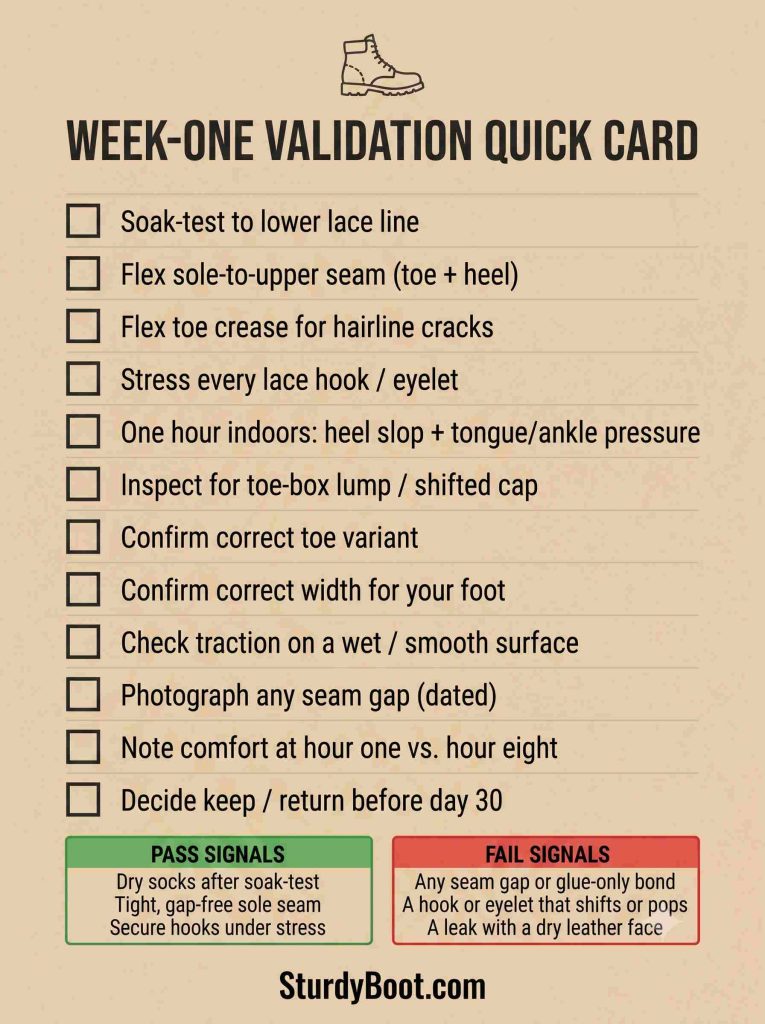
- [ ] Soak-test to lower lace line
- [ ] Flex sole-to-upper seam (toe + heel)
- [ ] Flex toe crease for hairline cracks
- [ ] Stress every lace hook/eyelet
- [ ] One hour indoors: heel slop + tongue/ankle pressure
- [ ] Inspect for toe-box lump / shifted cap
- [ ] Confirm correct toe variant
- [ ] Confirm correct width for your foot
- [ ] Check traction feel on a wet/smooth surface
- [ ] Photograph any seam gap (dated)
- [ ] Note comfort at hour one vs. hour eight
- [ ] Decide keep/return before day 30
Pass signals: dry socks after soak-test · tight, gap-free sole seam · secure hooks under stress. Fail signals: any seam gap or glue-only bond · a hook or eyelet that shifts/pops · a leak with a dry leather face.
Best overall pick to validate first: Carhartt Rugged Flex Waterproof.
Go Deeper (Optional): For the full framework on membranes, soles, toe types, and return-window protocol, our complete waterproof work boot buyer’s guide covers everything this ranking intentionally leaves out.
FAQ
What are the best waterproof work boots in 2026?
The Carhartt Rugged Flex is our best all-around pick for light-to-medium trades, with the Wolverine Overpass best for lightweight comfort and the Timberland PRO Boondock best for protection. Each earns its place on consistent owner-reported patterns rather than marketing, and the right one for you depends heavily on your trade intensity and foot width.
Why do so many waterproof work boots fail at the sole first?
The most common failure across this category is the sole separating from the upper, not the leather wearing out. Many of these boots use glued or bonded soles where visible stitching is cosmetic, so the bond can let go at the seam — and because that often happens months in, a sudden leak is usually the first visible sign the sole is delaminating.
Which waterproof work boots last the longest?
No boot here is a guaranteed multi-year performer under heavy abuse; longevity tracks trade intensity more than brand. Lighter-duty and walking-heavy owners report multi-year satisfaction from the Carhartt, Irish Setter, and KEEN models, while heavy-abuse trades report early breakdown from the same boots — so matching the boot to your workload is what actually determines lifespan.
Are these waterproof work boots good for wide feet?
The Irish Setter Wingshooter ST and KEEN Pittsburgh are the standout wide/large-foot picks, with the CAT Threshold also fitting standard-to-wide feet. Avoid the Wolverine Overpass and Floorhand for genuinely wide feet — their “wide” and “extra-wide” options repeatedly read narrow in owner feedback.
Which are the best waterproof work boots for women?
The CAT Women’s Echo is the top women’s pick for narrow-to-standard feet, built on a true women’s last, with the Timberland Direct Attach a solid choice if you size up a half. Both run narrow, so genuinely wide feet should look elsewhere, and both benefit from an early soak-test given a minority waterproofing risk.
Do waterproof work boots stay waterproof over time?
Usually only as long as the sole bond and flex points stay intact. Owners across these boots report waterproofing that’s reliable when new but degrades over months — and it typically fails at the sole seam or a toe-crease crack rather than through the leather, so protecting waterproofing really means watching for early sole separation.
Are steel-toe or composite-toe waterproof boots better?
Neither is universally better; it depends on your needs. Composite toes (like the Wolverine Overpass and KEEN Cincinnati) are lighter and metal-detector safe, while steel toes (like the CAT Threshold and KEEN Pittsburgh) are reported to stay cooler in heat but add weight — the protection standard both aim to meet is the same one OSHA references.
How should I test new work boots before the return window closes?
Treat the first 30 days as an active stress test, not a grace period. Soak-test the waterproofing, flex the sole-to-upper seam and toe crease hard, and stress every lace hook — because these boots’ failures repeatedly cluster just after returns close, provoking them early is the difference between an easy exchange and a ruined boot.
Can I repair a work boot whose sole is separating?
For minor early separation caught inside the return window, exchanging the boot is far better than repairing it. A flexible shoe adhesive can buy short-term time if caught very early, but anything structural belongs with a cobbler — and you should never field-repair a compromised safety boot before checking your employer’s PPE hazard assessment. This is general guidance, not a substitute for a qualified repair opinion.
Final Verdict & Quick Links
- Best overall: Carhartt Rugged Flex Waterproof — the safest comfort-per-dollar bet for light-to-medium trades.
- Best value: CAT Threshold Waterproof Steel Toe — surprising comfort at its price, if you accept weaker traction and hardware.
- Best for wide feet: Irish Setter Wingshooter ST — genuine 4E room with a metal-detector-safe toe.
Whichever you choose, the winning move in this category is the same: match the boot to your trade intensity and foot width, then stress-test hard inside your first 30 days. Check the current price on Amazon for the Carhartt Rugged Flex Waterproof.