


Last updated: July 2026
- Re-read the full run of owner feedback from mid-2025 through mid-2026 to confirm the split is still current-production, not an old batch.
- Re-checked the failure-timing pattern: the most damaging complaints (sole separation, stitching, lace hardware) still cluster after the 30-day return window closes.
- Verified that the “out-of-the-box comfort” praise and the “fell apart in months” durability complaints are coming from the same production run, not two different eras of the boot.
Affiliate disclosure: SturdyBoot.com is reader-supported. If you buy through links on this page, we may earn a small Amazon commission at no extra cost to you. It never changes what we report — the analysis below is driven entirely by owner feedback.
The Brunt Marin creates a very specific kind of buyer confusion
You buy a work boot expecting one honest trade-off: pay more, get more life out of it. The Brunt Marin scrambles that expectation. Half the people who own it will tell you it’s the most comfortable boot they’ve ever laced up straight out of the box — no break-in, feet fine after a 16-hour concrete shift. The other half will tell you the sole peeled, the stitching unraveled, or a lace hook popped off within a few months, and that Brunt’s own support offered them 15% off another pair as a consolation. Same boot. Same size. Wildly different verdicts.
So, is the Brunt Marin worth it? For light-to-moderate duty and out-of-box comfort, often yes; for heavy daily trade abuse where you need multi-year durability, frequently no. That single sentence is the whole review in miniature, and the rest of this page unpacks exactly which side of that line your job and your feet fall on.
This isn’t a spec-sheet regurgitation. It’s a synthesis of real owner experience — hundreds of jobsite hours, blisters, wins, and regrets — organized so you can find yourself in it. For a broader safety-first overview before you commit, the Work Boots 101 primer ties boot features to the actual hazards you face on the job.
How this review was built (so you can trust it)
- Reviews analyzed: I went through a sample of roughly 120 distinct owner reviews for the Brunt Marin, weighted toward those with real written detail rather than one-word ratings. For listing context, the product carries a large volume of ratings overall — but I only analyzed the individual written reviews I could actually read, and I’d rather under-count than inflate.
- Time window: Feedback spans roughly mid-2025 through mid-2026, which reflects current production. That matters here, because several long-term owners are explicitly grading this pair against older or discontinued boots and against rivals like Thorogood and Danner.
- Method: I tagged every review into buckets — out-of-box comfort, sizing and width, break-in and heel behavior, sole and construction durability, lace hardware, warranty and support, and country-of-origin — then separated “use or fit-driven issues” (wrong width, wrong trade, wrong expectations) from “likely product or design issues” (sole separation, stitching failure, hardware popping).
Important limitations:
- Reviews skew toward extremes — the delighted and the burned write more than the merely satisfied.
- Wear intensity varies enormously: a warehouse worker and a concrete finisher are stress-testing completely different boots.
- I prioritized patterns that recur across many owners over dramatic one-off lemons.
If you want the wider category context, the Work Boots 101 primer is a solid companion read to this single-product deep dive.
Quick Verdict (TL;DR)
Best for:
- Light-to-moderate duty: warehouse, delivery, plant maintenance, light construction, DIY.
- Buyers who prioritize immediate comfort and low weight over years of service.
- Wide and standard feet who can exploit the removable-insole width trick.
Not for:
- Heavy trades with abrasion and sparks (concrete finishing, steel mills, roofing on rough decks).
- Buyers expecting a multi-year boot at this price tier.
- Narrow feet without lacing adjustments — heel slop is a recurring complaint.
Standout win:
- Genuine out-of-the-box comfort and light weight that owners repeatedly rank above heavier steel-toe rivals.
Watch-outs:
- Durability is polarized: sole separation, stitching, and lace hardware failures cluster right after the return window closes.
Confidence Score: 7/10 🧭 — This is buyer-usefulness, not a reliability stat. The comfort signal is remarkably consistent, and the durability split is so clean that I can tell you who this boot fits with real confidence. I held it back from a higher number only because the durability outcomes are genuinely polarized and use-intensity-dependent, which raises the odds of a mismatch if you buy blind.
What This Boot Is (and What It Isn’t)
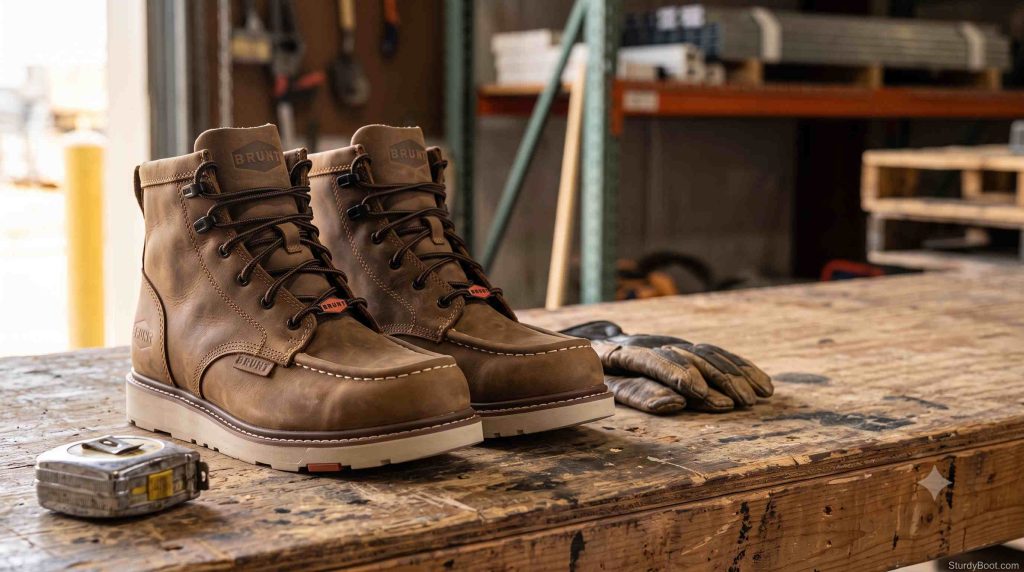
The Brunt Marin is a 6-inch, lightweight wedge-sole work boot with a composite safety toe, marketed as out-of-box comfortable and slip- and oil-resistant. In plain terms: it’s a soft, light, comfort-first boot with a flat wedge outsole — not a heavy-duty, welted, decades-of-service tank.
Three misconceptions worth clearing up:
- “It’s a heavy-duty boot because it has a safety toe.” Owners in abrasive trades repeatedly report it wearing through faster than they’d expect. The safety toe protects against impact; it doesn’t make the boot bombproof.
- “Made in USA.” A recurring and pointed owner complaint is that pairs arrived marked as made overseas despite the brand’s American-made image. If domestic manufacturing is a dealbreaker for you, verify the tag on arrival.
- “Comfortable means durable.” These are two separate axes here. The Marin scores high on one and splits hard on the other.
Key Specs That Actually Matter
- Composite (comp) safety toe: Lighter and non-conductive versus steel. Owners consistently credit the light toe for the all-day comfort. For where toe protection is legally required, employers work from OSHA’s foot protection standard, 29 CFR 1910.136, which points to protective footwear meeting recognized consensus standards.
- Wedge outsole: Flat, comfortable on hard flat surfaces like warehouse concrete; less aggressive on loose or uneven terrain — one owner specifically wished for more aggressive tread. To understand why this changes your footing, our breakdown of work boot outsoles explains where wedges win and where lugged soles pull ahead.
- Adjustable width system (removable insole): The single most useful spec here. Wide-footed owners pull an insole to open the boot up; without it, some report it feels flat.
- Lightweight, thin leather upper: The reason it’s comfortable and the reason abrasive trades wear through the toe. It’s a trade-off baked into the design.
- Lace hardware (hooks/rivets/loops): A repeat failure point — worth its own attention below.
The general toe-cap performance framework these boots operate under is defined by the ASTM F2413 footwear standard; the safety rating tells you about impact protection, not longevity.
Sizing & Fit — What Owners Actually Report
Bottom line: the Marin tends to run large, and width behavior is the whole story. More owners report “runs big” than “runs small,” and several went down a half size — one wore an 11 in sneakers and only found a workable fit at a 9.5.
- Width: The removable-insole “adjustable width” system genuinely works for wide feet — pull the top insole and the boot opens up. Extra-wide owners are more split; a couple still felt their foot hung over the sole edge.
- Half-size guidance: If you’re between sizes or ordering from your sneaker size, size down rather than up. Owners who sized up ended up shimming the extra room with inserts and still fought heel movement.
- Who it fits: Standard and wide feet who use the insole trick tend to be the happiest. Narrow feet are the ones reporting heel slop and rubbing — and heel rub is the top comfort complaint even among people who like the boot.
If dialing in fit is your worry, our work boot fit & sizing guide walks through the heel-lock lacing and foot-shape checks that head off exactly the slop owners describe here.
Feature-by-Feature Breakdown (Truth vs Marketing)
| Feature | What the Marketing Implies | What It Actually Means (Owner Experience) | Compared to Competitors |
|---|---|---|---|
| Out-of-box comfort | No painful break-in | Largely true — a genuine strength most owners confirm | Beats heavier steel-toe rivals on day-one comfort |
| Lightweight build | Less fatigue | Confirmed; light weight is a repeated selling point | Lighter than typical logger/heavy-duty boots |
| Durability | Built for work | Polarized — great for some, sole/stitch/hardware failures for others | Owners often rate Thorogood/Danner higher for longevity |
| Adjustable width | Fits many feet | Works well for wide feet via insole removal; less so for narrow | More flexible than fixed-width rivals |
| Wedge traction | Slip + oil resistant | Fine on flat hard floors; underwhelming tread for rough terrain | Less aggressive than lugged work outsoles |
| Comp safety toe | Protection | Delivers light impact protection without the steel weight | Comparable protection, lighter feel than steel toe |
Comparisons above are qualitative and drawn from what owners themselves said when they name-checked other brands.
Real-World Owner Experience (Deep Pattern Analysis)
The re-buyer paradox is the single loudest signal (and what most reviews won’t tell you)
In a nutshell: The most distinctive thing about the Marin isn’t that people love it or hate it — it’s that the loyalists and the burned are describing the exact same boot, and both are right. You’ll find owners who wear it daily to work, the garage, and the barn, who’ve talked coworkers into buying it, sitting right next to owners who swore off the brand entirely after a seam let go.
Hidden strength: When the Marin fits your use case, the loyalty is unusually strong — repeat buyers, gift-givers, “most comfortable boot I’ve ever owned.” That’s a real endorsement, not marketing.
Hidden weakness: The paradox exists because comfort and durability are decoupled. People buy on comfort, get hooked, and only discover the durability ceiling months later — often past the point of return.
What to do about it: Decide before you buy whether you’re a comfort buyer or a durability buyer. If you genuinely need years of hard service, the paradox is warning you. If you want comfort now and can accept a roughly year-ish lifespan under moderate use, you’re the happy owner.
The return-window trap — failure timing that actually matters
In a nutshell: The most damaging failures owners report — sole separating from the upper, stitching unraveling, lace hooks and rivets popping — tend to show up after the standard 30-day return window closes, often in the 3-to-7 month range. Some owners explicitly noted problems surfacing right after they’d lost the ability to send them back.
Hidden strength: Because the boot is comfortable and light on day one, the first month is genuinely pleasant — which is precisely why the trap catches people.
Hidden weakness: By the time the structural issues appear, you’re negotiating with brand support rather than clicking “return,” and multiple owners report being offered only a discount toward another pair.
What to do about it: Treat the return window as an active testing period, not a grace period (see the Return-Window Reality Check below). Stress the boot hard in the first weeks.
The use-case threshold: where happy owners and angry owners divide
In a nutshell: There’s a clean dividing line. Warehouse workers, plant maintenance, delivery drivers, light construction, and DIY users skew strongly positive on both comfort and durability. Concrete finishers, steel-mill-adjacent work, and abrasive trades report the toe wearing through and soles giving out in months.
Hidden strength: For the moderate-duty majority, the boot over-delivers on comfort for the weight.
Hidden weakness: The thin, light leather that makes it comfortable is the same material that surrenders under abrasion.
What to do about it: Match honestly. If your boots are a consumable tool on rough surfaces, this isn’t your boot. Our work boots by job type guide maps trades to the construction that survives them.
Lace hardware is a repeat-defect pattern, not bad luck
In a nutshell: Popped rivets, snapped lace hooks, and top loops breaking off show up across multiple owners, frequently at the same location — the upper lace hardware near the tongue. When the same part fails in the same spot across different buyers, that points to a design or materials consistency issue rather than random defects.
Hidden strength: Owners note the lacing locks well when it’s intact — several said they don’t even need to knot the laces.
Hidden weakness: The hardware is the weak link, and it can fail within the first month or two.
What to do about it: Inspect the top hooks and rivets early and often. If one loosens in the first weeks, that’s your return-window signal.
Heel and seam rub is the top comfort complaint — even from fans
In a nutshell: Even inside the comfort camp, the recurring caveat is the heel and a mid-ankle seam. Owners describe stiff heel counters that rub, blisters in the first days, and an interior seam that irritates the ankle. Some break through it; some never do.
Hidden strength: For most owners the sole underfoot is genuinely comfortable from day one.
Hidden weakness: The heel/seam area is the exception to the “no break-in” promise.
What to do about it: Heel-lock lacing and a broken-in sock rotation help; the work boot fit & sizing guide covers the lacing pattern. If a seam is physically abrading skin, that’s a defect, not a break-in issue.
The Good, The Bad & The Ugly
The Good (comfort & fit):
- Genuine out-of-box comfort with minimal break-in for most owners.
- Notably lightweight versus heavier steel-toe rivals.
- The removable-insole width system is a real, usable feature for wide feet.
- Strong repeat-buyer loyalty when the use case matches.
The Bad (durability caveats):
- Thin, light leather wears through fast in abrasive trades.
- Heel counter and a mid-ankle seam cause rub and blisters for a subset of owners.
- Wedge tread underwhelms on rough or loose terrain.
The Ugly (trust & support friction):
- Sole separation and stitching failures clustering after the return window.
- Lace hardware failing in the same spot across multiple owners.
- “Made in USA” expectation versus overseas manufacturing marks on some pairs, plus support that reportedly offers only a discount toward a replacement.
Mini Toolkit: Decide + Fix (Fast)
Issue tags to watch: #sole-separation #lace-hook-snap #heel-rub #seam-irritation #runs-big #toe-wear-through
Fit Mini-Matrix:
| Foot type | Verdict |
|---|---|
| Narrow | Risky — heel slop and rub reported; needs heel-lock lacing |
| Standard | Best fit — size down a half if between sizes |
| Wide | Good — pull the top insole to open the width |
Mini Decision Tree:
- If your job is abrasive (concrete, sparks, rough decks) → skip it, choose a heavier boot.
- If you need multi-year durability → skip it.
- If you want out-of-box comfort for moderate duty → strong candidate.
- If you have wide feet → good, use the insole width trick.
- If you have narrow feet → only with corrective heel-lock lacing.
Troubleshooting Quickflow (heel rub):
- Confirm size isn’t too big (the most common cause here) → size down if floating.
- Apply heel-lock lacing through the top eyelets.
- Add a thicker sock or heel-grip pad.
- Wear in short sessions the first week.
- If a hard seam is physically abrading skin, stop — that’s a defect.
- Flag it inside the return window rather than pushing through.
Mini Return-Window Reality Check
Because the worst failures show up after 30 days, use the window as a stress test:
- Stress the lace hardware: Lace tight and flex hard daily; owners report top hooks and rivets popping early — catch it now.
- Check the toe and sole bond: If you’re in an abrasive trade, put real wear on the toe in the first weeks; toe wear-through is a known pattern.
- Inspect stitching at the seams: Look at the mid-ankle seam and heel; run your hand for hard spots that rub.
- Verify the country-of-origin tag: If made-in-USA matters to you, confirm it before the window closes.
- Wear them a full shift, not just around the house: Comfort at 5 feet isn’t comfort at hour 12.
For a full pre-purchase checklist across the category, our complete work boot troubleshooting guide goes deeper than any single review can.
Sizing & Insider Tips (Realistic)
- Size down a half if you’re ordering from your sneaker size — “runs big” dominates the feedback.
- Wide feet: remove the top insole to open the width before assuming it doesn’t fit.
- Narrow feet: use heel-lock (runner’s loop) lacing through the top eyelets to kill heel slop.
- Don’t power through a seam that’s abrading skin — that’s a defect, not break-in.
- Break them in over several short sessions before a full shift; heel blisters are most common in days one to four.
- If you do concrete or abrasive work, monitor the toe box weekly for wear-through.
- Watch the top lace hooks/rivets in the first month; early looseness predicts failure.
- Keep the box and packaging until you’ve worn them a full week — the return window is your real warranty.
- If the outsole bond looks like it’s opening at the toe, stop wearing them and document it immediately.
- For anything beyond basic care — resoling, replacing hardware, or a slip-hazard concern — consult a qualified cobbler or repair shop, and verify the boot against your employer’s PPE hazard assessment rather than assuming it qualifies.
Owner Stories
The stories below are composite scenarios reflecting repeated patterns across owner feedback.
- The happy re-buyer: A warehouse worker with flat feet laces them up for a 12-hour concrete shift and, for the first time, goes home without aching legs. Months in they still look new. He talks two coworkers into a pair. For his moderate, flat-surface duty, the Marin is exactly right.
- The wrong-job mismatch: A concrete finisher treats boots as a consumable tool. He loves the day-one comfort, but three weeks of crawling and abrasion wear both toes through. The thin leather that felt great is the same leather that failed. He goes back to a heavier, pricier boot — correctly.
- The wrong-width returner: A buyer orders his usual sneaker size, feels his foot floating, cinches the laces until they cut off circulation at the ankle, and fights it for months before giving up. Had he sized down a half and used the width insole, he’d likely have been in the happy camp.
SEE MORE OWNER FEEDBACK ON AMAZON
Who This Is For (and Who Should Skip It)
Buy it if…
- You do light-to-moderate duty on mostly flat surfaces (warehouse, plant, delivery, DIY).
- You value out-of-box comfort and low weight above maximum lifespan.
- You have wide or standard feet.
- You’re willing to treat the first 30 days as an active stress test.
Skip it if…
- You work abrasive, spark-heavy, or rough-terrain trades.
- You expect a multi-year boot at this price.
- You have narrow feet and won’t adjust your lacing.
- Made-in-USA manufacturing is non-negotiable for you.
If you’re comparing options, start here: Top Work Boot Picks.
Alternatives (Quick Comparisons)
- Need proven long-haul durability? Owners who left the Marin frequently named Thorogood as their return-to boot — a heavier, longevity-first choice.
- Want lightweight without the durability gamble? Browse our roundup of the best lightweight work boots for options that keep the low weight.
- Working in the wet or cold? The Marin’s comfort doesn’t carry into harsh climates for everyone; see the best waterproof work boots and best winter work boots guides.
- Want the safest all-around shortlist? The most comfortable work boots roundup pits the Marin’s day-one comfort against boots that hold that comfort longer.
Deep-Dive FAQ
What should I test immediately after delivery?
Stress the lace hardware and check the toe-to-sole bond in the first days. The worst failures owners report — popped hooks, sole separation, seam issues — often appear after the return window, so treat those 30 days as a hard stress test, not a grace period. Also confirm the origin tag if made-in-USA matters to you.
What are the most common problems and fixes?
The big three are heel/seam rub, lace hardware failure, and sole or toe durability. Heel rub is usually a too-big fit — size down and use heel-lock lacing. Hardware failure and sole separation aren’t fixable at home; if they appear early, use the return window, and for later structural failures consult a cobbler rather than field-repairing a safety boot.
Will these work with my foot type and my job?
For standard and wide feet doing moderate-duty work, very likely yes. For narrow feet, only with lacing adjustments, and for abrasive heavy trades, probably not. The clean pattern is that flat-surface, moderate-duty owners are happy and abrasive-trade owners are not.
How long do they really last?
It depends heavily on use intensity, so a single number would mislead. Moderate-duty owners commonly report solid service with the boots still looking new after several months, while heavy-abrasion users report toe wear-through or sole issues within a few months. Comfort is immediate; longevity is conditional.
Do they run true to size?
Not for most — the recurring report is that they run big. If you’re ordering from your sneaker size or you’re between sizes, go down a half size. Sizing up leaves you shimming extra room and fighting heel movement.
Brunt Marin vs Thorogood — which should I pick?
If you want out-of-box comfort and light weight for moderate duty, the Marin edges it; if you want proven multi-year durability for hard daily use, Thorogood is the safer pick. Owners who abandoned the Marin most often named Thorogood as their fallback specifically for longevity — so the choice really comes down to comfort-now versus durability-over-time.
Is the comfort worth it if durability is a gamble?
For many moderate-duty owners, yes — the day-one comfort is the boot’s strongest, most consistent trait, and repeat buyers keep coming back for it. But if your job destroys boots, comfort won’t save a sole that separates, so the value math only works when your use case is gentle enough for the durability ceiling to be irrelevant.
Final Verdict
The Brunt Marin is a comfort-first, lightweight work boot that rewards the right buyer and punishes the wrong one — and the line between them is unusually clear. If you’re a warehouse, plant, delivery, light-construction, or DIY wearer with standard-to-wide feet who values immediate comfort over maximum lifespan, this is a genuinely likable boot with a loyal following. If you’re in an abrasive heavy trade, expect years of hard service, or won’t treat the return window as a stress test, the durability split and hardware failures are a real warning. Buy on comfort with clear eyes about the ceiling, test hard in the first 30 days, and you’ll likely land in the happy camp.