


Last updated: July 2026
- Re-checked the full run of owner feedback from late 2016 through mid-2026, and the same two signals still dominate: near-universal praise for weight and a persistent, well-documented squeak that shows up months in.
- Re-verified the sizing pattern across dozens of recent buyers — the “runs narrow, size up” advice holds steady into 2026 orders, not just older pairs.
- Cross-checked durability complaints against re-buyers and confirmed the paradox is real: the same people who report sole and seam failures often buy the boot again anyway.
As an Amazon Associate, we earn from qualifying purchases. If you buy through links on this page, we may earn a commission at no extra cost to you. It doesn’t change what owners actually reported, and it doesn’t change what we tell you here.
There’s a specific moment every cop, corrections officer, EMS worker, or security guard knows: hour ten of a shift, standing on concrete, and your feet feel like they’ve been through a war. The Danner Tachyon Gore-Tex 8″ gets pitched as the fix — a lightweight tactical duty boot so light it “feels like a running shoe.” And here’s the confusing part: that pitch is basically true, which is exactly why the boot is so polarizing. The same feature that wins people over is tangled up with the things that make others swear off it.
Is it worth it? Yes — if you want a featherweight, waterproof patrol boot for walking and running on flat, dry-to-wet surfaces, and no, if you need heavy-duty ankle support, cold/ice traction, or years of hard service.
I went deep into real owner feedback spanning nearly a decade of this boot — happy re-buyers, furious one-timers, and everyone in between — to figure out who this boot actually fits. For a broader safety-first overview of how features map to jobsite risks, the Work Boots 101 primer is a good companion to this review, and if you want the full category picture, the police and duty boot buyer’s walkthrough covers the trade-offs at a higher level.
How this review was built (so you can trust it)
- Sample size: I analyzed a sample of roughly 170+ verified-purchase and text reviews actually read across both a positive-filtered and a critical-filtered set. That’s a slice of the listing’s total rating pool (the listing shows a strong-majority-positive 4.4-out-of-5 pattern), not the whole thing — and I’m counting only the individual written reviews I read, not the global rating count.
- Time window: Feedback runs from roughly late 2016 through mid-2026, which matters here. This is current import production, and longtime Danner fans repeatedly compare it against older, USA-made, resoleable pairs like the Acadia and Ft. Lewis — so some of the harshest reviews are really “this isn’t my old Danner” reviews.
- Method: I tagged feedback into comfort/fit, sizing, waterproofing, sole and seam durability, lace hardware, weight, heat/breathability, noise (squeak), and traction — then separated use- and fit-driven complaints (wrong width, wrong climate, wrong trade) from likely product/design issues (the squeak, sole delamination, seam failure).
- Important limitations:
- Reviews skew toward extremes — thrilled or furious — so quiet middle-of-the-road owners are underrepresented.
- Wear intensity varies wildly: a courthouse deputy and a wastewater technician are grading two completely different tests.
- I prioritized patterns that recur across many owners over dramatic one-off lemons.
For a deeper look at how a boot’s parts actually fail in the field, the work boot problems and troubleshooting guide pairs well with what owners report below.
Quick Verdict (TL;DR)
Best for:
- Law enforcement, corrections, and security who walk or run miles on flat, paved, or indoor surfaces
- Anyone whose #1 complaint about duty boots is weight and heat
- Buyers who want real Gore-Tex waterproofing in a low-profile, sneaker-like package
Not for:
- Wide-footed owners (even the “wide” runs narrow for many)
- Cold-weather, icy, or heavy-off-road duty
- Trades hard on boots — welders, heavy industry, or anyone expecting multi-year service
Standout win:
- Astonishingly light and comfortable out of the box, with waterproofing many owners genuinely trust ankle-deep
Watch-outs:
- A recurring interior squeak that develops months in and, for many, never goes away
- Sole/seam durability that frequently gives out well before a year of hard use
Confidence Score: 8/10 🎯 — This is buyer-usefulness, not a reliability grade. I’m highly confident I can tell you who this boot fits and who it fights, because the owner signal is remarkably consistent: the comfort/weight praise is near-unanimous, and the sizing and squeak complaints are equally patterned. It’s not a 10 only because durability outcomes genuinely split by trade, so lifespan is harder to promise than fit is.
What This Boot Is (and What It Isn’t)
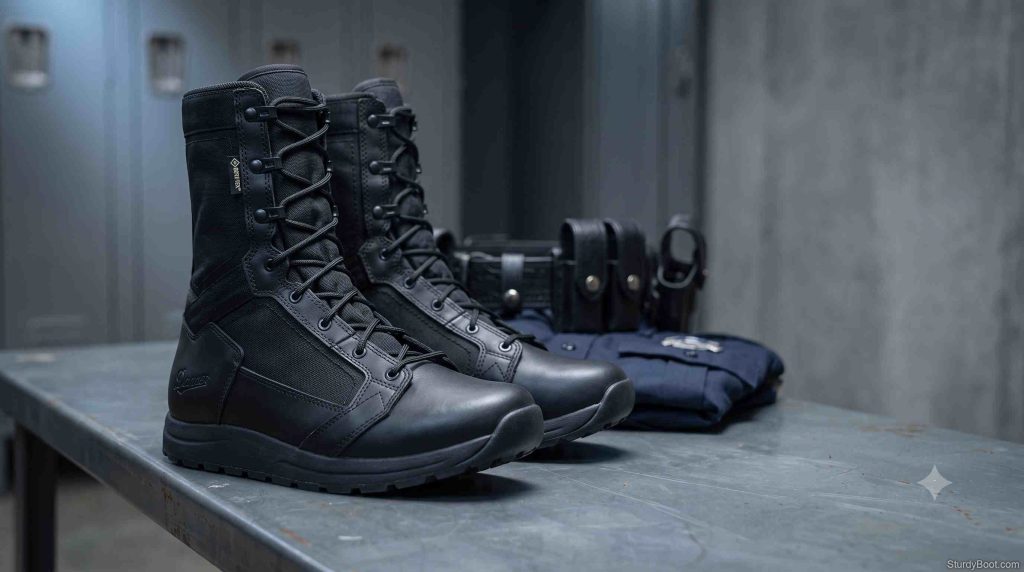
The Danner Tachyon is an 8-inch, lace-to-toe (no zipper), Gore-Tex waterproof tactical boot built on a lightweight, athletic, sneaker-like last with a nylon-and-leather upper. Think “duty boot that behaves like a running shoe” rather than “traditional stiff leather work boot.”
A few misconceptions worth clearing up:
- It’s not a heavy-duty support boot. Owners consistently describe minimal ankle structure — great for agility, not for rolling-ankle protection on rough terrain.
- It’s not an all-weather boot. Repeated feedback says it shines in warm and wet-mild conditions but struggles on ice and in cold, and can run warm inside from the waterproof membrane.
- It’s not the old made-in-USA Danner. This is an import, non-resoleable model, and longtime fans notice.
Key Specs That Actually Matter
- Weight (extremely light): This is the boot’s defining trait. Owner after owner compares it to sneakers or tennis shoes. On the job, that’s the difference between coming home exhausted and coming home fine after a 12–16 hour shift.
- Gore-Tex waterproofing: Frequently praised — many report standing ankle-deep with dry feet — but it’s not infinite. Because it’s a sealed membrane, several owners note it runs warm and sweaty in heat.
- Lace-to-toe speed lace, no zipper: Divisive. Fans love that there’s no zipper to break; others find full lacing time-consuming, and a few report eyelet/hardware issues.
- Fit/last (narrow, athletic): The single most consequential spec here. The toe box and overall last run narrow, which drives most of the returns.
- Outsole/traction: Adequate on dry pavement, but a recurring weak point on wet grass, ice, and snow.
- Sole/seam construction: The durability variable — fine for light patrol, prone to early breakdown under heavy use.
To understand why outsole compound and tread pattern make or break a duty boot, the work boot soles explainer is worth a read alongside the traction complaints below.
How Do the Danner Tachyons Fit? (What Owners Actually Report)
Direct answer: they run narrow and slightly small for many buyers — even the “wide” version is called narrow by wide-footed owners. Most people should size up a half size, and wide feet should be cautious.
The sizing signal is one of the most consistent things in the entire body of feedback. Recurring themes:
- Narrow toe box and last. This comes up again and again, from standard and wide buyers alike. Several wide-footed owners specifically warn that the wide size still isn’t wide.
- Runs small / short for many. A large share advise going a half size up; a few say a full size.
- Length can flip the other way. A minority (often those who did size up) find them slightly long — so if you’re between the “size up” advice and your true size, the toe-box width is the deciding factor, not overall length.
Fit guidance from the pattern:
- Standard/narrow feet: order true-to-size or a half up; you’re the target buyer.
- Wide feet: this is the highest-return-risk group — approach carefully, and consider that even EE may feel snug.
- Bring your own insole plan: many owners add aftermarket insoles, which eats a little interior volume, another reason not to buy tight.
For a foot-shape checklist that helps you avoid the heel-slop and toe-cramp complaints owners describe, the fit and sizing guide is the tool to use before you order.
Feature-by-Feature Breakdown (Truth vs Marketing)
| Feature | What the Marketing Implies | What It Actually Means (Owner Experience) | Compared to Competitors |
|---|---|---|---|
| Weight | Lightweight tactical performance | Genuinely sneaker-light; the #1 reason owners love it and re-buy | Consistently called lighter than Nike SFB, 5.11, and older American-made Danners |
| Gore-Tex waterproofing | Keeps you dry | Real and trusted by most for puddles and standing water; runs warm/sweaty in heat | Owners say drier than many rivals but hotter than non-membrane boots |
| Slip resistance | Slip-resistant outsole | Fine on dry pavement; a repeated weak point on wet grass, ice, snow | Owners rate traction below expectations; some prefer other soles |
| Ankle support | Tactical support | Minimal, athletic — great for agility, poor for rough terrain or rolling risk | Weaker than traditional stiff duty boots by design |
| Lace-to-toe / no zipper | Secure, fast | No zipper to fail (a plus); full lacing is slower; occasional eyelet issues | Preferred by anti-zipper buyers; slower than side-zip rivals |
| Durability | Built to last | Splits hard by use case — light patrol fine, heavy trades fail early | Owners say shorter-lived than premium duty boots at higher price points |
Real-World Owner Experience (Deep Pattern Analysis)
1. The Squeak — the thing owners obsess over most (and what most reviews won’t tell you)
If there is one pattern that defines this boot’s long-term reputation, it’s the squeak. Across the feedback I analyzed, a strikingly large number of owners report that after a few months of break-in, the boot develops a persistent internal squeak — described as coming from inside the footbed, audible on hard floors and carpet, and often impossible to eliminate. This Danner Tachyon squeak issue is the single most-repeated long-term complaint in the feedback.
In a nutshell: Love the boot, then it starts squeaking with every step, and for a duty officer that’s not cosmetic — it’s a tactical and professional problem.
Hidden strength: For a subset of owners the squeak eventually fades after about a year, and a few resolve early webbing/rub issues with a heat gun.
Hidden weakness — the failure-timing insight: The squeak tends to arrive right around or after the return window has closed — commonly cited at roughly 6–8 months — so buyers can’t catch it during the trial period. It also frequently appears in one boot first, then the other weeks later, which is a repeat-defect signature, not bad luck. One owner even reported multiple officers in the same department all developing the squeak on the same model.
What to do about it: Wear them hard indoors and on hard flooring within your return window specifically to try to provoke the squeak early. If it starts and you’re past returns, treatments owners try (footbed swaps, powders) are hit-or-miss; for anything structural, consult a qualified repair rather than pulling the boot apart yourself.
2. Featherweight comfort — the reason people forgive everything else
In a nutshell: The most consistent praise across all the owner feedback. Owners repeatedly say it’s the lightest, most sneaker-like duty boot they’ve worn, often with little to no break-in.
Hidden strength: For high-mileage patrol and security — people logging 12–16 miles a shift — this genuinely reduces end-of-day fatigue, and several call it the best boot they’ve ever owned for foot pursuits.
Hidden weakness: That lightness comes from thin construction and a firm/flat sole. On long standing shifts (corrections, courthouse concrete), a repeated complaint is that the insole compresses and it starts to feel like standing on a board.
What to do about it: Plan on aftermarket insoles from day one if you stand more than you walk — many satisfied owners specifically pair these with SuperFeet or similar.
3. The Re-Buyer Paradox — the truest verdict in the data
In a nutshell: This is the most revealing signal about the boot. Many owners who openly complain — about the squeak, the sole wear, the durability — still buy the boot again. Multiple people report being on their 2nd, 3rd, or even 4th pair.
Hidden strength: That paradox tells you the comfort/weight advantage is so strong that experienced duty users accept the boot as a consumable — replace it periodically rather than expect it to last.
Hidden weakness: It also confirms the durability ceiling is real. People aren’t re-buying because the boot lasts; they’re re-buying because nothing else feels this good and they’ve made peace with replacing it.
What to do about it: Budget for it. If you love the fit, treat this as a boot you’ll cycle every year or so under real duty use, not a multi-year investment.
4. Durability splits by trade — the use-case threshold
In a nutshell: The clearest dividing line between happy and unhappy owners is how hard they are on boots. Danner Tachyon durability splits sharply by trade: light-duty patrol, courthouse, security, EMS, detective work → often years of satisfaction. Wastewater, heavy industry, rough off-road, spark/abrasion environments → early failure, sometimes in weeks.
Hidden strength: For the target trades, several owners report 1–2 years of solid service and treat that as fully acceptable for the price and weight.
Hidden weakness — the failure sequence: When it does fail hard, owners describe a repeatable order: seams start letting go, then the sole begins delaminating from the toe/heel, sometimes with waterproofing loss trailing behind. A telling case: one owner had seams failing within two weeks under heavy daily wear, with sole delamination close behind.
What to do about it: Match the boot to the job. If you’re in a heavy trade, this is the wrong tool — start with the work boots by job type guide to find a boot built for your hazards.
5. Traction and cold — the situational blind spot
In a nutshell: Repeatedly flagged: not great on ice, snow, or wet grass, and not warm in cold climates.
Hidden strength: Excellent in warm, dry, and mild-wet conditions — where most of the happy urban/paved-duty owners operate.
Hidden weakness: Rural, cold-climate, and winter-patrol officers are among the most disappointed; a few report actual slips on ice or wet concrete.
What to do about it: If you patrol snow and ice, keep a dedicated winter pair — several owners do exactly that. The winter work boots roundup is the better starting point for that use case.
6. Heat, breathability, and shine — the everyday annoyances
In a nutshell: The Gore-Tex membrane that keeps water out also traps heat for many, leading to sweaty feet in summer; and the leather is widely called hard to keep shined.
Hidden strength: Some owners in mild climates report the opposite — breathable and not too hot.
Hidden weakness: In hot regions (Texas summers get named repeatedly), the heat and sweat complaint is common, and the dull-fast finish frustrates uniform-code officers.
What to do about it: Thinner moisture-wicking socks help with heat; for shine, owners report needing a heavy base coat to fill the pores. Neither is a dealbreaker if you know it going in.
The Good, The Bad & The Ugly
The Good (comfort & weight)
- Sneaker-light; frequently called the most comfortable duty boot owners have worn
- Little to no break-in for most
- Gore-Tex waterproofing most owners genuinely trust for puddles and standing water
- No zipper to fail; strong loyalty and repeat purchases
The Bad (fit & situational limits)
- Runs narrow and often small; wide feet struggle even in “wide”
- Weak on ice, snow, and wet grass; runs warm in heat
- Minimal ankle support; hard/flat sole for long standing shifts
- Leather is hard to keep shined
The Ugly (durability & the squeak)
- The recurring, often-permanent squeak that develops after the return window
- Seam and sole delamination under heavy use, sometimes shockingly early
- A price tier that stings when the boot is treated as a consumable
Mini Toolkit: Decide + Fix (Fast)
Issue-Tag Box #footbed-squeak · #runs-narrow · #sole-delam · #weak-ice-traction · #runs-hot · #minimal-ankle-support
Fit Mini-Matrix
| Foot type | Verdict |
|---|---|
| Narrow | Best match — true-to-size or half up |
| Standard | Good — size up a half, mind the toe box |
| Wide | High return risk — even “wide” reads narrow |
Mini Decision Tree
- If you walk/run miles on flat pavement or indoors → strong fit.
- If you stand all day on concrete → buy it, but add a real insole.
- If you patrol ice, snow, or rough terrain → skip it, get a winter/support boot.
- If you’re hard on boots (heavy trades) → wrong tool, look elsewhere.
- If you have wide feet → try in person or be ready to return.
Troubleshooting Quickflow (squeak)
- Provoke it early — wear hard indoors within the return window.
- If it squeaks and you can return → return.
- If past returns → try a footbed swap/powder.
- Reassess at ~12 months (some squeaks fade).
- If it persists and bothers duty use → cycle to a new pair.
- For structural noise, consult a qualified repair.
For the full diagnostic version of these fixes, the police and duty boot buyer’s walkthrough goes broader than this mini toolkit.
Mini Return-Window Reality Check
Run these before your ~30-day window closes:
- Squeak test: Wear them hard on hard floors and carpet daily — the squeak often needs a break-in to surface, so don’t baby them.
- Width/toe-box test: Wear thicker socks and stand a full shift; the narrow toe box shows up under real conditions, not a quick try-on.
- Waterproof soak test: Deliberately walk through a puddle ankle-deep and check for interior wetness or a warm, clammy membrane feel.
- Seam/hardware check: Inspect the top eyelets and toe/heel seams; a couple owners had eyelets separating within months.
- Long-shift comfort: Do a real 10+ hour day on your actual surface before deciding — the flat-sole fatigue only appears with time.
Sizing & Insider Tips (Realistic)
- Size up a half if you’re narrow-to-standard; more owners regret going true-to-size than regret sizing up.
- Wide feet: buy where you can return — even EE reads narrow to many.
- Add insoles proactively if you stand more than you walk; the stock footbed is thin and compresses.
- Wear thin/wicking socks to fight the membrane heat, especially in summer climates.
- Provoke the squeak early inside your return window rather than discovering it in month six.
- Keep a winter backup if you work ice and snow — traction is the situational weak point.
- Don’t expect a lasting shine; use a heavy base coat and accept the finish dulls fast.
- Treat it as a consumable for heavy duty use — plan your budget around cycling pairs, not one forever-boot.
- For anything beyond basic care — resoling (not really possible here), hardware replacement, or slip-hazard concerns — consult a cobbler or qualified repair, or verify against your employer’s PPE hazard assessment.
Owner Stories
The stories below are composite scenarios reflecting repeated patterns across owner feedback.
- The happy re-buyer (urban patrol): A deputy on courthouse concrete and paved patrol logs long shifts and swears these are the lightest, comfiest boots they’ve owned — already on a second or third pair, insoles added, fully aware the sole won’t last forever and fine with it.
- The wrong-job mismatch (heavy trade): A wastewater or heavy-industry worker buys the “waterproof work boot” framing, and the boot fails fast — tread gone, waterproofing compromised, done in weeks — because it was never built for that abuse.
- The wrong-width returner: A wide-footed buyer orders the wide size on faith, finds the toe box still pinches, tries a half size up, ends up too long, and returns the boot entirely — a fit story, not a quality story.
SEE MORE OWNER FEEDBACK ON AMAZON
Who This Is For (and Who Should Skip It)
Buy it if…
- You’re in law enforcement, corrections, security, or EMS on flat/paved/indoor surfaces
- Weight and heat are your biggest complaints about current duty boots
- You have narrow-to-standard feet
- You want real waterproofing in a sneaker-light package
- You’ll happily cycle boots yearly for that comfort
Skip it if…
- You have wide feet and can’t easily return
- You patrol ice, snow, or rough off-road terrain
- You’re hard on boots or in a heavy trade
- You need strong ankle support
- You expect multi-year service from a single pair
If you’re comparing options, start here: Top Police & Duty Boot Picks
Alternatives (Quick Comparisons)
- Need cold-weather and ice grip? These aren’t it — begin with the best winter work boots.
- Want the lightest possible feel across brands? The Tachyon is already near the top, but the lightweight work boots roundup shows how it stacks up.
- Wide feet or heavier-duty needs? Broaden the search with the most comfortable work boots shortlist, which spans more lasts and widths.
- Cross-shopping other duty options? The best police boots list frames the direct rivals owners keep naming.
Deep-Dive FAQ
What should I test immediately after delivery?
Test the squeak, the width, and the waterproofing — in that order. Wear them hard on hard floors to try to trigger the footbed squeak early, stand a full shift in real socks to judge the narrow toe box, and deliberately soak them ankle-deep to confirm the Gore-Tex. These are the three things owners most often discover too late.
What are the most common problems and fixes?
The big three are the developing squeak, narrow sizing, and early sole/seam wear under heavy use. Sizing is fixable by ordering a half up (and returning if wide feet don’t fit); the flat-sole fatigue is helped by aftermarket insoles; the squeak is the hardest — sometimes it fades after a year, often it doesn’t, and for many owners the practical fix is cycling to a new pair.
Will these work with my foot type and my job?
If you have narrow-to-standard feet and a walking/running-heavy duty job on flat surfaces, very likely yes. If you have wide feet, or you work ice, rough terrain, or a heavy trade, likely no. Fit and trade are the two variables that decide almost every review’s outcome.
How long do they really last?
It depends heavily on how hard you use them. Light patrol, security, and courthouse owners commonly report one to two years, with some getting multiple years; heavy-trade and rough-use owners sometimes report failure in months. There’s no single lifespan — the boot lasts as long as the job is gentle.
Are they actually waterproof?
Mostly yes. Many owners report standing ankle-deep in water with dry feet, and the Danner Tachyon waterproof Gore-Tex membrane is one of the boot’s most praised features. The caveats: the waterproof upper only goes so high, a minority report leaks after seam/eyelet failures, and the sealed membrane makes the boot run warm in heat.
Danner Tachyon vs 5.11 ATAC — which should I pick?
Pick the Tachyon if your priority is minimal weight and a sneaker-like, low-profile feel; pick a heavier tactical boot like the 5.11 if you want more structure and support. In the Danner Tachyon vs 5.11 debate, owners who switched from 5.11 and Nike SFB models overwhelmingly cite the Tachyon’s lighter, easier-on-off feel — while acknowledging they gave up some ruggedness and ankle support to get it.
Is the squeak a dealbreaker?
For some duty roles, yes. If you need to be quiet on patrol, a boot that squeaks with every step is a real problem, and it’s common enough that you should assume it might happen. If a little noise doesn’t affect your work, the comfort payoff makes it easy to forgive.
Foot protection standards like OSHA 29 CFR 1910.136 and the toe-cap performance criteria defined by ASTM F2413 exist because footwear failures on the job carry real safety consequences — worth verifying against your employer’s PPE hazard assessment before choosing any duty boot.
Final Verdict
The Danner Tachyon Gore-Tex 8″ is a specialist wearing a generalist’s label. As a featherweight, waterproof patrol boot for narrow-to-standard feet on flat, paved, and indoor surfaces, it earns the loyalty that keeps owners buying their third and fourth pairs — the comfort is that good. As a heavy-duty, all-weather, buy-it-once work boot, it disappoints, and the squeak plus the early durability failures are real, recurring, and clustered just past the point where you can return it.
Buy it if you’re the target buyer and you treat it as a comfortable consumable. Skip it if you have wide feet, work cold and rough environments, or need one boot to last years.