

Work Boot Anatomy: Construction Methods & Materials Explained
Last Updated: February 2026 | Reviewed by SturdyBoot Editorial Team
Every year, tens of thousands of preventable workplace foot injuries send workers to emergency rooms, result in lost wages, and derail careers. According to the Bureau of Labor Statistics, foot injuries account for over 50,000 lost-workday cases annually. The difference between adequate protection and superior protection often comes down to understanding what’s beneath the surface of your work boots—the construction methods, materials, and engineering decisions that determine whether your footwear truly protects or merely looks the part.
Work boots serve a dual purpose that’s easy to overlook: they’re both Personal Protective Equipment (PPE) and productivity tools. The wrong boot slows you down, fatigues your body, and puts you at risk. The right boot becomes an extension of your capabilities—supporting your arches through 12-hour shifts, protecting your toes from falling steel, and lasting years instead of months.
This guide takes you from the factory floor to your feet, revealing how boot construction choices directly impact your safety, comfort, and long-term value.
What This Guide Covers:
- Six major construction methods and which jobs they suit best
- Material science behind uppers, midsoles, and outsoles
- 2024-2026 safety standard updates (ASTM F2413-24) every buyer must know
- Emerging technologies reshaping the industry (nano composites, BOA systems, smart boots)
- A practical cost-per-wear framework most guides ignore
Reader Promise: By the end, you’ll identify construction methods by sight, match boot specifications to your specific workplace hazards, and make purchasing decisions based on lifetime value rather than shelf price.
Before examining how boots are assembled, understanding what they’re made of provides essential context.
📋 Key Takeaways — Quick Summary
Don’t have time to read 5,000+ words? Here’s what matters most:
Topic The Bottom Line Best Construction for Longevity Goodyear welt — resoleable 3–5 times, can last decades with care Best for Immediate Comfort Cement/Direct injection — no break-in, lighter weight, lower cost Steel vs. Composite Toe Same ASTM I/75 C/75 protection; composite is lighter & non-conductive; steel is thinner 2024 Standard Update ASTM F2413-24 replaces F2413-18 — look for updated SR slip ratings True Cost Winner $350 Goodyear welt + 3 resoles = $65–90/year vs. $150 cement boots = $120/year Break-in Time Goodyear welt: 80–100 hours; Cement: minimal to none Can It Be Resoled? Goodyear welt ✓ Stitchdown ✓ Blake ✓ — Cement ✗ Direct injection ✗ Quick Decision Guide:
- 🏗️ Construction/Trades: Goodyear welt + steel/composite toe + PR plate + 90° heel
- ⚡ Electrical Work: Composite toe + EH rating + composite shank (zero metal)
- 📦 Warehouse: Lightweight cement + SR-rated wedge sole + EVA midsole
- 🔥 Welding/Foundry: Goodyear welt + metatarsal guard + 300°C+ outsole
Want the full details? Keep reading below.
Complete Work Boot Anatomy — Every Component Explained
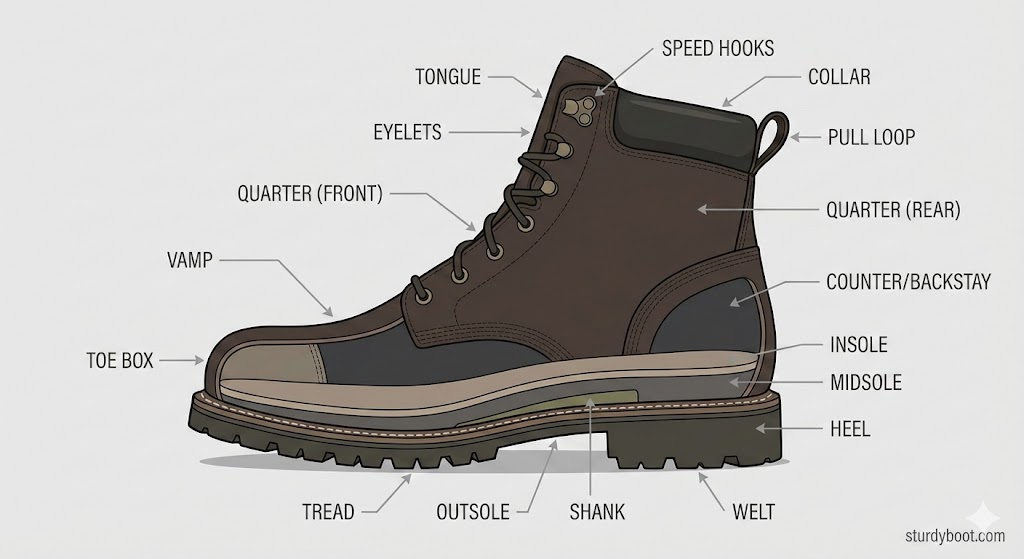
Understanding boot anatomy provides the foundation for evaluating quality and matching specifications to your needs. These terms appear throughout manufacturer specs, product reviews, and safety standards. For a deeper dive into how materials and components work together, our boot anatomy and construction materials guide offers additional technical detail.
Upper Section Components
Vamp: The front portion covering the top of the foot from toe box to tongue. This is where flexibility meets protection. Full-grain leather vamps (2–2.2mm thickness) balance durability with eventual break-in comfort. The vamp takes significant abuse—scuffs, impacts, flexion with every step.
Quarter (Front & Rear): Side panels wrapping from vamp to heel. Front quarter supports midfoot; rear quarter anchors heel counter. Oil-tanned leather quarters resist scuffs in construction environments where boots contact rough surfaces constantly.
Toe Box / Toe Cap: Houses protective toe caps (steel, composite, alloy, or nano composite). Shape determines fit comfort; material determines protection level. A cramped toe box causes blisters and long-term foot issues regardless of how good the protection is. Understanding proper fit and sizing prevents these common problems.
Counter / Backstay: The heel’s structural backbone. Thermoplastic heel counters maintain shape across thousands of steps. Critical for ladder work and uneven terrain where heel stability prevents ankle rolls.
Tongue: Standard or gusseted. Gusseted tongues stitch directly to the upper, preventing water and debris infiltration—essential for outdoor trades. A gusseted tongue means mud, sawdust, and rain stay outside the boot.
Collar: Padded rim around the ankle opening. Absorbs friction, prevents blisters during break-in. Quality collars use closed-cell foam that won’t compress flat after a few months of wear.
Eyelets, Speed Hooks & Pull Loops: Brass eyelets resist corrosion. Speed hooks accelerate lacing for workers donning/doffing frequently. Pull loops (backstay straps) ease entry without damaging heel counters.
Mid-Section Components
Insole / Footbed: The platform your foot contacts directly. Removable insoles allow orthotic customization. Anti-fatigue technology (found in various premium brands) returns energy with each step, reducing cumulative leg and back strain.
Midsole: Shock absorption headquarters. EVA (Ethylene Vinyl Acetate) delivers lightweight cushioning. PU (Polyurethane) offers density and durability. Cork midsoles in Goodyear welted boots mold to foot shape over time—a feature that makes these boots more comfortable at month six than day one.
Shank: The arch support spine—steel, composite, fiberglass, or nylon plates running heel-to-ball. Essential for ladder work, uneven terrain, and preventing arch fatigue. Steel shanks offer maximum rigidity; composite shanks satisfy metal-detector requirements at secure facilities.
Welt: The stitched strip connecting upper to sole in welted constructions. 270-degree welts wrap three-quarters around; full 360-degree welts provide complete seam sealing. The welt’s presence (or absence) determines resoling potential—arguably the most important factor in boot longevity.
Lower Section Components
Outsole: Ground contact surface. Material choice dictates slip resistance, heat tolerance, chemical resistance, and wear rate. Vibram rubber remains the premium benchmark with 75+ years of compound innovation. For a comprehensive breakdown of outsole technologies, the work boot soles explained guide covers everything from tread patterns to compound formulations.
Tread Pattern: Geometry matters more than most buyers realize:
- Directional lugs channel water on wet surfaces
- Multi-directional lugs grip unpredictable terrain
- Waffle soles (flat) suit warehouse floors
- Deep Panama soles grip soft earth on jobsites
Heel Configuration:
| Heel Type | Design | Best For |
|---|---|---|
| 90-Degree (Logger) Heel | Defined heel block with 45° angle | Soft terrain, ladder rungs, lineman applications |
| Wedge Sole | Continuous flat profile | Concrete, steel, hard surfaces, ironwork, warehouses |
Lug Depth: Deeper lugs (8mm+) grip loose surfaces but collect mud. Shallower lugs (<5mm) shed debris but sacrifice traction. Match to primary work surface.
Work Boot Construction Methods — Complete Guide

Construction method determines three things buyers consistently underestimate: how long your boots last, whether they can be rebuilt, and how they perform in specific hazard environments. Not all construction suits all jobs.
Goodyear Welt Construction
What It Is:
Named for Charles Goodyear Jr. (son of the vulcanized rubber inventor), this 230+ step process stitches a leather or synthetic welt strip to both the upper and outsole. A cork-filled cavity between insole and outsole molds to the wearer’s foot over time.
The Process:
- Upper stretched over last (boot form)
- Welt strip stitched to upper’s edge
- Cork filling applied to footbed cavity
- Outsole stitched to welt (not directly to upper)
- Heel attached, finishing applied
Pros:
- Resoleable: The defining advantage. Quality Goodyear welts accept 3–5 resoles, potentially spanning decades
- Water Resistance: Welt seam sits above ground contact; cork filling provides additional moisture barrier
- Comfort Evolution: Cork midsole compresses to foot shape, improving fit over 80–100 hours of wear
- Durability: Premium materials justify premium construction; these boots are built to last
Cons:
- Break-in Period: Expect 4–5 days to several weeks before full comfort
- Weight: Multiple layers add ounces—typically 2–3 lbs per boot
- Initial Cost: $250–$450+ price point; value emerges over ownership lifespan
- Stiffness Initially: Cork requires compression time; first week can feel rigid
Best For: Construction workers, linemen, tradespeople seeking long-term value, outdoor professionals, anyone prioritizing resoling over replacement
Brands Known For Goodyear Welt: Red Wing (Iron Ranger 8111, 875 Moc Toe, Blacksmith), Thorogood, Danner, Wolverine 1000 Mile
For Red Wing owners specifically, understanding the Red Wing warranty coverage helps maximize the value of your investment.
Cement Construction (Direct Attach)
How It Works:
Industrial adhesives bond the outsole directly to the upper—no stitching involved. Modern polyurethane adhesives create bonds that often outlast the outsole material itself.
Advantages:
- Lightweight: Absence of welt layers reduces weight significantly
- Flexible Immediately: No structural break-in; comfort from day one
- Lower Price Point: Simpler manufacturing reduces retail cost ($80–$180 typical)
- Sleeker Profile: No visible welt creates cleaner aesthetic
Disadvantages:
- Non-Resoleable: When the sole wears through, the boot is finished
- Adhesive Degradation: Extreme heat, chemical exposure, and age can compromise bond
- Shorter Lifespan: Expect 6–18 months under heavy use; replacement required vs. repair
Best For: Warehouse workers, light-duty industrial roles, workers needing immediate comfort, budget-conscious buyers who accept shorter replacement cycles
Direct Injection Molded Construction
Manufacturing Process:
Molten rubber or PU is injected directly onto the upper inside a mold, creating a chemical bond as the material cures. The sole literally becomes part of the boot—no seams, no adhesives, no stitching at the attachment point.
Waterproofing Advantages:
The seamless bond eliminates the primary water entry point. No stitching holes, no adhesive gaps. This is why direct injection dominates waterproof work boot categories. If waterproofing is your priority, the best waterproof work boots compares top options across construction types.
Industrial Applications:
- Food processing (seamless = no bacterial harbors)
- Chemical handling (continuous barrier)
- Wet environments (agriculture, marine, outdoor utilities)
Durability Characteristics:
PU injection offers excellent shock absorption and flex fatigue resistance. Boots can withstand millions of flex cycles without sole separation—a failure mode that plagues cemented boots.
Trade-offs:
- Generally non-resoleable (sole and upper are unified)
- Limited to specific sole material properties
- Repair options minimal once damaged
Why Premium Manufacturers Choose It: Steel Blue (Australia), Timberland PRO, and CAT use direct injection for waterproof lines specifically because it eliminates the weakest point in traditional boot construction.
Stitchdown Construction
Process Description:
The upper leather is turned outward (not inward as with Goodyear) and stitched directly to the midsole. This creates a visible “flange” of upper material along the sole’s edge.
Water Resistance Benefits:
No inward-facing seams means fewer water entry points. The turned-out construction naturally sheds water away from the foot.
Durability Characteristics:
Wide stitching base distributes stress across more material. Resoleable, though requires a cobbler experienced with the method. Often seen in Pacific Northwest logging boots where wet conditions are constant.
Best For: Loggers, arborists, outdoor workers in consistently wet environments
Brands Using Stitchdown: White’s Boots, Nick’s Boots, Wesco
Blake Stitch Construction
Single-Stitch Method:
A single row of stitching runs through the insole, upper, and outsole simultaneously. No welt strip involved. Originally developed for dress shoes, now used in lighter-duty work boots.
Flexibility vs. Durability Trade-offs:
| Aspect | Blake Stitch | Goodyear Welt |
|---|---|---|
| Flexibility | Excellent | Moderate (improves with break-in) |
| Water resistance | Lower (stitch holes penetrate insole) | Higher |
| Resole potential | 1–2 cycles | 3–5 cycles |
| Break-in | Minimal | 80–100 hours |
| Weight | Lighter | Heavier |
Choose Blake for comfort priority; choose Goodyear for longevity priority.
Norwegian Welt / Storm Welt Construction
What Distinguishes It:
The welt is turned outward and stitched with the upper facing outward as well, creating a pronounced ridge. This “storm welt” configuration maximizes water resistance by keeping all seams above the waterline.
Applications:
Premium hiking boots, mountaineering footwear, extreme-weather work boots. Overkill for indoor work; essential for persistent outdoor wet exposure.
Moccasin Construction
Traditional Approach:
The upper leather wraps beneath the foot and stitches to a vamp piece on top. Creates the distinctive “moc toe” seam visible on classic work boots like the Red Wing 875.
Modern Work Boot Application:
Combines with Goodyear welt outsole construction. The moccasin upper provides comfortable foot-wrapping fit; the welted outsole provides industrial durability and resoling capability.
How to Identify Boot Construction Without Cutting It Open
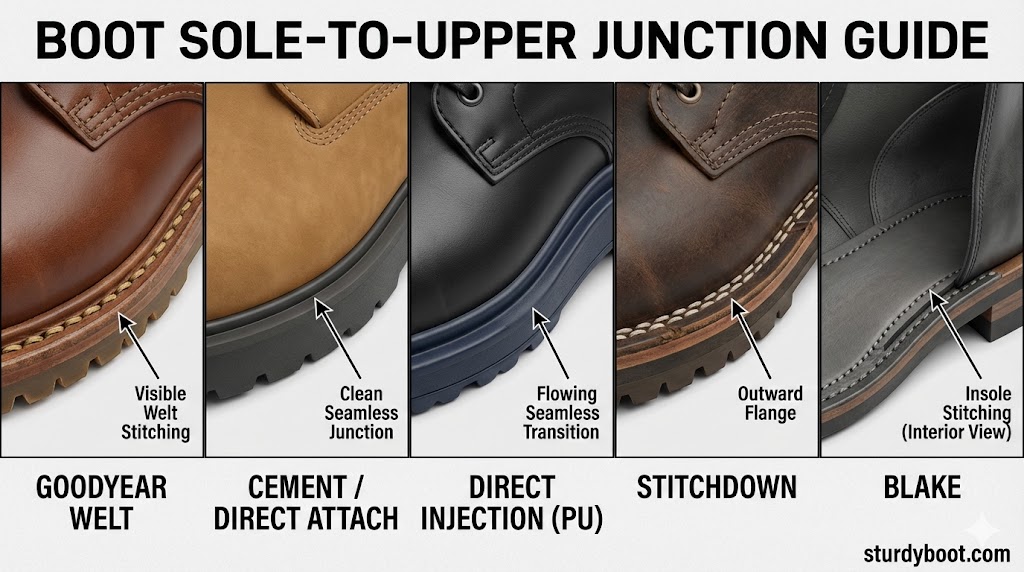
Practical field identification helps you assess boots on store shelves or evaluate used boots for purchase.
Visual Identification Markers
Quick Reference Checklist:
☐ Goodyear Welt: Visible stitching around perimeter; distinct “lip” (welt) between upper and outsole; dual stitch rows
☐ Cement/Direct Attach: Clean, seamless junction; no visible stitching; thin visible adhesive line or painted seam
☐ Direct Injection: Completely seamless transition; sole material “flows” into upper; often single continuous color
☐ Stitchdown: Upper material visibly flares outward; stitching on horizontal flange; “turned out” edge
☐ Blake Stitch: Lift insole (if removable) to see stitching; single row around sole perimeter; thinner profile
Work Boot Materials — Upper, Midsole & Outsole Guide
Upper Leather Types
Full-Grain Leather:
The outermost layer of the hide—strongest, most durable, develops patina with age. Oil-tanned full-grain (2–2.2mm thickness) resists water and abrasion. The gold standard for work boots.
Top-Grain Leather:
Sanded/buffed surface removes imperfections but also removes the toughest fibers. More uniform appearance, slightly less durable. Common in mid-tier boots.
Nubuck:
Full-grain leather with a brushed surface creating velvet-like texture. Attractive but requires more maintenance. Water resistance depends on treatment.
Suede:
Inner split of the hide. Softer, more affordable, less water-resistant, less durable. Typically reserved for casual or light-duty applications.
Pull-Up Leather:
Oil-saturated leather that “pulls up” lighter when bent, showing oils migrating. Self-conditioning, develops character, excellent for outdoor work.
Oil-Tanned Leather:
Oils (not chromium salts) used in tanning process. Superior water resistance, supple feel, natural appearance. Preferred for work boots over chrome-tanned alternatives.
Exotic Leathers:
Ostrich (distinctive quill patterns, extremely supple), Bison (thick, durable, distinctive grain), Python (unique aesthetics, specialty markets). Performance varies; often chosen for aesthetics in Western work boots.
Synthetic & Lightweight Alternatives (2024-2025 Innovation)
Carbon Fiber & Thermoplastic Uppers:
Emerging 2024-2025 trend replacing heavy leather in performance applications. Weight reduction significant—premium boots now achievable under 1.5 lbs per boot.
Synthetic Textiles:
Cordura nylon, ballistic mesh for ventilation panels. Common in composite toe athletic-style work shoes. Sacrifice durability for breathability.
Midsole Materials
| Material | Weight | Cushioning | Durability | Break-in | Best For |
|---|---|---|---|---|---|
| EVA | Very Light | Excellent | Moderate (may compress) | None | All-day comfort, light duty |
| PU | Medium | Good | Excellent | Minimal | Heavy-duty, longevity priority |
| Cork | Medium | Excellent (custom molds) | Excellent | 80-100 hours | Goodyear welt boots |
| Phylon (MD) | Light | Good | Moderate | None | Athletic-style work footwear |
Outsole Materials & Compounds
Vibram Rubber:
Italian-engineered compound with 75+ years of innovation. Heat-resistant (up to 300°C in specific compounds), oil-resistant, acid-resistant. The benchmark name in outsoles. Multiple formulations for specific applications (Vibram Mini Lug, Vibram Christy Wedge, etc.).
Nitrile Rubber:
Synthetic rubber with exceptional oil and fuel resistance. Preferred in automotive, petroleum, and industrial settings with hydrocarbon exposure.
Natural Rubber:
Excellent wet traction, cold-weather flexibility. Less heat-resistant than synthetics. Common in general-purpose work boots.
TPU (Thermoplastic Polyurethane):
Hard, puncture-resistant, excellent abrasion resistance. Heavier than PU. Used in high-hazard outsoles where puncture protection matters.
PU Outsoles:
Lighter than rubber, excellent shock absorption, flexible. Less heat-resistant; not suitable for welding or foundry work.
Heat, Chemical & Slip Resistance Properties
| Material | Heat Resistance | Oil Resistance | Slip Resistance (Wet) | Weight |
|---|---|---|---|---|
| Vibram Rubber | Excellent (up to 300°C) | Excellent | Excellent | Heavy |
| Nitrile Rubber | Good | Excellent | Good | Medium |
| TPU | Moderate | Good | Excellent | Heavy |
| PU | Low-Moderate | Moderate | Good | Light |
| EVA | Low | Low | Moderate | Very Light |
Safety Features & Certifications — 2024-2026 Standards Update
All safety toe types meeting ASTM I/75 C/75 provide identical protection levels despite different materials.
According to OSHA’s foot protection standard (29 CFR 1910.136), employers must ensure workers use protective footwear when workplace hazards—falling objects, puncture risks, or electrical hazards—are present. Understanding safety certifications ensures compliance. For a complete breakdown of the updated standard, our ASTM F2413-24 explained guide covers every marking and what it means.
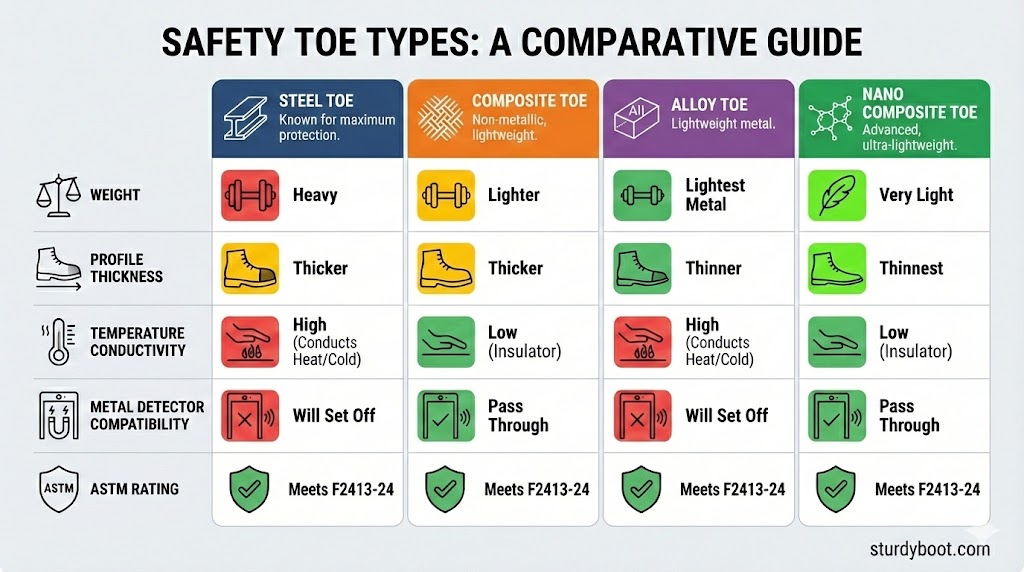
Toe Cap Protection Types
Steel Toe:
- ASTM I/75 C/75 Rating: Withstands 75 ft-lbs impact, 2,500 lbs compression
- Pros: Thinnest profile for given protection level, proven technology
- Cons: Conducts temperature (cold in winter, hot in summer), sets off metal detectors, heavier
- Weight: Adds approximately 1–1.5 oz per cap
Composite Toe (Kevlar, Carbon Fiber, Fiberglass):
- Same I/75 C/75 Protection: Meets identical ASTM impact/compression standards
- Pros: Non-metallic (airport/security friendly), non-conductive, lighter
- Cons: Bulkier to achieve same protection (adds toe box volume)
- Best For: Electricians, frequent travelers, workers in temperature extremes
Alloy Toe (Aluminum/Titanium):
- Middle Ground: Lighter than steel, thinner than composite
- Trade-off: Metal detection still triggered; less common availability
Nano Composite Toe (2024-2025 Innovation):
- What’s New: Carbon nanotube technology creates toe caps 10–50 nanometers thick
- Industry Impact: Eliminates the “composite = bulkier” assumption from older content
- Result: Thinnest, lightest safety toe boots on the market—combining composite benefits with steel-like profiles
- Source: Thorogood and others introducing 2024-2025 models
Soft Toe:
- No impact protection; chosen when safety toe not required by workplace
- Prioritizes weight reduction, flexibility, comfort
ASTM Safety Standards Decoded — F2413-18 vs F2413-24
⚠️ Critical 2024 Update: ASTM F2413-24 replaces F2413-18 as the current performance standard. Content citing only F2413-18 is now outdated.
What Changed:
- Updated Slip Resistance Testing: New SR (Slip Resistant) and SRO (Slip Resistant Oil) designations with standardized coefficient of friction (COF 0.4+) testing
- Revised Marking Requirements: Clearer labeling standards for consumer identification
- Test Method Alignment: Updated alignment with ASTM F2412 test methods
Standard Markings Explained:
| Marking | Meaning |
|---|---|
| I/75 | Impact protection: 75 ft-lbs |
| C/75 | Compression protection: 2,500 lbs |
| EH | Electrical Hazard: Resists 600V in dry conditions |
| PR | Puncture Resistant: Protects against sole penetration |
| MT | Metatarsal Guard: Top-of-foot impact protection |
| CD | Conductive: Dissipates static charge |
| SR | Slip Resistant (ASTM F2413-24 standard) |
| SD | Static Dissipative |
OSHA Compliance Note: OSHA mandates protective footwear meeting ASTM F2413 for identified foot hazards. Employers must assess workplace hazards (29 CFR 1910.136) and require appropriate footwear.
International Standards:
- EN ISO 20345: European safety footwear standard (S1, S2, S3 classifications)
- AS/NZS 2210.3: Australian/New Zealand standard
Puncture Resistance, EH Protection & Metatarsal Guards
Puncture-Resistant (PR) Plates:
Steel or composite plates in the midsole prevent nail, screw, and sharp object penetration. Essential for construction sites, roofing, demolition. Composite PR plates maintain flexibility better than steel.
Electrical Hazard (EH) Protection:
Insulates against accidental contact with live circuits up to 600V under dry conditions. Critical for electricians, utility workers, anyone near electrical panels. Note: EH rating requires dry conditions—wet boots compromise protection.
Metatarsal Guards (MT):
External or internal guards protecting the metatarsal bones (top of foot). Required in heavy manufacturing, foundry work, and high-drop-risk environments. External guards offer higher protection; internal guards offer sleeker profile.
Choosing the Right Construction for Your Work Environment
Construction Workers
Primary Hazards: Puncture, impact, compression, uneven terrain, ladder work
Recommended Construction: Goodyear welt or stitchdown
Key Specifications:
- ☐ Steel or composite toe (I/75 C/75)
- ☐ Puncture-resistant midsole
- ☐ Steel or fiberglass shank for arch support
- ☐ 90-degree heel for ladder grip
- ☐ Full-grain leather upper (2mm+)
Why: Resoling capability justifies higher initial investment; puncture plates essential on active construction sites.
Electricians & Utility Workers
Primary Hazards: Electrical contact, ladder work, confined spaces
Recommended Construction: Goodyear welt or direct injection (for waterproof models)
Key Specifications:
- ☐ Composite toe (non-conductive, non-magnetic)
- ☐ EH-rated (600V dry conditions)
- ☐ Composite shank (no metal detection issues)
- ☐ Wedge or 90-degree heel (depending on primary work surface)
Why: Resoling capability justifies higher initial investment; puncture plates essential on active construction sites. The best carpenter boots covers specialized options for different trades.
Warehouse & Distribution Workers
Primary Hazards: Forklift traffic, dropped loads, concrete floor fatigue, slip hazards
Recommended Construction: Cement (athletic-style) or direct injection
Key Specifications:
- ☐ Composite or alloy toe (weight reduction for high-step-count days)
- ☐ Slip-resistant outsole (SR rating, COF 0.4+)
- ☐ EVA or PU midsole for shock absorption
- ☐ Wedge sole for flat surface traction
Why: Immediate comfort and lightweight construction reduce fatigue over 10,000+ daily steps.
Linemen & Pole Climbers
Primary Hazards: Electrical contact, falls, climbing fatigue, extended ladder/pole time
Recommended Construction: Goodyear welt (specifically pole-climbing designs)
Key Specifications:
- ☐ EH-rated
- ☐ Composite toe and shank
- ☐ Steel shank or equivalent arch support
- ☐ 45-degree heel angle (hooks climbing hardware)
- ☐ 8″+ shaft height (ankle support and protection)
Why: Specialized heel geometry and superior arch support are non-negotiable for this trade.
Welders & Foundry Workers
Primary Hazards: Molten metal splash, extreme heat, spark exposure
Recommended Construction: Goodyear welt or direct injection
Key Specifications:
- ☐ Metatarsal guard (external preferred for spark deflection)
- ☐ Heat-resistant outsole (Vibram or nitrile, rated 300°C+)
- ☐ Leather upper (no synthetics that melt)
- ☐ Pull-on style or covered lacing (prevents spark entry)
Why: Heat resistance is paramount; traditional construction with appropriate materials outperforms synthetic alternatives.
Chemical Handling & Food Processing
Primary Hazards: Chemical splash, bacterial contamination, wet floors
Recommended Construction: Direct injection molded
Key Specifications:
- ☐ Seamless construction (no bacterial harbors)
- ☐ Chemical-resistant outsole (specific to exposure type)
- ☐ SR-rated for wet surface traction
- ☐ Easy-clean upper materials
Why: The seamless bond of direct injection eliminates contamination points that stitched constructions create.
For complete job-specific recommendations across all industries, the work boots by job type guide matches boot features to specific workplace hazards.
The True Cost of Work Boots — Construction Method Comparison Over 5 Years

Initial Price vs. Lifetime Value
The Calculation Most Buyers Miss:
Initial purchase price tells a fraction of the story. True cost-per-wear reveals which construction delivers value.
5-Year Cost Comparison:
| Construction | Initial Cost | Resoles | Total 5-Year Cost | Effective Lifespan | Cost Per Year |
|---|---|---|---|---|---|
| Goodyear Welt | $350 | 2–3 @ $100 ea | $450–$650 | 5–10+ years | $65–$90 |
| Stitchdown | $400 | 2–3 @ $125 ea | $525–$775 | 5–10+ years | $75–$105 |
| Cement (replaced) | $150 | N/A | $600 (4 pairs) | 12–18 months each | $120 |
| Direct Injection | $200 | N/A | $400–$600 (2–3 pairs) | 18–24 months each | $80–$120 |
Key Insight: A $350 Goodyear welted boot with three resoles costs less per year than four pairs of $150 cement boots delivering the same service life.
When Premium Construction Doesn’t Make Sense
- Rapidly changing job requirements (boot needs may shift before resole)
- Extreme chemical exposure (may degrade boot before sole wears)
- Temporary or seasonal work (duration doesn’t justify investment)
- Budget constraints requiring immediate footwear (safety now > optimal value later)
For a comprehensive ranking of top options across all price points, see the best work boots.
Repair vs. Replace — Decision Framework by Construction Type
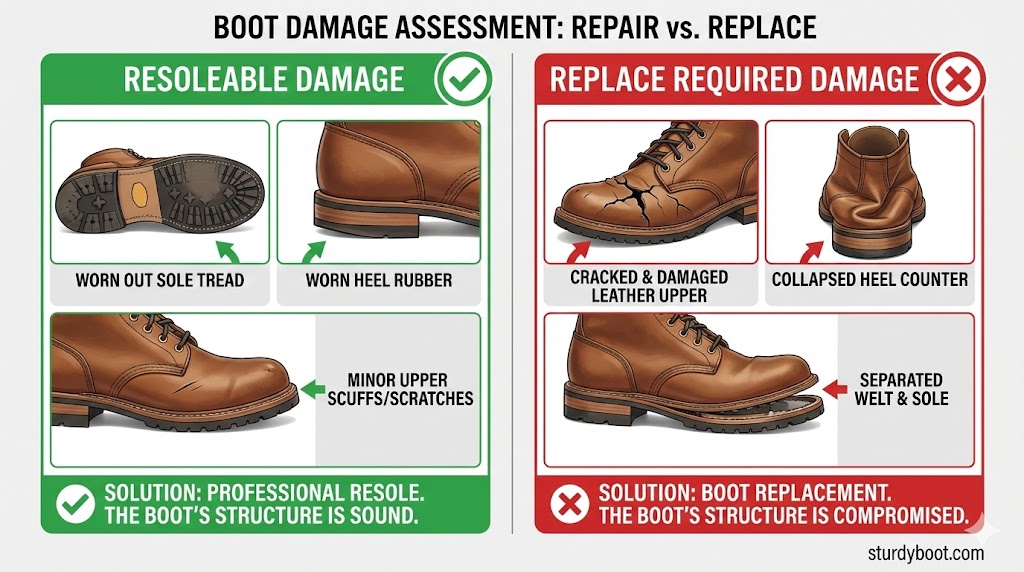
Resole-Worthy Condition Checklist
Goodyear Welt / Stitchdown — Resole When:
- ☐ Outsole worn through tread but upper intact
- ☐ Welt stitching secure (no separation visible)
- ☐ Heel counter maintains shape
- ☐ Upper leather free of cracks penetrating full thickness
- ☐ No midsole degradation (soft spots, crumbling cork)
Point of No Return — Replace When:
- ☒ Upper leather cracked through (no longer waterproof)
- ☒ Welt separated or stitching failed
- ☒ Heel counter collapsed (boot no longer supports ankle)
- ☒ Midsole cork crumbling or compressed flat
- ☒ Insole board damaged or delaminating
Visual Guide — Damage Assessment
| Damage Level | Signs | Action |
|---|---|---|
| Acceptable wear | Sole tread worn smooth, minimal upper damage | Resole |
| Borderline | Minor upper cracking, heel worn but counter intact | Evaluate—may have 1 resole left |
| Replace required | Full-thickness cracks, separated welt, counter collapse | New boots needed |
For common issues and their fixes, the work boot troubleshooting guide helps diagnose problems before they become irreparable.
Finding a Qualified Cobbler
Quality resoling requires craftsmen familiar with specific construction methods. Not all cobblers handle Goodyear welts competently.
Questions to Ask:
- Do you resole [specific construction method]?
- What replacement soles do you offer? (Vibram availability is a quality signal)
- What’s your turnaround time and warranty?
Brand Recrafting Programs: Red Wing, Danner, Wolverine, and others offer factory recrafting services—often the best choice for premium boots.
How Boot Construction Affects Workplace Safety & Fatigue
Biomechanics of Boot Construction
Shock Absorption & Joint Loading:
Midsole material and construction method directly affect how much impact your knees, hips, and spine absorb. EVA and cork midsoles reduce ground reaction forces; rigid constructions transmit more shock.
According to research from the National Institute for Occupational Safety and Health (NIOSH), inadequate footwear cushioning increases cumulative joint stress over 8-hour shifts—a factor in long-term musculoskeletal strain.
Gait Alteration & Stability
Construction Weight Distribution:
Heavier Goodyear welted boots change gait mechanics compared to lightweight athletic-style work shoes. Neither is inherently superior—match to task requirements.
Shank Rigidity & Arch Support:
Steel shanks prevent arch collapse on ladder rungs and I-beams. Composite shanks offer flexibility for varied terrain. Insufficient shank support contributes to plantar fatigue and potential strain.
Break-In Period Injury Risk
The 80–100 Hour Window:
New Goodyear welted boots require 4–5 days to several weeks of break-in. During this period, stiff leather and cork can cause:
- Blisters (friction before leather conforms)
- Altered gait (stiffness changes walking pattern)
- Arch strain (cork not yet molded)
Mitigation: Break in new boots gradually—wear 2–4 hours daily before full shift use. Leather conditioner accelerates suppleness. For detailed techniques that minimize discomfort, the break in work boots guide covers proven methods.
Sustainable Work Boots — Materials & Construction for 2025-2026
Resoling as Environmental Strategy
The Hidden Sustainability Advantage:
Resoleable construction (Goodyear welt, stitchdown, Blake) keeps uppers out of landfills. A boot resoled 3 times over 10 years generates less waste than 5 pairs of disposable cement construction boots.
Eco-Tanning & Recycled Materials
Chrome-Free Tanning:
Traditional chrome tanning produces hazardous waste. Vegetable-tanned and eco-certified leathers reduce environmental impact without sacrificing durability.
Recycled Content:
Emerging 2024-2025 boots incorporate:
- Recycled rubber outsoles
- Recycled PET (plastic bottle) textiles
- Reclaimed leather scraps in non-critical components
Pathogen-Resistant & Antimicrobial Leathers
Innovation from manufacturers like Steel Blue (2022+): pathogen-resistant leather treatments reduce bacterial growth without chemical additives that harm ecosystems.
Emerging Technologies in Work Boot Construction (2024-2026)
BOA Fit System — Mainstream Adoption
September 2024 Milestone: Timberland PRO x BOA partnership announcement signals dial-adjust lacing entering mainstream work boot market.
How It Works:
Micro-adjustable dial replaces traditional lacing. Steel cables distribute pressure evenly across the instep. One-hand operation enables precision fit adjustment while wearing gloves.
Benefits:
- Faster on/off (critical for workers donning/doffing frequently)
- Consistent fit (no lace loosening throughout shift)
- Glove-compatible adjustment
- Even pressure distribution reduces hot spots
Trade-offs:
- Higher price point
- Cable replacement if damaged (though systems designed for durability)
- Learning curve for traditional boot wearers
Nano Composite Toe Technology
2024-2025 Commercial Availability:
Carbon nanotube toe caps—measuring 10–50 nanometers in thickness—deliver steel-equivalent protection at a fraction of the weight and bulk.
Industry Impact:
Eliminates the longstanding compromise: steel (thin but heavy) vs. composite (light but bulky). Nano composites deliver both advantages simultaneously.
Current Availability: Thorogood and select manufacturers introducing nano composite models in 2024-2025 product lines.
Smart Boot Integration
2025-2026 Market Trajectory:
Work boot market growth driven partly by smart feature integration:
- GPS Location Tracking: Worker safety on large jobsites
- Fall Detection Sensors: Automatic alerts when worker down
- Health Metrics: Step count, fatigue indicators, gait analysis
- Environmental Sensors: Temperature, chemical exposure alerts
Current State: NoCry and emerging brands offer consumer-accessible smart work boots. Enterprise adoption accelerating.
Consideration: Smart features add cost and potential failure points. Evaluate whether technology justifies investment for specific use case.
3D-Printed Components & Custom Fit
Emerging Capability:
Additive manufacturing enables custom midsoles, personalized arch support, and rapid prototyping of specialized components.
Current Limitation: Mass customization not yet cost-competitive for standard work boot production. Watch for 2026+ developments.
Women’s Work Boots — Fit, Construction & 2024+ Innovations
Beyond Scaled-Down Men’s Boots
The Problem with Traditional Sizing:
Many “women’s work boots” were simply men’s boots built on smaller lasts—ignoring anatomical differences.
2024+ Standard:
True female lasts now standard in quality women’s lines:
- Narrower heel proportional to ball width
- Different arch profile
- Adjusted toe box shape
- Women-specific EE widths (not just A-C range)
Brands Leading Innovation: Ariat (dedicated women’s lines), Timberland PRO, Keen, Carhartt
For women-specific recommendations across construction types, the best women’s work boots covers options designed for female anatomy.
Fit Considerations
Brannock Device Measurement:
Accurate sizing starts with proper measurement. Both heel-to-toe length AND arch length matter—women’s feet often have proportionally different arch positions.
Width Options:
Quality women’s lines now offer B (standard), C/D (wide), and EE (extra wide)—comparable to men’s width availability.
Break-In, Fit & Maintenance Guide
Proper Fit Assessment
Brannock Device Protocol:
Measure both feet (they differ). Measure standing, not sitting. Size to the larger foot. Consider both length AND width.
Fit Checkpoints:
- Heel: Snug with minimal lift (1/4″ maximum acceptable)
- Width: Ball of foot aligns with boot’s widest point; no pinching
- Toe Box: Half-inch to full thumb width between longest toe and end
- Arch: Shank aligns with natural arch position
Break-In Protocol (Goodyear Welt / Stitchdown)
Timeline: 80–100+ hours of wear
Best Practice:
- Wear 2–4 hours first day
- Increase by 1–2 hours daily
- Apply leather conditioner every 3–4 wears during break-in
- Wear quality wool or moisture-wicking socks
- Address hot spots immediately (moleskin, bandages)
[Internal link: /how-to-break-in-work-boots/ | Anchor: detailed break-in protocol]
Ongoing Maintenance
| Task | Frequency |
|---|---|
| Brush off debris | After each wear |
| Deep clean with leather cleaner | Monthly |
| Leather conditioner | Every 4–6 weeks (more in dry climates) |
| DWR (water repellent) treatment | Every 2–3 months |
| Tread wear inspection | Monthly |
| Insole replacement | Every 6–12 months |
Storage: Boot trees maintain shape. Room temperature, away from direct heat (which cracks leather).
When to Replace Insoles
Factory insoles compress over time. Replace every 6–12 months with quality aftermarket options for maintained support and cushioning.
Frequently Asked Questions
What is the most durable work boot construction method?
Goodyear welt construction delivers the longest service life due to its 230+ step process, cork midsole that molds to foot shape, and the ability to resole 3–5 times. With proper care, Goodyear welted boots can last decades.
How long does it take to break in work boots?
Expect 80–100 hours of wear (approximately 4–5 days of full-time use to several weeks of part-time wear) for Goodyear welt and stitchdown construction. Cement and direct injection boots require minimal break-in.
What’s the difference between steel toe and composite toe boots?
Steel toes are thinner, heavier, and conduct temperature. Composite toes (Kevlar, carbon fiber, fiberglass) are lighter, bulkier, non-metallic (airport-friendly), and non-conductive. Both meet identical ASTM I/75 C/75 impact and compression ratings.
Can all work boots be resoled?
No. Goodyear welt, stitchdown, and Blake stitch constructions are resoleable. Cement construction and direct injection molded boots generally cannot be resoled—the attachment method doesn’t allow it.
What does ASTM F2413-24 mean on work boots?
ASTM F2413-24 is the 2024-updated safety performance standard for protective footwear, establishing requirements for impact (I/75), compression (C/75), and optional protections (EH, PR, MT, SR, etc.). It replaces the previous F2413-18 standard.
How often should work boots be replaced?
Cement construction boots typically need replacement every 6–18 months under heavy use. Quality Goodyear welted boots, with resoling, can last 5–10+ years. Evaluate based on safety feature integrity, not just cosmetic appearance.
What is a Goodyear welt and why is it considered better?
A Goodyear welt is a construction method where a leather strip (welt) is stitched to both the upper and outsole, with cork filling the cavity. Benefits include resoling capability (extending lifespan), water resistance (welt sits above ground contact), and improving comfort (cork molds to foot shape over time).
What does EH-rated mean on safety boots?
EH (Electrical Hazard) rated boots resist accidental contact with live electrical circuits up to 600 volts under dry conditions. This rating requires proper maintenance—wet or contaminated boots compromise EH protection.
Are wedge sole or heel sole work boots better?
Wedge soles distribute pressure evenly on hard, flat surfaces (concrete, steel) and reduce fatigue. 90-degree heel soles provide superior grip on soft terrain, ladder rungs, and climbing applications. Match sole style to primary work surface.
What is Vibram rubber and why is it used in work boots?
Vibram is an Italian rubber compound manufacturer with 75+ years of innovation. Their formulations offer exceptional heat resistance (up to 300°C), oil resistance, acid resistance, and durability. Vibram outsoles are considered a quality benchmark in work footwear.
How thick should work boot leather be?
Quality work boot leather measures 2–2.2mm thickness. Full-grain, oil-tanned leather at this thickness balances durability, water resistance, and eventual break-in flexibility.
What is a boot shank and do I need one?
A shank is an arch support plate (steel, composite, fiberglass, or nylon) running from heel to ball. Shanks are essential for ladder work, uneven terrain, and extended standing—they prevent arch collapse and reduce fatigue. Workers on flat, stable surfaces may find shanks less critical.
What is direct attach construction in work boots?
Direct attach (direct injection) construction involves molten rubber or PU injected directly onto the upper inside a mold. The material cures and bonds chemically, creating a seamless, waterproof junction. This method dominates waterproof work boot categories.
Why do some work boots have gusseted tongues?
Gusseted tongues are stitched directly to the upper on both sides, creating a sealed pocket. This prevents water, mud, and debris from entering through the tongue gap, keeps the tongue centered, and enhances overall fit. Essential for outdoor and wet environment work.
What’s the difference between PU and TPU soles?
PU (Polyurethane) soles are lighter, more flexible, and provide excellent cushioning but have limited puncture resistance. TPU (Thermoplastic Polyurethane) soles are harder, heavier, and offer superior abrasion and puncture resistance for high-hazard industrial environments.
Final Considerations — Making Your Selection
Manufacturer Variation Disclaimer:
Construction quality varies significantly between brands and even between models within brands. The guidelines above represent general characteristics—always evaluate specific boots individually.
The Investment Perspective:
Work boots are occupational tools. Match construction to job requirements, prioritize safety specifications for identified hazards, and consider cost-per-wear over initial price.
Evolving Technology:
The 2024-2026 period represents significant innovation in work boot construction—nano composites, BOA systems, smart integration, and sustainability focus. Content from 2022-2023 may not reflect current capabilities.
Professional Guidance:
For specialized hazard environments (electrical, chemical, extreme heat), consult safety professionals regarding specific ASTM requirements and manufacturer certifications.
Try these evaluation steps before you buy—or better yet, get fitted in-store if you can. Your feet support your livelihood; they deserve boots that support them back.
Have questions about boot construction or need personalized recommendations? Drop a comment below or check our complete work boots for in-depth reviews.