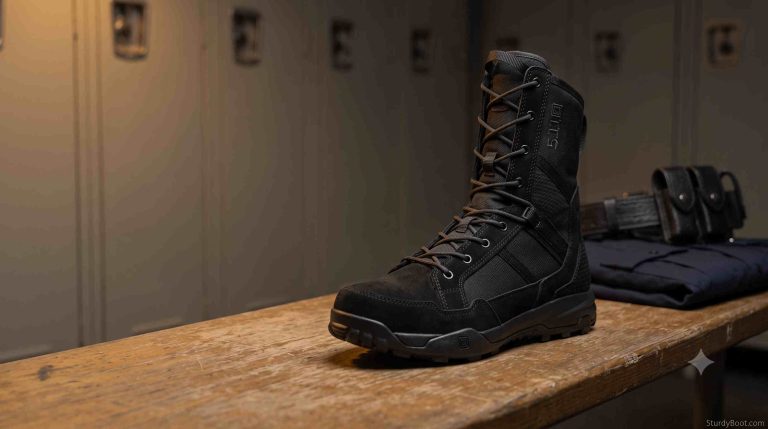
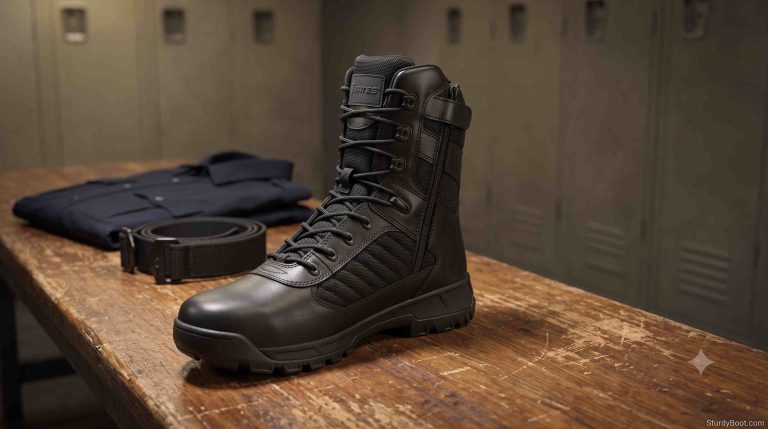
The Police Boots Buying Guide: What Owners Learn After the Return Window Closes (2026 Edition)
Last updated: July 2026
Editor’s Note: This guide isn’t built from spec sheets or brand copy. It’s a synthesis of real, long-run owner feedback across many pairs of duty boots – the happy re-buyers and the furious one-and-done owners – pulled together to show you where these boots actually succeed and where they quietly fail. The goal is simple: help you land on the right side of that split before you spend the money.
Already know your criteria and just want models? Skip ahead – our owner-vetted shortlist lives in the 10 Best Police Boots (Owner-Backed Picks) roundup, which ranks specific duty boots against the standards below.
The Comfort Trap: Why Duty Boots That Feel Perfect Still Get Returned
Here’s the fast answer to how you choose the best police boots: match the boot to your surface, your foot width, and your shift length first, then stress-test the closure and the sole bond hard within the return window – because a duty boot that feels amazing on day one tells you almost nothing about whether it survives month three. The single most consistent pattern in owner feedback is that the real failures – side-zipper cracks, sole separation, a footbed squeak – cluster in the two-to-six-month range, often just past the point where you can send them back. Choose for how the boot fails, not just how it feels.
That’s the trap, and every officer eventually meets it. You stand a twelve-hour shift on jail concrete, your current boots feel like ankle weights by hour four, and you go looking for something lighter. You find a boot everyone calls comfortable. It is comfortable. Then, months later, the zipper won’t stay up, or the sole peels at the toe, or a squeak develops that broadcasts your position on a quiet floor.
A few concrete pains that come up again and again for duty-boot buyers: a side zipper that fails on a foot pursuit and leaves you fighting your own boot; a factory insole so thin that a “comfortable” boot feels like standing on a board by mid-shift; a “wide” size that still pinches a wide foot; and a boot that’s silent for months, then squeaks with every step right after returns close. If any of that sounds familiar, you’re not imagining it – the pattern is real, and it’s remarkably consistent across brands.
None of this means these boots are bad. It means most duty boots are specialists wearing a generalist’s uniform, and the buyers who get burned are almost always the ones who matched the wrong boot to the wrong shift. This guide is grounded in aggregated owner experience across many units and years of feedback, tagged for the difference between fit-and-use mismatches (wrong width, wrong climate, wrong trade) and genuine product failures (zipper breakage, sole delamination, the squeak). That separation is the whole value here: it tells you which complaints predict your experience and which ones don’t.
Quick Summary: The Fast Verdict
- The Golden Rule: Buy for your worst surface and your longest shift, then prove the closure and sole bond survive stress within the return window. Comfort is a given with modern duty boots; durability and the right fit are what actually decide whether you keep them.
- 5 Questions to Ask Before Buying:
- What surface do I actually work – flat indoor floors, wet pavement, ice, or rough terrain?
- Lace-up or side-zip, and can I live with the closure’s known failure mode?
- Is my foot narrow, standard, or wide – and does this model offer a real wide, or just a “wide” that reads narrow?
- How long is my typical shift, and will I add an aftermarket insole from day one?
- Am I buying a boot to last years, or a comfortable consumable I’ll replace roughly yearly?
- The “Don’t Do This” Warning: Don’t baby a new duty boot through the return window to keep it pristine. The most-returned owners are the ones who wore the boot gently for thirty days, fell in love, and only discovered the zipper failure, sole peel, or squeak in month three – with no recourse left. Provoke the failure early or lose the leverage to return.
Owner Pattern Index (Fast Diagnosis)
Use this to translate a symptom into a likely cause and the first thing to check. These are recurring owner-reported patterns, not guarantees.
| What owners complain about | What it usually points to | What to check first |
|---|---|---|
| Side zipper won’t stay up, teeth split, or pull tab tears | Curved plastic side-zip is the category’s weakest link; it fails on a predictable timeline | Zip and unzip hard dozens of times in week one; watch for teeth separating or the slider creeping down while worn |
| Sole peeling away at the toe or heel | Sole-to-upper bond breaking down, common under high-mileage or wet use | Tug the sole edge away from the upper at toe and heel; any lift is an early separation warning |
| Persistent squeak on hard floors | Footbed or heel construction rubbing internally, often surfacing after break-in | Wear hard on hard flooring and carpet within returns to provoke it early – it rarely shows on a quick try-on |
| “Wide” size still pinches the toe box | Narrow last; some models’ wide reads narrow to genuinely wide feet | Wear thick socks and stand a full shift; toe-box width shows under real conditions, not a living-room fit |
| Feels great, then aches by mid-shift | Thin factory insole that compresses; the boot’s light platform lacks cushion | Do a real 10+ hour day on your actual surface; plan an aftermarket insole from the start |
| Slips on wet floors, grass, or ice | Outsole compound tuned for dry pavement, weak in cold and wet | Test grip on a damp surface before committing; keep a dedicated winter pair if you patrol ice |
| Feels colder or hotter than expected | Waterproof membrane traps heat in summer; thin uppers give zero warmth in cold | Match the boot to your climate; a membrane that keeps water out also keeps sweat in |
| The misleading one: boot feels flawless for the first month | Return-window trap – the real failure hasn’t surfaced yet, not proof of quality | Assume nothing from an easy first month; run the stress tests before day 30, because silence early is normal |
Return-Window Test Protocol (Do This Before You Toss the Box)

The failures owners regret most surface right after returns close. This protocol front-loads the stress so weaknesses appear while you can still act.
| Time window | Test | Pass looks like | Fail looks like | What to do next |
|---|---|---|---|---|
| Day one, indoors | Closure stress: work the side zipper hard, or lace tight and tug the eyelets | Zip glides and stays seated; eyelets and stitching hold | Slider creeps down, teeth catch or split, eyelet area strains | Return immediately; closure failure rarely improves |
| First few days | Sole-bond tug at toe and heel | Sole stays bonded, no gap | Any lift or gap between sole and upper | Photograph it, stop wearing, return in window |
| First week, on your surface | Live-conditions walk: a real shift on your actual floor – wet pavement, jail concrete, or whatever you truly work | Comfort holds, grip feels secure, no early hot spots | Slipping on damp ground, heel rub, mid-shift ache | Reassess fit and terrain match before committing |
| First weeks | Squeak provocation: wear hard on hard floors and carpet daily, don’t baby them | Stays quiet under heavy indoor wear | A squeak develops from footbed or heel | Decide now – if it bothers duty use and you’re in window, return |
| First weeks | Full-shift fit check: thick socks, stand and walk a complete shift | Toe box and heel stay comfortable all day | Toe-box pinch or heel-cup rub appears under load | If width or heel shape is wrong, it won’t wear in – return |
The live-conditions walk is the one owners skip and regret. A duty boot’s grip, waterproofing, and cushion only reveal themselves under real movement on your real surface – a quick indoor try-on hides every one of them.
1. Pick Your Lane (Risk vs. Convenience)
Duty boots force a trade between quick access, all-day comfort, and long-haul toughness. Pick the lane that matches your shift; you can’t max all three.
| Lane | Who it’s for | What you give up |
|---|---|---|
| Featherweight comfort (lace or zip, athletic build) | Indoor and paved patrol, corrections, security, EMS – high-mileage, flat-surface shifts | Long-term durability and rough-terrain protection; treat it as a roughly annual consumable |
| Side-zip convenience | Anyone who values fast on-off and a polishable service look for inspection | Closure reliability – the zipper is the recurring weak point and can strand you |
| Built-to-last toughness (heavier leather, resoleable construction) | Officers who want one pair for years, rough terrain, or heavy standing work | Out-of-box lightness and instant comfort; expect break-in and more weight |
For a broader safety-first overview of how boot features map to jobsite risks before you pick a lane, the Work Boots 101 primer ties construction choices to the hazards you actually face.
2. The First-Shift Surprises That Trigger Most Returns

Most regret traces to a handful of constraints owners wish they’d checked before committing. Front-load these.
- Foot width and the “wide” that isn’t. The most consistent fit complaint across duty boots is a narrow last. Standard and narrow feet usually do fine; genuinely wide feet repeatedly report toe-box pinch even in the wide size. If you’re wide, buy where you can return.
- Closure type. Side-zip means fast on-off but a failure-prone zipper; lace-to-toe means no zipper to break but slower entry and occasional eyelet issues. Decide which failure mode you can live with.
- Insole reality. Many owners find the factory insole thin and compressible; the happiest long-term wearers nearly all swapped in a cushioned or gel insert. Budget for that from day one.
- Climate match. A waterproof membrane keeps puddles out but runs warm and sweaty in summer heat; a thin, breathable upper is cool but offers no warmth or water resistance in cold.
A common regret pattern: an owner orders true-to-size on faith, feels the toe box pinch on the first wear, tries a half-size up, ends up too long, and returns the boot entirely – a fit story, not a quality story, and entirely avoidable by checking width first.
The install-day surprise that catches nearly everyone on premium models: opening the box to a boot with almost no real insole inside, feeling shorted, and only later learning that the sparse footbed is by design and expected to be paired with an aftermarket insert. Knowing that going in turns a “ripped off” first impression into a five-minute fix.
Compatibility Matrix (What Owners Say Actually Fits)

Compatibility here means owner-reported patterns across duty-boot families, not a spec sheet. Use it to anticipate the recurring theme for each style before you buy.
| Model / Family (as referenced by owners) | Common install/fitment notes owners mention | Noise sensitivity notes | Recurring failure or complaint theme | Best prevention step owners learned |
|---|---|---|---|---|
| Lightweight lace-to-toe patrol boots | Run narrow; size up a half; plan an aftermarket insole | A footbed squeak can develop months in | Sole and seam delamination under heavy use; the squeak | Provoke the squeak early; treat as a yearly consumable |
| Side-zip service boots | Often roomy in the toe; the zipper is the whole risk | Some develop a heel squeak on hard floors | Side-zipper cracking, tearing, or creeping down | Stress the zipper hard in week one; lace-and-leave if possible |
| Waterproof side-zip duty boots | “Wide” can still read narrow; size up | Generally quiet | Zipper failure clustering a few months in; runs warm | Return-window zipper stress test; keep it out of constant heat |
| Athletic zip boots with cushioned midsole | Best on narrow-to-standard feet; not for wide | Generally quiet | Forefoot upper tears and sole separation under high flex | Avoid for wide feet and heavy flex; watch the toe seam early |
| Premium resoleable USA-made boots | Run long and narrow; size down a half; minimal stock insole | Generally quiet | Missing-insole first impression; leaks only on old, heavy-used pairs | Add a real insole; resole rather than replace |
3. Real-World Performance: What Actually Happens?
Duty-boot marketing and duty-boot reality diverge in predictable places. Here’s the translation owners keep confirming.
| What the marketing implies | What it actually means (owner experience) |
|---|---|
| Rugged tactical durability | Splits hard by use case: light indoor/paved duty is fine, heavy or wet outdoor use fails early |
| Slip-resistant outsole | Adequate on dry pavement, repeatedly weak on wet grass, snow, and ice |
| Secure side-zip convenience | Fast on-off, but the zipper is the single most common failure point |
| All-day comfort out of the box | Genuinely comfortable early, but the thin factory insole compresses on long standing shifts |
| Waterproof, all-weather | Real waterproofing for puddles, but the membrane runs warm in heat and gives little in cold |
Weight is the win that makes owners forgive everything else
The near-universal praise across modern duty boots is weight. Owners logging long shifts repeatedly call these the lightest, most sneaker-like boots they’ve worn, often with little to no break-in, and say it’s the difference between coming home exhausted and coming home fine. That comfort is so valued it explains the entire re-buyer paradox below.
The polarizing split: same boot, opposite verdicts
Two owners buy the identical model and land at “best duty boot I’ve ever worn” versus “crushed my feet in an hour.” The split isn’t random taste – it traces almost entirely to foot width, surface, and shift type. Narrow-to-standard feet on flat, paved, warm-weather duty are the happy camp; wide feet, or anyone on wet, icy, or rough outdoor ground, are the frustrated one. The boot didn’t change; the match did.
The named failure signature (nobody tells you this): When a duty boot fails hard, owners describe a repeatable order – seams start letting go first, then the sole begins delaminating from the toe or heel, sometimes with waterproofing loss trailing behind. On side-zip models, the zipper often goes first and alone. The tell that it’s a product defect rather than bad luck: the problem frequently appears in one boot, then the other weeks later, and multiple officers in the same department report the same failure on the same model. That’s a repeat-defect pattern, not a lemon.
The counter-intuitive finding: Common advice says to break a boot in gently and let it “settle.” Owner reports say the opposite for duty boots – babying a new pair through the return window is exactly how people miss the zipper, sole, and squeak failures until it’s too late to return. The right move is to stress it hard early.
Because footwear failures on the job carry real safety consequences, it’s worth grounding your choice in the standards that exist for exactly that reason. For general foot-protection criteria, OSHA’s foot protection standard (29 CFR 1910.136) is the baseline employers work from, and the toe-cap performance and labeling criteria defined by ASTM F2413 explain what a safety rating actually certifies – worth checking against your employer’s PPE hazard assessment before relying on any duty boot. If the label decoding feels opaque, our ASTM F2413-24 breakdown translates the markings into plain language.
4. First Use & Validation: Where Most Police Boot Problems Show Up

The first two weeks decide almost everything. Run this sequence in order; it’s built from what satisfied long-term owners did that returners skipped.
- Confirm the basics first. Verify width and size against the model’s known tendency (narrow last, or runs-long on premium leather), check the heel-cup shape against your heel, and confirm the closure type is what you can live with. Fit and closure are the two variables that decide most reviews.
- Controlled first wear indoors. Walk a couple of hours on hard flooring in your real socks. Watch the back of your heel for rub – heel-cup mismatch is the earliest, clearest disqualifier, and no break-in fixes it.
- Stress the weak points. Work the side zipper hard, or tug the laced eyelets; flex the toe box repeatedly and watch the toe seam; and pull the sole edge away from the upper at toe and heel. These are the exact points that fail in the field.
- Real-conditions test. Do a genuine shift on your actual surface – a deliberate walk on wet pavement or a real stretch of your jail floor, not a dry living-room lap. Grip, waterproofing, and cushion only surface under real movement and moisture.
- Job-like movement. Kneel, squat, climb stairs, sit and drive, then walk and stand a full stretch. A boot that’s fine standing can bite when you move the way your shift actually demands.
Misread Risk: Buyers assume a new squeak or a mid-shift ache is normal break-in that time will cure. Owner feedback says otherwise for duty boots – the footbed squeak is usually a construction issue that often never fully goes away, and the ache is usually a thin insole, not a boot that hasn’t “settled.” Break-in fixes stiffness; it rarely fixes a squeak, a narrow last, or a low heel cup.
The one step owners skip: Testing under real movement on the real surface before committing. Buyers try the boot on dry indoor floors, feel the famous comfort, and skip the wet-and-moving test that would have exposed slick traction, a heel rub, or an early sole-bond weakness while there was still time to return.
POLICE BOOT: Fit/Setup vs Use-Case vs Product Decision Tree

START: What's the symptom?

1) Toe box pinches / heel rubs raw
 -> Likely cause: narrow last or heel-cup mismatch (FIT)
 -> Confirm: thick-sock full-shift wear; check heel redness
 -> Next: wrong width or heel shape won't wear in -> return/exchange

2) Zipper won't stay up / teeth split / pull tab tears
 -> Likely cause: side-zip hardware failure (PRODUCT)
 -> Confirm: does it fail on a fresh pair too, or just this one?
 Swap test -> if a replacement pair does the same, it's the design
 -> Next: return in window; if past it and lace-and-leave isn't viable, cycle out

3) Sole peeling at toe or heel
 -> Likely cause: sole-to-upper bond failure (PRODUCT)
 -> Confirm: tug sole edge; photograph any gap
 -> Next: return in window; for duty use, don't home-glue -> see a cobbler

4) Squeak on hard floors
 -> Likely cause: footbed/heel construction (PRODUCT, often permanent)
 -> Confirm: does it follow the boot across surfaces and socks?
 -> Next: return if in window and it hurts duty use; try footbed swap if past

5) Slips on wet/ice, or feet cold/hot
 -> Likely cause: wrong terrain/climate for this boot (USE-CASE)
 -> Confirm: does it grip fine on dry pavement but slip only when wet?
 -> Next: not a defect -> keep a dedicated winter/traction pair for that duty

6) Great early, aches by mid-shift
 -> Likely cause: thin factory insole (SETUP, fixable)
 -> Confirm: does a cushioned insert resolve it?
 -> Next: swap the insole before judging the boot
How to validate a new police boot before the return window ends
Promise: Fifteen minutes of deliberate stress in week one prevents the month-three regret that owners can’t undo.
- DO: Work the closure hard (zip/unzip or tug eyelets), tug the sole bond at toe and heel, and wear the boot on your real surface for a full shift.
- WATCH: A slider that creeps, a sole edge that lifts, a squeak that develops, or heel rub that appears under load.
- IF-FAIL: Return it that week – closure, sole-bond, and heel-cup failures don’t wear in, and they cluster right after the window closes.
Fit and closure checks that prevent first-shift surprises
Promise: Confirming a few fit and closure points before you commit prevents nearly every return-worthy mistake owners describe.
- DO: Check toe-box width against your foot, heel-cup fit against your heel, closure reliability, and insole cushion on a full-shift wear.
- WATCH: Toe-box pinch even in “wide,” heel rub within a single shift, a zipper that won’t seat, or a footbed that compresses flat by mid-shift.
- IF-FAIL: Wrong width or heel shape means return – it’s structural, not a break-in issue; a thin insole is the one you can simply swap.
When it’s a fit, use-case, or product problem
Promise: Locating where the problem shows up tells you whether to adjust, re-choose, or return.
- DO: Identify the exact location – toe box, heel cup, side zipper, sole bond, toe seam, or footbed.
- WATCH: Whether the issue follows YOU (fit), your CONDITIONS (wet/cold terrain), your SETUP (insole), or the PRODUCT itself (zipper, sole, squeak).
- IF-FAIL: Return true defects like a failed zipper or delaminating sole; adjust setup issues like a thin insole; and for terrain or climate mismatch, choose a different type rather than blaming the boot.
5. Reliability & Support: The Hidden Cost
Duty boots carry a quality-control variance most listings hide: two buyers a year apart can receive noticeably different pairs, and longtime owners frequently note that current import production feels different from older, USA-made versions they remember. Some of the harshest reviews are really “this isn’t my old boot” comparisons rather than defects on the current pair – worth separating when you read feedback.
Support experiences vary. Some owners resolve early issues cleanly; others find the return window closes just before the failure appears, leaving them stuck. That timing is the recurring frustration, which is exactly why the stress testing above matters more than the paperwork.
Buyer protection habits owners learned:
- Buy where the return window is generous and easy to use, and count the clock from delivery.
- Photograph any early sole lift, zipper issue, or seam gap the day you see it.
- Keep the box and packaging until you’ve run the full return-window protocol.
- For anything structural – resoling, a lifting sole, a failed zipper – consult a cobbler or qualified repair rather than gluing it yourself for duty use.
Expectation reset: Even a genuinely good duty boot can’t promise a fixed lifespan. The same model lasts one owner years of light indoor patrol and fails another in weeks of heavy wet-and-rough use – because lifespan tracks how hard the job is, not the price tag. A boot this light and comfortable is often, by design, a consumable rather than a buy-it-once investment. Budgeting for periodic replacement isn’t pessimism; it’s what the happiest long-term owners actually do.
6. Pre-Purchase Checklist (Save This)
Before you buy any police boot, confirm:
- I know my exact surface and climate (indoor flat, wet pavement, ice, rough terrain).
- I’ve chosen a lane: featherweight comfort, side-zip convenience, or built-to-last.
- I know my foot width and whether this model’s “wide” is genuinely wide.
- I’ve decided lace vs. side-zip and can accept that closure’s failure mode.
- I’m buying where the return window is generous and easy.
- I’ve planned for an aftermarket insole if I stand more than I walk.
- I know whether I need a safety toe, and if so, that the boot carries a real rating.
- I’ve checked my department’s regulation on color, height, and polishability.
- I understand this may be a roughly annual consumable, not a forever boot.
- I have a plan to stress-test the closure and sole bond within the return window.
7. Who Should Buy What? (Buyer Personas)
- The high-mileage urban patroller / EMS walker. Needs: featherweight comfort, breathability, real waterproofing for puddles. Avoid: heavy stiff boots and anything with a fragile closure on foot pursuits. Plan on an insole and roughly yearly replacement.
- The indoor corrections / security officer on flat floors. Needs: maximum lightness, cushion, and a quiet sole. Avoid: aggressive-terrain boots you don’t need, and the footbed squeak – provoke it early. Metal-detector facilities should confirm hardware won’t trip detectors.
- The wide-footed officer. Needs: a genuinely wide last, tried where returns are easy. Avoid: narrow athletic models whose “wide” reads narrow – this is the highest-return-risk group by far.
- The cold-climate / rough-terrain patroller. Needs: real traction, insulation, and ankle support for ice, snow, and uneven ground. Avoid: thin warm-weather boots and slick outsoles. Keep a dedicated winter pair for that duty.
- The buy-it-once traditionalist. Needs: heavier, resoleable, made-to-last construction and a polishable toe for inspection. Avoid: featherweight consumables and expect break-in and more weight in exchange for years of service.
- The side-zip convenience seeker. Needs: fast on-off for quick shift changes. Avoid: over-trusting the zipper on a pursuit – treat it as lace-and-leave, and stress it hard before the window closes.
For matching a specific role to a build type, the work boots by job type guide frames features against real hazards.
FAQ (Data-Backed Answers)
What are the best police boots for standing on concrete all shift?
The best police boots for concrete are lightweight duty boots paired with a real aftermarket insole. Owners on long standing shifts consistently report that even a comfortable, featherweight boot feels like standing on a board once the thin factory footbed compresses – and that swapping in a cushioned or gel insert is the single most common fix that turns “no cushion” into “pretty much perfect.” Buy for lightness, then add the insole from day one.
Are side-zip police boots reliable, or does the zipper always fail?
The zipper is the most common failure point on side-zip duty boots, but it isn’t guaranteed to fail – it’s a known risk to manage, not a certainty. Owner feedback shows zipper cracking, tearing, or creeping down clustering in the two-to-six-month range, often just past the return window. If you value fast on-off, stress the zipper hard in week one and consider a lace-and-leave approach; if you need a closure you can trust on a foot pursuit, a well-laced boot removes the variable entirely.
Why do my police boots squeak, and can I fix it?
A duty-boot squeak usually comes from the footbed or heel construction, and it’s often difficult or impossible to fully eliminate. Owners report it develops after a few months of break-in – frequently right after the return window closes – and appears on hard floors and carpet alike. Footbed swaps and powders are hit-or-miss; the most reliable move is to provoke it early within your return window and send the boot back if it starts, because for a duty officer a squeak isn’t cosmetic, it’s a position-giving-away problem.
Do lightweight duty boots hold up, or do they wear out in a year?
Lightweight duty boots split sharply by how hard you use them. Light indoor, paved, and warm-weather duty commonly yields a year or more, sometimes several; heavy, wet, or rough outdoor use can bring sole and seam failure in months. There’s no single lifespan – the boot lasts as long as the job is gentle. Many owners knowingly treat these as roughly annual consumables and re-buy anyway because nothing else feels as good.
Side-zip vs lace-up police boots – which should I get?
Choose side-zip for speed and easy on-off; choose lace-up for closure reliability. Side-zip boots get you in and out fast and suit a polishable service look, but the zipper is the recurring weak point. Lace-to-toe boots have no zipper to break and lace secure for pursuits, but take longer to put on and can have occasional eyelet issues. Decide which failure mode you’d rather manage – that single choice resolves most of the debate.
Are police boots waterproof enough for wet patrol?
Membrane-lined duty boots handle puddles and standing water well for most owners, but they aren’t all-weather. Owners report dry feet ankle-deep, with two caveats: the waterproof upper only rises so high, and the sealed membrane runs warm and sweaty in summer heat. Thin uppers on breathable, non-membrane models are cool but not waterproof at all. Match the boot to your climate rather than expecting one pair to do both.
Do metal eyelets on duty boots set off metal detectors?
They can. At least one owner reported metal lace eyelets triggering a workplace metal detector, which matters if you work a facility with screening. If that’s your environment, confirm the hardware won’t be a problem before you rely on the boot on duty. Because protective footwear needs vary by role, checking your choice against your employer’s PPE hazard assessment and the criteria in OSHA’s foot protection standard is a smart baseline.
What to Re-Check Before You Buy (Listings Change)
Owner feedback surfaces a few listing-level surprises worth confirming right before you order. Sizing advice can flip between production runs, so re-read recent reviews for the current “runs narrow / size up” or “runs long / size down” consensus. Country-of-origin can shift – several duty boots moved from older USA-made to current import production, and longtime buyers flag a different feel. Confirm the exact model and successor number, since popular boots get quietly replaced by a new version that wears differently. And on premium leather boots, check whether a real insole is included or expected to be added separately, so the box isn’t a surprise.
Printable Cards (Save These)
Return-Window Test Card Run these before your window closes:
- Closure: work the zipper hard / tug the eyelets – must stay seated
- Sole bond: tug the sole edge at toe and heel – no lift
- Live walk: a full shift on your real surface, wet if you work wet
- Squeak: wear hard on hard floors daily – don’t baby it
- Fit: thick socks, stand a full shift – no toe pinch or heel rub
- Any fail -> return that week. Failures cluster right after the window.
Police Boot Problem Decision Card
- Toe pinch / heel rub -> FIT -> won’t wear in -> return
- Zipper fails -> PRODUCT -> return in window / else lace-and-leave
- Sole peeling -> PRODUCT -> return / see a cobbler, don’t home-glue
- Squeak -> often permanent -> return if it hurts duty use
- Slips wet or ice / too hot or cold -> USE-CASE -> get the right pair
- Aches mid-shift -> SETUP -> swap the insole first
Update Log
- July 2026: Rebuilt around the return-window trap as the category’s dominant owner-pattern; added the side-zipper failure signature and the sole-bond stress test.
- July 2026: Expanded the fit-vs-use-case-vs-product decision tree and refreshed the compatibility patterns across duty-boot families.
Final Verdict
Choosing police boots comes down to lane strategy: decide whether you want featherweight comfort, side-zip convenience, or built-to-last toughness, because no single duty boot maxes all three. Then live the Golden Rule – buy for your worst surface and your longest shift, and prove the closure and sole bond survive stress inside the return window. The boots that get returned aren’t usually bad boots; they’re good boots matched to the wrong shift, or great boots whose real failure surfaced one month too late to send back. Get the match right and provoke the failures early, and the decision gets easy.
Ready to choose a specific model? We’ve ranked the standouts from owner feedback against exactly these criteria – fit, closure reliability, real-surface traction, and how they hold up past the return window. See the top picks: 10 Best Police Boots Reviews