
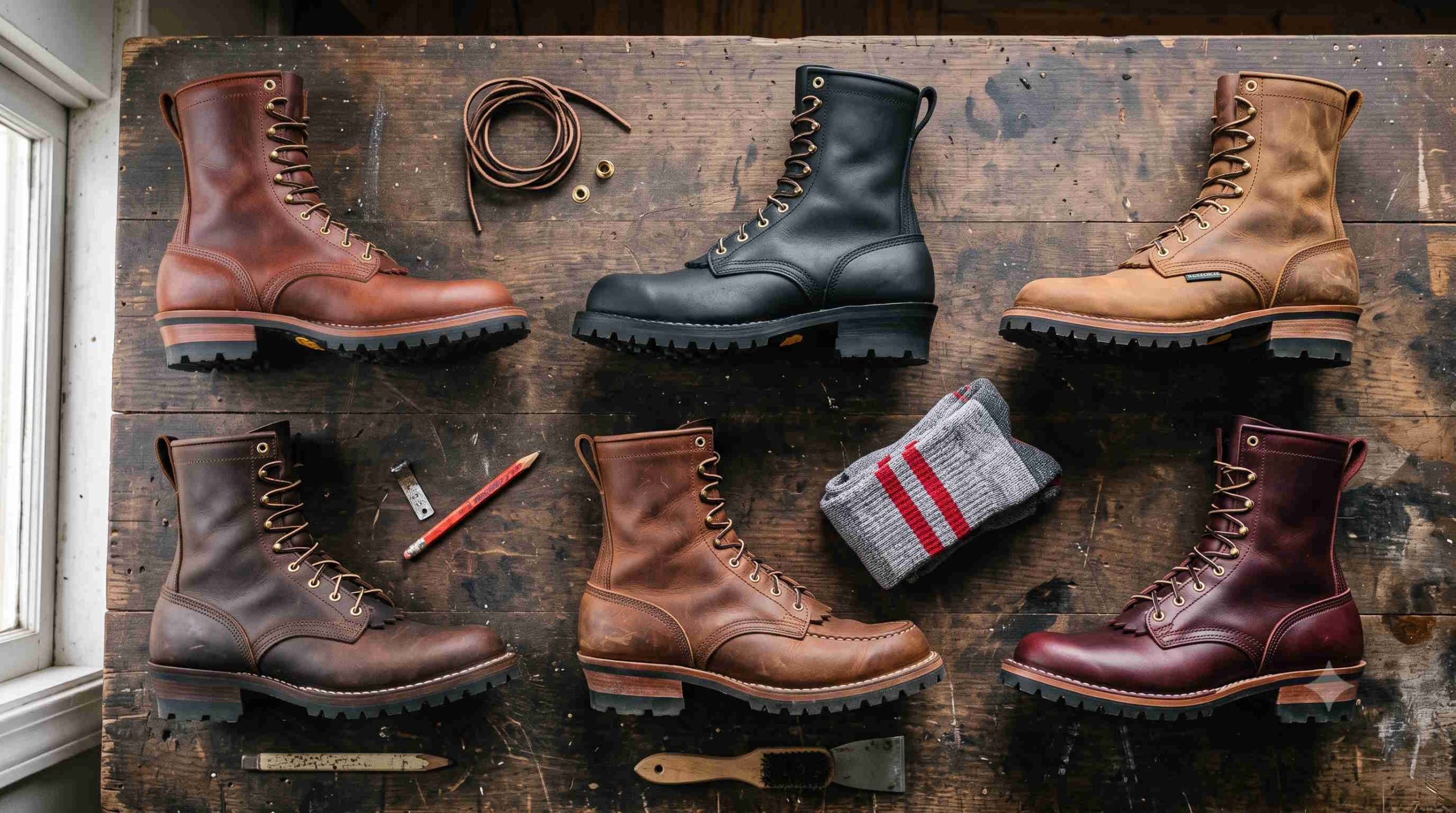
The 10 Best Logger Boots of 2026 — Waterproofing, Fit & Failure Patterns
Last updated: July 2026
- The story that changed this cycle: across nearly every boot here, sole and waterproofing failures cluster just after the 30-day return window — a timing pattern that rose to the front of our analysis this year and now shapes the whole ranking.
- A new theme sharpened: the “budget-tier + accept a shorter lifespan” segment (SUREWAY, Ad Tec, Safety Girl) is clearly separating from the “premium platform you must upgrade” segment (Thorogood, Chippewa).
- Lace and eyelet hardware complaints grew loud enough to promote up the page — on several otherwise-loved boots, it’s the single most consistent gripe from happy long-term owners.
- Added the Irish Setter Mesabi’s steel-toe-box narrowness as a distinct “skip if wide-footed” flag after 2026 sizing feedback kept repeating it.
Loggers get bought for one reason: your last pair rotted, leaked, or split at the sole, and you want the one that finally holds. The frustrating truth in this category is that the same boot often delights one owner and betrays the next — and the dividing line is almost never random. It’s width, sourcing, and how hard you actually work the boot.
Why trust this ranking: Every placement below is synthesized from aggregated owner feedback across our individual reviews — not manufacturer claims, lab tests, or sponsored placement.
Methodology Snapshot
This ranking distills recurring themes from multiple individual full reviews, each built on aggregated verified-purchase owner feedback. Review volume varies by product, with feedback windows noted per boot and spanning roughly 2010 to 2026 depending on the model. We tag every owner report into buckets — comfort and fit, sizing, waterproofing, sole and construction durability, hardware, weight, warmth, and warranty — then weight recurring patterns over one-off lemons.
How the Confidence Scores work: Scores are inherited verbatim from each boot’s full review and reflect buyer-usefulness — how confidently we can name who the boot fits — not a reliability percentage. Here’s how to read them:
- 9 and up — Very consistent positives.
- 8 to 8.9 — Strong, with manageable tradeoffs.
- 7 to 7.9 — Good, but quality or fit variance matters.
- Under 7 — Niche fit or higher downside risk.
When two boots tie on score, we break the tie by outcome consistency first, then downside severity, then breadth of fit.
Here’s what you’ll get below: a fast award table, a one-glance summary, a decide-and-fix toolkit, two original data artifacts (a dominant-failure snapshot and a use-case fit matrix), full per-boot deep dives, and a short buying teaser. Skim the Quick Verdict, click a Confidence Score for the full review, and you can decide in about two minutes.
Affiliate disclaimer: SturdyBoot.com is reader-supported. If you buy through links on this page, we may earn a small Amazon commission at no extra cost to you. It never changes what we recommend.
Quick Verdict (Awards)
| Award | Product | Best For | Quick Reason |
|---|---|---|---|
| Best Overall | Georgia Boot Low Heel Logger GORE-TEX | Wet, cold, on-your-feet trades | Real GORE-TEX + Vibram at a mid-budget price, with the most consistent waterproofing signal here. |
| Best Value | SUREWAY Waterproof Steel-Toe Logger | Budget trades who’d replace yearly | A genuinely comfortable ~$100 steel-toe logger — if you inspect the pair on arrival. |
| Best Premium | Thorogood Logger Series 9″ Waterproof | Cold-climate, rough-terrain workers | USA-made, 400g-insulated, warm and waterproof when you draw a good pair. |
| Best for Wide Feet | Chippewa Apache Insulated Waterproof Logger | Wide and standard feet | One of the few loggers wide-footers actually rave about for out-of-box comfort. |
| Best for Sizing-Up Buyers | Irish Setter Mesabi Safety Toe Logger | Standard-to-narrow feet who size up | Tall, waterproof, real logger heel — when the fit lands, owners get years. |
| Best Women’s Fit | Safety Girl Women’s Logger | Women wanting a true-to-foot logger | A feminine 8-inch leather logger women can find in their size, at a value price. |
- Best Overall — bottom line: The safest “who it’s for” call in the category: comfortable, genuinely waterproof, and priced under premium rivals.
- Best Value — bottom line: Treat it as a comfortable disposable and inspect on arrival, and it over-delivers for the money.
- Best Premium — bottom line: Worth every penny on a good pair, but budget for a better insole and new laces from day one.
- Best for Wide Feet — bottom line: Buy it for comfort and roominess, not for maximum toe-leather longevity.
- Best for Sizing-Up Buyers — bottom line: Size up a half to a full size and skip it if you’re truly wide.
- Best Women’s Fit — bottom line: Nail the sizing and plan to swap the insole, and most owners become loyal re-buyers.
Tip: Click a Confidence Score anywhere below to see the full review and scoring context.
One-Glance Summary
| Product | Best For | Confidence Score |
|---|---|---|
| Georgia Boot Low Heel Logger GORE-TEX | Wet, cold standing trades | 8.5/10 |
| Carolina 8″ Waterproof Logger | Comfortable-out-of-box, true-to-size | 8.5/10 |
| Irish Setter Mesabi Safety Toe Logger | Standard/narrow feet, size up | 7.5/10 |
| Thorogood Logger Series 9″ Waterproof | Cold-weather premium | 7.5/10 |
| Chippewa Apache Insulated Waterproof Logger | Wide feet, comfort-first | 7.5/10 |
| Danner Logger Boots | Aggressive-heel, moderate use | 7.5/10 |
| SUREWAY Waterproof Steel-Toe Logger | Budget steel-toe | 7.5/10 |
| Safety Girl Women’s Logger | Women’s fit, value | 7.5/10 |
| Ad Tec Men’s Logger Boots | Light-duty budget | 7.5/10 |
| Chippewa Paladin 8″ Logger | Heavy-mass, USA-legacy style | 7/10 |
Toolkit (Decide + Fix)
Logger boots share a small set of predictable panic moments. Use this triage kit to self-diagnose before you assume you drew a lemon — and to know when the clock on a return really matters.
Issue-Tag Box
| Issue Tag | What It Usually Means | First Fix / Check |
|---|---|---|
| Wet sock after months | Waterproofing breach, usually near the sole-flex line | Re-treat the leather and seams; check where dampness first appears |
| Sole/tread separating | Glue bond failing at the toe or heel | Photograph it and check your return window today |
| Toe steel showing early | Thin toe-box leather wearing through | Condition the leather; stop toe-scraping tasks in these |
| Bent/snapped speed hook | Weak lace hardware (a repeat defect on several models) | Swap to heavier laces; re-lace gently on arrival |
| Toes hitting the front | Boot runs small or narrow at the toe box | Exchange for a half/full size up before wearing outside |
| Hard, flat underfoot | Thin stock insole | Drop in an aftermarket cushioned insole |
| Heel counter giving way | Heel-separation defect in the weeks-to-months window | Inspect early; escalate a return if it’s structural |
| Mismatched pair | QC “two left feet” defect | Compare both boots side by side day one; return immediately |
Decision Tree
- If you work wet, cold, standing shifts → go to the Georgia GORE-TEX (#1).
- If you have genuinely wide feet → go to the Chippewa Apache (#5); avoid the Irish Setter Mesabi’s narrow steel toe box.
- If your budget caps around $100 and you accept a shorter life → go to the SUREWAY (#7).
- If you want USA-made warmth for winter and will upgrade the insole → go to the Thorogood (#4).
- If you’re a woman needing a true logger fit → go to the Safety Girl (#8).
- Skip/avoid: any of these if you kick, scrape, or abuse the toe daily and want a decade of zero-maintenance waterproofing — that’s a different (welted, resole-grade) boot entirely.
- Upgrade path: if you keep re-buying a $100 logger yearly, the Georgia or Thorogood may cost less per year of service over time.
Troubleshooting Quickflow
Symptom: “My waterproof boots feel wet inside.”
- Confirm the water is entering, not sweat (runs-hot boots feel similar).
- Check where dampness starts — sole-flex line points to a glue/seam breach.
- Re-treat leather and seams with a quality conditioner/waterproofing.
- If water still enters within weeks of purchase → escalate a return before the window closes.
Symptom: “The sole is peeling off the boot.”
- Look at where — toe or heel separation is the common glued-sole failure.
- Photograph the gap with a date reference.
- If it’s inside the return window → return it now, don’t wait to “see if it holds.”
- If just outside → check whether the model has a manufacturer warranty path; document everything.
Failure-Mode Frequency Snapshot (single dominant complaint per boot)
| Product | #1 Reported Failure Mode |
|---|---|
| Georgia Boot Low Heel Logger GORE-TEX | Lace/eyelet hardware wear |
| Carolina 8″ Waterproof Logger | Glued heel/sole separation |
| Irish Setter Mesabi | Sole cracking near the arch |
| Thorogood Logger 9″ | Sole-seam separation |
| Chippewa Apache | Thin toe-box leather / early steel exposure |
| Danner Logger | Heel-counter separation |
| SUREWAY Logger | Mismatched-pair (“two left feet”) defect |
| Safety Girl Women’s Logger | Thin, flat insole |
| Ad Tec Men’s Logger | Bent/snapped speed hooks |
| Chippewa Paladin 8″ | Sole/tread separation |
Use-Case Fit Matrix (Strong / Moderate / Poor, from owner themes)
| Product | Wet/Waterproof Work | Heavy Daily Abuse | Wide Feet | Budget Priority | Cold-Weather Warmth |
|---|---|---|---|---|---|
| Georgia GORE-TEX | Strong | Moderate | Moderate | Moderate | Strong |
| Carolina Waterproof | Moderate | Moderate | Strong | Strong | Moderate |
| Irish Setter Mesabi | Strong | Moderate | Poor | Moderate | Moderate |
| Thorogood 9″ | Strong | Moderate | Moderate | Poor | Strong |
| Chippewa Apache | Moderate | Poor | Strong | Moderate | Strong |
| Danner Logger | Moderate | Poor | Poor | Poor | Strong |
| SUREWAY | Moderate | Poor | Moderate | Strong | Moderate |
| Safety Girl (Women’s) | Moderate | Poor | Moderate | Strong | Moderate |
| Ad Tec | Poor | Poor | Moderate | Strong | Moderate |
| Chippewa Paladin | Moderate | Strong | Strong | Poor | Strong |
Quick Decision Matrix
- Need the most trustworthy waterproofing → Go to #1 Georgia GORE-TEX.
- Need out-of-box comfort with wide-foot room → Go to #5 Chippewa Apache.
- Need a tall waterproof steel-toe and you’ll size up → Go to #3 Irish Setter Mesabi.
- Need USA-made winter warmth → Go to #4 Thorogood 9“.
- Need to spend the least → Go to #7 SUREWAY or #9 Ad Tec.
- Need a women’s true fit → Go to #8 Safety Girl.
- Need maximum mass and ankle support → Go to #10 Chippewa Paladin.
Comparison Table
| Product | Best For | Owner-Reported Outcome | What Owners Liked | Common Complaints / Tradeoff | Owner Signals | Confidence Score |
|---|---|---|---|---|---|---|
| Georgia GORE-TEX | Wet, cold standing trades | Polarized | Comfort, true waterproofing, value | Hardware wear; a minority see fast sole/heel failure | Repeat-buyer loyalty; soft-toe | 8.5/10 |
| Carolina Waterproof | Comfortable, true-to-size | Polarized | Out-of-box comfort, TTS fit | Glue-based sole and waterproofing fail before year one for hard users | Strong re-buy loyalty | 8.5/10 |
| Irish Setter Mesabi | Standard/narrow, size up | Polarized | Waterproofing, traction when it fits | Narrow steel toe box; arch-area cracking on a subset | Loud sizing signal | 7.5/10 |
| Thorogood 9″ | Cold-weather premium | Polarized | Warmth, waterproofing, USA-made | Seam separation and panned stock insole/laces at a premium price | Passionate re-buyers | 7.5/10 |
| Chippewa Apache | Wide feet, comfort-first | Polarized | Roomy toe box, all-day comfort | Thin toe leather; waterproofing gap vs the name | Wide-foot praise | 7.5/10 |
| Danner Logger | Aggressive-heel, moderate use | Polarized | Looks, grip, comfort for the right buyer | Heel/hardware failures; runs stiff and hot | Made-in-Vietnam surprise | 7.5/10 |
| SUREWAY | Budget steel-toe | Polarized | Comfort and value for ~$100 | QC lottery, early sole failure on hard use | Re-buy-anyway pattern | 7.5/10 |
| Safety Girl (Women’s) | Women’s fit, value | Polarized | Feminine look, real leather, welt | Contradictory sizing; thin insole; durability split | Loyal correctly-sized buyers | 7.5/10 |
| Ad Tec | Light-duty budget | Polarized | Looks and comfort at entry price | Hardware and soles fail early under daily trade abuse | Re-buy-on-price paradox | 7.5/10 |
| Chippewa Paladin 8″ | Heavy-mass, USA-legacy style | Polarized | Mass, ankle support, toughness | Post-return-window sole and waterproofing failure; junk laces; heavy | Third/fourth/fifth-pair loyalists | 7/10 |
Detailed Product Reviews
#1. Georgia Boot Low Heel Logger GORE-TEX — The Waterproofing You Can Actually Trust
Key takeaway: For most wet, cold, standing trades this is the safest logger pick here — genuinely waterproof and comfortable — if you baby the laces and maintain the leather.
Tagline: Real GORE-TEX, real value.
At a Glance
- Best for: Concrete crews, arborists, heavy-equipment operators, well-drillers
- Owner-reported outcome: Polarized (large happy majority, smaller fast-failure minority)
- Confidence score: 8.5/10
Signature (from review notes)
- Failure signature: Sole separation / heel blowout in a minority
- Install friction: Easy
- Downside risk: Medium
Quick Summary: A budget-tier logger with a Vibram sole and a real GORE-TEX liner that owners consistently praise for staying dry — the tradeoff is a smaller-but-repeating minority whose pairs came apart fast.
The Deep Dive (Why It Ranked Here)
- The comfort-out-of-the-box signal is the dominant theme, now joined by a fresh batch of second- and third-pair repeat buyers.
- The GORE-TEX waterproofing signal is remarkably consistent across trades and years — the easiest “who it’s for” call in this ranking.
- Sole-separation and heel-blowout reports cluster in a specific way the star average hides, which is what docks it from a perfect score.
- The lace-and-eyelet pattern is the single most consistent gripe from otherwise-happy long-term owners.
- Owners flag a clear wet-weather threshold: the liner holds where maintenance neglect doesn’t let water back in.
Why Buy
- Truly waterproof performance most owners can rely on for years.
- Vibram + GORE-TEX at a price well under Danner/White’s territory.
- Comfortable enough that many re-buy without hesitation.
Dealbreakers / What to Consider
- This reads as a soft-toe boot in owner reports — if you need a certified safety toe, skip this.
- Narrow feet may need lacing tricks for a locked-in fit.
- Baby the laces; the hardware is the weak point.
Verdict for You
- Pick this if you work wet and cold and want dependable dryness:
- You’ll actually re-oil and maintain the leather.
- You want premium waterproofing tech without premium pricing.
- Skip this if you need a certified safety toe on the job:
- Or you refuse to do any leather upkeep.
Quick Links: View on Amazon · Read the full Georgia GORE-TEX review
#2. Carolina 8″ Waterproof Logger — The Comfortable Coin-Flip
Key takeaway: A comfortable, true-to-size logger that many owners re-buy for years — but the glued sole and waterproofing can fail before the one-year mark for hard users.
Tagline: Comfort now, glue is the gamble.
At a Glance
- Best for: Standard-to-wide feet who want out-of-box comfort and rotate pairs
- Owner-reported outcome: Polarized (predictable happy/unhappy split)
- Confidence score: 8.5/10
Signature (from review notes)
- Failure signature: Glued heel/sole separation at a fairly consistent point in the boot’s life
- Install friction: Easy
- Downside risk: Medium
Quick Summary: Owners split down the middle in a way most boots don’t — the comfort is near-universal, but longevity is a coin-flip for hard users because the sole is glued (visible stitching is largely decorative for the bond).
The Deep Dive (Why It Ranked Here)
- Sole-separation timing clusters between the multi-month and one-year mark, not day one — a predictable failure window.
- Waterproofing is genuinely split: some owners stay bone-dry after a year while others are wet in weeks.
- The re-buyer thread is unusually strong, with many longtime owners on their third and fourth pair.
- Comfort and fit land right for a large majority, often straight out of the box.
- Sizing runs true-to-size, which removes one common source of returns.
Why Buy
- Comfortable out of the box for most owners.
- True-to-size fit that’s friendly to standard and wide feet.
- Strong repeat-buy loyalty from owners who know the trade-offs.
Dealbreakers / What to Consider
- If you need guaranteed multi-year waterproofing from a single hard-worn pair, skip this.
- Narrow feet may not get a locked-in heel.
- The glued sole won’t survive constant water, mud, and abrasion daily.
Verdict for You
- Pick this if you want comfort-first and don’t mind maintenance:
- You rotate more than one pair.
- You size true and baby the boot a little.
- Skip this if you’re a hard daily user needing long-haul dryness:
- Or you want a resole-grade, stitched-sole build.
The glued-sole weakness here is exactly the kind of thing worth understanding before you buy — the work boot soles explainer breaks down why glued and stitched constructions age so differently under abuse.
Quick Links: View on Amazon · Read the full Carolina Logger review
#3. Irish Setter Mesabi Safety Toe Logger — Size Up or Struggle
Key takeaway: A handsome, waterproof 8-inch steel-toe logger that most buyers love — if they size up a half to a full size and don’t have a truly wide foot.
Tagline: Great boot, unforgiving toe box.
At a Glance
- Best for: Standard-to-narrow feet; mechanics, welders, linemen, delivery, farm work
- Owner-reported outcome: Polarized (sizing decides everything)
- Confidence score: 7.5/10
Signature (from review notes)
- Failure signature: Sole cracking near the arch on a subset
- Install friction: Moderate (sizing decision required)
- Downside risk: Medium
Quick Summary: One of the most sizing-polarizing boots we’ve dug into — the steel toe box runs narrow and unforgiving, so the size-up decision separates the happy owners from the returners.
The Deep Dive (Why It Ranked Here)
- The “runs small, and the steel-toe box runs narrow” pattern is the single loudest signal, echoed again in early-2026 reviews.
- When the fit lands, owners rave about waterproofing and traction, with multiple reporting years of dry feet in mud, swamp, and snow.
- A recurring subset reports the sole cracking near the arch and stitching or lace loops failing early — sometimes inside the return window, sometimes just after.
- A longtime-fan thread grades current pairs against older production, so some criticism is really a comparison to discontinued boots.
Why Buy
- Excellent waterproofing and traction for correctly-sized owners.
- Tall 8-inch build with a real logger heel.
- Reliable reorder for standard-to-narrow-footed repeat buyers.
Dealbreakers / What to Consider
- If you have genuinely wide feet, skip this — even the “wide” runs narrow around the steel toe.
- Don’t order your normal size and refuse to exchange.
- Constant sparks and heavy abrasion will shorten its life without care.
Verdict for You
- Pick this if you’ll size up and have a standard-to-narrow foot:
- You want a tall waterproof steel-toe logger.
- You reorder the size that already worked.
- Skip this if you’re wide-footed or won’t exchange sizes:
- Or you need spark-proof multi-year life with zero care.
Since fit is the whole ballgame on this one, the work boot fit and sizing guide walks through how to measure for a narrow toe box before you commit.
Quick Links: View on Amazon · Read the full Irish Setter Mesabi review
#4. Thorogood Logger Series 9″ Waterproof — The USA-Made Winter Platform
Key takeaway: Yes for cold-weather, rough-terrain workers who want a heavy, warm, waterproof USA-made logger — but budget for a better insole and new laces from day one.
Tagline: Worth it, once you upgrade it.
At a Glance
- Best for: Cold-climate and winter trades; loggers, sawmill and diesel workers, linemen
- Owner-reported outcome: Polarized (loyal re-buyers vs. seam failures)
- Confidence score: 7.5/10
Signature (from review notes)
- Failure signature: Sole-seam separation / welt stitching backing out
- Install friction: Moderate (insole + lace upgrade expected)
- Downside risk: Medium
Quick Summary: One of the most passionately loyal followings in the trades sits right next to owners who watched the soles peel at the seams before their first winter was over — that split is the whole story.
The Deep Dive (Why It Ranked Here)
- Sole-seam separation reports cluster in the first several months of hard use, not years in.
- Real 400g insulation plus waterproofing makes it a genuine one-boot winter solution when you draw a good pair.
- A fresh wave of ex-Chippewa Super Logger converts keeps the loyalty thread alive.
- Sizing pulls in two directions: a “runs large / order down” crowd and a “toebox too tight even in wide” crowd both exist.
- Stock insoles and laces are near-universally panned — owners treat the boot as a platform.
Why Buy
- Real cold-weather warmth and waterproofing in one boot.
- Aggressive tread and steel toe for uneven, muddy, hilly terrain.
- USA-made construction that loyalists re-buy repeatedly.
Dealbreakers / What to Consider
- If you need out-of-box, all-day comfort with zero fuss, skip this.
- These are heavy, and owners feel it.
- Quality-control roulette on a premium-priced boot is a real risk.
Verdict for You
- Pick this if you want USA-made winter warmth and will upgrade it:
- You work cold, rough, muddy terrain.
- You’ll swap the insole and laces on arrival.
- Skip this if you want comfort out of the box with no tinkering:
- Or you can’t tolerate QC variance at this price.
Quick Links: View on Amazon · Read the full Thorogood 9″ review
#5. Chippewa Apache Insulated Waterproof Logger — The Wide-Foot Comfort Champ
Key takeaway: A standout for comfort, fit, and out-of-box wearability — but current production runs thin on toe-leather durability, so it’s a gamble for heavy daily abuse.
Tagline: Comfort king, fragile toe.
At a Glance
- Best for: Wide and standard feet who prize comfort over maximum longevity
- Owner-reported outcome: Polarized (comfort camp vs. durability camp)
- Confidence score: 7.5/10
Signature (from review notes)
- Failure signature: Thin toe-box leather / early steel-toe exposure
- Install friction: Easy
- Downside risk: Medium
Quick Summary: Half the owners call it the most comfortable boot they’ve ever laced up; the other half say the toe leather tore before they finished breaking it in — and both are telling the truth.
The Deep Dive (Why It Ranked Here)
- Comfort and fit are the most consistent praise in the entire sample — many report zero real break-in and all-day wear without foot pain.
- Thin toe-box leather and early steel-toe exposure is the single most repeated durability complaint, and it often lands fast.
- It’s one of the few loggers wide-footers rave about for a roomy toe box.
- A waterproofing gap versus the “waterproof” name is real and worth planning around.
- Longtime Chippewa loyalists grade current pairs harshly on leather versus older USA-made loggers.
Why Buy
- Exceptional out-of-box comfort and a roomy toe box.
- One of the best logger options for wide feet.
- Insulated build for colder work.
Dealbreakers / What to Consider
- If you kick, scrape, and abuse the toe daily (climbers, demo), skip this.
- Don’t expect true submersion-grade waterproofing from the name.
- You must condition the leather and monitor the toe box early.
Verdict for You
- Pick this if you want comfort and wide-foot room:
- You’ll condition the leather and watch the toe.
- Your work isn’t toe-destroying.
- Skip this if you abuse the toe daily or need guaranteed waterproofing:
- Or you want maximum leather longevity.
Because the weak point here is the leather over the toe, the boot anatomy and construction materials guide explains how leather grade and toe reinforcement affect how early a boot shows wear.
Quick Links: View on Amazon · Read the full Chippewa Apache review
#6. Danner Logger Boots — The Aggressive-Heel Looker for Moderate Use
Key takeaway: For most buyers, yes — if you want a sharp-looking, aggressive-heeled logger for moderate use and accept it’s a stiff, warm, Vietnam-made boot, not the old USA-welted legend.
Tagline: Grip and looks, coin-toss durability.
At a Glance
- Best for: Moderate-use wearers who value looks and grip over all-day cushioning
- Owner-reported outcome: Polarized (repeat buyers vs. heel-failure owners)
- Confidence score: 7.5/10
Signature (from review notes)
- Failure signature: Heel-counter separation in the weeks-to-months window
- Install friction: Moderate
- Downside risk: Medium
Quick Summary: For every owner who calls it the most comfortable boot they’ve laced up and re-buys a fifth time, there’s another who says the heel tore off inside a few months — same boot, opposite outcome.
The Deep Dive (Why It Ranked Here)
- The polarization between long-haul repeat buyers and one-time disappointed owners is the defining pattern, not an outlier.
- Heel counter or shoelace-hook failures cluster in the weeks-to-months window, several landing just past easy-return timing.
- Hard-sole and “runs hot” complaints are a consistent minority theme, not a one-off.
- The made-in-Vietnam surprise remains a live sore point for buyers who expected USA construction.
- The aggressive 90-degree heel is genuinely loved for digging into slopes and ladder rungs.
Why Buy
- Aggressive heel that grips slopes and rungs well.
- Strong looks and a loyal repeat-buyer base.
- Comfortable and grippy for the owners it fits.
Dealbreakers / What to Consider
- If you do hard, wet daily labor needing long-haul waterproofing, skip this.
- Wide-footed workers may find the forefoot tight.
- Runs stiff and warm; the stock insole underwhelms many owners.
Verdict for You
- Pick this if you want an aggressive-heel logger for moderate use:
- You value grip and looks.
- You’ll accept a stiff, warm boot.
- Skip this if you need daily hard-use waterproof reliability:
- Or you expected USA-welted construction at this price.
Quick Links: View on Amazon · Read the full Danner Logger review
#7. SUREWAY Waterproof Steel-Toe Logger — The Best $100 Gamble
Key takeaway: Yes — if you treat it as a genuinely comfortable ~$100 logger that may last a year or two, inspect the pair on arrival, size up a half, and re-waterproof early.
Tagline: Comfort and value, QC lottery.
At a Glance
- Best for: Budget-conscious tradespeople who’d rather replace yearly than pay $300+ once
- Owner-reported outcome: Polarized (comfort lovers vs. early-failure owners)
- Confidence score: 7.5/10
Signature (from review notes)
- Failure signature: Mismatched-pair (“two left feet”) defect + heel/sole separation
- Install friction: Moderate (inspect + size up)
- Downside risk: High
Quick Summary: Two completely different boots wear the same name — one owner buys a fifth pair, the next trashes theirs in a month with a peeling sole — and inspecting on arrival is what tilts the odds your way.
The Deep Dive (Why It Ranked Here)
- Two failure signatures still surface on recent pairs: heel/sole separation and a “two left feet” mismatched-boot defect.
- A striking number of owners who complain about longevity still buy a second or third pair anyway.
- A job-type durability threshold emerges: casual and lighter use stays happy; welding and spark-heavy trades hit a repeat heel-stitching failure.
- Waterproofing follows a familiar pattern — bone-dry for months, then the first damp sock right around the sole-flex line.
- Comfort and value signals are loud and consistent, which is what keeps confidence up despite the QC lottery.
Why Buy
- Genuinely comfortable with real full-grain leather at a shocking price.
- Tall wedge-sole logger silhouette without the premium cost.
- Painless to replace when it wears out.
Dealbreakers / What to Consider
- Welders and spark-heavy trades hit a repeat heel-stitching failure — skip it there.
- Don’t expect guaranteed multi-year waterproofing with zero babysitting.
- No true width options for narrow-footed workers.
Verdict for You
- Pick this if you want maximum comfort-per-dollar and will inspect on arrival:
- You’d rather replace a $100 boot yearly.
- You’ll size up and re-treat early.
- Skip this if you weld or need multi-year reliability:
- Or you need a dialed-in narrow fit.
Quick Links: View on Amazon · Read the full SUREWAY review
#8. Safety Girl Women’s Logger — A True Women’s Fit at a Value Price
Key takeaway: A genuine value pick for women wanting a good-looking 8-inch leather logger in their size — as long as you nail the sizing and plan to drop in your own insole.
Tagline: Women’s fit, insole required.
At a Glance
- Best for: Women needing a true logger fit for yard work, warehouse, gardening, standing jobs
- Owner-reported outcome: Polarized (adore vs. returned-in-a-week)
- Confidence score: 7.5/10
Signature (from review notes)
- Failure signature: Thin, flat insole (cushioning complaint across nearly a decade)
- Install friction: Moderate (sizing + insole swap)
- Downside risk: Medium
Quick Summary: Half the buyers adore these and the other half returned them in a week — and the gap comes down to nailing sizing and adding cushioning, not random luck.
The Deep Dive (Why It Ranked Here)
- The “runs big / runs small” sizing split is still the loudest theme and hasn’t settled.
- The “hard, flat insole” pattern shows up across nearly a decade of owners — a design tradeoff, not a bad batch.
- Owners who size correctly and add an insole for yard work, warehouse, and standing jobs mostly become loyal repeat buyers.
- A soft-toe vs steel-toe listing confusion still trips buyers up at checkout — this listing is the soft toe.
- Real leather and a Goodyear welt at a value price is a rare combination for a women’s logger.
Why Buy
- A feminine 8-inch leather logger women can actually find in their size (down to 5, wide options).
- Real leather and a welt without a premium price.
- Loyal re-buy pattern among correctly-sized owners.
Dealbreakers / What to Consider
- If you need true out-of-box comfort with no insole tinkering, skip this.
- Not for heavy-abuse jobsites with sparks or brutal daily mileage.
- Confirm soft-toe vs steel-toe before checkout.
Verdict for You
- Pick this if you want a real women’s logger fit on a budget:
- You’ll dial in the size carefully.
- You’ll add a cushioned insole.
- Skip this if you need plush out-of-box comfort:
- Or you’re on a heavy-abuse jobsite.
For readers who want more options beyond this single model, the best women’s work boots roundup covers true women’s-last builds across categories.
Quick Links: View on Amazon · Read the full Safety Girl review
#9. Ad Tec Men’s Logger Boots — The Entry-Price Look-Alike
Key takeaway: For light-duty, casual, or budget-strapped buyers who accept a short lifespan, yes; for heavy daily trades, no — the hardware and soles fail too soon.
Tagline: Looks the part, priced to replace.
At a Glance
- Best for: Budget buyers who can’t stretch to a $150+ logger right now
- Owner-reported outcome: Polarized (light-duty happy vs. heavy-trade disappointed)
- Confidence score: 7.5/10
Signature (from review notes)
- Failure signature: Bent/snapped speed hooks
- Install friction: Easy
- Downside risk: High
Quick Summary: It looks like a $180 logger and costs a fraction of that, which makes people either love it or feel burned — and use intensity predicts which camp you land in.
The Deep Dive (Why It Ranked Here)
- The lace-hardware failure pattern (bent or snapped speed hooks) is the single most-repeated durability complaint, not an old-batch fluke.
- Sole and heel separation reports cluster suspiciously close to the end of the return window.
- The light-duty/casual crowd is mostly happy; heavy daily-trade owners are mostly disappointed — that divide predicts satisfaction better than anything else.
- A re-buyer paradox holds: a real slice keep re-purchasing on price even while acknowledging the boot doesn’t last.
Why Buy
- Genuinely comfortable and good-looking out of the box for many owners.
- Steel-toe protection and logger looks at an entry price.
- Cheap enough that replacement is painless.
Dealbreakers / What to Consider
- Heavy daily trades on hard surfaces expecting a year-plus should skip it.
- Don’t count on real waterproofing for standing water or wet grass.
- Not a resole-and-keep-forever boot.
Verdict for You
- Pick this if you need a low-cost logger look right now:
- You do light-duty or casual wear.
- You accept a short lifespan.
- Skip this if you’re in a heavy daily trade:
- Or you need dependable waterproofing.
When a boot fails this predictably right after the return window, knowing the fixes and escalation paths helps — the complete work boot troubleshooting guide covers hardware and sole failures step by step.
Quick Links: View on Amazon · Read the full Ad Tec review
#10. Chippewa Paladin 8″ Logger — Maximum Mass, USA-Legacy Style
Key takeaway: Worth it if you want a heavy, sturdy, USA-legacy-style logger and buy the right width; risky if you need dependable long-term waterproofing or a light boot.
Tagline: Built like a tank, laces like string.
At a Glance
- Best for: Trades wanting serious mass and ankle support — utility, oil-and-gas, heavy manufacturing, cold-weather riding
- Owner-reported outcome: Polarized (multi-pair loyalists vs. fast-failure owners)
- Confidence score: 7/10
Signature (from review notes)
- Failure signature: Sole/tread separation after the return window
- Install friction: Moderate (size for width, re-lace on arrival)
- Downside risk: High
Quick Summary: Some of the most loyal repeat buyers in the category — people on their third, fourth, even fifth pair — sit right next to furious owners whose tread cracked off in weeks, and width plus sourcing explains the gap.
The Deep Dive (Why It Ranked Here)
- The repeat-purchase loyalty is unusually strong: a real subset treats this as a multi-year, re-buy-forever boot.
- Sole/tread separation and waterproofing failure both tend to appear after the 30-day return window.
- Laces are near-universally called junk — plan to re-lace on arrival.
- A large chunk of the anger is longtime fans grading current Vietnam-made production against older USA-made pairs.
- Width is decisive: narrow-footed buyers hoping standard width will “break in wider” are usually the disappointed camp.
Why Buy
- Serious mass, ankle support, and a steel toe for brutal work.
- Unusually strong re-buy loyalty among owners it fits.
- A maintained-boot value for those who pair it with a dryer and leather grease.
Dealbreakers / What to Consider
- If you need guaranteed all-day waterproofing months down the road, skip this.
- Narrow-footed buyers should not expect standard width to stretch.
- These are heavy, and several owners say so plainly.
Verdict for You
- Pick this if you want maximum mass and will maintain it:
- You buy the right width and re-lace on arrival.
- You treat it as a maintained boot, not a disposable one.
- Skip this if you need a light boot or long-term waterproofing:
- Or you have narrow feet and won’t exchange.
Because the waterproofing here fades over time rather than day one, the best waterproof work boots guide is worth a look if dry feet are your top priority.
Quick Links: View on Amazon · Read the full Chippewa Paladin review
Who Should Skip ALL of These
If you kick, scrape, and abuse the toe daily and expect a decade of maintenance-free, submersion-grade waterproofing, none of these will satisfy you — nearly every boot here shows a glue-based sole or waterproofing failure under that load. Look instead at premium stitched/welted, resole-grade boots built for that abuse, and be ready to pay several times more.
Buying Guide: How to Avoid a Bad Purchase (Quick Teaser)
Waterproofing Fails on a Clock, Not on Day One
The most important pattern across these boots in 2026: waterproofing and glued soles rarely fail on arrival — they fail weeks to months later, often just past the return window. Plan to stress-test wet performance hard in week one. According to OSHA’s foot protection standard 29 CFR 1910.136, employers must ensure protective footwear where foot hazards exist, so if your job requires a rated toe, confirm the certification before you rely on a listing’s name.
Match the Toe Rating to Your Job, Not the Look
Several boots here are soft-toe despite a rugged logger silhouette, and listings sometimes blur soft-toe versus steel-toe. If you need impact and compression protection, look for footwear meeting the ASTM F2413 standard for protective toe caps — and read our ASTM F2413-24 explainer to decode what those markings actually promise.
Width and Sizing Decide More Than Brand
On boots like the Irish Setter Mesabi and Chippewa Paladin, fit is the difference between a happy owner and a returner. For a broader safety-first foundation on matching features to your trade, the Work Boots 101 primer ties boot features back to real jobsite hazards, and the work boots by job type guide helps you match a build to your daily tasks.
Week-One Testing Checklist
- Try both boots on together and compare them side by side for size and shape mismatches.
- Lace fully and check the toe box — do your toes hit the front?
- Walk stairs and slopes to test the heel counter and ankle hold.
- Flex each sole hard by hand and look for any glue-line gaps at toe and heel.
- Wear them a full day indoors to catch hot spots before you commit outside.
- Do a controlled wet test (garden hose or a wet job) and check for damp socks.
- Inspect every speed hook and eyelet for bending or looseness.
- Confirm the toe rating on the listing matches what you actually need.
- Log the purchase date and note when your return window closes.
- Re-treat the leather and seams before heavy field use.
Printable “Week-One Validation” Quick Card

- [ ] Both boots match in size and shape
- [ ] Toes don’t hit the front when fully laced
- [ ] Heel counter holds firm on stairs/slopes
- [ ] No glue-line gaps at toe or heel on hard flex
- [ ] No hot spots after a full indoor day
- [ ] Feet stay dry through a controlled wet test
- [ ] All speed hooks and eyelets solid
- [ ] Toe rating matches the job
- [ ] Return-window close date noted
- [ ] Leather and seams re-treated
Pass signals: dry feet after wet test · firm heel hold · no glue gaps on flex. Fail signals: damp sock at the sole-flex line · bent speed hook out of the box · mismatched pair.
Ready to lock it in? Check the current price on the Georgia Boot Low Heel Logger GORE-TEX, our Best Overall pick.
Go Deeper (Optional): For the complete shopping framework — heel height, shank, welt, and waterproofing trade-offs — the full logger boots buying guide covers everything a single-product review can’t.
FAQ
What are the best waterproof logger boots in 2026?
The Georgia Boot Low Heel Logger GORE-TEX is the most trustworthy waterproof pick here, because its GORE-TEX signal is the most consistent across trades and years. The Irish Setter Mesabi and Thorogood 9″ also earn strong waterproofing praise from correctly-sized owners, though every waterproof boot in this ranking shows a minority of delayed breach reports.
Why do so many logger boots fail right after the return window?
Because glued soles and waterproofing tend to fail weeks to months into use, not on day one, so problems surface just after the 30-day window closes. This timing pattern recurs across Chippewa, Danner, Ad Tec, SUREWAY, and Carolina reports, which is why we recommend a hard week-one stress test rather than waiting to “see if it holds.”
Which logger boots are best for wide feet?
The Chippewa Apache and Chippewa Paladin are the standouts for wide and standard feet, with owners specifically praising their roomy toe boxes. Avoid the Irish Setter Mesabi if you’re truly wide — even its “wide” runs narrow around the steel toe.
Are cheap logger boots worth it?
For light-duty, casual, or budget-strapped buyers who accept a shorter lifespan, budget loggers like the SUREWAY and Ad Tec are worth it. For heavy daily trades on hard surfaces, they aren’t — hardware and soles fail too soon, so a mid-tier boot often costs less per year of service.
Do these logger boots have steel toes?
Some do and some don’t, and listings occasionally blur the line. The Irish Setter Mesabi, SUREWAY, and Chippewa boots are steel-toe in owner reports, while the Georgia GORE-TEX and this Safety Girl listing read as soft-toe — always confirm the toe rating at checkout if protection is required.
How should I size logger boots?
Sizing varies by model, so read each boot’s fit pattern before ordering rather than assuming your usual size. The Irish Setter Mesabi runs small and narrow (size up a half to full size), while Safety Girl and Thorogood show contradictory sizing feedback that makes trying both boots on together essential.
Which logger boot lasts the longest?
No single boot here guarantees the longest life, because durability is polarized on every model — the same boot delights and fails depending on use intensity. Your best odds come from matching the boot to your trade: heavy-mass work suits the Chippewa Paladin, cold rough terrain suits the Thorogood, and lighter standing work suits the budget picks.
Are these boots OSHA compliant?
Compliance depends on the specific toe rating and your jobsite’s hazards, not the boot’s logger styling. Where foot hazards exist, OSHA requires protective footwear, so confirm a boot meets the applicable ASTM F2413 protective-toe standard before treating it as job-compliant.
Final Verdict & Quick Links
- Best Overall: Georgia Boot Low Heel Logger GORE-TEX — the most trustworthy waterproofing and the easiest “who it’s for” call in the category.
- Best Value: SUREWAY Waterproof Steel-Toe Logger — a comfortable ~$100 steel-toe you inspect on arrival and replace without pain.
- Best for Wet, Cold Work: Georgia Boot Low Heel Logger GORE-TEX — Vibram and GORE-TEX at a mid-budget price.
Check the current price on Amazon for the Georgia Boot Low Heel Logger GORE-TEX.


