Chippewa Apache Insulated Waterproof Logger Review (2026): Worth It?
Last updated: July 2026
- Re-checked the owner feedback and confirmed the pattern that defines this boot: longtime Chippewa loyalists comparing current pairs to older USA-made loggers and grading the newer ones harshly on leather.
- Re-verified the failure-timing cluster — thin toe-box leather and exposed steel toe showing up shockingly early, sometimes within days.
- Re-confirmed the split verdict: a large, genuinely happy comfort-and-fit camp sitting right next to a vocal durability-and-country-of-origin camp.
- Cross-checked the waterproofing complaints against the “waterproof” name on the listing — that gap is real and worth planning around.
Affiliate disclosure: This review contains Amazon affiliate links. If you buy through them, we may earn a small commission at no extra cost to you. It never changes what the owner feedback says or how we read it.
The short version before you scroll
Work all day in the woods or on a jobsite and your boots take a beating your dress shoes will never understand. The Chippewa Apache logger creates a very specific kind of confusion: half the owners call it the most comfortable boot they’ve ever laced up, and the other half say the leather tore before they finished breaking it in. Both groups are telling the truth.
Is the Chippewa Apache logger worth it? For comfort, fit, and out-of-box wearability it’s a standout — but current production runs thin on toe-leather durability, so it’s a gamble for heavy daily abuse.
Everything below is a synthesis of real owner experience — patterns I pulled from a large sample of verified-purchase reviews, not spec-sheet copying. If you want the wider category lens before you commit, the complete logger boot buying walkthrough frames how heel height, sole, and leather grade should match your trade.
How this review was built (so you can trust it)
- Sample size: I analyzed a sample of roughly 145 verified-purchase text reviews (about 40 critical, about 100 positive) that I could actually read in full. For listing context, the product page shows 679 global ratings — but I did not treat that number as my analyzed count. I only counted reviews I actually read.
- Time window: The readable feedback spans roughly 2011 through early-to-mid 2026, with the bulk landing in the last few years. This matters: a lot of the most loyal reviewers are openly comparing current pairs to older, USA-made Chippewas they owned years ago, so some five-star nostalgia is grading a boot that isn’t quite the boot on sale today.
- Method (plain English): I tagged every review into buckets — comfort/fit, sizing/width, waterproofing, sole and construction durability, toe-leather integrity, lace hardware, weight, smell, warranty/support, and country-of-origin — then separated “wrong-use or wrong-fit” complaints from what looks like a genuine product/design pattern.
- Important limitations:
- Reviews skew to extremes — thrilled or furious — so the quiet middle is underrepresented.
- Wear intensity is wildly different: an office-plus-weekend wearer and a full-time tree climber are grading totally different stress levels.
- I prioritized patterns that repeat across many owners over dramatic one-off lemons.
For a feature-to-risk overview that pairs well with this, the work boots 101 primer ties boot features back to actual jobsite hazards.
Quick Verdict (TL;DR)
Best for:
- Guys who prize out-of-box comfort and a roomy toe box over maximum longevity
- Wide and standard feet — this is one of the few loggers wide-footers rave about
- Lighter-duty to moderate use: everyday wear, walking, ranch/farm chores, mechanic work
Not for:
- Anyone who kicks, scrapes, and abuses the toe daily (climbers, hard graders, demo)
- Buyers expecting true submersion-grade waterproofing from the name
- Owners who won’t condition the leather and monitor the toe box early
Standout win:
- Comfort and fit are the most consistent praise in the entire sample — many report zero real break-in and all-day, multi-hour wear without foot pain.
Watch-outs:
- Thin toe-box leather and early steel-toe exposure is the single most repeated durability complaint, and it often lands fast.
Confidence Score: 7.5/10 🥾 This score is about buyer-usefulness — how confidently I can tell you who this boot fits — not a reliability statistic. The comfort-and-fit signal is remarkably consistent, which pulls it up. The durability signal is sharply polarized and the waterproofing gap is real, which pulls it down. High confidence on fit, lower confidence on how long your pair survives your job.
What This Boot Is (and What It Isn’t)
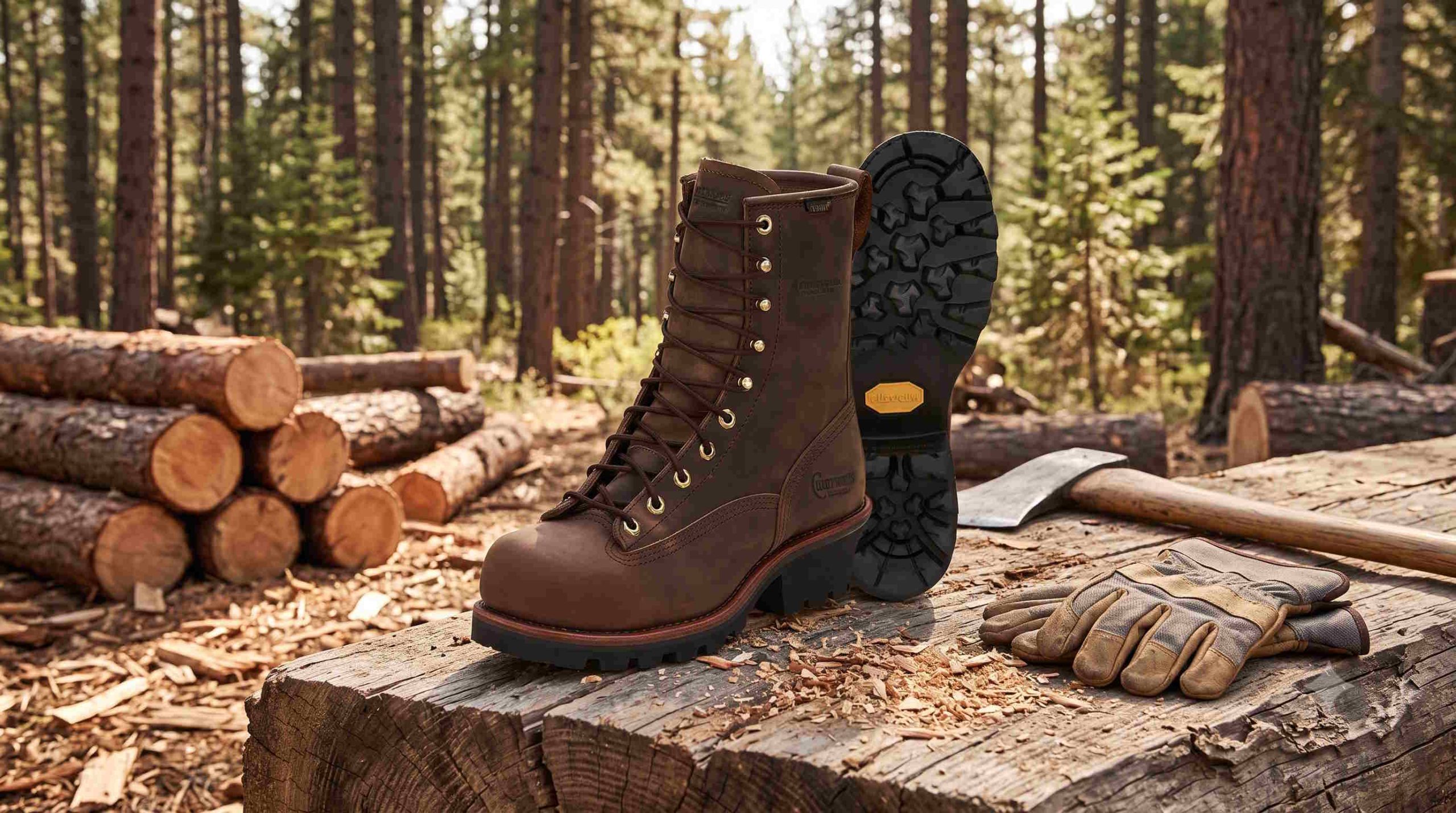
The Apache is an 8-inch lace-to-toe logger in full-grain leather with a steel safety toe and a lug outsole, built on a roomy last that owners consistently describe as wide and toe-forgiving. Owners repeatedly call out the Vibram-style oil-resistant sole as a genuine strong point even when they’re unhappy with everything else.
A few misconceptions worth clearing up:
- “Waterproof means it’ll shrug off puddles all day.” Not according to owners. Several who plowed through storms or wet fields ended the day with wet, cold feet. Treat it as water-resistant that benefits from conditioning, not a rubber boot.
- “It’s still the old USA-made Chippewa.” Many long-time buyers were surprised to find current pairs made in Vietnam, and the packaging language around country of origin confused several of them.
- “Steel toe or not?” A handful of buyers were caught off guard by the steel toe — some expected it and it wasn’t clear, others didn’t expect it and got it. Confirm the exact variant before you order.
Key Specs That Actually Matter
- Steel safety toe — the impact protection meets the kind of safety-toe performance defined under ASTM F2413, the standard OSHA references for protective footwear, but the recurring issue is the leather over the toe wearing thin and exposing that steel early. Watch this zone.
- Full-grain leather upper — praised for looks and comfort; criticized by longtime owners as thinner than older pairs. Conditioning it early comes up again and again.
- Roomy, wide-friendly last — the biggest fit win. Wide and standard feet report excellent room; very narrow feet occasionally report extra volume.
- Lug / oil-resistant outsole — consistently the most durable part of the boot; several owners note the sole outlasts the upper.
- Lace-to-toe hardware — laces are a repeated weak point (see below), and a few report an eyelet or hook issue.
- Weight — opinions split: some call it light for a steel-toe logger, others find it a touch heavy and bulky. Expect a substantial, protective boot rather than a nimble one.
Because sole design drives so much of the day-to-day experience, the work boot soles explained guide is worth a look if you’re weighing grip on wet metal versus rough terrain.
Sizing & Fit — What Owners Actually Report
Bottom line: these run true to size for most, with a notably roomy, wide-friendly toe box. This is one of the rare loggers where wide-footed owners repeatedly say the fit is perfect.
- True to size is the dominant verdict; most owners order their normal size and are happy.
- Width behavior: runs generous. Wide feet love it; standard feet find it comfortably roomy; a few narrow-footed owners feel extra volume and wish it were snugger.
- Half sizes: owners between sizes generally report going with their standard rather than sizing up, since the toe box already has room.
- Break-in: most report little to no break-in — a major selling point — though a minority find the leather stiff at first.
One isolated owner reported a mis-labeled pair fitting a size off, framed as a likely factory one-off rather than a pattern. If you want a foot-shape checklist to dodge heel-slop and volume issues before they start, the work boot fit and sizing guide is the one to bookmark.
Feature-by-Feature Breakdown (Truth vs Marketing)
| Feature | What the Marketing Implies | What It Actually Means (Owner Experience) | Compared to Competitors |
|---|---|---|---|
| Waterproof | Keeps feet dry | Water-resistant at best; several report wet feet after storms/puddles unless heavily conditioned | Trails dedicated waterproof-membrane boots on wet-out resistance |
| Full-grain leather | Rugged, durable | Comfortable and handsome, but toe-box leather runs thin and tears early for many | Longtime owners rate older Chippewas and some Red Wing/Carolina pairs as tougher |
| Steel toe | Safety protection | Protection is present, but thin overlying leather exposes the steel early on hard-used pairs | Protection on par; leather coverage durability lags |
| Roomy last / wide fit | Comfortable fit | Genuinely excellent, especially for wide feet — a top-tier fit story | Beats many loggers that pinch wide feet |
| Oil-resistant lug sole | Grip and traction | Consistently praised; often outlasts the upper; slightly slick on wet metal for a few | Competitive; the boot’s most reliable component |
| Laces | Standard hardware | Repeated weak point — several shred or snap within weeks | Below several rivals; easy aftermarket fix |
Real-World Owner Experience (Deep Pattern Analysis)
1. The re-buyer paradox and the “time-machine effect” (the pattern owners obsess over)
In a nutshell: This boot’s reputation is caught between two crowds who both bought the same model. One crowd is on their third, fourth, even fifth pair over 8–30 years and won’t wear anything else. The other crowd — often also longtime Chippewa fans — says the current pair fell apart faster than any they’d owned.
What most reviews won’t tell you: the anger and the loyalty are frequently coming from the same type of buyer. Owners who loved older, USA-made Chippewas are the harshest graders of current Vietnam-made pairs, explicitly saying the leather feels thinner than the boots they remember. So the polarization isn’t “good buyers vs bad buyers” — it’s partly a production-era comparison happening in real time.
Hidden strength: the repeat-buyer volume is real. A lot of people who complain about a specific pair still say Chippewa is the only brand they’ll buy, which tells you the core boot still wins loyalty.
Hidden weakness: if your mental image of “Chippewa toughness” comes from a pair you owned a decade ago, the current toe-leather may not match that memory.
What to do about it: buy for what the current boot actually is — a comfort-forward logger — and condition the leather from day one rather than assuming legacy durability.
2. Failure timing and sequence: the toe tells first, and it tells early
In a nutshell: The most information-rich pattern in the whole sample is when and where failure starts. Across critical reviews, the first symptom is the same recurring one: the leather over the toe wears thin, cracks, or tears — sometimes within the first days of wear, frequently well before the typical 30-day return window closes, and commonly around the 2–3 month mark for moderate users.
What most reviews won’t tell you: the toe is the leading indicator. Owners describe bumping the toe on a stoop or kicking mud off and finding a hole; from there the steel toe becomes visible under the leather. If your toe leather is looking thin at week two, that’s your early-warning signal — not a cosmetic fluke.
Hidden strength: because the tell comes early, an attentive buyer can catch it inside the return window if they inspect and lightly stress-test right away.
Hidden weakness: several owners report the failure landing just after returns closed, or being told the wear was “normal,” leaving them stuck.
What to do about it: inspect and flex the toe hard in the first week, condition the toe leather immediately, and don’t wait to test — the window is the whole game here.
3. The waterproofing gap
In a nutshell: Despite the name, waterproofing is a recurring letdown. Owners who genuinely got wet — storms, puddles, wet fields — report soaked feet, and at least one long-term owner resorted to repeated aggressive leather-waterproofing treatments to compensate.
Hidden strength: with diligent conditioning, several owners keep them water-resistant enough for their conditions.
Hidden weakness: out of the box, it’s not the sealed barrier the name suggests.
What to do about it: treat them before first wear and re-treat regularly; if you truly need dry feet in standing water, this isn’t the tool. The best waterproof work boots roundup is the better starting point if dryness is non-negotiable.
4. The comfort camp is huge and consistent
In a nutshell: The single most repeated positive is comfort with little or no break-in. Electricians, linemen, railroad crews, miners, mechanics, and 12-hour-shift workers describe all-day wear without foot pain, good arch and ankle support, and a boot they forget they’re wearing.
Hidden strength: for a steel-toe logger, “comfortable straight from the box” is genuinely rare and shows up constantly here.
Hidden weakness: a minority with flat feet or very narrow feet find the arch high or the volume too generous.
What to do about it: if comfort is your top priority and your use is light-to-moderate, this is squarely your boot. Insole swaps come up often for dialing in fit.
5. Lace hardware is the small, fixable weak spot
In a nutshell: Across both happy and unhappy owners, laces are a repeated gripe — several shred or snap within weeks, and a few flag cheap-feeling hardware. Notably, even loyal re-buyers mention it, then just swap in better laces.
What to do about it: budget for aftermarket laces (leather or Kevlar-style come up) as a near-default upgrade; it’s cheap and it removes the most common early annoyance.
The Good, The Bad & The Ugly
The Good (comfort & fit):
- All-day comfort with minimal break-in, praised across trades
- Roomy, wide-friendly toe box — a standout for wide feet
- Reliable, grippy oil-resistant lug sole that often outlasts the upper
- Strong arch and ankle support for a logger
The Bad (fixables & annoyances):
- Laces are a frequent early failure — plan to replace them
- Not truly waterproof out of the box; needs conditioning
- A bit heavy/bulky for some; slightly slick on wet metal for a few
The Ugly (the real durability risk):
- Thin toe-box leather exposing the steel toe, sometimes within days
- Failures clustering near or just after the return window
- Longtime owners consistently grading current leather below older USA-made pairs
Mini Toolkit: Decide + Fix (Fast)
Issue-Tag Box: #thin-toe-leather · #steel-toe-exposure · #not-really-waterproof · #lace-shred · #wide-foot-win · #no-break-in
Fit Mini-Matrix:
| Foot type | Verdict |
|---|---|
| Wide | Excellent — a top reason to buy |
| Standard | Roomy and comfortable, true to size |
| Narrow | Usable but may feel voluminous; lace snug or add an insole |
Mini Decision Tree:
- If you have wide feet and want out-of-box comfort → strong buy.
- If you abuse the toe daily (climbing, demo, hard grading) → skip or expect early toe wear.
- If you need true waterproofing → look elsewhere.
- If you loved an old USA-made pair → buy for comfort, not legacy toughness.
- If laces failing early would ruin it for you → pre-order replacement laces.
Troubleshooting Quickflow:
- Toe leather thinning early? → Condition it now and inspect daily inside the return window.
- Steel showing through? → Return immediately; this is the known failure, not normal wear.
- Feet getting wet? → Re-treat with waterproofing conditioner in multiple coats.
- Laces shredding? → Swap to leather or Kevlar-style laces.
- Fit too roomy? → Add a supportive insole and lace tighter.
- Anything structural (sole seam, shank feel)? → Consult a cobbler or qualified repair, or verify against your employer’s PPE hazard assessment.
Sizing and hazard-matching are exactly where the logger boot buying guide earns its keep before you order.
Mini Return-Window Reality Check
Run these before your return window closes, because owner feedback shows failures cluster right around it:
- Flex and firmly press the toe box — look for thinning, cracking, or any hint of steel under the leather.
- Wear them hard for a few short sessions, including bumping the toe as you naturally would on a jobsite.
- Do a soak or heavy-hose test if you’re relying on the “waterproof” claim, then check for interior dampness.
- Tug each lace under real tension and inspect eyelets/hooks for early fraying.
- Confirm the variant matches what you ordered (steel toe vs not, size labeling).
Sizing & Insider Tips (Realistic)
- Order your true size; only size up if you run thick socks and prefer extra toe room.
- Wide and standard feet: buy with confidence — the roomy last is the boot’s best trait.
- Very narrow feet: add a supportive insole and lace snugly to take up volume.
- Condition the leather — especially over the toe — before first wear; owners who do this report better longevity.
- Pre-buy leather or Kevlar-style laces; treat stock laces as temporary.
- Don’t kick mud off with the toe; owners repeatedly trace early tears to exactly that habit.
- If waterproofing matters, apply multiple coats and re-treat regularly rather than trusting the name.
- Inspect the toe zone weekly for the first month — it’s your early-warning system.
- For anything past basic care — resoling, hardware replacement, structural sole concerns — consult a cobbler or qualified repair, or verify against your employer’s PPE hazard assessment, which OSHA’s foot protection rule makes the employer’s job to conduct.
- If your last pair was an older USA-made Chippewa, set expectations for comfort, not identical leather toughness.
Owner Stories
The stories below are composite scenarios reflecting repeated patterns across owner feedback.
- The wide-footed re-buyer (happy fit): A construction electrician on his fourth pair wears them half a day to break in, then forgets they’re on his feet through winter and summer. Wide feet, no pinch, great support — he tells every Red Wing wearer to switch.
- The wrong-job mismatch: A tree climber who beats his boots daily sees the steel toe pushing through the leather within weeks. Comfortable, yes — but on his job the toe leather can’t keep up, and he’s back in a different boot fast.
- The legacy comparison returner: A longtime fan whose old USA-made pair lasted years opens the box, finds thinner leather and Vietnam origin, and is disappointed before the first shift — grading today’s boot against a memory.
Who This Is For (and Who Should Skip It)
Buy it if:
- You have wide or standard feet and want a genuinely comfortable logger
- You value out-of-box comfort and minimal break-in
- Your use is light-to-moderate: everyday wear, farm/ranch, mechanic, walking
- You’re willing to condition the leather and swap the laces
- You want a reliable, grippy oil-resistant sole
Skip it if:
- You brutalize the toe daily (climbing, demo, hard grading)
- You need true, out-of-box waterproofing
- You expect the leather toughness of older USA-made pairs
- You won’t inspect and condition early in the return window
If you’re comparing options, start here: Top Logger Boot Picks
Alternatives (Quick Comparisons)
- Need real waterproofing? Prioritize a dedicated membrane boot; browse the best waterproof work boots rather than relying on this one’s name.
- Want the lightest option for long shifts? Compare against the lightest work boots roundup — a few owners find the Apache bulky.
- Cold-weather / winter priority? The insulated angle is worth weighing against purpose-built picks in the winter work boot guide.
- Want the broadest comfort-first shortlist? The most comfortable work boots list is a good cross-check, since comfort is exactly where the Apache shines.
Deep-Dive FAQ
What should I test immediately after delivery?
Inspect and stress the toe box first. Flex it hard, press for any thinning or steel showing through, tug each lace under tension, and do a water test if you’re counting on the waterproofing — owner failures cluster right around the return window, so early testing is everything.
What are the most common problems and fixes?
The top three are thin toe-box leather exposing the steel toe, laces that shred or snap early, and weaker-than-expected waterproofing. Fixes: condition the toe leather from day one and inspect it weekly, swap in leather or Kevlar-style laces, and apply multiple waterproofing coats and re-treat regularly.
Will these work with my foot type and my job?
Wide and standard feet do exceptionally well; narrow feet may find them roomy and should add an insole. Job-wise they suit electricians, linemen, mechanics, railroad and moderate-duty wearers, but owners who brutalize the toe (climbers, hard graders) see early toe-leather failure.
How long do they really last?
It’s polarized. Many moderate users get multiple years and re-buy repeatedly; a vocal group of hard users report the toe leather failing within weeks to a few months. Owner feedback doesn’t support one clean number — your job intensity and how early you condition the leather are the deciding factors.
Are they actually waterproof?
Not reliably out of the box. Multiple owners report wet feet after storms or puddles, and some maintain water-resistance only through repeated conditioning. Treat “waterproof” here as a starting point that needs upkeep, not a sealed guarantee.
Chippewa Apache vs Carolina logger — which should I pick?
It depends on fit and priority. In the feedback, several owners who tried both preferred the Apache’s roomy toe box and comfort, and a few said Carolina bothered their heels or shins — while other longtime buyers went the opposite way after durability disappointments. If comfort and wide-foot fit lead your list, the Apache tends to win; if you want maximum toe-leather toughness, cross-shop carefully.
Why do longtime Chippewa fans seem so split?
Many are comparing current Vietnam-made pairs to older USA-made boots they owned for years and feel the leather is thinner now. The loyalty to the brand is intact — the disappointment is often specifically about production changes, which is why the same person can praise Chippewa and pan their newest pair.
Final Verdict
The Chippewa Apache logger is a comfort-and-fit champion wrapped in a real durability question mark. If you have wide or standard feet, want a logger you can wear hard from the first hour with almost no break-in, and you’re willing to condition the leather and replace the laces, few boots at this level feel this good on your feet. But if you punish the toe every day, need genuine waterproofing, or expect the leather to match a decade-old USA-made pair, the current production will likely let you down — and it may do it fast, right around the return window. Buy it for comfort, inspect it early, and treat the toe leather like the fragile part it is.