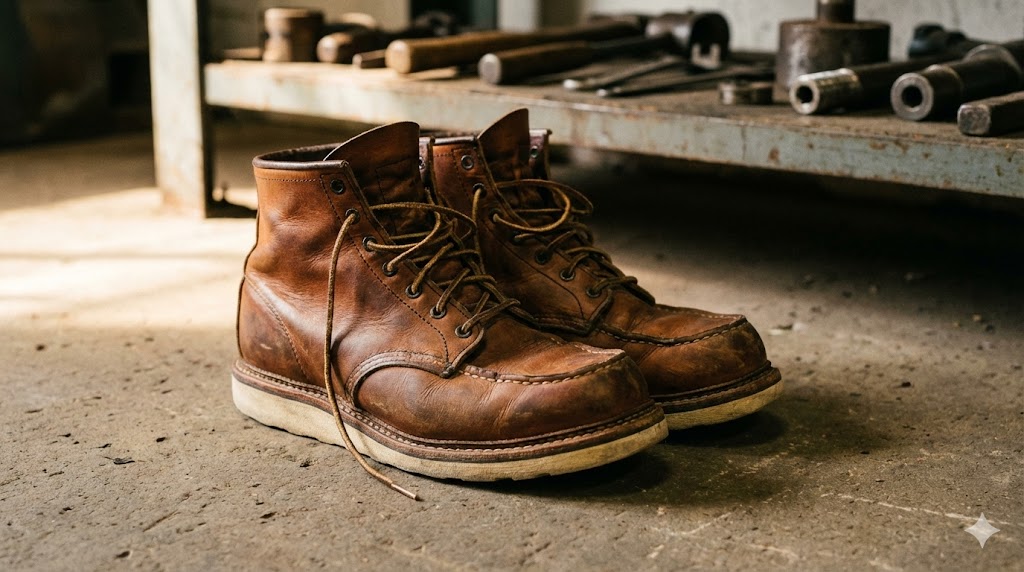
Red Wing 1907 Heritage Moc Review: Break-In Truth, Sizing Guide & Real Owner Verdict
Last updated: February 2026
- Re-checked recurring sizing complaints and updated half-size-down guidance with width-specific nuance
- Refreshed break-in tips based on the latest owner feedback patterns (late 2025 reviews included)
- Updated quality control watch-outs with recent moc toe stitching and sole-wear reports
- Verified current Amazon availability and pricing
Disclosure: SturdyBoot.com participates in the Amazon Associates program. If you purchase through our links, we may earn a small commission at no extra cost to you. This never influences our analysis or recommendations.
Why This Boot Keeps Sparking Arguments
You have probably seen the 1907 recommended in every “buy it for life” thread on the internet. You have also probably seen someone call it a medieval torture device. Both camps are telling the truth, and that contradiction is exactly why this boot is so hard to evaluate from a product page alone.
The Red Wing 1907 Heritage Moc sits in a strange middle ground. It is a heritage boot with genuine workwear DNA, built on a resoleable Goodyear welt with triple-stitched Copper Rough & Tough leather — yet it ships without a safety toe, without a lining, and with a break-in reputation that scares off anyone who expects sneaker comfort out of the box. Owners either swear by it for decades or abandon it within the return window.
I spent hours digging through real owner feedback — from Amazon, Red Wing’s own site, and Zappos — to figure out where the truth actually sits, who this boot rewards, and who should save their money. If you are shopping across the broader Red Wing lineup and want a framework for comparing models, our Red Wing boots buying guide breaks down the key decision points before you commit.
How this review was built (so you can trust it)
- Approximate reviews analyzed: ~150+ individual owner reviews from Amazon, RedWingShoes.com, and Zappos.
- Time window covered: Feedback spans from approximately 2011 through late 2025, giving us both fresh first-impressions and long-term durability reports over a decade-plus window.
- Synthesis method: I tagged every piece of feedback into categories — comfort and break-in, sizing consistency, traction and slip behavior, durability and wear patterns, waterproofing and breathability, build quality and QC issues, and support/warranty/returns. I then separated “fit or setup-driven issues” (things the buyer could have avoided with better sizing or break-in pacing) from “likely product failures” (defects, premature sole wear, seam separation).
- Important limitations:
- Owner reviews skew toward the extremes — people who love or hate a product are more likely to write about it than people who feel neutral.
- Jobsite variability matters enormously. A boot performing beautifully on office floors or light outdoor use may struggle under daily concrete pounding.
- Individual foot shape, sock choice, and insole swaps change the experience dramatically.
- I prioritized recurring patterns over isolated complaints. A single report of a defect is noted; a pattern of the same defect across multiple owners carries more weight.
Quick Verdict (TL;DR)
Best for:
- Casual-to-moderate work use where you want heritage style and resoleable longevity (delivery drivers, project managers, light trades, all-day standing on varied surfaces)
- Owners who value a boot that molds to their foot over time and develops unique character with wear
- Buyers willing to invest in a proper break-in period for a payoff that lasts years — potentially decades
Not for:
- Anyone who needs certified safety toe protection on a regulated jobsite (this is a soft toe heritage boot — verify your employer/site PPE requirements and confirm ratings via the manufacturer labeling)
- Buyers who expect sneaker comfort from day one and will not tolerate a stiff, sometimes painful first few weeks
- Heavy-duty daily concrete pounders who need a sole that will not wear down quickly under aggressive surface contact
Standout win: The Copper Rough & Tough leather ages remarkably well. Scuffs blend in rather than standing out, patina develops beautifully, and the boot genuinely looks better after a year of honest wear than it does brand new.
Watch-outs: Quality control inconsistency is a real, recurring theme. Multiple owners report mismatched toe boxes, staples left in the heel area, glue bleeding from moc stitching, and premature seam separation — all on a boot priced north of $300. Inspect carefully upon delivery.
Confidence Score: 🟢 8/10 (High Buyer-Usefulness)
This score reflects how useful the available owner feedback is in helping you make a good purchase decision — not a reliability statistic or a product rating. I weighed pattern consistency (sizing and break-in feedback is remarkably consistent across sources and years), clarity of fit guidance (strong consensus on sizing down), how repeatable outcomes are across different use cases, and how severe the recurring downsides are (QC issues are a minority but can be expensive when they hit). The sizing guidance alone saves most buyers from a bad experience.
👉 Check today’s price on Amazon
What This Boot Is (and What It Isn’t)
The Red Wing 1907 Heritage Moc 6″ boot behaves in real wear like a premium heritage boot with genuine work-boot construction — not a modern safety work boot and not a fashion-only piece either. It sits in that rare overlap where construction workers, delivery drivers, chefs, and style-focused buyers all find something to appreciate.
Common misconceptions to clear up:
- “It’s waterproof.” It is not marketed as waterproof, and owners should not treat it as such. The oil-tanned Copper Rough & Tough leather and Norwegian-style welt offer solid water resistance — one owner even reported staying dry through motorcycle downpours — but standing water or prolonged wet conditions will eventually wet through. If waterproofing is non-negotiable, our best waterproof work boots roundup covers boots specifically engineered for that.
- “It’s true to size.” It is not. This is the single most consistent piece of feedback across all sources and all years. The 1907 runs large. Nearly every satisfied owner sized down at least a half size from their sneaker or athletic shoe size. Buying your usual size is the most common setup mistake.
- “Break-in is a few days.” For some owners it is. For the majority, expect one to four weeks of stiffness, heel pressure, and potential hot spots before the leather molds to your foot shape. This is not a defect — it is the nature of thick, unlined, oil-tanned leather over a leather insole. The payoff, according to owners who pushed through, is a custom-fit feel that lasts for years.
Key Specs That Actually Matter for This Boot
These are the features that actually drive real-world outcomes based on what owners consistently report. I am only listing what is supported by the manufacturer’s provided specs or direct owner experience — no invented numbers.
- Copper Rough & Tough Leather (S.B. Foot Tanning Co.): Oil-tanned, minimal finishing, naturally water and stain resistant. This is the feature owners praise most for long-term character. Scuffs and scratches blend into the patina rather than marring the boot. Understanding how different leathers and construction methods affect boot performance helps set expectations here.
- No. 45 Last: This last is roomier than the No. 23 last used on the Red Wing 875 and other Heritage Mocs. It accommodates a removable leather insole and gives slightly more footbed volume — which matters enormously for owners who use custom orthotics.
- Removable Leather Insole: Unusual for Red Wing Heritage boots. Owners can swap in aftermarket insoles or orthotics, or remove the insole entirely to sit directly on the vegetable-tanned leather midsole for a more traditional (and stiffer) break-in.
- Goodyear Welt with Norwegian-Style Welt Construction: This is what makes the 1907 resoleable. Multiple owners report two to three resoles over five to twelve-plus years of wear. The welt also contributes to water resistance at the sole-to-upper junction.
- Traction Tred Cushion Crepe Wedge Sole: Comfortable and quiet on hard floors but wears down noticeably faster than harder rubber compounds, especially on concrete. This is both the boot’s comfort advantage and its most common durability complaint.
- Triple Stitching: Reinforces the moc toe construction. When QC is on point, this stitching holds for years. When it is not, it is one of the first areas to show issues.
- Two Sets of Laces: Ships with both Chestnut leather laces and Taslan cord laces. The leather laces look better but break earlier according to several owners. Having a backup pair in the box is a thoughtful touch.
Feature-by-Feature Breakdown (Truth vs Marketing)
| Feature | What the Manufacturer Says | What It Actually Means (Owner Experience) | Compared to Similar Boots |
|---|---|---|---|
| Copper Rough & Tough Leather | Oil-tanned, water/stain/perspiration resistant, natural look and feel | Genuinely lives up to the billing. Owners report excellent aging, scuffs that blend in, and minimal care requirements. Bick4 and leather conditioner keep it supple without darkening. | Compared favorably to Thorogood and other heritage moc toes for leather quality. Multiple owners who own both say Red Wing leather feels more substantial. |
| Traction Tred Sole | Soft cushion crepe wedge outsole for comfort | Very comfortable on flat, hard surfaces — owners praise the cushion on concrete and warehouse floors. However, the softness means it wears down noticeably faster than firmer soles. Some owners report significant wear after a few months of daily heavy use. Traction on ice and wet surfaces is limited. | Softer and more cushioned than Vibram lug soles, but wears faster. Some owners resole with Vibram lugs for better longevity and winter traction. For a deeper comparison, our guide to work boot soles explains why sole compound matters so much. |
| Goodyear Welt / Norwegian-Style Welt | Goodyear leather welt for durability | Resoleable construction is the real long-term value proposition. Owners report multiple resoles across years or decades of ownership. There is some controversy about whether the storm welt is a “true” storm welt, but the practical water resistance at the sole junction holds up in owner reports. | Resoleable construction puts this ahead of cemented-sole competitors. Cost-per-year drops dramatically with resoles. |
| No. 45 Last | Not specified in the provided listing/spec text (available via Red Wing directly) | Roomier footbed than the 875’s No. 23 last. Accommodates the removable insole and custom orthotics. Owners with wider feet generally find it more comfortable than other Heritage models, though D width can still feel snug for genuinely wide feet. | Roomier than the Iron Ranger last and the 875’s 23 last. Owners who struggled with fit in other Red Wing models sometimes find the 45 last works. |
| Removable Leather Insole | Leather insole included | Divisive. Some owners love the added comfort layer. Others remove it immediately for orthotics or to get a more traditional footbed feel. A few owners report it feels too hard and needs replacement. The ability to swap insoles is a genuine advantage at this price point. | Most heritage moc toes at this price do not include a removable insole, making the 1907 more orthotic-friendly. |
| Made in USA | Made in USA | Confirmed across all sources. Manufactured in Red Wing, Minnesota. This is a consistent source of pride among owners and frequently cited as a purchasing motivator. | Matches Thorogood’s USA-made heritage line. Differentiates from many boots in the sub-$300 range that are imported. |
Real-World Owner Experience (Deep Pattern Analysis)
Pattern 1: Sizing Is the Make-or-Break Decision
In a nutshell: The single most discussed topic across all owner feedback. Get this wrong and everything else about the boot fails.
Hidden strength: The consensus is remarkably consistent, which makes guidance reliable. Most satisfied owners sized down a half to one full size from their sneaker or athletic shoe size. The No. 45 last runs generous, and the leather stretches further during break-in. Owners who visited a Red Wing store for Brannock device measurement or thermal imaging sizing report the best outcomes.
Hidden weakness: Some owners sized down too aggressively (1.5 sizes) on advice from sales staff or forums and ended up with boots that never stretched enough. A few owners also found that buying a wide (EE) width caused heel drag after the leather stretched, while others who needed wide did not get it and suffered through a painfully narrow toe box. For a systematic approach to nailing fit, our work boot fit and sizing guide walks through the measuring process step by step.
What to do about it: Start by measuring on a Brannock device. Go a half size down from your Brannock measurement for D width. If you have genuinely wide feet, try EE — but be aware the leather will stretch, so a snug-but-not-painful initial fit in EE is what you want. Wear the thick socks you plan to use regularly when trying them on.
Pattern 2: Break-In Is Brutal but Transformative
In a nutshell: The majority of owners describe a genuinely painful first one to four weeks, followed by what many call the most comfortable boot they have ever worn.
Hidden strength: Once broken in, the Copper Rough & Tough leather molds to individual foot shapes in a way that softer, pre-cushioned boots cannot replicate. Owners with years of wear consistently describe a “glove-like” or “second-skin” fit. The thick leather that causes initial pain is the same leather that delivers long-term custom comfort.
Hidden weakness: The heel counter area is a consistent pain point during break-in. Multiple owners report heel blisters, raw spots, and even numbness in the first weeks. A few owners never made it through break-in and considered the boot unwearable. If you have ongoing foot pain or medical concerns, consider checking with a clinician or podiatrist before committing to an aggressive break-in.
What to do about it: Wear them around the house for short sessions (starting at twenty minutes, building up gradually) before committing to full-day wear. Apply leather conditioner (Bick4 is the most-recommended by owners) to soften the leather around the heel counter and ankle area. Wear thick wool boot socks. Do not try to accelerate break-in with extreme heat or chemical softeners.
Pattern 3: Sole Comfort Is Excellent — But Sole Durability Is Not
In a nutshell: The Traction Tred crepe wedge sole is one of the most comfortable outsoles in heritage boots, and also one of the fastest-wearing.
Hidden strength: Owners who stand all day on hard floors — chefs, retail workers, delivery drivers — consistently praise the cushioning. The wedge profile also provides stable footing on flat surfaces and ladders.
Hidden weakness: Owners who wear the 1907 daily on concrete, asphalt, or rough outdoor surfaces report the sole wearing thin faster than expected. A few owners reported needing a resole after just a few months of aggressive daily use. The sole also picks up debris and offers limited grip on ice or wet, slippery surfaces.
What to do about it: If you plan heavy daily concrete use, budget for earlier-than-expected resoles or ask your cobbler about upgrading to a Vibram lug sole. Rotating with a second pair of boots extends sole life significantly.
Pattern 4: Leather Aging Is the Real Payoff
In a nutshell: The Copper Rough & Tough leather is the star of this boot, and it earns its reputation over time.
Hidden strength: Scuffs and scratches do not ruin the look — they enhance it. The oil-tanned leather develops a two-tone patina that is unique to each pair. Owners consistently describe the boot looking better at one year than at purchase. Minimal care is needed: a light coat of conditioner every few months keeps the leather healthy without darkening it significantly.
Hidden weakness: A few owners noticed what they described as “bumps” or irregularities in the leather on the vamp area, possibly from how the hides are cut. The unlined construction also means interior seams can rub against feet without socks thick enough to buffer.
What to do about it: For conditioning, Bick4 is the most-recommended product across owner feedback for maintaining color while keeping leather supple. Mink oil works but will darken the leather. Always wear boot-weight socks to protect against interior seam contact.
Pattern 5: Quality Control Is a Legitimate Concern
In a nutshell: The majority of 1907s arrive in excellent condition, but a recurring minority of owners report QC defects that are unacceptable at this price point.
Hidden strength: When QC is on point, the craftsmanship is consistently described as “top notch” — owners cite the stitching, welt, leather quality, and overall build as clearly superior to mass-market competitors.
Hidden weakness: Reports include staples left protruding from the heel area, mismatched or asymmetrical toe boxes, glue bleeding from moc stitching, premature seam separation around the toe box, and stitching coming undone within the first few wears. Several owners also reported receiving boots that appeared used or damaged.
What to do about it: Inspect carefully upon delivery. Check both boots for symmetry, run your hand inside the heel area for staple points, examine all stitching on the moc toe, and look for glue residue along the welt. If buying in-store, inspect before leaving. If buying online, photograph everything before your first wear so you have documentation for returns.
The Good, The Bad & The Ugly (Pros/Cons)
The Good
Build & Materials:
- Made in USA with genuine Goodyear welt construction — resoleable for decades of use
- Copper Rough & Tough leather from S.B. Foot Tanning Co. ages beautifully and requires minimal maintenance
- Norwegian-style welt and triple stitching add durability and water resistance at the seams
- Removable leather insole allows for orthotic swaps — rare in heritage boots at any price
Comfort (Post Break-In):
- Once broken in, owners overwhelmingly describe a custom-molded, glove-like fit
- Traction Tred wedge sole provides excellent cushioning on hard surfaces
- The No. 45 last offers a roomier footbed than most Red Wing Heritage models, accommodating wider feet and aftermarket insoles
Style & Longevity:
- Develops a unique patina that consistently earns compliments from owners
- Bridges work and casual wear — equally at home on a jobsite (soft-toe environments) and a weekend outing
- Multiple owners report 5, 10, even 12+ years of active use with periodic resoles
- Ships with both leather and cord laces for style versatility
The Bad
Sizing & Fit:
- Runs significantly large — buying your sneaker size virtually guarantees a poor fit
- Width can be tricky: D feels snug initially but stretches; EE can develop heel drag after break-in
- In-store sizing advice is inconsistent — some owners were sized correctly, others were put in dramatically wrong sizes
Break-In:
- Genuinely painful for the majority of owners during the first one to four weeks
- Heel counter and ankle area are the most common hot spots for blisters and rubbing
- A minority of owners never achieved a comfortable fit despite weeks of effort
The Ugly
Quality Control:
- Staples left in the heel area (reported by multiple owners at both the $300+ price point)
- Asymmetrical toe boxes and visible defects in stitching or glue
- Seam separation around the moc toe area within weeks or months for some owners
- Several reports of receiving boots that appeared previously worn or handled roughly
Sole Durability:
- Traction Tred sole wears down faster than expected under heavy daily use, especially on concrete
- Limited traction on ice, slush, and wet surfaces — owners who need winter grip should look at lug-soled alternatives
- Some owners report needing a resole earlier than anticipated given the price
Laces:
- Leather laces look great but break relatively early for some owners despite conditioning
- Cord backup laces are functional but lack the aesthetic appeal of the leather set
Mini Toolkit: Decide + Fix (Fast)
Issue-Tag Box
Based on the recurring patterns across owner feedback, here are the top issues to watch for with the Red Wing 1907:
- 🏷️ Runs large / sizing confusion — most common issue, most preventable
- 🏷️ Long break-in / heel blisters
- 🏷️ Outsole wears fast on concrete
- 🏷️ Stitching / seam issues (moc toe area)
- 🏷️ Heel slip when oversized
- 🏷️ Laces break early (leather set)
Fit/Sizing Mini-Matrix
| Your Situation | Recommended Action |
|---|---|
| Normal-width foot, sneaker size known | Size down 0.5–1 full size from sneaker size in D width. Brannock measurement is ideal. |
| Wide foot or high-volume foot | Try EE width at 0.5–1 size down. Expect the leather to stretch, so a snug (not painful) initial fit is correct. |
| Between sizes or unsure | Visit a Red Wing store for thermal imaging or Brannock sizing. If ordering online, buy from a retailer with free returns and test with your intended boot socks. |
Mini Decision Tree
- If you need a certified safety toe for your jobsite → Skip this boot. It is a soft-toe heritage boot. Check our best work boots list for rated options.
- If you want a “buy it for life” boot and are willing to endure break-in → Strong candidate. Size down and be patient.
- If you pound concrete daily and need soles that last → Proceed with caution. Budget for earlier resoles or a Vibram lug swap.
- If you have wide feet and other Red Wing models felt narrow → The 45 last may work for you in EE width. Worth trying.
- If you need a boot comfortable from day one with zero break-in → Look elsewhere. This boot rewards patience, not instant gratification. Our most comfortable work boots guide covers options that deliver cushion out of the box.
Troubleshooting Quickflow: “My 1907s Hurt”
- Check sizing first — Are you in your sneaker size? You are likely too large. Sizing down is the most common fix for heel slip, toe bang, and general discomfort.
- Assess sock thickness — Thin dress socks cause friction. Switch to medium-to-heavy wool boot socks (Darn Tough or similar).
- Apply leather conditioner to pain points — Work Bick4 or Red Wing Leather Conditioner into the heel counter and ankle collar to soften stiff areas.
- Pace the break-in — Start with one to two hours per day at home. Increase gradually. Do not jump to a full work shift in week one.
- Consider an insole swap — If the leather insole feels too hard or flat, swap in an aftermarket insole with arch support. The 45 last provides the volume for this.
- If pain persists after three to four weeks of proper sizing and gradual wear — the boot may not suit your foot shape. Use the return window. Consider checking with a clinician or podiatrist if you have ongoing foot pain or medical concerns.
If you want a full troubleshooting framework for common boot problems beyond just the 1907, our work boot troubleshooting guide covers dozens of issues and fixes.
Mini Return-Window Reality Check
Your return window is your safety net. Here is what to validate fast before the window closes:
- Heel lock under real socks: Lace up with the boot socks you will actually wear. Walk stairs, bend your knees, go up on your toes. Any persistent heel slip after snug lacing likely means you need a smaller size or narrower width.
- Toe room after a simulated shift: Wear them around the house for a few hours. Your feet swell as the day goes on. If your big toe is hitting the front by hour three, the boot is too short — even if it “felt fine” when you first tried them on.
- Symmetry and build quality: Compare both boots side by side. Check toe box shape, stitching alignment on the moc toe, and run your fingers inside the heel for any protruding staples or rough spots.
- Sole condition and traction feel: Walk on a smooth kitchen floor and then on an outdoor surface. Does the sole grip adequately for your typical work environment?
- Hot spots vs. break-in discomfort: Tightness that eases as you walk is normal break-in. A sharp, localized pain point that gets worse — especially on a bony area of the heel or instep — may indicate a fit issue, not a break-in issue.
- Insole comfort baseline: Try the included leather insole and your own preferred insole. Decide early which setup you will use long-term.
For a broader pre-purchase checklist that works across all boot types, our Red Wing boots buying guide includes return-window strategies specific to the Heritage line.
Break-In / Fit Tips (Job-Realistic)
- Size down. This cannot be overstated. A half to one full size down from your sneaker size is the starting point. Use a Brannock device measurement if possible.
- Wear thick wool boot socks from day one. They buffer against interior seams (this boot is unlined) and reduce friction on the heel counter during break-in.
- Start with short indoor sessions. Twenty to thirty minutes around the house the first day, adding time gradually over two to three weeks. Do not commit to a full work shift during week one.
- Apply leather conditioner to stiff areas early. Bick4 is the most-recommended product by owners. Work it into the heel counter, ankle collar, and any areas that feel rigid. This softens the leather without significantly changing the color.
- Lace strategically. If you experience heel slip, try a “heel lock” lacing pattern using the top eyelets. This pulls the heel back into the pocket without over-tightening the forefoot.
- Do not use extreme heat methods. No hair dryers on high, no ovens, no boiling water. These can damage the leather, warp the sole adhesion, and void any goodwill with Red Wing if you need warranty service later.
- The leather laces stretch. If they feel loose after the first week, that is normal. Switch to the cord laces for a more consistent tension during break-in, then go back to leather for aesthetics once the boot has molded.
- Consider removing the leather insole temporarily. Some owners found that removing the included insole during break-in allowed their foot to sit lower in the boot, reducing heel slip and improving the initial fit. Add the insole (or your own orthotic) back once the leather upper has stretched to accommodate it.
- Condition, do not drench. A thin coat of conditioner is plenty. Over-oiling the leather can make it too soft too fast, and products like mink oil will darken the Copper Rough & Tough color significantly.
- Expect heel discomfort but monitor it. Mild stiffness and pressure on the heel is standard break-in. Sharp, tearing pain or numbness is not — if this persists, reassess your sizing and width. Consider checking with a clinician or podiatrist if you have ongoing foot pain or medical concerns.
- Rotate with another pair of shoes if possible. Giving the boot a day off between wears allows the leather to rest and dry, which actually speeds up the molding process compared to wearing the same pair every single day.
- Know your break-in exit point. If the boot is still causing significant pain after three to four weeks of gradual wear with proper socks and conditioning, the boot may simply not suit your foot shape. Use your return window rather than enduring months of hope. For more strategies on softening stiff boots, our break-in tips guide covers safe methods that work across brands.
See It on Feet: Visual Reality Check
Specs and reviews can only tell you so much — seeing how a boot actually looks and moves on a real foot under real conditions fills in the gaps. This walkthrough video gives you a visual reference point for the 1907 in action.
What to look for in this video (based on owner patterns):
- Fit cues: Watch for heel lift when walking, toe pinch or toe box crumpling, how the boot wraps around the instep, and whether the collar sits flush against the ankle or gaps open up.
- Flex cues: Notice where the boot creases during a natural stride. Moc toe boots crease differently than plain-toe or cap-toe designs — the crease typically forms across the moc stitching line. Watch for stiffness on stairs or inclines.
- Outsole cues: Look at how the Traction Tred wedge sole contacts the ground. Does it grip smoothly or show any slip moments? Notice the flat-bottom wedge profile — great for ladders and flat surfaces, less aggressive than a lugged sole.
- Build cues: Check the stitching visibility on the moc toe, the welt where it meets the upper, and how the leather laces seat in the eyelets. Look for any signs of the welt “rolling” or the sole edge separating.
Missing context note: A short video will not reveal the longer-term themes that owners frequently report — specifically, how fast the Traction Tred sole wears down under daily use, whether the moc toe seams hold over months, and how the leather patina develops. Those are patterns that only emerge over weeks and months of real wear.
Owner Stories
The stories below are composite scenarios reflecting repeated patterns across owner feedback.
The Construction Veteran Who Came Back for Pair Three: A twenty-year construction worker bought his first pair of 1907s as an off-duty boot after resoling his Red Wing 877s. He sized down a half size, endured a two-week break-in, and found the Copper Rough & Tough leather developed a worn-in look he loved from the start. Five years in, the soles wore through and he had them resoled — at a fraction of replacement cost. He now calls them his “forever boots” and owns multiple Red Wing models, but the 1907s are the ones he reaches for when he’s not on a regulated jobsite.
The Wide-Foot Office Worker Who Almost Returned Them: After ordering his usual size in D width, this buyer experienced immediate heel slip and toe pinch. He nearly sent them back but decided to try EE width a half size down instead. The second pair fit snugly at first — uncomfortably so for the first week — but after conditioning the heel counter with Bick4 and wearing thick wool socks for two weeks of evening sessions, the leather stretched into what he described as the most comfortable boot he’d ever worn. He now wears them daily as a chef, standing all day with no back or foot pain.
The Frustrated First-Timer Who Hit a QC Wall: A buyer excited about his first Red Wing purchase drove four hours to a store, got professionally sized, and brought home a pair of 1907s. Two days later, he felt a sharp pain in his heel and discovered a protruding staple inside the boot. He exchanged them, but the second pair had visibly asymmetric toe boxes. After a third exchange with similar issues, he walked away from the brand entirely. His experience represents a minority pattern — but one that surfaces often enough to warrant careful inspection of every pair before committing.
🔎 See more owner feedback on Amazon
Who This Is For (and Who Should Skip It)
Buy it if:
- You want a heritage boot built on resoleable Goodyear welt construction that can last a decade or more with proper care
- You work in environments where a soft-toe boot meets your safety requirements (always verify your employer/site PPE requirements)
- You value leather quality and patina development — you want a boot that tells a story after a year of wear
- You are willing to invest two to four weeks in a genuine break-in process for a long-term payoff
- You have wider-than-average feet and have struggled with other Red Wing lasts — the No. 45 last is worth trying in EE
- You want the option to swap in custom orthotics (the removable insole accommodates this)
Skip it if:
- Your jobsite requires ASTM-rated safety toe protection — this boot does not carry that certification. According to OSHA’s general foot protection standards, employers must ensure protective footwear when foot injuries from falling, rolling, or piercing objects are possible.
- You need immediate out-of-box comfort with zero break-in tolerance
- You work primarily on ice, wet tile, or oil-slick surfaces where aggressive traction is critical — the Traction Tred sole was not designed for that. Consider our best work boots roundup for slip-rated options.
- You pound concrete daily and need soles to last more than a few months without resoling
- You are not willing to carefully inspect a boot upon delivery and navigate a potential return/exchange for QC issues
- Your budget does not comfortably accommodate a $300+ boot plus potential insole and resole costs over time
👉 Check today’s price on Amazon
If you’re comparing options across the Red Wing Heritage lineup, start here: Top Red Wing Boot Picks
Alternatives (Quick Comparisons)
If the 1907 is not the right fit for your situation, here are alternatives worth considering based on the patterns in owner feedback:
- Red Wing 875 (Classic Moc on No. 23 Last): Same Moc Toe design but built on a narrower last without the removable insole. Owners who found the 1907 too roomy (especially in D width) sometimes prefer the 875. The trade-off is less orthotic flexibility.
- Red Wing Iron Ranger: If you want Red Wing heritage construction but prefer a cap-toe look and a slightly different fit profile, the Iron Ranger is the most common alternative owners mention. Several owners note the 1907 has an easier break-in than the Iron Ranger. Our Red Wing warranty guide applies equally to both models.
- Thorogood American Heritage Moc Toe: The most frequently mentioned competitor in owner feedback. Often praised for a more comfortable out-of-box experience and lower price point, though multiple owners who have owned both say the Red Wing leather quality feels more substantial long-term.
- Red Wing Roughneck: If you like the 1907’s style but need a lugged sole for winter traction and rough terrain, the Roughneck uses a Vibram lug outsole instead of the Traction Tred. Several owners specifically mentioned upgrading to Roughnecks for winter after finding the 1907 slippery on ice.
Deep-Dive FAQ
What should I test immediately after delivery?
Before your first real wear, inspect both boots side by side for symmetry in the toe box area and along the moc toe stitching. Run your fingers inside the heel counter to check for protruding staples — this has been reported by multiple owners. Check for glue residue along the welt. Then lace up with the boot socks you intend to wear, walk around for fifteen to twenty minutes, and assess heel lock, toe room, and any immediate sharp pressure points. Photograph the boots from multiple angles in case you need to document a defect for returns.
What are the most common problems and fixes?
The most common issues are oversizing (fix: size down 0.5–1 from sneakers), heel blisters during break-in (fix: leather conditioner on the heel counter, thick wool socks, gradual wear), heel slip (fix: heel-lock lacing, thicker socks, or sizing down further), and premature sole wear on concrete (fix: rotate boots, budget for resoles, or upgrade to Vibram lug sole). QC defects like mismatched toe boxes or staples require returns — these are not user-fixable.
Will this work with my job and surfaces?
The 1907 works well for light-to-moderate trade work (delivery, project management, light construction), all-day standing on flat hard surfaces (retail, warehouse, kitchen), casual outdoor use, and general daily wear. It is not ideal for regulated safety-toe jobsites, prolonged exposure to standing water, icy conditions, oil-slick shop floors, or heavy daily concrete work where sole wear is a concern. For job-specific boot recommendations, our work boots by job type guide matches boots to work environments.
How does sizing run compared to what people expect?
Large. This is the single most consistent piece of owner feedback across all sources. The typical recommendation is to size down a half to one full size from your sneaker or athletic shoe size. Owners who use a Brannock device generally report going a half size down from their measured Brannock size. D width accommodates normal to slightly narrow feet. EE width is recommended for genuinely wide feet, keeping in mind the leather stretches during break-in.
How long does break-in feel for most owners?
The most commonly reported break-in window is one to four weeks of gradual wear. Some owners report comfort from day one (these tend to be people who sized accurately and have worn stiff leather boots before). The majority describe noticeable stiffness and heel discomfort for the first two weeks, with significant improvement by week three or four. A smaller group reports needing a full month before the boot felt truly comfortable. Owners who forced a full work shift too early in the process had the worst experiences.
Can I use custom orthotics with this boot?
Yes, and this is one of the 1907’s key differentiators. The No. 45 last and removable leather insole are specifically designed to create enough volume for aftermarket insoles or prescription orthotics. Multiple owners confirm successful use of custom orthotics in this boot. Remove the included leather insole before inserting your own.
Is this boot worth the price?
Owners who make it through break-in and have a QC-clean pair overwhelmingly say yes. The resoleable construction means the cost-per-year drops significantly compared to boots that get discarded after one or two years. Multiple owners report five, ten, even twelve-plus years of use with periodic resoles. However, owners who received defective pairs or never achieved a comfortable fit understandably feel differently. The value proposition depends heavily on getting the right size and a well-made individual pair.
Final Verdict
The Red Wing 1907 Heritage Moc 6″ Boot is not a boot for everyone, and it does not pretend to be. It demands patience during break-in, careful attention to sizing, and inspection at delivery to catch QC inconsistencies. It does not carry safety toe ratings, it will not keep your feet dry in standing water, and its soles will wear faster than you expect if you pound concrete every day.
But for the buyer who gets the sizing right, pushes through the break-in, and draws a well-made pair — this boot delivers something that very few modern boots can match. The Copper Rough & Tough leather develops character that makes the boot more attractive with age, not less. The Goodyear welt construction means you are buying a boot platform that can be resoled for decades. And the custom-molded fit that emerges after the leather breaks in is, according to the overwhelming majority of long-term owners, unlike anything they have experienced in other footwear.
This is a boot for the buyer who thinks in years, not months. If that is you, the 1907 rewards the investment.