The Ultimate Red Wing Boots Buying Guide (2026 Edition)
Last updated: Feb 2026
Editor’s Note: This guide is based on a deep-dive synthesis of real owner feedback and long-term usage patterns across multiple Red Wing Heritage models — spanning over a decade of buyer experiences. We cut through marketing to focus on what actually changes outcomes.
Already know what you need? Jump straight to our recommendations in the Top Red Wing Boots picks.
The Sizing Gamble, the Break-In Gauntlet, and Why Loyal Owners Sound Like Evangelists
Here is what nobody warns you about Red Wing Heritage boots clearly enough: the single biggest predictor of whether you end up loving or hating them has almost nothing to do with the boot itself. It comes down to three things you control — sizing accuracy, break-in patience, and inspecting your pair at delivery.
Across the owner feedback I analyzed — spanning hundreds of reviews over more than a decade across the Iron Ranger, 1907 Moc Toe, Blacksmith, Work Chukka, and 8146 Moc Lug — the patterns were strikingly consistent. Satisfied owners who sized down correctly, paced their break-in, and drew a well-made pair almost universally describe these boots in terms that border on devotion. Frustrated owners who bought their sneaker size, tried to power through a full work shift on day one, or received a pair with quality control defects almost universally describe them as overpriced disappointments.
Both groups are telling the truth. The difference is setup, not product.
I compared recurring owner themes across comfort, break-in timelines, fit consistency across different lasts, traction and surface sensitivity, durability patterns, waterproofing expectations, and quality control reports — then separated fit-and-setup-driven issues from likely product defects. What emerged is a category where the right preparation eliminates most of the risk, and the wrong expectations create most of the regret.
If you are trying to understand boot construction fundamentals before diving in, the Work Boots 101 primer ties features to jobsite risks and clarifies where Heritage boots fit in the broader landscape.
Quick Summary: The Fast Verdict
The Golden Rule: Red Wing Heritage boots reward the buyer who gets sizing right, accepts a real break-in period, and inspects their pair carefully at delivery. Skip any one of those three steps and you are gambling with a $300+ purchase.
Questions to Ask Before Buying:
- Does my job or employer require ASTM-rated safety footwear? If yes, Heritage boots are not the answer — they carry no safety certifications. According to OSHA’s foot protection standards (29 CFR 1910.136), employers must ensure protective footwear where foot injuries from falling, rolling, or piercing objects are possible. For a breakdown of what those certifications actually mean, the ASTM F2413-24 explainer walks through every rating.
- Am I willing to invest one to four weeks of gradual wear before these feel comfortable?
- Can I visit a Red Wing store for proper Brannock device sizing, or am I prepared to handle at least one exchange if ordering online?
- Do I have the budget for this boot plus potential aftermarket insoles and eventual resoling?
The “Don’t Do This” Warning: Do not buy your sneaker size, wear them for a full work shift on day one, and assume the leather will “stretch to fit.” This exact sequence is the origin story of most one-star reviews across the entire Red Wing Heritage lineup. Owners commonly report that sizing down a half to one full size from their athletic shoe size is the starting point — and that the break-in period requires short, gradual wear sessions before committing to all-day use.
Owner Pattern Index (Fast Diagnosis)
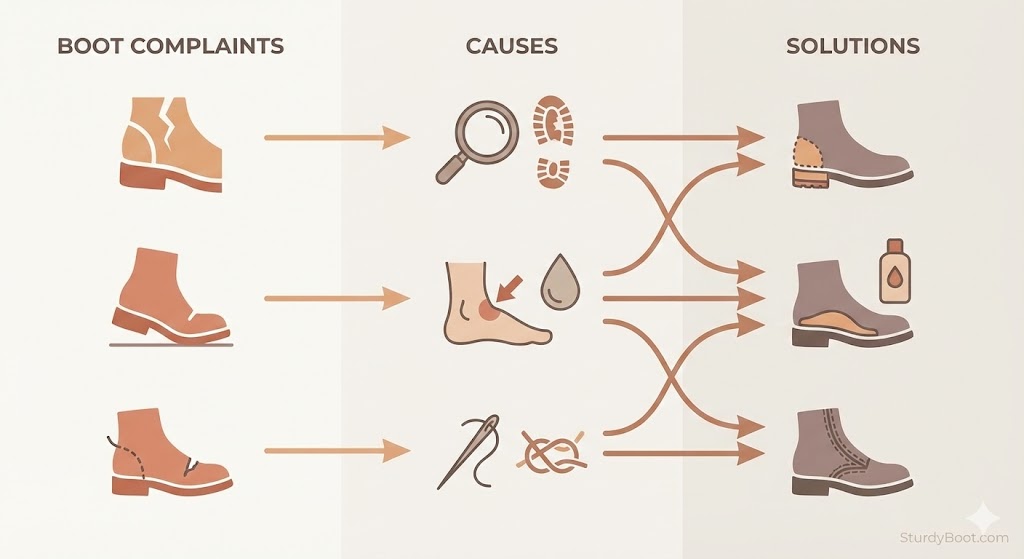
This table compiles the most recurring complaint patterns across all Red Wing Heritage models reviewed. Each row reflects a theme that surfaced repeatedly — not one-off gripes.
| What owners complain about | What it usually points to | What to check first |
|---|---|---|
| Boots feel too long, heel slips when walking | Oversizing — bought sneaker size instead of sizing down | Measure on a Brannock device; most owners size down 0.5–1 full size from athletic shoes |
| Toe box feels crushingly tight across the forefoot | Width mismatch, not a length issue — D width runs narrow on many Heritage lasts | Try EE width if available; do not size up for length to solve a width problem |
| Heel blisters and raw spots during first weeks | Normal break-in on stiff, full-grain leather — not a defect if it improves daily | Condition the heel counter with leather cream (Bick4 most recommended), wear thick wool socks, limit to short sessions |
| Feels fine when trying on at home, becomes unbearable mid-shift | Foot swell over the day exposed a sizing problem that a brief try-on masked | Wear the boots for several hours with your intended socks before committing — your feet expand under sustained load |
| Outsole wearing down noticeably fast | Traction Tred crepe soles trade cushion for durability — this is by design, not a defect | Rotate boots to extend sole life; budget for resoling; consider cobbler upgrade to Vibram lug sole for heavy-use surfaces |
| Sharp pain in one specific spot inside the boot | Possible QC defect — protruding staple, rough interior seam, or hardware issue | Run fingers inside the heel counter and along all interior seams immediately upon delivery; return if structural |
| Boot looks different from product photos — color seems off | Oil-tanned leathers photograph inconsistently; Copper Rough & Tough often appears more orange in person | This is normal for natural leather variation; conditioning or mink oil can darken to your preference |
| Speed hooks cutting into the tongue leather | Improperly crimped hooks — a well-documented, ongoing QC issue on Iron Rangers | Inspect back of each hook on delivery; if sharp or loose, return or have a cobbler replace with standard eyelets |
| No arch support, feet ache on hard floors | Heritage boots use a flat leather-over-cork footbed with no cushioning by design | Swap in aftermarket insoles — Superfeet or Red Wing’s own insoles are the most commonly recommended by owners |
Return-Window Test Protocol (Do This Before You Toss the Box)
Your return window is the most valuable asset in any Red Wing Heritage purchase. This protocol is built from the patterns that separate owners who catch problems early from those who get stuck with the wrong pair.
| Time window | Test | Pass looks like | Fail looks like | What to do next |
|---|---|---|---|---|
| Immediately at delivery | Visual and tactile inspection — compare both boots side by side for symmetry, run fingers inside heel for staples/rough spots, check welt bonding and stitching | Both boots match in toe box shape, stitching is consistent, no sharp interior points, sole is centered | Asymmetric toe boxes, protruding staple in heel, visible sole separation, loose speed hooks | Return or exchange immediately — these are not break-in issues |
| First try-on (indoor, clean floors only) | Lace up with your intended boot socks and walk on carpet for at least twenty minutes | Snug but not painful; toes can wiggle slightly; heel stays locked when walking stairs | Toes crushed across forefoot (width, not length); heel lifts with every step despite firm lacing; sharp localized pain | Width or sizing mismatch — do not “wait for stretch” on these patterns; exchange for different size or width |
| First several days of short sessions | Wear for gradually increasing periods around the house — building up from one to three hours | Stiffness that loosens as you walk; mild heel pressure that eases through the session; leather beginning to soften at flex points | Pain that intensifies over the session; blisters forming in the same spot repeatedly; numbness in toes | If pain worsens rather than eases, reassess sizing; if localized to one sharp point, inspect for defect |
| End of first week | Full real-conditions test — walk stairs, bend knees, stand for extended periods, test on your actual work or daily surfaces | Heel lockdown holds under real movement; sole grips adequately on your typical surfaces; no worsening hot spots | Heel still slipping despite snug lacing; zero traction on your actual floor surfaces; hot spots getting worse | This is your last comfortable window for a clean return — act on anything that is not improving |
| End of second week | Break-in progress check — compare comfort to day one | Noticeable improvement in flexibility; heel area softening; the boot is beginning to feel like it is conforming to your foot | No change or worsening comfort despite proper socks and gradual wear; stiffness feels structural, not surface | If no improvement by this point with correct sizing, the boot may not suit your foot shape — use remaining return window |
Pick Your Lane (Risk vs Convenience)
Not every Red Wing Heritage buyer wants the same thing, and that is the source of most expectation mismatches. From real-world owner patterns, three distinct buyer lanes emerge — and each involves a different set of tradeoffs.
| Lane | Who it’s for | What you give up |
|---|---|---|
| The Heritage Purist — values patina, resoleability, and the “buy it for life” philosophy above all else | Buyers who think in years, not months; who see break-in as a feature; who condition their leather and rotate boots | Immediate comfort, convenience of no break-in, predictable sizing from online orders |
| The Practical Crossover — wants Red Wing quality for mixed use (office, light work, weekends) without suffering for it | Workers splitting time between desk and warehouse; riders; professionals who want one boot that looks sharp and lasts | Will likely need aftermarket insoles from day one; may need to budget for an earlier resole if on hard surfaces daily |
| The Safety-First Worker — needs footwear that meets jobsite PPE requirements first, aesthetics second | Anyone on a regulated jobsite where compliance matters more than character — these buyers should skip Heritage entirely | The Heritage aesthetic, the patina story, the resoleable-for-decades narrative; safety-rated boots serve a different purpose entirely, and the work boots by job type guide matches rated boots to specific environments |
The Boring Stuff That Matters
These are the constraint factors that owners consistently wish they had thought about before buying. None of them are exciting, but every one of them shows up in regret patterns.
Foot shape factors
Width is the hidden variable in Red Wing Heritage fit. Owners with average-to-narrow feet generally have straightforward sizing experiences — size down, break in, enjoy. Owners with wider feet face a much harder puzzle: D width on most Heritage lasts runs narrow through the forefoot, and sizing up for width creates excess length that causes heel slip. EE width is the solution, but availability varies by model and retailer. A frequent buyer surprise is that the width problem only becomes obvious after extended wear — a quick try-on at the store may feel “fine” until a full day of standing reveals forefoot pressure. The Work Boot Fit & Sizing Guide walks through measurement techniques that help avoid this trap.
Jobsite surface factors
Red Wing Heritage soles are not universal-grip soles. The Traction Tred crepe wedge is excellent for cushioning on flat, hard surfaces like warehouse and kitchen floors but owners repeatedly report poor grip on ice, wet tile, and oily shop floors. The Vibram 430 mini-lug (on Iron Rangers and Blacksmiths) performs better on outdoor surfaces and light trails but still struggles on ice and snow. If your daily surfaces include consistently wet or slippery conditions, a purpose-built slip-resistant boot is a safer investment. NIOSH provides practical context on why slip-resistant footwear matters in wet or greasy work settings.
Break-in tolerance
This is the most polarizing factor in the entire Red Wing Heritage ownership experience. In the reviews I went through, I kept seeing the same split: owners who accepted a one-to-four-week break-in as part of the deal became the brand’s most loyal advocates. Owners who expected immediate comfort — especially those coming from cushioned sneakers or foam-lined work boots — had the worst experiences. Heritage construction with full-grain leather, cork midsoles, and leather footbeds fundamentally requires a conforming period. This is not a defect. But if your tolerance for it is low, the Red Wing Weekender line or a competitor with modern cushioning may be a better fit.
The common regret pattern
It looks the same across models: buy online in your sneaker size, try them on briefly, wear them to work for a full day, get blisters or heel slip, conclude the boot is “bad,” leave a frustrated review. The boot was probably fine. The setup was wrong. If you nail the sizing and pace the break-in, the same boot that felt punishing on day one can feel glove-like by week three or four.
The first-shift surprise
Owners commonly report that their Red Wings felt “fine” during a short try-on at home but became a different experience under sustained wear. Your feet swell throughout the day, and surfaces that feel manageable for twenty minutes reveal traction or comfort issues over hours. The most successful owners test under real conditions — stairs, long standing periods, their actual work surfaces — while still within the return window.
Compatibility Matrix (What Owners Say Actually Fits)
This matrix reflects what owners across multiple models consistently report about fit, surface behavior, and common failure points. Only patterns that appear repeatedly across independent reviews are included.
| Model / Family (as referenced by owners) | Common fit notes owners mention | Surface sensitivity notes | Recurring failure or complaint theme | Best prevention step owners learned |
|---|---|---|---|---|
| Iron Ranger (No. 8 last) | Runs large and narrow; most owners size down one full size from sneakers; D-width-only on most options limits wide-foot buyers | Vibram 430 mini-lug adequate on dry floors and light trails; poor on ice and snow; not designed for wet or oily surfaces | Speed hooks not properly crimped — cuts tongue leather; scattered QC reports of off-center soles and mismatched leather | Inspect speed hooks immediately; run finger along back of each hook; buy from Red Wing store if possible for in-person QC check |
| 1907 Heritage Moc (No. 45 last) | Runs large; No. 45 last is roomier than No. 23; accommodates removable insole and custom orthotics; EE width available and recommended for wide feet | Traction Tred crepe sole excellent on flat hard surfaces; wears fast on concrete; limited grip on ice and wet surfaces | Staples protruding from heel area; asymmetric toe boxes; moc toe stitching separation over time; leather laces break relatively early | Run fingers inside heel on delivery; photograph boots from multiple angles for return documentation; budget for earlier resoles on concrete |
| Blacksmith (No. 8 last, same as Iron Ranger) | Same sizing as Iron Ranger — size down one full size; slightly easier break-in reported due to absence of cap toe | Vibram 430 mini-lug same as Iron Ranger; works on varied surfaces including snow and wet pavement; not for icy or oily conditions | QC reports of scuffed or previously-worn boots arriving; stock laces too short and break early; gusseted tongue makes initial entry difficult | Replace laces with longer waxed cotton laces; use shoe horn from day one; inspect for signs of prior wear at delivery |
| Work Chukka (No. 210 last) | Narrow toe box punishes wide feet; sizing advice is contradictory — some say size down, others say true to size; depends heavily on sock thickness and insole plans | Atlas Tred wedge cushions on hard floors; slippery on ice; wears faster than Vibram alternatives | Sole separation at the toe for owners who kneel frequently (HVAC, electrical work); minimal insulation for cold conditions | Inspect welt regularly for early separation signs; avoid for kneeling-heavy work; consider if your climate demands insulation |
| 8146 Moc Lug | Runs long and narrow — width is often the deciding factor more than length; thick socks change the fit equation significantly | Lug sole provides confidence on mud, snow, and uneven ground; mixed results on slick indoor surfaces | Break-in can range from quick to multi-week grind; occasional sole separation or hardware issues on minority of pairs | Treat width as the primary fit variable; do not over-tighten lacing through forefoot; inspect sole bonding and hardware at delivery |
Real-World Performance: What Actually Happens
Marketing vs Owner Reality
| What the marketing suggests | What owners actually experience |
|---|---|
| Premium leather that resists the elements | Light water resistance at best — not waterproof; owners consistently report wet feet within minutes of rain exposure despite treatment; Goodyear welt creates seam gaps where water enters |
| Cushioned comfort from heritage construction | Zero cushioning from the factory footbed — the flat leather-over-cork design molds over time but offers no immediate comfort; most experienced owners add aftermarket insoles on day one |
| Built to last | Genuinely true when QC delivers a well-made pair — owners report five, ten, even twelve-plus years of use with periodic resoles; but QC inconsistencies mean some pairs show defects within weeks |
| Rugged traction | Surface-dependent; Traction Tred cushions beautifully on flat floors but is poor on ice; Vibram 430 mini-lug handles varied terrain but is not a slip-resistant sole for wet or oily environments |
Break-in behavior
This is the most documented aspect of Red Wing Heritage ownership. The majority of owners across all models describe a genuinely stiff and sometimes painful first one to four weeks, followed by what many call the most comfortable boot they have ever worn. The transformation is not marketing — it is the nature of full-grain leather molding to individual foot shapes over a cork midsole that compresses to match your pressure points.
The polarizing split: owners who sized accurately, have worn stiff leather boots before, and ramped up gradually tend to report comfort within days to two weeks. Owners who sized incorrectly, have high arches, or attempted a full work shift during week one tend to report weeks of suffering — and some never achieve comfort because the sizing was wrong all along. The lesson across all the feedback is that break-in pain that improves day over day is normal; pain that worsens or stays localized in one sharp spot usually indicates a fit problem or defect, not a break-in phase.
For model-specific strategies that owners have validated, the guide to breaking in work boots faster covers techniques that work without risking damage.
All-day comfort and fatigue
A recurring theme in owner feedback is the divide between the stock leather footbed and aftermarket insoles. Some owners — particularly those with flat feet or who prefer a firm platform — thrive on the leather-over-cork footbed once it molds. Others, especially those with high arches or who work on hard surfaces all day, find it unbearable without aftermarket support. One pattern that comes up repeatedly is owners who add an insole before confirming that their sizing is correct — the added volume can mask a width problem or create new pressure points. The recommendation from experienced owners: confirm length and width first, then dial in comfort with insole selection.
Traction and surface sensitivity
The sole is one area where owner expectations and reality diverge sharply across models. Traction Tred crepe wedge soles (on the 1907, Work Chukka, and similar models) deliver genuine cushioning on concrete, warehouse, and kitchen floors — owners who stand all day consistently praise this. But the same soft compound wears down faster than harder alternatives and provides minimal grip on ice, wet surfaces, or oily shop floors.
The Vibram 430 mini-lug (on Iron Rangers, Blacksmiths) handles more varied terrain — snow, wet pavement, light trails — but still falls short on ice. Owners who need winter-capable traction repeatedly mention switching to models with full Vibram lug soles or having their Heritage boots resoled with more aggressive tread. For a deeper comparison of how sole compounds affect real-world grip, the work boot soles guide breaks down the differences by surface type.
Durability and wear patterns
When quality control delivers a clean pair, Red Wing Heritage durability is genuinely exceptional. Based on aggregated owner experiences discussed in these reviews, multi-year ownership is the norm rather than the exception. Owners report four, six, ten, and even fourteen years of regular wear with periodic resoles. The Goodyear welt construction makes resoling straightforward — either through Red Wing’s own repair service or a quality cobbler.
The durability counter-pattern: a minority but recurring set of owners report premature sole separation, stitching failure at the moc toe, or adhesive breakdown within the first year. These are not break-in issues — they are quality control failures. The Goodyear welt means most are repairable, but at this price point, owners understandably expect better initial build consistency.
Waterproofing vs breathability tradeoffs
Red Wing Heritage boots are not waterproof. This comes up in nearly every model’s feedback. The oil-tanned leathers and welted construction offer solid water resistance — light rain and brief exposure are generally handled well, and some owners report surprising performance in motorcycle downpours. But prolonged wet conditions or standing water will wet through. If waterproofing is a genuine requirement for your environment, the best waterproof work boots roundup covers boots engineered specifically for that purpose.
Where Most Failures Happen
Most Red Wing Heritage returns and negative reviews trace back to the setup phase — not to the boot’s fundamental design. Here is what the success pattern looks like, synthesized from owners who got it right.
Sizing selection approach. The single most consistent piece of owner feedback across all models and all years: Red Wing Heritage boots run large. The typical starting point is a half to one full size down from your sneaker or athletic shoe size. Owners who use a Brannock device generally report going a half size down from their measured Brannock size. D width accommodates normal-to-slightly-narrow feet; EE width is recommended for genuinely wide feet, keeping in mind that the leather stretches during break-in. If at all possible, visit a Red Wing retail store for in-person fitting. If ordering online, buy from a retailer with free returns and plan for at least one exchange.
Sock strategy. This is not optional. Thick wool boot socks (Darn Tough is the most commonly recommended brand by owners) serve multiple purposes: they buffer against interior seams on unlined boots, reduce friction at the heel counter during break-in, and add slight volume that helps with fit calibration. Owners who wore thin dress socks in Heritage boots consistently had worse break-in experiences. Match your sock thickness on day one to what you plan to wear long-term — switching later changes the fit equation.
Lacing adjustments. Owners who experience heel slip without forefoot tightness frequently solve it with a “heel lock” lacing pattern using the top eyelets, which pulls the heel back into the pocket without over-tightening the forefoot. On Iron Rangers specifically, do not overtighten the speed hooks — this creates instep pressure that mimics a bad fit. On Blacksmiths, replace the stock laces early (owners consistently report they are too short and break prematurely).
Break-in pacing. Start with short indoor sessions — twenty to thirty minutes around the house on day one, building up gradually over two to three weeks. Walk on carpet first to keep soles clean for potential returns. Do not debut these on a full work shift. The single most common mistake across all owner feedback is wearing stiff new Heritage boots for an extended day and ending up with blisters or hotspots that permanently sour the experience.
Care steps that prevent “false failure.” Light leather conditioning before first wear softens stiff areas — Bick4 is the most recommended product across owner feedback for maintaining color while reducing rigidity. Cedar shoe trees between wears maintain shape and draw out moisture. Rotating with at least one other pair of shoes extends sole life and actually speeds break-in by allowing the leather to flex and recover between sessions. Do not use extreme heat (hair dryers, ovens) to accelerate break-in — this can damage leather and void any warranty consideration.
Misread Risk
Owners commonly misinterpret what their boot is telling them during the first two weeks. The most frequent misread: assuming all discomfort is “normal break-in” when the sizing is actually wrong. Break-in stiffness that eases as you walk and improves day over day is the leather conforming — this is expected. A sharp, localized pain that worsens with each session, persistent heel slip that lacing cannot fix, or forefoot pinching that does not ease up are fit problems, not break-in problems. If you wait too long to distinguish between the two, you may find yourself outside the return window with the wrong size.
The one step owners skip
The step most commonly skipped — and most commonly regretted — is the tactile inspection at delivery. Across multiple models, owners report defects like protruding staples inside the heel counter, asymmetric toe boxes, improperly crimped speed hooks, and visible sole separation that were completely avoidable with a two-minute hands-on check before the first wear. Photograph your boots from multiple angles at delivery, run your fingers along every interior surface, compare both boots side by side, and flip them over to check sole centering. This takes minutes and can save weeks of frustration and a complicated return process.
SYSTEM vs PRODUCT DECISION TREE — RED WING HERITAGE BOOTS

SYMPTOM: Boot feels uncomfortable
  → Is this within the first two weeks?
    YES → Is pain diffuse (general stiffness) or localized (one sharp spot)?
      DIFFUSE → Likely normal break-in. Confirm: does discomfort ease during each session?
        YES → Continue gradual wear. Condition leather at pain points. Increase session length slowly.
        NO → Swap test: change socks (thicker wool). Does the discomfort location change?
          YES → System issue (sock/lacing). Adjust sock strategy and lacing tension.
          NO → May be sizing issue. Measure on Brannock. Consider exchange.
      LOCALIZED → Run fingers inside boot at pain point. Feel for staple, rough seam, or hardware edge.
        FOUND → Product defect. Return/exchange immediately.
        NOT FOUND → Swap test: does the hotspot move if you change socks or insole?
          YES → System issue. Adjust socks/insole/lacing.
          NO → Likely fit issue. Compare your foot width to boot width. Consider different size or width.
    NO (past two weeks) → Has comfort improved AT ALL since day one?
      YES → Break-in is progressing. Continue. Most owners report significant improvement by week three to four.
      NO → Reassess sizing. Extended discomfort with no improvement usually means the fit is wrong, not that break-in needs more time.

SYMPTOM: Heel slips when walking
  → Is the boot new (first week)?
    YES → Some initial slip is normal — cork footbed has not molded yet.
      → Swap test: try heel-lock lacing and thicker socks. Does slip reduce?
        YES → System issue. Continue break-in with adjusted lacing.
        NO → Likely oversized. Consider sizing down.
    NO → Persistent heel slip after break-in = sizing issue. Exchange for smaller size.

SYMPTOM: Sole feels slippery
  → Does the slip happen only on one specific surface type?
    YES → Surface sensitivity, not a boot defect. Traction Tred and Vibram 430 have known limitations on ice, wet tile, and oily floors.
      → Consider resoling with more aggressive tread or switching to a boot designed for your primary surface.
    NO (slips on everything) → Check sole for packed debris in tread. Clean thoroughly and retest.

SYMPTOM: Sole separating from boot
  → Is this within the first few months?
    YES → Likely QC defect. Return/exchange.
    NO → Normal wear pattern — especially with Traction Tred on concrete. Have a cobbler inspect. Resoling is the standard fix for Goodyear welted boots.

SYMPTOM: Speed hooks cutting tongue
  → Product defect (improperly crimped). Options: return for exchange, have cobbler replace hooks with eyelets, or add a kiltie (leather tongue protector) as a shield.
How to validate a new Red Wing boot before the return window ends
Your return window is the single most important safety net in a $300+ Heritage boot purchase. Use it aggressively.
- DO: Inspect both boots at delivery for defects (staples, loose hooks, asymmetry), then test with your actual boot socks on clean indoor surfaces for several hours before committing to outdoor wear.
- WATCH: Whether heel lockdown holds during stairs and inclines, whether forefoot pressure eases over the session or worsens, and whether traction feels adequate on surfaces you will actually encounter.
- IF-FAIL: Initiate return or exchange before the end of your first week if sizing feels fundamentally wrong — do not push through hoping the leather will “stretch to fit” a problem that is really about length or width.
Fitment checks that prevent first-shift surprises
The gap between a twenty-minute home try-on and an eight-hour work day is where most sizing problems reveal themselves.
- DO: Wear boots for gradually increasing sessions across different times of day (your feet swell by afternoon), test on the actual surfaces you work on, and try both the stock insole and any aftermarket insole you plan to use.
- WATCH: Toe room after three to four hours of continuous wear (if your big toe is hitting the front by hour three, the boot is too short); heel behavior on stairs (any persistent lift means sizing is wrong); and hotspot patterns (a hotspot that moves when you change socks is a system issue; one that stays fixed is a fit issue).
- IF-FAIL: Exchange for different sizing or width while the soles are still clean enough for return. The Work Boot Fit & Sizing Guide provides the complete measurement and validation process.
When it’s a system problem vs a product problem
Not every uncomfortable Red Wing is a bad Red Wing. Most discomfort has a cause you can identify and fix.
- DO: Run the swap tests in the decision tree above — change one variable at a time (socks, insole, lacing) to isolate whether the issue moves or stays fixed.
- WATCH: Whether the issue improves with each wear session (system/break-in) or stays the same or worsens (likely fit or defect).
- IF-FAIL: If you have confirmed correct sizing, tried multiple sock and insole combinations, and the issue persists beyond four weeks — the boot may not suit your specific foot shape. This is not a failure on your part; it is a compatibility issue. Use the return window or consult the complete boot troubleshooting guide for additional fix-it flows.
Reliability and Support: The Hidden Cost
Quality control variance. This is the uncomfortable reality of Red Wing Heritage boots in their current era. The majority of pairs arrive in excellent condition, and when QC is on point, the craftsmanship is consistently described as “top notch” by owners — the stitching, welt, leather quality, and overall build clearly outclass mass-market competitors. But a recurring minority of owners across all models report defects that are difficult to reconcile with the price point: protruding staples inside the heel, asymmetric toe boxes, improperly crimped speed hooks, off-center outsoles, mismatched leather thickness, glue bleeding from moc stitching, and even boots that appeared to have been previously worn or handled roughly.
The pattern is consistent enough that inspection at delivery is not optional — it is a required step. Owners who buy from Red Wing retail stores report better outcomes on QC because they can inspect before walking out. Online buyers should photograph everything before their first wear for return documentation.
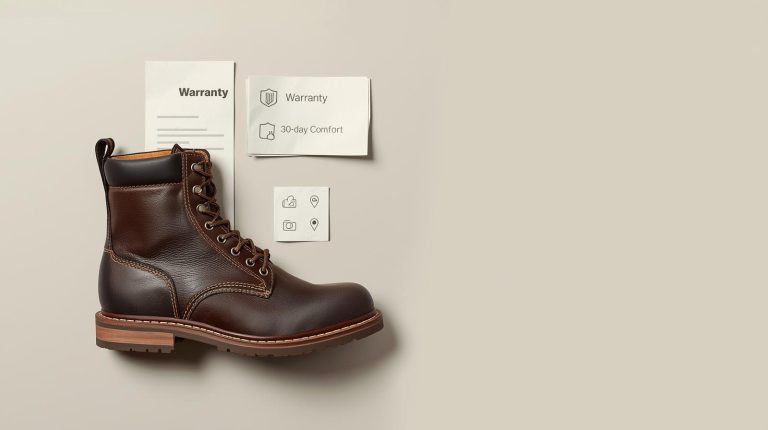
Buyer protection practical notes. Red Wing offers a limited warranty against manufacturing defects, but coverage terms can vary between Heritage and work boot lines. Crucially, boots purchased through third-party sellers (including Amazon) may not be honored by Red Wing stores for warranty service. If warranty matters to you, buying direct from Red Wing is the safer path. For warranty specifics across models, the Red Wing Boots Warranty guide covers what is and is not included.
Resoling is the long-term value proposition. Red Wing’s own repair service handles resoles, or you can use a quality cobbler. The cost is a fraction of replacement, and because Goodyear welt construction separates the sole from the upper, the boot platform can be rebuilt multiple times. Multiple owners report two to three resoles across years or decades of ownership.
Expectation reset
Even when everything goes right — correct sizing, clean QC, proper break-in, good care habits — Red Wing Heritage boots have inherent limitations that no setup can fix. They are not waterproof and will not keep your feet dry in sustained wet conditions. They provide no insulation for cold weather without a serious sock strategy. The Traction Tred sole will wear down faster than you expect on concrete. The leather will scuff and scratch (this is considered a feature, not a flaw, by Heritage enthusiasts — but it surprises some buyers). And the flat leather footbed will never feel like a modern cushioned insole, even after break-in. These are tradeoffs inherent to heritage construction, not problems to be solved. Setting accurate expectations before purchase prevents the most common forms of buyer disappointment.
Pre-Purchase Checklist (Save This)
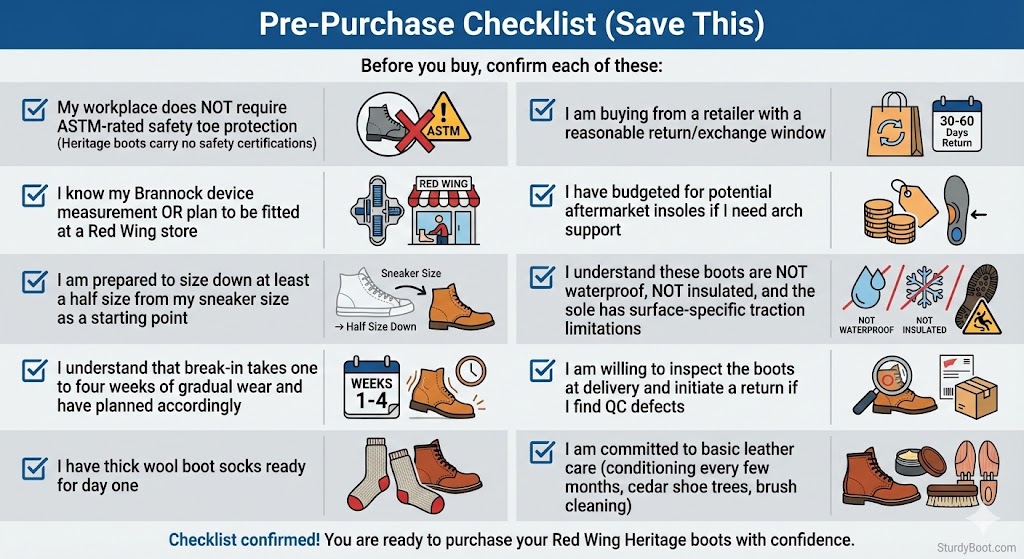
Before you buy, confirm each of these:
- [ ] My workplace does NOT require ASTM-rated safety toe protection (Heritage boots carry no safety certifications)
- [ ] I know my Brannock device measurement OR plan to be fitted at a Red Wing store
- [ ] I am prepared to size down at least a half size from my sneaker size as a starting point
- [ ] I understand that break-in takes one to four weeks of gradual wear and have planned accordingly
- [ ] I have thick wool boot socks ready for day one
- [ ] I am buying from a retailer with a reasonable return/exchange window
- [ ] I have budgeted for potential aftermarket insoles if I need arch support
- [ ] I understand these boots are NOT waterproof, NOT insulated, and the sole has surface-specific traction limitations
- [ ] I am willing to inspect the boots at delivery and initiate a return if I find QC defects
- [ ] I am committed to basic leather care (conditioning every few months, cedar shoe trees, brush cleaning)
Who Should Buy What (Buyer Personas)
These personas are based on the use cases and foot types that come up most often in owner feedback. No specific model is “best” for everyone — the right choice depends on where your constraints overlap.
The all-day hard-floor stander (warehouse, kitchen, retail). Needs: cushioning on flat surfaces, manageable break-in, insole flexibility. Avoid: boots with no insole accommodation, aggressive lug soles designed for outdoor terrain. The Traction Tred wedge sole is the most praised by owners in these roles for its cushioning, but budget for earlier resoles if your floors are concrete. Models on the No. 45 last are worth considering for their removable insole design.
The mixed-use weekday-weekend buyer (office or light trade work plus casual wear). Needs: versatile styling, resoleable construction, ability to handle varied surfaces. Avoid: aggressive safety-first boots that look out of place in casual or professional settings. This is the sweet spot for most Red Wing Heritage models. The Iron Ranger and Blacksmith are the most commonly cited by owners as transitioning seamlessly between work and personal contexts.
The wide-foot buyer. Needs: EE width availability, a last that does not crush the forefoot, patience with the fit process. Avoid: ordering D width “because it’s what they had” — this is the setup for the most common width-related frustrations. The No. 45 last (used on the 1907) consistently gets the best feedback from wide-foot owners. EE width on any available model is the starting point, not the backup plan.
The outdoor and rough-terrain user (yard work, light trail, winter errands). Needs: lug sole for grip on uneven or soft ground, leather that handles elements. Avoid: Traction Tred crepe soles, which lack bite on anything other than flat, hard surfaces. The 8146 Moc Lug and models with Vibram lug soles get the most positive outdoor traction feedback from owners. For dedicated winter use, some owners specifically recommend the Red Wing Roughneck or resoling Heritage boots with aggressive Vibram tread — the best winter work boots guide covers options built for cold and ice.
The motorcycle rider. Needs: slim profile for pedal manipulation, sturdy toe area for shifting, overall ankle coverage. Avoid: overly bulky moc toe designs that interfere with controls. Multiple owners specifically call out the Iron Ranger as an excellent motorcycle boot — the cap toe is ideal for shifting, and the overall profile is slim enough for easy pedal manipulation.
FAQ (Data-Backed Answers)
Do Red Wing Heritage boots run true to size? No. This is the single most consistent finding across all models and all sources. Red Wing Heritage boots run large. The typical recommendation from satisfied owners is to size down a half to one full size from your sneaker or athletic shoe size. Owners who get fitted on a Brannock device and go a half size down from that measurement report the best outcomes.
How long does break-in actually take? The most commonly reported window is one to four weeks of gradual wear. Some owners in softer leather options (Copper Rough & Tough, Briar Oil Slick) report comfort within days. The majority describe noticeable stiffness and heel discomfort for the first two weeks, with significant improvement by weeks three to four. A smaller group reports needing a full month or more. Owners who forced full-day wear too early had the worst experiences across the board.
Are these boots waterproof? No. The oil-tanned leathers offer solid water resistance — light rain and brief exposure are generally handled well. But prolonged wet conditions or standing water will wet through, and the Goodyear welt creates seam gaps where water can enter. Leather treatment (mink oil, boot oil) adds some resistance but does not make them waterproof.
Can I use custom orthotics? On models with removable insoles — the 1907 on the No. 45 last is the most commonly cited — yes. Multiple owners confirm successful use of prescription orthotics and aftermarket insoles. Remove the included leather insole before inserting your own. On models without removable insoles, aftermarket options can still work but may require sizing adjustment to account for added volume.
Is the QC issue overblown? In real-world wear, most pairs arrive in excellent condition. But the minority QC pattern is well-documented, recurring, and consistent across years: staples in heels, mismatched toe boxes, loose speed hooks, premature stitching failure. At this price point, owners rightly expect better. The practical defense is inspection at delivery and willingness to exchange. It is not a reason to avoid the brand — it is a reason to inspect your pair before committing.
Should I buy from Amazon or a Red Wing store? Buying from a Red Wing store gets you: proper sizing measurement, verified first-quality boots, warranty support, and in-person QC inspection. Buying from Amazon may be cheaper and offers convenient returns, but scattered owner reports suggest some boots arrive in less-than-first-quality condition, and Red Wing stores may not honor warranties on third-party purchases. It is a tradeoff between convenience and certainty.
How does leather care affect the look? Almost every conditioning product darkens the leather to some degree. Bick4 is the most recommended product for maintaining original color while keeping leather supple. Mink oil works but darkens more aggressively and permanently. Some owners of roughout leathers recommend no conditioning at all — just a damp sponge and a brush. Always test any product on a small area first.
What to Re-Check Before You Buy
From real-world owner feedback, a few practical surprises surface repeatedly around the purchase process itself.
Some owners report receiving boots through online retailers that appeared to have been previously tried on, worn, or returned — scuff marks on soles, creased leather, missing lace sets. This is not universal, but it is documented enough to warrant checking at delivery. If anything looks off — torn labels, unusual packaging, visible wear signs — Red Wing stores can verify authenticity.
Leather color in product photos is often unreliable. Copper Rough & Tough frequently appears more orange in person than in studio shots. Briar Oil Slick tends to be richer and darker. The “right” color is subjective, but know that conditioning and mink oil will shift it further. Product listings sometimes do not clearly distinguish between Heritage (lifestyle) and Work (safety-rated) lines — confirm you are buying from the correct line for your needs before checkout.
Width availability varies by retailer and model. EE width may be listed but out of stock in your size. Confirm availability before assuming you can get the width you need.
See It in Action: Visual Reality Check
Specs and reviews tell part of the story, but seeing these boots worn in real conditions adds context that owner patterns alone cannot capture. The following video shows the Red Wing Iron Ranger in a real-world context.
What to look for based on owner patterns: Watch for heel lift when walking, how the boot flexes at the vamp (the cap toe holds its shape while the area behind it creases heavily), the low profile of the Vibram 430 mini-lug, and stitching consistency on the speed hooks. Keep in mind: video will not show the long-term themes owners repeatedly report — how break-in transforms the fit over weeks, whether speed hooks eventually damage the tongue, or how the sole wears under months of daily use.
Printable Cards (Save These)

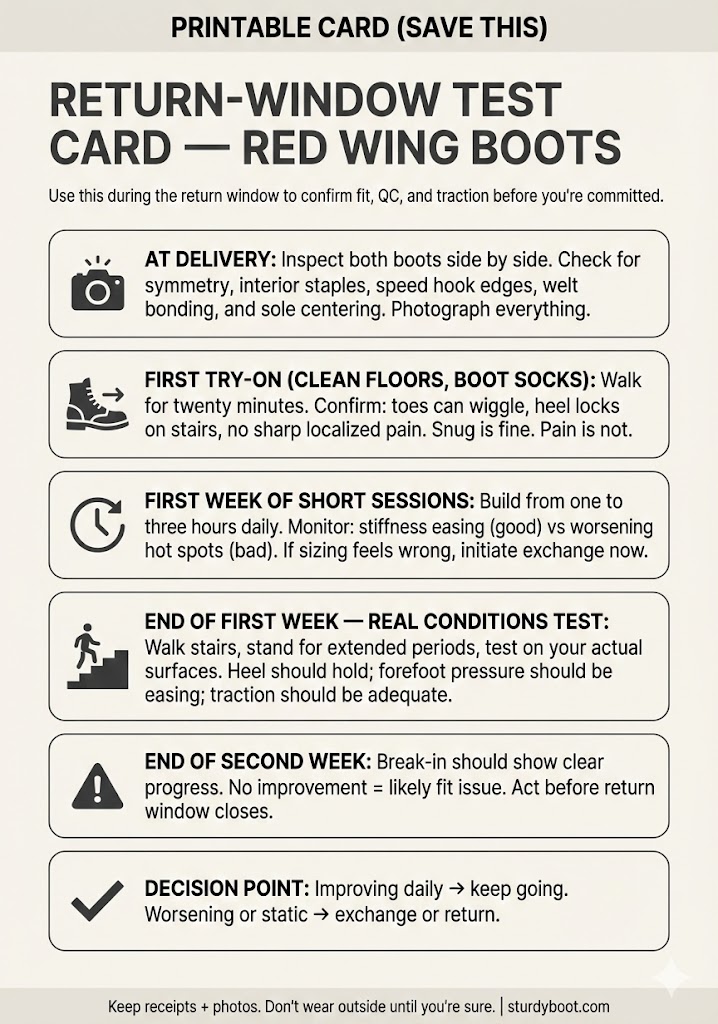
Return-Window Test Card — Red Wing Boots
At delivery: Inspect both boots side by side. Check for symmetry, interior staples, speed hook edges, welt bonding, and sole centering. Photograph everything.
First try-on (clean floors, boot socks): Walk for twenty minutes. Confirm: toes can wiggle, heel locks on stairs, no sharp localized pain. Snug is fine. Pain is not.
First week of short sessions: Build from one to three hours daily. Monitor: stiffness easing (good) vs worsening hot spots (bad). If sizing feels wrong, initiate exchange now.
End of first week — real conditions test: Walk stairs, stand for extended periods, test on your actual surfaces. Heel should hold; forefoot pressure should be easing; traction should be adequate.
End of second week: Break-in should show clear progress. No improvement = likely fit issue. Act before return window closes.
Decision point: Improving daily → keep going. Worsening or static → exchange or return.
Red Wing Boots Problem Decision Card
Heel slips when walking → Try heel-lock lacing + thicker socks first. Still slips? Likely oversized — size down.
Forefoot feels crushingly tight → This is usually width, not length. Try EE width. Do NOT size up — that causes heel slip.
Heel blisters during first weeks → Condition heel counter with Bick4. Thick wool socks. Shorter sessions. If improving daily, this is normal break-in.
Sharp pain in one fixed spot → Run fingers inside the boot at pain point. Staple or rough edge? Return. Nothing found but pain persists across sock changes? Likely fit issue.
No arch support, feet ache → Add aftermarket insole (Superfeet, Red Wing insoles). Confirm sizing is correct first — insoles add volume.
Sole wearing down fast → Normal for Traction Tred on concrete. Rotate boots. Budget for resoles. Consider Vibram lug upgrade via cobbler.
Speed hooks cutting tongue → Inspect hooks; return if sharp. Fix options: cobbler replaces with eyelets, or add leather kiltie as shield.
Boot arrived looking pre-worn → Return immediately. Document with photos. Consider buying from Red Wing store directly for QC assurance.
Update Log
- Feb 2026: Initial publication. Synthesized owner feedback across the Iron Ranger, 1907 Heritage Moc, Blacksmith, Work Chukka, and 8146 Moc Lug spanning over a decade of real-world use.
- Feb 2026: Built Owner Pattern Index, Return-Window Test Protocol, and System vs Product Decision Tree from recurring cross-model patterns.
- Feb 2026: Added Compatibility Matrix and buyer personas grounded in owner-reported fit and surface behavior by model family.
Final Verdict
Red Wing Heritage boots occupy a unique position in the footwear world: they reward the prepared buyer more than almost any other boot you can buy, and they punish the unprepared buyer just as decisively. The sizing gamble, the break-in gauntlet, and the QC lottery are all real. But the owners who get past those hurdles — who sized down correctly, paced their break-in, drew a well-made pair, and invested in basic care — overwhelmingly describe a boot that molds to their foot, improves with age, and lasts for years or even decades.
The Golden Rule bears repeating: get the sizing right, accept the break-in, and inspect at delivery. Nail those three, and the Red Wing Heritage platform delivers on its reputation. Skip any one, and you are gambling with your money and your comfort.
Ready to choose a specific model? We’ve ranked the top performers based on these criteria. See the top picks: Top Red Wing Boots reviews