Red Wing Boots Review: The Brand’s 5 Best & Most Popular Collections
Freshness / Update Log
Last updated: February 2026
- Re-checked recurring sizing, break-in, and QC themes across all five models using feedback through late 2025
- Updated traction and sole-wear comparisons after new Vibram 430 and Traction Tred owner reports surfaced
- Refreshed fit guidance for wide-footed buyers across each model’s last shape
- Verified current Amazon availability, pricing, and internal review links
Red Wing Heritage boots inspire a kind of loyalty you rarely see with footwear — and a kind of frustration that sends first-time buyers scrambling for a return label. The gap between “best boot I’ve ever owned” and “most painful purchase I’ve regretted” almost always comes down to three things: sizing, break-in expectations, and knowing which model actually fits your life.
That gap is exactly what this ranking is built to close. We dug into our individual full-length reviews — each one built from extensive owner feedback — and pulled out the patterns that repeat across years of real-world wear. Not marketing. Not hype. Just what consistently works, what frustrates owners, and what actually matters once you’re three months into owning a pair.
How we reviewed: We compiled this ranking from our individual product reviews, prioritizing real-world patterns: what consistently works, what frustrates owners, and what matters for long-term value.
Methodology snapshot: Approximately 600+ combined owner reviews analyzed across all five models, spanning feedback from 2010 through late 2025. Each product review synthesizes owner experiences from Amazon, RedWingShoes.com, and Zappos.
Confidence score rubric: 9+ = very consistent positives · 8–8.9 = strong with manageable tradeoffs · 7–7.9 = good but variance matters · <7 = niche fit or higher downside risk
Important note: All five boots in this ranking are from Red Wing’s Heritage line — meaning they are lifestyle/heritage boots, not ASTM-rated safety footwear. If your employer requires protective footwear under OSHA’s foot protection standards (29 CFR 1910.136), none of these boots meet that requirement. For safety-rated options, see our best work boots roundup instead.
By the end of this guide, you’ll know exactly which Red Wing model matches your foot, your use case, and your tolerance for break-in — and which ones to skip entirely.
Affiliate Disclosure: SturdyBoot.com earns a small commission from qualifying purchases made through Amazon links on this page — at no extra cost to you. This helps us keep producing honest, in-depth boot content. Our rankings are never influenced by affiliate relationships.
Quick Verdict
| Award | Product | Best For… | Quick Reason |
|---|---|---|---|
| 🥇 Best Overall | Red Wing Heritage Blacksmith | Business casual, riders, all-around heritage | Vibram 430 traction + cleanest plain-toe profile + fewest recurring complaints |
| ⚡ Best for Outdoor & Rough Terrain | Red Wing Heritage 8146 Moc Lug | Yard work, mud, uneven ground, winter errands | Lug sole confidence on rough surfaces that wedge soles can’t match |
| 🎯 Best for Custom Orthotics / Wide Feet | Red Wing 1907 Heritage Moc 6″ | Orthotic users, wider feet, all-day standing | Removable insole + roomier No. 45 last = most orthotic-friendly Heritage boot |
| 💰 Best Everyday Versatility | Red Wing Heritage Work Chukka | Office-to-warehouse, casual wear, lower profile | Chukka height transitions anywhere; decade-plus lifespan at a lower Heritage price point |
| ⭐ Best for Style & Patina | Red Wing Iron Ranger | Style-first buyers, motorcycle riders, patina enthusiasts | Iconic cap-toe that ages like no other — if you survive the QC lottery |
Tip: Click a Confidence Score in the detailed reviews below to see the full review and scoring context.
Moat Toolkit: Decision + Fix
Issue-Tag Box
These are the most common owner-reported friction points across all five Red Wing Heritage models. If you hit one of these, you’re not alone — and there’s usually a fix.
| Issue Tag | What It Usually Means | First Fix / First Check |
|---|---|---|
| SIZING-LARGE | Heritage boots run 0.5–1 full size big vs. sneakers | Measure on a Brannock device; size down from sneaker size |
| BREAK-IN-BRUTAL | Stiff leather + cork footbed = weeks of discomfort | Limit to 2–4 hr sessions; thick wool socks; condition leather lightly |
| NO-CUSHION | Leather-over-cork footbed has zero padding | Add aftermarket insoles (Superfeet, Red Wing comfort insoles) |
| NARROW-FIT | Standard D width runs tight for many buyers | Try EE width if available; test with intended socks before committing |
| HEEL-SLIP | Common early when cork hasn’t molded | Heel-lock lacing first; thicker socks; reassess size if it persists past break-in |
| QC-DEFECT | Mismatched toe boxes, loose hooks, staples, sole issues | Inspect on arrival; photograph defects; return/exchange immediately |
| SOLE-WEAR | Soft crepe soles wear faster than Vibram on concrete | Rotate boots; budget for resoles; consider Vibram-soled models |
| NOT-WATERPROOF | Heritage construction does not seal out sustained moisture | Condition leather for resistance; don’t expect waterproof performance |
If you’re troubleshooting a specific boot issue, our complete boot troubleshooting guide covers fix-it flows for dozens of common problems.
Decision Tree
- IF you need OSHA-compliant or ASTM F2413-rated safety footwear → SKIP all five (these are Heritage lifestyle boots, not PPE)
- IF you expect cushioned comfort on day one with zero break-in → SKIP or budget for insoles + 2–4 weeks of patience
- IF you want the most versatile plain-toe profile for business casual → Go to #1 Blacksmith
- IF your main use is outdoor/rough terrain and you need real traction → Go to #2 Moc Lug 8146
- IF you use custom orthotics or have wider feet → Go to #3 1907 Heritage Moc
- IF you want a lower-profile everyday boot at a slightly lower Heritage price → Go to #4 Work Chukka
- IF style and patina development matter most and you’ll tolerate QC risk → Go to #5 Iron Ranger
- IF you primarily work on ice, wet tile, or oily floors → SKIP all five and look at purpose-built slip-resistant boots in our best work boots roundup
- UPGRADE PATH: If you want Red Wing durability with actual safety ratings → move to Red Wing’s Work line (separate from Heritage)
Troubleshooting Quickflow
Flow 1: “My boots are killing my heels / I have blisters by day 2”
- Symptom: Sharp heel pain, rubbing, or blisters within the first few wears
- Check 1: Are you within the first two weeks? → Some heel discomfort is normal during break-in for heritage leather boots
- Check 2: Did you size correctly? → If heel is slipping AND toes are fine, the boot is likely too long
- Fix: Apply leather conditioner to the heel counter area. Wear thick wool boot socks. Limit sessions to 2–3 hours. Moleskin patches on hotspots
- Escalation: If pain is worsening (not improving) after week 2, or if you feel sharp internal pressure (possible staple/defect), initiate return/exchange before your window closes
- Return trigger: Pain localized to one sharp spot that doesn’t move = likely defect, not break-in
Flow 2: “The sole feels slippery / I don’t trust the traction”
- Symptom: Slipping on smooth floors, wet surfaces, or icy conditions
- Check 1: Which sole do you have? → Traction Tred (crepe wedge) is designed for flat hard surfaces, NOT for ice or oil. Vibram 430 mini-lug is better but still not a slip-rated sole
- Check 2: Is debris packed in the lugs? → Clean tread regularly; packed dirt kills grip
- Fix: For indoor-slick surfaces, accept that Heritage boots are not slip-rated work footwear. For winter/outdoor use, the 8146 Moc Lug or Blacksmith (Vibram 430) are your best Heritage options
- Escalation: If your workplace requires slip-resistant footwear, these Heritage boots are not the right tool — as NIOSH’s guidance on slip-resistant shoes explains, matching footwear to surface conditions is critical
- Return trigger: If you bought a Traction Tred model expecting winter traction, exchange for a Vibram-soled model or look outside the Heritage line entirely
Fit / Width / Volume Mini-Matrix
Fit is the single biggest source of buyer frustration across all five models. This matrix reflects the patterns owners report most consistently.
| Your Foot Type | Recommended Approach | Watch For |
|---|---|---|
| Average width, average arch | Size down 0.5–1 from sneaker size; start with D width | Toe box may feel snug at first — leather stretches |
| Wide forefoot | Try EE width where available; 1907 on No. 45 last is roomiest | D width will likely pinch; don’t assume break-in fixes width problems |
| High arches / need orthotics | Choose the 1907 (removable insole); size to accommodate your insert | Adding thick insoles to other models can steal volume and create new fit issues |
| Narrow heel, wider toes | Size for heel lockdown first; add a thin insole to take up forefoot volume if needed | Heel slip usually means you need to go smaller, not bigger |
| Planning thick winter socks | Stay closer to normal size or size down less aggressively | Over-sizing for thick socks = heel slip once socks thin out in spring |
For a systematic approach to nailing boot fit, our work boot fit and sizing guide walks through proper measurement techniques and what to expect from different brands.
Quick Decision Matrix
- Need versatile plain-toe styling + best traction balance → Go to #1 Blacksmith
- Need outdoor/rough terrain grip that wedge soles can’t deliver → Go to #2 Heritage 8146 Moc Lug
- Need removable insole for custom orthotics or widest toe box → Go to #3 1907 Heritage Moc
- Need lowest-profile Heritage boot for office-to-casual transitions → Go to #4 Work Chukka
- Need the iconic cap-toe look that develops the best patina → Go to #5 Iron Ranger
Comparison Table
| Product | Best For | Owner-Reported Outcome | What Owners Liked | Common Complaints / Tradeoff | Owner Signals | Confidence Score |
|---|---|---|---|---|---|---|
| Red Wing Blacksmith | Business casual, riders, versatile heritage | Strong | Vibram 430 traction, patina, resoleable | Break-in brutal, no cushion, color varies from photos | Long-haul durability: Positive · Break-in friction: Moderate · QC consistency: Mostly positive | 8.5/10 |
| Red Wing 8146 Moc Lug | Outdoor chores, rough terrain, mixed use | Strong | Lug-sole traction, heritage styling, build quality | Narrow fit, break-in variance, traction mixed on slick indoor floors | Long-haul durability: Positive · Break-in friction: Moderate-to-Hard · Fit variance: Mixed | 8.3/10 |
| Red Wing 1907 Moc 6″ | Orthotics, wide feet, all-day standing | Strong | Removable insole, roomier last, leather aging | QC inconsistency (staples, toe boxes), Traction Tred wears fast | Long-haul durability: Positive · Orthotic friendliness: Strong · QC consistency: Mixed | 8/10 |
| Red Wing Work Chukka | Office-to-warehouse, casual, lower profile | Strong | Versatile styling, decade+ lifespan, made in USA | Narrow toe box, sizing confusion, Atlas Tred wears fast | Long-haul durability: Positive · Versatility: Strong · Sole durability: Moderate | 8/10 |
| Red Wing Iron Ranger | Style, patina, motorcycle riding | Strong (post break-in) | Exceptional aging, cap-toe style, multi-decade potential | Speed hook QC, sizing runs very large, no cushion | Long-haul durability: Positive · QC consistency: Mixed · Break-in friction: Hard | 7.5/10 |
Detailed Product Reviews
#1. Red Wing Heritage Blacksmith Vibram Boot — The Cleanest All-Rounder
📌 At a Glance
- Best for: Business casual, motorcycle riders, weekend warriors, anyone wanting a “buy it for life” boot without a flashy toe profile
- Owner-reported outcome: Strong
- Confidence score: 8.5/10
Signature (from review notes):
- Failure signature: Scattered QC reports — scuffed/scratched boots on arrival, possible factory seconds sold as firsts through certain sellers
- Break-in friction: Moderate (Briar Oil Slick breaks in faster; Copper Rough & Tough is stiffer)
- Downside risk: Low (once sizing is dialed in, most owners report years of satisfaction)
Owner signals:
- Long-haul durability: Positive — owners report 5–10+ years of wear with resoling
- Traction confidence: Positive — Vibram 430 mini-lug praised across varied surfaces
- QC on arrival: Mostly positive — minority reports of cosmetic defects
Quick Summary: The Blacksmith takes the top spot because it delivers the most balanced combination of traction, versatility, and fewest recurring complaints. The Vibram 430 sole gives it real grip that older cork-soled Heritage boots couldn’t match, and the clean plain-toe profile works in more settings than any moc-toe or cap-toe. The main tradeoff is the same as every Heritage boot: break-in demands patience, and there’s essentially no cushioning from the factory.
The Deep Dive (Why It Ranked Here):
- Owners consistently praise the Vibram 430 mini-lug for traction on snow, wet pavement, and light trails — a major improvement over flat cork soles
- The plain-toe profile transitions seamlessly from casual to business casual without the polarizing moc-toe or cap-toe aesthetics
- Goodyear welt construction means resoling is straightforward; owners report cost is typically $75–150 depending on the provider
- Multiple leather options (Copper Rough & Tough, Briar Oil Slick, Black Prairie, Black Spitfire) let buyers choose their break-in speed and aesthetic
- Break-in period ranges from “a few days” to “several painful weeks” depending on leather choice — Briar Oil Slick tends to soften fastest
- The steel shank provides arch support and structural rigidity, though it can trigger airport metal detectors (frequent flyers take note)
- Virtually no cushioning from the factory — most owners add aftermarket insoles immediately, which changes the comfort equation dramatically
- The gusseted tongue makes entry difficult; a shoe horn is recommended from day one
✅ Why Buy
- Best traction in the Heritage lineup thanks to the Vibram 430 mini-lug
- Clean, timeless styling that works across casual, business casual, riding, and weekend contexts
- Resoleable Goodyear welt construction provides multi-decade value when maintained
- Made in USA (Red Wing, Minnesota) with parts availability for ongoing repairs
- Post-break-in comfort is consistently described as “exceptional” and “custom-molded”
⛔ Dealbreakers / What to Consider
- No safety ratings whatsoever — this is not PPE
- Not waterproof despite thick leather; owners report wet feet within 15–20 minutes of rain
- Break-in can produce blood blisters and heel abrasions for some owners, especially in Copper Rough & Tough
- Stock laces are too short and tend to break; plan to replace with 54″–60″ waxed laces
- If you can’t try before you buy, sizing is an educated guess — returns may be necessary
Verdict for You:
- 👉 Pick this if: You want one heritage boot that handles business casual, riding, light outdoor use, and weekend wear without looking like heavy-duty work boots
- You value real traction on varied surfaces
- You’re willing to invest 2–4 weeks of break-in for long-term payoff
- 🛑 Skip this if: You need safety-rated work boots for a regulated jobsite
- You expect cushioned comfort from day one
- You need waterproof performance in sustained wet conditions
Quick Links:
#2. Red Wing Men’s Heritage 8146-6″ Moc Lug — The Rough-Terrain Moc
📌 At a Glance
- Best for: Yard work, outdoor walking, mixed terrain, winter errands, buyers who want moc-toe styling with real bite underfoot
- Owner-reported outcome: Strong
- Confidence score: 8.3/10
Signature (from review notes):
- Failure signature: Minority but repeated reports of sole separation or hardware issues
- Break-in friction: Moderate-to-Hard (stiff unlined leather; timeline varies widely across owners)
- Downside risk: Medium (fit variance is the primary risk — narrow-leaning for many buyers)
Owner signals:
- Outdoor traction: Positive — lug sole inspires confidence in mud, snow, and uneven ground
- Fit variance: Mixed — “runs big AND feels narrow” is a recurring contradiction
- Comfort tuning required: Mixed — many owners report needing insole or sock adjustments
Quick Summary: The 8146 Moc Lug fills a gap that other Heritage moc-toes leave open: real traction on rough surfaces. Owners who buy this model specifically because wedge soles felt sketchy on uneven ground or in winter consistently report satisfaction. But the fit is finicky — it runs long yet feels narrow through the forefoot — and traction on slick indoor surfaces is not guaranteed despite the lugged sole. Understanding what you need from a boot sole matters here; our work boot soles guide breaks down how different outsole designs perform on different surfaces.
The Deep Dive (Why It Ranked Here):
- Owners frame it as a “do-everything” pair: yard work, walking, light jobsite duty, winter errands, and casual wear
- The lug sole delivers outdoor confidence that wedge-sole moc-toes can’t match on rough ground
- Unlined leather develops a glove-like fit once formed — owners who push through break-in often describe deep loyalty
- Fit is the central challenge: many owners need to size down for length but still feel narrow through the forefoot
- Break-in timelines vary dramatically — from “fine in a few wears” to “weeks of daily wear”
- Insoles are a frequent comfort optimization; they can solve arch feel but may worsen width issues in an already-tight boot
- Slick indoor surface traction gets mixed reactions — lugs grip dirt and uneven ground well, but wet tile or oily floors are a different story
- A minority of owners report sole separation or hardware defects that require immediate return/exchange
✅ Why Buy
- Best outdoor traction of any Heritage moc-toe boot
- Rugged heritage styling that works for both chores and casual outfits
- Supportive once formed — repeated “molds to your foot” sentiment across owners
- Premium build quality and leather praised consistently
- Resoleable construction designed for years of service
⛔ Dealbreakers / What to Consider
- Fit guesswork is significant — “runs large” and “feels narrow” co-exist frequently
- Break-in can be harsh; some owners describe weeks of discomfort
- Comfort often requires insole and sock tuning — you’re buying extras to make it work
- Lug tread does not equal slip-resistant on all surfaces — don’t assume safety on wet tile
- If you see sole separation or loose hardware early, treat it as a defect, not break-in
Verdict for You:
- 👉 Pick this if: Your days involve outdoor use, mixed terrain, or conditions where wedge soles feel inadequate
- You’re comfortable tuning fit with socks and insoles
- You want the moc-toe aesthetic with more real-world bite
- 🛑 Skip this if: You have wide feet and hate fit experimentation
- You need comfort immediately with zero adjustment period
- Your primary surfaces are slick indoor floors where certified slip-resistant footwear is the priority
Quick Links:
#3. Red Wing 1907 Heritage Moc 6″ Boot — The Orthotic-Friendly Icon
📌 At a Glance
- Best for: Custom orthotic users, owners with wider feet, delivery drivers, chefs, anyone who values a removable insole and roomier footbed
- Owner-reported outcome: Strong
- Confidence score: 8/10
Signature (from review notes):
- Failure signature: QC inconsistency — mismatched toe boxes, staples left in the heel area, glue bleeding from moc stitching, premature seam separation
- Break-in friction: Moderate (1–4 weeks typical; Copper Rough & Tough leather softens progressively)
- Downside risk: Medium (QC issues are minority but can be expensive when they hit at this price point)
Owner signals:
- Orthotic friendliness: Strong — removable insole + No. 45 last confirmed by multiple owners using custom orthotics
- Leather aging: Strong — Copper Rough & Tough praised as one of the best aging leathers in the Heritage line
- QC consistency: Mixed — the recurring defect reports are notable at a $300+ price point
Quick Summary: The 1907 is the Heritage moc-toe you choose when you need the boot to work with your feet, not against them. The No. 45 last is roomier than the No. 23 last used on the 875, and the removable leather insole means custom orthotics or aftermarket insoles actually have space. The Copper Rough & Tough leather ages in a way that makes the boot look better with every year — scuffs blend in rather than marring the surface. The catch? Quality control inconsistency is a real theme, and the Traction Tred crepe sole wears down noticeably faster than Vibram alternatives on hard surfaces. To understand the tradeoffs between construction types, our boot anatomy and materials guide explains what drives these differences.
The Deep Dive (Why It Ranked Here):
- The removable leather insole is a genuine differentiator — most Heritage boots at this price don’t offer it, making the 1907 the clear choice for orthotic users
- The No. 45 last provides more footbed volume than most other Heritage lasts, giving wider feet more room to breathe
- Copper Rough & Tough leather ages remarkably well; scuffs blend in rather than standing out, requiring minimal care (Bick4 is the most-recommended conditioner)
- Goodyear welt with Norwegian-style construction contributes to both resolability and water resistance at the sole junction
- Traction Tred cushion crepe sole is comfortable on flat hard surfaces but wears down faster than harder rubber compounds — daily concrete use is its weakness
- Triple stitching on the moc toe holds for years when QC is on point, but it’s one of the first areas to show issues when QC fails
- Owners who sized correctly and received a QC-clean pair overwhelmingly describe this as a “forever boot” — 5, 10, even 12+ years with resoles
- Ships with both leather laces and Taslan cord laces; leather laces look better but break earlier
✅ Why Buy
- Most orthotic-friendly boot in the Heritage lineup (removable insole + roomier last)
- Copper Rough & Tough leather develops exceptional patina over years
- Resoleable Goodyear/Norwegian welt means cost-per-year drops dramatically over time
- Accommodates wider feet better than most Heritage models, especially in EE width
- Made in USA with two sets of laces included
⛔ Dealbreakers / What to Consider
- QC inconsistency is a documented, recurring issue — inspect carefully upon delivery
- Traction Tred sole wears fast on concrete; budget for resoles sooner than expected
- Not waterproof — solid water resistance, but standing water or prolonged wet conditions will get through
- Sizing runs large; nearly every satisfied owner sized down at least a half size
- If you’re comparing options across the Heritage lineup, our Red Wing warranty guide covers what is and isn’t included when something goes wrong
Verdict for You:
- 👉 Pick this if: You use custom orthotics or need a Heritage boot that accommodates a removable insole
- You have wider-than-average feet and have struggled with other Red Wing lasts
- You value leather that ages beautifully with minimal care
- 🛑 Skip this if: You pound concrete daily and need soles that won’t wear through in months
- You’re not willing to inspect boots at delivery and navigate a potential return for QC issues
- Your budget doesn’t accommodate $300+ plus potential insole and resole costs over time
Quick Links:
#4. Red Wing Heritage Men’s Work Chukka — The Office-to-Everywhere Transition Boot
📌 At a Glance
- Best for: Workers splitting time between office and light warehouse duties, casual-to-professional crossover, buyers who want heritage quality in a lower-profile silhouette
- Owner-reported outcome: Strong
- Confidence score: 8/10
Signature (from review notes):
- Failure signature: Atlas Tred sole separation reported by minority of heavy users, particularly those who kneel frequently (HVAC techs, electricians)
- Break-in friction: Moderate (some owners report comfort from day one; majority describe 1–4 weeks)
- Downside risk: Low-to-Medium (the main risk is buying the wrong size online due to conflicting sizing advice)
Owner signals:
- Versatility: Strong — office, warehouse, brewery, weekend errands all cited regularly
- Long-haul durability: Positive — owners report 5–8 years before first resole, with boots continuing afterward
- Sizing clarity: Mixed — owner advice on sizing is wildly contradictory for this model specifically
Quick Summary: The Work Chukka is the Heritage boot for the buyer who doesn’t want to look like they’re wearing boots. The ankle-height chukka silhouette and white wedge sole keep things casual-professional, and the lower profile makes it the easiest Heritage model to transition between settings. It’s also the model that inspires the most sizing confusion — owner advice conflicts wildly because the narrow toe box interacts differently with different foot shapes. Once you nail the fit, this boot delivers a decade-plus of wear with the same Goodyear welt resolability as its taller siblings. For a broader view of how Heritage boots fit into the overall work boot landscape, the Work Boots 101 primer ties features to jobsite risks and helps clarify where each category belongs.
The Deep Dive (Why It Ranked Here):
- The chukka height (two eyelets, ankle-level) is unique in the Heritage lineup and genuinely more versatile for office/professional environments
- Briar Oil Slick leather ages beautifully — scratches and creases become features rather than flaws
- Atlas Tred wedge outsole cushions well on hard floors but wears faster than Vibram alternatives, especially in the heel area
- Made in USA (Red Wing, Minnesota) with continued domestic production ensuring parts availability
- The leather footbed conforms to foot shape over time — great for long-term fit, challenging during break-in
- Steel shank provides arch support and structural stability, reducing fatigue on hard surfaces
- Sizing is the #1 pain point: narrow toe box punishes wide feet, and online advice ranges from “size down 0.5” to “size up 0.5” depending on foot shape and sock preference
- Sole separation at the toe has been reported by owners who kneel frequently — the Goodyear welt makes this repairable, but it shouldn’t happen early
✅ Why Buy
- Lowest-profile Heritage boot — works with chinos, jeans, or shop clothes without looking like heavy work boots
- Decade-plus lifespan with proper care and resoling at a fraction of replacement cost
- Briar Oil Slick leather develops rich character over years of wear
- Made in USA with resoleable Goodyear welt construction
- Steel shank provides genuine arch support and stability
⛔ Dealbreakers / What to Consider
- No ASTM safety ratings — not compliant with OSHA protective footwear requirements
- Narrow toe box makes blind ordering risky for wide-footed buyers
- Atlas Tred sole wears quickly on concrete and is slippery on ice
- Not waterproof and provides no insulation for cold conditions
- No built-in arch support from the leather footbed — budget for aftermarket insoles if you need cushioning
Verdict for You:
- 👉 Pick this if: You need one boot that transitions from office to warehouse to weekend without looking out of place
- You value heritage craftsmanship in a lower, more versatile silhouette
- You understand and accept a multi-week break-in period
- 🛑 Skip this if: You have wide feet and can’t try before you buy
- You need serious arch support without aftermarket insoles
- You work primarily in wet conditions or on icy surfaces
Best Pairing Gear (mentioned in reviews)
- Aftermarket insoles (Superfeet or Red Wing’s own) — improves immediate comfort while cork molds
Quick Links:
#5. Red Wing Men’s Iron Ranger — The Patina Legend (With Caveats)
📌 At a Glance
- Best for: Style-first buyers, motorcycle riders, patina enthusiasts, anyone who wants the most iconic Red Wing silhouette and is willing to navigate QC and sizing challenges
- Owner-reported outcome: Strong (post break-in)
- Confidence score: 7.5/10
Signature (from review notes):
- Failure signature: Speed hooks not properly crimped — sharp metal edges that shred tongue leather. This is widespread, not occasional, and is the most consistent product defect across the entire review base
- Break-in friction: Hard (genuinely painful first 1–4 weeks for many owners; some report blood blisters)
- Downside risk: Medium-to-High (QC lottery + most aggressive sizing inconsistency of any model reviewed)
Owner signals:
- Patina development: Strong — owners describe leather aging that makes the boot look better after a year than brand new
- QC consistency: Mixed — speed hook defects, uneven sole sanding, mismatched leather thickness documented repeatedly
- Multi-decade durability: Positive — owner reports of 4, 6, 10, 12, even 14 years of regular wear
Quick Summary: The Iron Ranger is the Red Wing that people fall in love with — and the Red Wing that frustrates the most first-time buyers. It earns the #5 rank not because it’s a lesser boot, but because the speed hook QC issue is well-documented, sizing runs the most inconsistently of any model here, and the break-in is the most demanding. When everything lines up — right size, clean pair, patience through break-in — owners describe it with genuine affection as a lifetime boot. The cap-toe design works beautifully for motorcycle riding, and the full-grain leather develops a patina that is uniquely its own. But the gap between “best case” and “worst case” is wider here than anywhere else in the lineup.
The Deep Dive (Why It Ranked Here):
- The cap-toe is both the Iron Ranger’s signature and its most polarizing feature — some love it, some call it “clownish”
- Speed hook QC is a documented, ongoing issue: improperly crimped hooks leave sharp edges that slice tongue leather, sometimes within weeks of wear
- Sizing runs large — most owners size down a full size from sneakers, some go 1.5 sizes down, and even then exchanges are common
- Multiple leather options (Copper Rough & Tough, Amber Harness, Hawthorne Muleskinner) break in at different speeds and feel noticeably different
- Vibram 430 mini-lug sole is adequate for dry surfaces but poor on snow and ice — not suitable for consistently slippery environments
- The flat leather insole provides zero cushioning and minimal arch support, which catches many first-time buyers off guard
- Motorcycle riders specifically praise the cap toe for shifting and the slim-enough profile for pedal manipulation
- Post-break-in comfort is overwhelmingly described as exceptional — “like they were made for my feet” is a recurring phrase
✅ Why Buy
- Iconic cap-toe design that develops the most dramatic patina of any Heritage model
- Full-grain leather quality praised even by owners who had other complaints
- Multi-decade durability potential with Goodyear welt resolability
- Excellent motorcycle boot — cap toe protects during shifting, profile works well with pedals
- Made in USA with no external branding or logos — the design speaks for itself
⛔ Dealbreakers / What to Consider
- Speed hook QC is a real, recurring defect — inspect hooks immediately on arrival and run your finger along the back of each one
- Sizing is the most confusing of any model — a full size down is standard but not universal
- Break-in is the most demanding in the lineup — genuine pain, potential blisters, weeks of commitment
- Not waterproof despite thick leather and gusseted tongue
- D-width-only on most colorways severely limits wide-foot buyers
- If you need winter traction, the Vibram 430 mini-lug cannot handle ice reliably — consider our best winter work boots for cold-weather options
Verdict for You:
- 👉 Pick this if: Style and patina development matter most to you, and you’re willing to inspect, exchange, and push through the break-in
- You ride motorcycles and want a heritage boot that works with pedals
- You’re buying for long-term value and think in years, not months
- 🛑 Skip this if: QC inconsistency at $330+ is a non-starter for you
- You need wide widths and they’re not available in your preferred leather
- You walk primarily on snow or ice
Best Pairing Gear (mentioned in reviews)
- Aftermarket insoles (medium-density foam or wool; avoid rigid plastic-backed insoles per owner reports) — improves day-one comfort dramatically
- Kiltie / tongue protector — shields the tongue from sharp speed hooks
Quick Links:
See Red Wing Heritage Boots in Action
Specs and review patterns tell you a lot, but seeing these boots on real feet adds context for styling, proportion, and leather character. This comparison from Red Wing experts and employees walks through five Heritage models and discusses which one works for different lifestyles and foot types:
📺 Red Wing Heritage Blacksmith (our #1 pick) — Visual Reality Check:
What to look for: Notice the boot’s profile and how the Vibram 430 sole sits — that’s the traction advantage over crepe-soled models. Pay attention to the leather color on screen versus product photos (Copper Rough & Tough often looks more orange in person), and listen for the solid sound when the boot contacts the ground. What this video won’t show is the break-in transformation that happens over weeks and months — that’s where the owner feedback in our full reviews fills the gap.
Buying Guide: How to Avoid a Bad Red Wing Purchase
Know Where Heritage Ends and Safety Begins
Every boot in this ranking is from Red Wing’s Heritage line. None carry ASTM F2413 safety ratings. If your employer or jobsite requires certified protective footwear — steel toe, composite toe, electrical hazard protection — you need Red Wing’s actual Work line, not Heritage. For a clear explanation of what those safety certifications actually mean, our ASTM F2413-24 explainer walks through every rating. And for job-specific boot matching, our work boots by job type guide connects boot features to work environments.
Size for the Last, Not the Label
Red Wing Heritage boots run large — but “how large” varies by model and last shape. The No. 8 last (Iron Ranger) fits differently from the No. 45 last (1907), which fits differently from the No. 210 (Work Chukka). Sizing down from your sneaker size is almost always correct, but the amount depends on your foot width, intended sock thickness, and whether you’ll add aftermarket insoles. A Brannock device measurement at a Red Wing store is the most reliable starting point.
Budget Beyond the Boot
The purchase price is just the beginning. Budget for aftermarket insoles ($20–40), replacement laces ($8–15 for quality waxed laces), leather conditioner ($10–15), and eventual resoling ($75–150). These aren’t failures — they’re part of the ownership model that makes Heritage boots last for decades instead of being discarded after a year or two. If the break-in process concerns you, our guide to breaking in work boots faster covers proven methods that owners consistently recommend.
Inspect Every Pair on Arrival
QC variability is a documented theme across multiple models — from mismatched toe boxes to uncrimped speed hooks to sole adhesive issues. Before your first real wear: check both boots side by side for symmetry, run your fingers inside the heel counter for protruding staples, inspect the welt-to-sole bond, and verify stitching consistency. Photograph everything before wearing outdoors in case you need to document a defect for returns.
Week-One Testing Checklist
- Inspect both boots for cosmetic defects, asymmetry, scratches, or signs of previous wear
- Check speed hooks (Iron Ranger) for sharp edges on the back side
- Run fingers inside the heel counter for protruding staples or rough spots
- Try on with your intended everyday socks on clean carpet (keeps soles returnable)
- Walk for 15–20 minutes assessing heel lockdown, toe room, and pressure points
- Verify width feels appropriate — snug is okay, sharp pain or side-to-side pinching is not
- If adding aftermarket insoles, insert them now and reassess fit with the added volume
- Wear in short sessions (2–4 hours) for the first week, building up gradually
- By day 5–7, assess whether stiffness is improving (normal break-in) or worsening (possible size/defect issue)
- If anything feels structurally wrong — not just stiff — initiate return/exchange before your window closes
Printable Quick Card: Best Red Wing Boots Week-One Validation
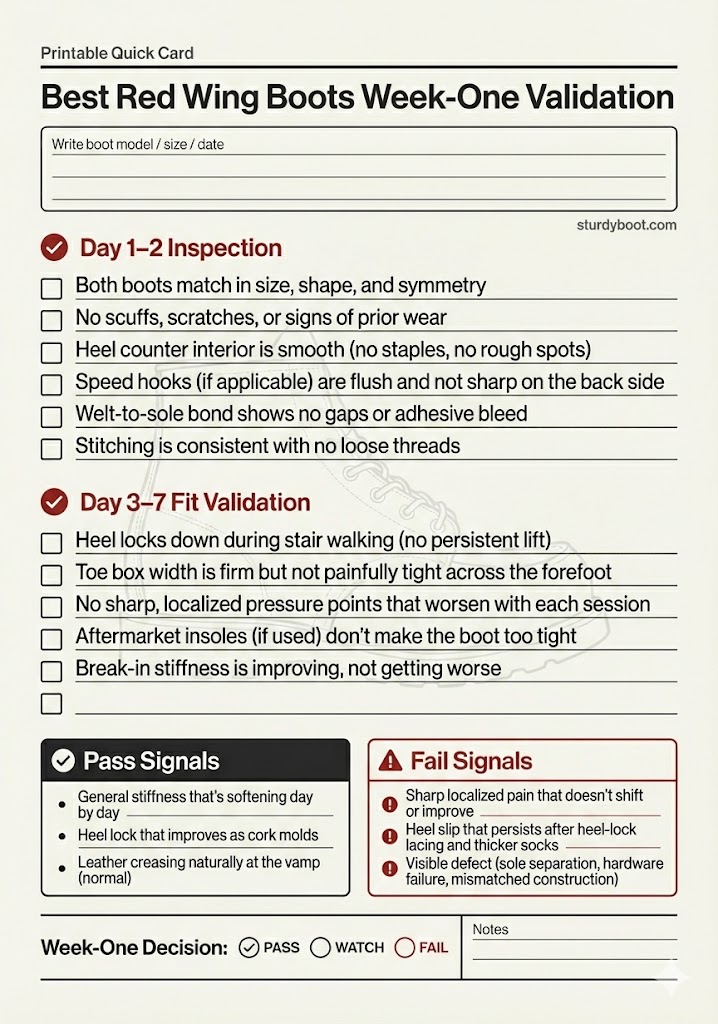
Day 1–2 Inspection:
- [ ] Both boots match in size, shape, and symmetry
- [ ] No scuffs, scratches, or signs of prior wear
- [ ] Heel counter interior is smooth (no staples, no rough spots)
- [ ] Speed hooks (if applicable) are flush and not sharp on the back side
- [ ] Welt-to-sole bond shows no gaps or adhesive bleed
- [ ] Stitching is consistent with no loose threads
Day 3–7 Fit Validation:
- [ ] Heel locks down during stair walking (no persistent lift)
- [ ] Toe box width is firm but not painfully tight across the forefoot
- [ ] No sharp, localized pressure points that worsen with each session
- [ ] Aftermarket insoles (if used) don’t make the boot too tight
- [ ] Break-in stiffness is improving, not getting worse
Pass Signals:
- General stiffness that’s softening day by day
- Heel lock that improves as cork molds
- Leather creasing naturally at the vamp (normal)
Fail Signals:
- Sharp localized pain that doesn’t shift or improve
- Heel slip that persists after heel-lock lacing and thicker socks
- Visible defect (sole separation, hardware failure, mismatched construction)
👉 Check the current price on Amazon for the Blacksmith (our #1 pick)
Go Deeper (Optional):
- For the full decision framework covering all Red Wing models, sizing validation, and a deeper return-window protocol, the Red Wing Boots Buying Guide lays out the complete process before you commit.
FAQ
Are Red Wing Heritage boots actual work boots?
No. The Heritage line is explicitly separate from Red Wing’s safety-rated Work line. Heritage boots are lifestyle boots built with premium materials and traditional construction, but they carry no ASTM certifications for impact, compression, electrical hazard, or slip resistance. If your employer requires protective footwear under OSHA’s foot protection standards, Heritage boots do not meet those requirements.
How much should I size down for Red Wing Heritage boots?
Most satisfied owners size down 0.5–1 full size from their sneaker or athletic shoe size. The exact amount depends on the last shape (varies by model), your foot width, intended sock thickness, and whether you plan to add insoles. The most reliable approach is getting measured on a Brannock device at a Red Wing store. If ordering online, be prepared for potential exchanges.
How long is the break-in period, realistically?
The most commonly reported window is 1–4 weeks of gradual wear, with meaningful improvement by week 3. Some owners in softer leathers (Briar Oil Slick) report comfort within days. Others in stiffer leathers (Amber Harness, Copper Rough & Tough) describe a full month before the boot felt truly comfortable. Owners who forced full work shifts too early had the worst experiences.
Can I use custom orthotics in these boots?
The 1907 Heritage Moc is the best choice for orthotics — its removable leather insole and No. 45 last are specifically designed to accommodate aftermarket insoles. Other models can accept thin insoles, but the non-removable footbed and tighter volume make orthotic use more challenging.
Are Red Wing Heritage boots waterproof?
No. The oil-tanned leather and welt construction provide solid water resistance for light rain and splashes, but these boots are not sealed waterproof footwear. Sustained wet conditions will wet through. Leather conditioner and treatment help, but don’t expect waterproof performance. If waterproofing is non-negotiable, our best waterproof work boots roundup covers purpose-built options.
What’s the deal with Red Wing’s quality control?
QC variability is a documented, recurring theme across multiple models — more pronounced on the Iron Ranger (speed hooks) and 1907 (mismatched toe boxes, heel staples). Most buyers receive well-made boots, but the frequency of defect reports at the $300+ price point is notable. Inspect every pair on arrival, photograph before wearing outdoors, and know your return window.
Is it worth buying Red Wings from Amazon vs. a Red Wing store?
There are meaningful tradeoffs. Red Wing stores offer proper sizing, verified first-quality boots, and full warranty support. Amazon offers convenience and easy returns, but scattered reports suggest some boots arrive as possible factory seconds or in less-than-first-quality condition, and Red Wing stores may not honor warranties on boots purchased through third-party sellers.
Can these boots be resoled, and is it worth it?
Absolutely — resoleable Goodyear welt construction is the core value proposition. Red Wing offers resoling services from their facility in Minnesota, or any quality cobbler can do it. Cost typically runs $75–150 depending on the sole type and provider. Given that the boots can last decades with care, resoling is almost always cheaper than replacing.
Which Red Wing Heritage boot has the easiest break-in?
Based on owner feedback patterns, the Work Chukka and the Blacksmith in Briar Oil Slick leather tend to break in fastest. The Iron Ranger in Amber Harness consistently reports the most demanding break-in. The 1907 and 8146 fall in the middle, with break-in speed heavily influenced by individual foot shape and sock choice.
Final Verdict & Quick Links
The Red Wing Heritage Blacksmith earns the top spot for its combination of Vibram 430 traction, clean styling versatility, and the fewest recurring complaints across our review analysis. It’s the Heritage boot that works in the widest range of settings without demanding the most from its buyer.
For outdoor and rough-terrain use, the Heritage 8146 Moc Lug delivers the lug-sole confidence that wedge soles can’t match.
For custom orthotics and wider feet, the 1907 Heritage Moc is the clear winner — no other Heritage boot matches its orthotic-friendly design.
Every boot in this ranking rewards patience, punishes wrong sizing, and delivers exceptional long-term value when the fit is right. The difference between a Red Wing you love for a decade and one you return in frustration almost always comes down to sizing homework and break-in expectations — not the boot itself.
👉 Check the current price on Amazon for the Red Wing Blacksmith (our #1 pick)