Carolina Logger Boots Review: The Glued-Sole Truth Owners Won’t Tell You
Last updated: July 2026
- Re-checked the owner feedback specifically for the sole-separation timeline and confirmed the pattern still clusters between the multi-month and one-year mark, not day one.
- Re-read the newest 2026 reviews to see whether waterproofing complaints had eased; the wet-in-weeks failures still show up alongside owners reporting bone-dry feet after a year, so the split is real and current.
- Re-tagged the “re-buyer” comments after a fresh pass, because the number of longtime owners buying their third and fourth pair kept jumping out.
Affiliate disclosure: SturdyBoot is reader-supported. If you buy through links on this page, we may earn a small Amazon commission at no extra cost to you. It never changes what the owner feedback says or how I read it.
The 60-Second Take
Loggers get bought for one reason: your last pair rotted, leaked, or split at the sole, and you want the one that finally holds. The Carolina 8″ waterproof logger is the boot that makes that decision genuinely hard, because owners are split down the middle in a way most boots aren’t.
Is it worth it? Yes for most buyers who size right and rotate pairs — it’s a comfortable, true-to-size, well-priced logger that many owners re-buy for years, but the glued sole and waterproofing can fail before the one-year mark.
That verdict comes from synthesizing real owner experience across a large sample of verified-purchase reviews, not a spec sheet. If you’re still weighing the whole category, the waterproof work boot buying guide lays out how loggers stack up against other builds before you commit to this one.
How this review was built (so you can trust it)
- Roughly 100 verified-purchase text reviews analyzed. That’s the number of individual, readable owner reviews I actually went through — out of 517 global ratings on the listing. I’m not counting the star-filter tallies as reviews I “read”; I’m counting the ones with real words in them.
- Time window covered: late 2013 through mid-2026. That’s a long runway, which matters here, because several longtime owners openly compare current pairs to older ones and to discontinued builds. Some of the “it’s not what it used to be” sentiment reflects that, so treat the oldest five-star raves as a different era than the newest pairs.
- Synthesis method, in plain English: I tagged every review into buckets — comfort/fit, sizing, waterproofing, sole and construction durability, lace hardware, weight, heat/cold behavior, and warranty/support — then separated use-and-fit-driven complaints (wrong width, wrong climate, wrong job) from likely product failures (sole delamination, seam leaks, stitching pulling out). Filtering the first group out is what reveals the truer failure pattern.
- Important limitations:
- Reviews skew to extremes — thrilled repeat buyers and furious return-it owners both write more than the quiet middle.
- Wear intensity is wildly different across owners; a landscaper’s year is not a lineman-in-molten-splatter year, so “how long it lasts” depends heavily on who’s wearing it.
- I prioritized patterns that recur across many owners over dramatic one-off lemons.
Quick Verdict (TL;DR)
Best for
- Guys who want a comfortable-out-of-the-box logger and don’t mind babying it a little.
- True-to-size buyers in standard-to-wide feet who rotate more than one pair.
- Repeat Carolina fans who already know the trade-offs and buy anyway.
Not for
- Anyone who needs guaranteed multi-year waterproofing from a single hard-worn pair.
- Narrow feet expecting a locked-in heel.
- Buyers who put boots through constant water, mud, and abrasion daily and expect the glued sole to survive it.
Standout win
- Comfort and fit land right for a large majority of owners, often straight out of the box — and the re-buy loyalty is unusually strong.
Watch-outs
- The sole is glued (the visible stitching is largely decorative for the bond), and heel/sole separation plus waterproofing loss are the two failures that recur.
Confidence Score: 🟢 8.5/10 (for buyer-usefulness). This score reflects how confidently I can tell you who this boot fits — not a reliability percentage. It scores high because the comfort-and-fit signal is remarkably consistent across a decade of owners, and the durability split, though polarized, is predictable (glue and waterproofing, at a fairly consistent point in the boot’s life). It’s not a perfect 10 because longevity itself is a coin-flip for hard users and the waterproofing is inconsistent — but when I can name both the happy buyer and the failure mode this cleanly, confidence stays high.
What This Boot Is (and What It Isn’t)
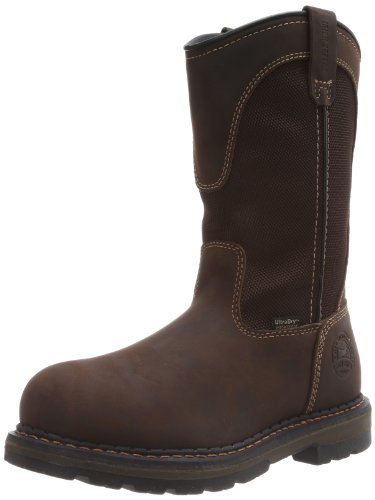
Plain version: it’s an 8-inch waterproof logger boot with a raised logger heel, a rubber lug outsole, an EH (electrical hazard) rating, and welt-style construction — sold to loggers, linemen, landscapers, and construction crews who want ankle support and traction on uneven, wet ground.
Three things it isn’t, based on where owners get surprised:
- It isn’t a “stitched-down forever” boot. Owners who studied the sole after failure report the outsole is bonded with adhesive and the stitching around it is mostly cosmetic. That reframes the whole durability story.
- It isn’t a guaranteed all-day-dry boot for its entire life. Plenty of owners stay bone-dry for a year-plus; a real minority report water coming through in weeks to a couple of months. Both are true — it’s inconsistent, not uniformly waterproof.
- It isn’t a narrow-foot boot. The heel runs roomy for several owners, and one narrow-footed buyer flat-out couldn’t get the fit they wanted.
No hype here: this is a comfortable, affordable logger with a real durability asterisk.
Key Specs That Actually Matter
Only the features that actually change your day on the job, with why they matter:
- Logger heel (raised): Owners repeatedly notice it makes them taller and changes their gait. Great for digging into terrain and pole/tree work; a few report rolling an ankle until they adjusted. It matters because it changes how the boot walks, not just how it looks.
- Waterproofing (membrane/liner): The single most polarizing feature. When it works, feet stay dry through creek crossings and rainstorms; when it fails, it fails early. Matters because it’s the exact thing you’re paying the “waterproof” premium for.
- Rubber lug outsole: Good aggressive tread for mud and terrain, but the bond to the upper is the weak link, not the rubber itself. Matters because the tread can look fine while the sole is peeling.
- Fit/last: Runs true-to-size for most, with a roomy heel and a genuine wide/extra-wide availability. Matters because sizing is the number-one reason loggers get returned.
- Lace hardware (speed hooks/eyelets): Owners like the speed lacing but the laces themselves are widely called the first thing to replace. Matters because a snapped lace mid-shift is avoidable.
- EH rating: Real value for linemen and electrical trades. For the general definition of electrical-hazard footwear, OSHA’s foot protection standard (29 CFR 1910.136) is the reference point employers use.
No made-up numbers here — where owners didn’t state a figure, I’ve kept it qualitative on purpose.
Sizing & Fit — What Owners Actually Report
Verdict: true-to-size for the clear majority. Buy your normal size and most owners report a spot-on fit. A repeated phrase across years of reviews is some version of “true fitted size” and “fit as advertised.”
Width behavior: This boot leans roomy, not snug. The heel pocket runs large for several owners — one specifically flags the heel height and heel room as bigger than expected. Wide and extra-wide options are real and well-liked, and a big share of happy reviews come from wide-size buyers.
Half-size guidance: Most owners don’t need to adjust. One taller reviewer suggested going a half-size smaller because the boot ran a touch big — but that’s the exception, not the rule, so only size down if you’re between sizes and prefer a tighter fit.
Who the fit suits, and who it fights:
- Suits: standard and wide feet, guys who wear a thicker sock, anyone who likes a little toe room.
- Fights: narrow feet — one narrow-footed buyer couldn’t get the lock-in they wanted and compared it unfavorably to their Irish Setters. If your heel tends to slip in most boots, plan on a lacing fix.
For a foot-shape checklist before you order, the work boot fit and sizing guide walks through the exact heel-slip and width checks that separate a keeper from a return here.
Feature-by-Feature Breakdown (Truth vs Marketing)
| Feature | What the Marketing Says | What It Actually Means (Owner Experience) | Compared to Competitors |
|---|---|---|---|
| Waterproofing | Waterproof membrane keeps feet dry | Works well for many for a year+; a real minority get wet in weeks to two months. Inconsistent, not fake | Weaker consistency than the priciest Red Wing/Goretex loggers owners name-drop |
| Outsole bond | Rugged welt/lug construction | Tread is aggressive and grippy, but the sole is glued and can peel at the heel; stitching is largely decorative | This glued-sole failure is the recurring knock vs stitched premium boots |
| Comfort | All-day cushioned support | Genuinely comfortable out of the box for most; a repeated bright spot across a decade | Comfort competes with boots costing far more |
| Fit/last | True fit, wide options | True-to-size, roomy heel, strong wide availability | More forgiving width range than several rivals owners tried |
| Heel | Logger heel for stability | Makes you taller, digs into terrain well; a few roll ankles at first | Higher/more aggressive heel than a flat work boot |
| Laces | Speed-lace hardware | Hooks are liked; laces are the first thing many owners replace | Lace quality lags the hardware quality |
Comparisons here are qualitative and owner-grounded — no invented stats.
Real-World Owner Experience (Deep Pattern Analysis)
I’m leading with what owners of this boot obsess over most: the durability split, and specifically the sole.
Pattern 1 — The glued-sole timeline (what most reviews won’t tell you)
In a nutshell: The failure owners describe most is the outsole separating from the upper — heels “falling off,” bottoms tearing away “piece by piece,” glue “giving out on the sole.” Crucially, owners who inspected the boot report the sole is glued, and the stitching you see is decorative rather than structural.
Why this is the high-value insight: The failures cluster in a telling window — commonly a few months to about a year of real use, which for many buyers lands after the return window has closed. Several owners describe getting “about a year’s worth of moderate use” before the bond lets go. So the boot often outlasts your ability to return it, then fails.
Hidden strength: For light-to-moderate wearers (landscaping, general yard and site work), that same bond frequently lasts long enough that they re-buy happily and never think about it.
Hidden weakness: For hard, wet, abrasive daily use — water, mud, tree-climbing friction — the glue is the ceiling, not the leather or tread.
What to do about it: Monitor the outsole-to-upper seam monthly, especially at the heel. If you see a gap starting, stop field-flexing it and take it to a cobbler for a re-bond or stitched repair before it spreads — don’t try to force-glue a structural sole yourself, and verify any safety-toe or slip concern against your employer’s PPE hazard assessment.
Pattern 2 — Waterproofing that either lasts a year or dies in weeks
In a nutshell: This is the most polarized feature. One camp crosses creeks and works nurseries in the rain for a year with dry feet; another camp reports water coming through in roughly five-to-six weeks to two months.
Hidden strength: When the membrane holds, owners rave — “big puddle, not a drop inside.”
Hidden weakness: The failures often pair with the sole/seam issues — a sudden leak can be the first sign the sole seam or trim is starting to separate, not just a membrane problem.
What to do about it: Treat a new leak as a construction warning, not just wet feet. Soak-test early (see the return-window check below) so a defective pair reveals itself while you can still send it back.
Pattern 3 — The re-buyer paradox
In a nutshell: Here’s the twist that defines this boot. Owners who complain about durability frequently re-buy Carolinas anyway — some are on their third, fourth, or fifth pair, buying “till they stop making them.” One even bought a lifetime supply of backup boxes.
Why it matters: That loyalty tells you the comfort-and-price combination is strong enough that experienced owners accept the durability ceiling as a known cost. It’s not blind fandom — it’s “I know these die in a year, and I buy them anyway.”
What to do about it: Take the hint and treat these as a rotate-and-replace boot, not a buy-once boot. Owners who rotate two pairs report far longer calendar life.
Pattern 4 — Comfort and break-in
In a nutshell: Comfort is the most consistent positive across the entire decade of feedback — many report comfort straight out of the box, others a short break-in as stiff leather conforms.
Hidden strength: Several owners with back pain credit the logger heel with easing their day.
Hidden weakness: A minority run hot and report sweaty feet; another minority find them heavy.
What to do about it: If you run hot, plan for moisture-wicking socks and don’t expect a mesh-summer feel. If break-in aches your ankle, an insole swap and patience fix it for most.
Pattern 5 — Heat/spark and job threshold
In a nutshell: The clearest happy-vs-unhappy divider is the job. Landscapers, surveyors, construction, and general-purpose wearers skew positive; the harshest failures come from the wettest, most abrasive, tree-climbing use.
What to do about it: Match the boot to moderate-to-tough terrain work, not the single most punishing wet-abrasive role you have.
The Good, The Bad & The Ugly
The Good (comfort, fit, value, loyalty)
- Comfortable out of the box for most owners, across many years of feedback.
- True-to-size with genuinely useful wide/extra-wide options.
- Strong price-to-comfort value that keeps owners coming back for repeat pairs.
- Aggressive lug traction and a heel that many find eases back and ankle fatigue.
The Bad (fixable annoyances)
- Factory laces are weak — multiple owners replace them early.
- Speed-lacing doesn’t run the full shaft for some, loosening the top.
- Runs hot for a subset; heavy for a subset.
The Ugly (the real risk)
- Glued sole separating at the heel, often after the return window.
- Waterproofing failing early on a minority of pairs, sometimes as the first sign of seam separation.
- A few reports of cracking or defects out of the box — inspect on arrival.
Mini Toolkit: Decide + Fix (Fast)
Issue-Tag Box #sole-separation · #glued-not-stitched · #seam-leak · #weak-laces · #heel-slop · #runs-hot
Fit Mini-Matrix
| Foot type | Verdict |
|---|---|
| Narrow | Expect heel slop; needs a lacing lock or skip it |
| Standard | True-to-size, comfortable — the sweet spot |
| Wide / X-wide | Strong fit; wide sizes are well-reviewed |
Mini Decision Tree
- If you do light-to-moderate outdoor work and rotate pairs → strong buy.
- If you need one pair to survive constant water + abrasion for years → look higher-tier.
- If your feet are narrow → try in person or plan a lacing fix.
- If you’re a repeat Carolina owner → you already know; size normal.
- If you need certified electrical protection → confirm the EH rating meets your site’s PPE assessment.
Troubleshooting Quickflow (max 6 steps)
- Water getting in? Check the sole-to-upper seam first, not just the membrane.
- Seam gap at the heel? Stop flexing it hard; bag it for a cobbler.
- Heel slipping? Try a runner’s-loop lacing lock before returning.
- Laces fraying? Swap to aftermarket laces now, before they snap.
- Feet hot? Switch to wicking socks; don’t expect summer mesh.
- Anything structural (sole, toe, slip risk)? Cobbler or qualified repair, and check your employer’s PPE hazard assessment.
Mini Return-Window Reality Check
Run these before the return window closes, because the worst failures show up after it:
- Soak-test early: wear them through real wet — a hose, a puddle, a rainy shift — in the first week to expose an early-leaking pair while you can still send it back.
- Inspect the sole bond on arrival: look for any gap or thin glue line where the outsole meets the upper, especially at the heel.
- Check for out-of-box defects: a few owners report cracking or a missing insole — verify both immediately.
- Stress the lace hardware: cinch the speed hooks fully and confirm the lacing holds tension up the whole shaft.
- Confirm the fit at the heel: walk a hard floor; if the heel slops badly, decide now, not in month three.
If this quick check makes you want the full pre-purchase protocol, the logger boot buying guide has the complete return-window testing framework.
Sizing & Insider Tips (Realistic)
- Order your true size. The strong majority report true-to-size; only size down a half if you’re between sizes and want it snug.
- Wide feet, order the wide. The wide/X-wide sizes are among the happiest reviews here.
- Narrow feet, lock the heel. Use a heel-lock (runner’s loop) lacing to fight the roomy heel owners report.
- Replace the laces on day one. Owners across years call the factory laces the first thing to fail — keep a spare pair on hand regardless.
- Swap the insole if the ankle aches during break-in. A better insole plus a short break-in period fixes most early discomfort.
- Expect to feel taller. The logger heel changes your gait; ease into ladders and uneven ground until you’re used to it.
- Run wicking socks if you run hot. A subset reports sweaty feet; sock choice is the cheapest fix.
- Don’t over-scuff or over-soak them early to “break them in.” Let the leather conform naturally; abusing a glued-sole boot early works against you.
- Monitor the sole seam monthly. Catch heel separation before it spreads — this is the failure that ends these boots.
- Anything past basic care — resoling, re-bonding, hardware replacement — goes to a cobbler or qualified repair. For safety-toe or slip-hazard concerns, verify against your employer’s PPE hazard assessment rather than DIY-ing it.
See It in Action: Visual Reality Check
Specs and star ratings only get you so far — seeing a logger heel and lug sole on a real foot tells you more about the gait change and bulk than any bullet list. This walkthrough shows the build up close.
WATCH THIS WALKTHROUGH OF THE CAROLINA WATERPROOF LOGGER
What to look for in this video (based on owner patterns):
- Sole-bond check: watch the outsole-to-upper seam at the heel — that’s the exact spot owners report separating.
- Lace-hook check: notice how the speed hooks are built; owners like the hardware but ditch the laces.
- Scale/weight cue: see how substantial the toe and heel are — a subset of owners call these heavy.
- Toe-box room: gauge the forefoot space, since the fit runs roomy in the heel.
- Upper material: spot how closed-off the leather upper is, which explains the “runs hot” complaints.
Keep in mind this shows a fresh pair at its best — it won’t show the heel-sole separation some owners hit months in.
Owner Stories
The stories below are composite scenarios reflecting repeated patterns across owner feedback — not quotes or a single person’s account.
- The happy re-buyer: A landscaper on his third pair. Each lasts him a couple of solid years of moderate use before the tread wears, he sizes true, rotates them, and re-orders without thinking twice. The durability ceiling never bites him because he never overloads a single pair.
- The wrong-job mismatch: A tree-climber in constant wet and mud. Comfortable and waterproof at first, but within a couple of months the heel starts pulling from the sole under climbing friction and water. Not a lemon — just more punishment than a glued sole absorbs.
- The narrow-foot returner: Buys true-to-size, loves the leather, but the heel slops and the width swims. Compared to a snugger boot they owned, it never locks in, and back it goes.
SEE MORE OWNER FEEDBACK ON AMAZON
Who This Is For (and Who Should Skip It)
Buy it if…
- You do light-to-moderate outdoor, landscaping, surveying, or general construction work.
- You want out-of-box comfort at a fair price.
- You have standard or wide feet.
- You’re willing to rotate pairs and monitor the sole.
- You want an EH-rated logger for electrical-adjacent work (confirmed against your site’s requirements).
Skip it if…
- You need one pair to survive years of constant water and abrasion.
- You have narrow feet and hate heel slop.
- You can’t inspect and soak-test within the return window.
- You want a stitched-down sole you can resole indefinitely.
If you’re comparing options, start here: Top Logger Boot Picks.
Alternatives (Quick Comparisons)
- If your top priority is long-term waterproofing: look at the field’s more consistent performers in the best waterproof work boots roundup — owners who name-drop pricier Goretex loggers usually want fewer early leaks.
- If you need a lighter boot: a subset of owners find these heavy, so the lightweight work boots picks fit better for high-mileage walking.
- If cold and snow is your real enemy: the logger heel is great on terrain but this isn’t an insulated winter build for everyone — the best winter work boots guide is the better starting point.
- If you climb tree/pole all day: consider a stiffer, stitched climbing-specific boot; the glued sole here is the wrong tool for constant spur/climb friction.
Deep-Dive FAQ
What should I test immediately after delivery?
Soak-test the waterproofing and inspect the sole-to-upper seam in the first week. Early leaks and any glue gap at the heel are the two things that predict trouble, and both are easiest to catch — and return — right away. Also confirm the insole is present and the leather isn’t cracked out of the box, since a few owners report exactly those defects.
What are the most common problems and fixes?
The two big ones are the glued sole separating at the heel and waterproofing failing early; the small ones are weak laces and a roomy heel. Fixes: monitor the seam monthly and cobbler-repair at the first gap, swap the laces on day one, and lock the heel with runner’s-loop lacing. Anything structural goes to a qualified repair, not DIY.
Will these work with my foot type and my job?
Standard and wide feet do best; narrow feet often get heel slop. Job-wise, they shine for landscaping, surveying, and general construction, and struggle under constant water-plus-abrasion like all-day tree climbing. If your work is moderate and your feet aren’t narrow, you’re the target buyer.
How long do they really last?
For hard daily users, many report roughly a year before the glued sole or waterproofing gives out; for light-to-moderate users, owners commonly report a couple of years before the tread wears. There’s no single number — wear intensity is everything, and rotating two pairs dramatically extends calendar life.
Are they actually waterproof?
Mostly yes, inconsistently. A clear majority stay dry — through puddles, creeks, and rainy shifts — often for a year or more, while a real minority get wet within weeks to a couple of months. Because early leaks can signal a seam problem, treat a new leak as a reason to inspect the construction, not just re-treat the leather.
Carolina logger vs Red Wing — which should I buy?
If you want maximum out-of-the-box comfort and value and you’ll rotate pairs, the Carolina is the easier buy; if you want a stitched, resoleable boot built to survive years of hard wet use and you’ll pay for it, the Red Wing-tier loggers owners compare against are the sturdier long-haul pick. Several Carolina owners explicitly frame it as “Red Wing quality-feel at a fraction of the price, with a shorter lifespan” — that trade is the whole decision.
Is the sole really just glued?
Based on owners who inspected failures, yes — the outsole is bonded and the visible stitching is largely decorative for the sole bond. That’s why heel separation is the signature failure and why a cobbler re-bond, not a home fix, is the right response.
Final Verdict
The Carolina 8″ waterproof logger is a genuinely comfortable, true-to-size, fairly-priced boot that a decade of owners keep re-buying — and that same decade tells you exactly where it breaks: a glued sole and inconsistent waterproofing that can fail before the year is out. That’s not a contradiction, it’s the deal. If you’re a standard-or-wide-footed worker doing moderate-to-tough (not constantly-wet-and-abrasive) work, who’ll rotate pairs and glance at the heel seam now and then, this is an easy, comfortable, high-value boot to live in. If you need one pair to survive years of the harshest wet abrasion, buy higher up the ladder. Match it to the right buyer and it’s worth it; ask it to be a buy-once-cry-once boot and it isn’t.