Timberland PRO Boondock 6″ Review: Tough Boot, One Big Catch
Last updated: June 2026
- Re-checked the sole-separation complaint against happy long-haul owners — the split between “fell apart at 5 months” and “lasted 2+ years” is real, not random, and it tracks with when and how hard the boot gets worn.
- Re-verified where the waterproofing actually fails: owners consistently point to the sole-to-upper seam and the flex crease behind the toe cap, not the leather body.
- Re-read the “old pairs were better” reviews to confirm it’s a recurring generational theme from repeat buyers, not one-off nostalgia.
Affiliate disclosure: SturdyBoot is reader-supported. If you buy through links on this page, we may earn an Amazon commission at no extra cost to you. We don’t get paid more for positive reviews — our job is to tell you who this boot fits and who it’ll fight.
The pain point nobody warns you about
You’re standing in two inches of cold runoff at 6 a.m., eleven hours of shift ahead of you, and the one thing you cannot afford is wet feet. So you buy the boot with “waterproof” stamped right in the name. Then four or five months in, the sole starts whispering apart at the seam and the water finds its way in anyway — right after your return window quietly closed.
That’s the confusion the Timberland PRO Boondock creates. It’s genuinely one of the toughest, most protective, most comfortable-out-of-the-box boots a lot of tradespeople have ever strapped on — and it’s the boot a loud chunk of owners say came apart at the sole faster than a $100 pair would. Both things are true at once, and which camp you land in is not luck.
Is it worth it? Worth it if you need maximum protection and out-of-the-box comfort and you’ll re-treat the leather and watch the sole seam; skip it if you need lightweight, all-day-walking footwear or guaranteed multi-year sole life.
What follows isn’t a spec sheet rewrite. I went deep into real owner experience to map exactly when this boot wins and when it bites. If you want the wider category lay-of-the-land first, our waterproof work boot buyer’s guide frames the trade-offs the Boondock forces you to make.
How this review was built (so you can trust it)
I analyzed a sample of roughly 200 verified-purchase owner reviews — about 100 from the critical side and 100 from the positive side — for the current Boondock 6″ composite-toe waterproof model. The Amazon listing carries far more total ratings than that (in the thousands), but I’m only counting the individual text reviews I actually read, not the listing’s headline rating count.
The feedback I worked from spans roughly mid-2024 through mid-2026, which matters here: a big share of the most useful reviews come from longtime Boondock and Timberland PRO buyers comparing this current production run to older pairs they owned years ago. Where owners are clearly describing a discontinued or earlier version, I’ve flagged it rather than blending it in.
My synthesis method, in plain English: I tagged every review into buckets — comfort/fit, sizing, waterproofing, sole and construction durability, lace hardware, weight, heat/cold behavior, and warranty/support — then separated use-and-fit-driven complaints (wrong width, wrong climate, wrong job) from likely product-design failures (sole delamination, rear-stitching tears). Filtering the first group out is what reveals the truer failure pattern underneath the star average. For the foot-shape side of all this, our fit and sizing guide pairs well with the sizing section below.
Important limitations:
- Reviews skew toward extremes — thrilled owners and furious ones write more than the satisfied middle.
- Wear intensity is wildly different across trades; a CDL driver and a welder are not stress-testing the same boot.
- I prioritized patterns that recur across many owners over dramatic one-off lemons.
Quick Verdict (TL;DR)
Best for
- Workers who need serious toe/underfoot protection and want comfort on day one, not after a month of break-in.
- Cold and wet environments — snow removal, winter outdoor trades — where warmth and dry feet beat low weight.
- Wide-footed owners who’ve been burned by “crowded toe box” safety boots.
Not for
- High-mileage walkers logging long shifts who’ll feel every ounce of this heavy boot.
- Anyone who needs guaranteed multi-year sole life with zero maintenance.
- Riders, technicians, or anyone needing a flexible, low-profile sole for pedal/foot feel.
Standout win
- Out-of-the-box comfort and protection that repeat buyers come back for again and again — some on their 5th, 9th, even 10th-plus pair.
Watch-outs
- The sole-to-upper bond is the recurring failure point, and it tends to let go right around the 5–6 month mark — often just past the return window.
Confidence Score: 🛡️ 8/10. This score reflects how confidently I can tell you who this boot fits, not a reliability percentage. It’s high because the owner signal is unusually clear in both directions: the comfort-and-protection praise is consistent, and the sole-bond failure pattern is specific and repeatable. It’s not a 10 because the durability outcome is genuinely polarized and partly depends on wear intensity and leather upkeep — variables I can’t see for your specific job.
What This Boot Is (and What It Isn’t)
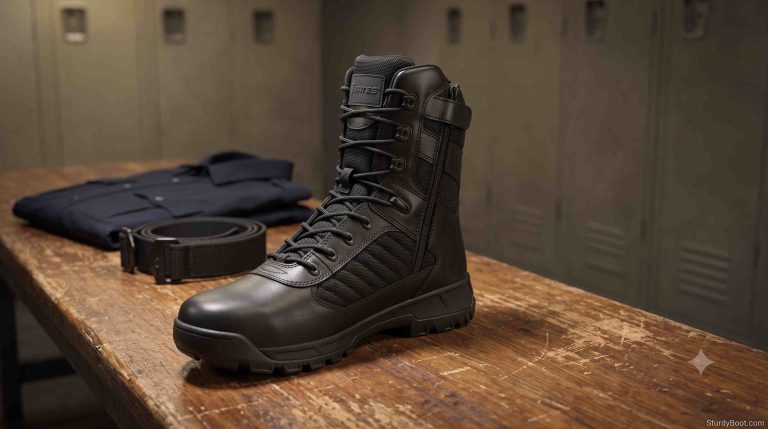
The Boondock 6″ is a tall, heavily-built waterproof work boot with a non-metallic composite safety toe and a thick, aggressive outsole, sitting on a roomy last that runs toward the bulky end of the spectrum. Safety toes in boots like this are graded against ASTM F2413, the standard that defines impact and compression performance for protective footwear. It is a maximum-protection boot first and a comfort boot second — and a surprising number of owners say it nails both on day one.
A few misconceptions worth clearing up:
- It’s not a lightweight boot. “Heavy,” “bulky,” and “like cement blocks” come up constantly, even from fans. If weight is your enemy, this is the wrong tool.
- “Waterproof” is not “waterproof forever.” Owners report the membrane holds early on, then water finds the sole seam or the flex crease as the boot ages or the sole bond loosens.
- It’s not the same boot longtime fans remember. A recurring theme from repeat buyers is that recent production doesn’t match pairs they owned years ago — thinner laces, different feel, faster sole issues.
Key Specs That Actually Matter
Forget the marketing bullet list. These are the features owners say actually change the outcome on the job:
- Composite safety toe — non-metallic, so it doesn’t pull cold the way steel does (a real plus several cold-weather owners called out). Protective-toe footwear like this is what OSHA’s foot protection standard (29 CFR 1910.136) points to when a job has foot-injury hazards. Note the listing also sells a steel-toe variant, and a few reviewers specifically flag steel-toe cold conductivity, so confirm which toe you’re buying.
- Waterproof membrane — works well when the boot is new and the leather’s maintained; the weak link is the seam and flex zones over time, not the upper itself.
- Bulky, roomy last — the reason wide-footed owners love it and narrow-footed owners slide around inside it. Fit is the single biggest divider in the feedback.
- Thick, aggressive outsole — excellent grip (owners praise traction on ice and mud) but stiff, heavy, and the part most likely to delaminate.
- Lace hardware — recent pairs draw complaints about cheap, thin laces and inner ankle lace hooks that dig in. A frequent, low-cost first upgrade.
For how outsole construction drives both grip and lifespan, our work boot soles explainer is the companion read here.
Sizing & Fit — What Owners Actually Report
The short version: the Boondock runs big and bulky, and most owners should strongly consider the Wide. That sounds backwards, so let me explain what the feedback actually shows.
Length tends to run slightly large — several owners say to size down or wear a heavier sock if you’re between sizes. But the bigger story is volume. This is a roomy, high-instep boot. If you have a narrow or standard foot, multiple owners describe their foot sliding around inside, heel slop, and “clown shoe” looseness no matter how tight they lace.
Counterintuitively, wide-footed owners are some of the happiest people in the entire dataset — the toe box doesn’t crowd their toes the way other safety boots do. One detail worth knowing: a longtime buyer reported that a recent change to the boot’s fit forced them to move from their usual regular width up to a Wide to get the old fit back. So even if you’ve bought regular Boondocks before, the current run may fit differently.
Half-size guidance from owners: if you walk all day, consider going up a half size for toe room; if you mostly stand or drive, true-to-size in Wide tends to land right.
| Foot shape | Verdict |
|---|---|
| Narrow | Risky — expect heel slop and internal sliding; size carefully or skip. |
| Standard | Usually fine in Wide; regular width can feel loose for some. |
| Wide | Best match — this is where the Boondock shines. |
Feature-by-Feature Breakdown (Truth vs Marketing)
| Feature | What the Manufacturer Implies | What It Actually Means (Owner Experience) | Compared to Competitors |
|---|---|---|---|
| Waterproofing | Stay dry in wet conditions | Solid when new; leaks later at the sole seam and toe flex crease as the bond ages | Owners coming from Red Wing/Thorogood often say those held water out longer late in life |
| Composite safety toe | All-day protection | Genuinely protective and warmer than steel in cold; one owner did report a finish nail penetrating the sole underfoot | On par for toe protection; underfoot puncture resistance isn’t bulletproof |
| Comfort out of the box | Anti-fatigue, ready to work | Frequently excellent on day one — a real standout — but a vocal minority finds the new lining/heel area rough and blistering | Beats many rivals for zero break-in; loses to some on long-haul softness |
| Outsole / durability | Built to last | Aggressive grip owners love; the sole-to-upper bond is the #1 failure, often by 5–6 months | Several owners say cheaper boots outlasted this sole, which stings at the price |
| Weight | Heavy-duty | Heavy and toe-forward; protective but tiring on high-mileage days | Among the heavier boots in its class by owner consensus |
| Laces / hardware | — | Recent laces feel thin and cheap; inner ankle hooks can dig in | A common, immediate aftermarket swap |
Comparisons above are qualitative, drawn from what owners say versus boots they’ve personally owned — not lab numbers.
Real-World Owner Experience (Deep Pattern Analysis)
Pattern 1 — The sole lets go right after returns close (the one most reviews bury)
This is what owners obsess over, so it leads. Across the critical feedback, the dominant, repeating story isn’t a slow wear-out — it’s the sole separating or delaminating from the upper, clustered around the 5-to-6-month mark. That timing is the high-value part: it lands just past the typical return window and well short of the year-plus owners expect from a $200 boot. Several describe the heel “flapping,” rubber peeling, or the bond unglueing on both boots at once — and one owner noted the review feed itself filling with the same complaint, which points to a production-consistency issue rather than individual bad luck.
- In a nutshell: If this boot is going to fail, it usually fails at the sole bond, and usually around month 5–6.
- Hidden strength: The uppers, leather, and tread often outlast the bond — people are losing boots that are otherwise still solid.
- Hidden weakness: The failure window is engineered, almost, to fall just outside returns.
- What to do about it: Stress-test and soak-test early (see the return-window check below), watch the seam from week one, and if you see early separation, document it with photos immediately. For glue-it-yourself temptation: a basic flexible shoe adhesive can buy time, but anything structural belongs with a cobbler or a warranty claim, not a driveway epoxy job.
The information-gain version of this: what most reviews won’t tell you is that the first symptom is often a sudden, unexplained leak in dry-ish conditions — water reaching the seam before you can see the gap. Treat a new leak as the early warning that the sole bond is starting to go, not as a one-off puddle.
Pattern 2 — The “they changed it” generational drop
A strikingly large group of reviewers are repeat Timberland buyers — people on their 4th, 5th, even 10th-plus pair — and they keep saying the same thing: the current production doesn’t match the older pairs. Thinner laces, a different heel/lining feel, and faster sole failure show up again and again from people who have a direct old-vs-new comparison. When your harshest critics are your most loyal customers, that’s a signal worth weighting.
- In a nutshell: Longtime fans report a real quality step-down versus pairs from a few years back.
- Hidden strength: They keep buying anyway, which tells you the core boot is still good enough to win loyalty.
- Hidden weakness: If your expectation is set by an old pair, you may be disappointed.
- What to do about it: Judge this boot on its current self, not your memory of a 2019 pair.
Pattern 3 — The re-buyer paradox
Here’s the part that resolves the chaos: plenty of owners who complain about weight, break-in, or even a failed sole still buy another pair. People mention this being their 9th pair of Boondocks; an archaeologist who walked ~1,900 miles in one pair bought a replacement the same day despite calling them heavy and slow to break in. That tells you the real-world verdict isn’t “bad boot” — it’s “boot with a known weak spot that many decide is worth living with for the protection and comfort.”
- In a nutshell: High complaint volume coexists with high repurchase loyalty.
- What to do about it: Read the complaints as “manage these risks,” not “avoid this boot.”
Pattern 4 — Comfort is polarized, and it splits by where the boot touches you
Most owners call it comfortable-to-amazing on day one. A real minority describe a rough heel/ankle ridge, pressure on the instep, or blisters within minutes — and several specifically tie it to a recent change in the material around the heel. The pattern: forefoot and underfoot comfort is widely praised; the rear ankle collar is where the unhappy minority gets hurt.
- What to do about it: Test the heel and ankle aggressively in the first hour indoors. If it’s rubbing on day one, it won’t “break in” away for most people — return it fast.
Pattern 5 — The use-case threshold (who’s happy vs who’s miserable)
Filtering wrong-use complaints out reveals a clean line. Owners in cold/wet, stand-or-drive, wide-foot, protection-first roles — snow removal, winter outdoor trades, mechanics, marine construction, truck drivers — are overwhelmingly the happy camp. Owners in high-mileage all-day-walking, heat-exposed, or narrow-foot situations — long concrete shifts, asphalt and spark work, hiking-style work — are where the misery clusters (heavy, hot, sweaty, sole wears fast near heat).
- What to do about it: Match the boot to the threshold. If your day is miles-on-concrete or sparks-and-asphalt, this likely isn’t your boot.
The Good, The Bad & The Ugly
The Good (comfort & protection)
- Excellent out-of-the-box comfort for many; little to no break-in.
- Strong protection and traction; grips ice and mud well.
- Warm and dry in cold conditions; composite toe avoids steel’s cold-pull.
- Roomy fit that finally suits wide feet.
The Bad (weight & fit friction)
- Heavy and toe-forward — tiring on long walking shifts.
- Runs big and loose for narrow/standard feet; heel slop is common.
- Thin recent laces and ankle hooks that can dig in.
The Ugly (the sole bond)
- Sole separation/delamination clustered around 5–6 months, frequently just past returns.
- Some owners report it on replacement pairs too, and customer-service experiences are hit or miss.
Mini Toolkit: Decide + Fix (Fast)
Issue tags: #sole-separation · #runs-big · #heel-slop · #runs-hot · #lace-quality · #heavy-boot
Fit Mini-Matrix
| Foot | Verdict |
|---|---|
| Narrow | Skip or size with caution — expect sliding |
| Standard | Wide recommended; regular may feel loose |
| Wide | Ideal — the Boondock’s sweet spot |
Mini Decision Tree
- If you work cold/wet and stand or drive → strong buy.
- If you walk high-mileage on concrete all day → look lighter instead.
- If you work around sparks/asphalt heat → the sole won’t love it; reconsider.
- If you have wide feet and want zero break-in → this is your boot.
- If you need guaranteed multi-year sole life with no upkeep → set expectations or skip.
Troubleshooting Quickflow (sole-bond watch)
- New leak in mild conditions? → inspect the sole-to-upper seam.
- See a gap or lifting edge? → photograph it, dated, immediately.
- Still in return window? → return now, don’t wait for “break-in.”
- Just past returns? → file a warranty claim with photos before DIY.
- Need a stopgap? → flexible shoe adhesive, not rigid epoxy.
- Recurring/structural? → cobbler or replacement; stop trusting it on wet sites.
Mini Return-Window Reality Check
Before your window closes, actually do these — most failures show up early if you provoke them:
- Soak-test the seam: stand in shallow water deep enough to reach the sole-to-upper seam for a few minutes, then check for damp socks. This is exactly where late leaks start.
- Flex the toe crease hard dozens of times and inspect for any seam lifting behind the toe cap.
- Wear them indoors for a full hour focused on the heel and ankle collar — if it rubs or pinches now, it won’t fix itself.
- Check the toe box and underfoot for defects, and confirm the pair isn’t a returned/used unit (a recurring shipping complaint).
- Stress the laces and hooks so you find cheap hardware while you can still send them back.
If any of these fail, return immediately. For deciding between this and other contenders before you commit, the waterproof work boot buyer’s guide lays out the alternatives side by side.
Sizing & Insider Tips (Realistic)
- Default to Wide unless you know you have a narrow foot — the volume runs big.
- Walking all day? Go up a half size for toe room; standing/driving, stay true.
- Swap the laces early — owners routinely replace the thin stock laces with longer, beefier ones for a better tie and snug hold.
- Fix heel slop with a lacing change (heel-lock/runner’s loop through the top eyelets) before assuming the boot’s a lost cause.
- Add a supportive aftermarket insole if the rear/instep feels rough — several owners tamed pressure points this way.
- Re-treat the leather on a schedule with a wax or mink-oil type conditioner — owners who maintain the leather report the waterproofing lasting dramatically longer.
- Don’t scuff or abuse them right away if you might return them — keep the first week return-safe while you test.
- Watch the sole seam weekly and treat any new leak as an early-warning sign, not bad luck.
- In heat/spark work, expect faster sole wear — this boot is happiest cold and wet.
- For anything beyond basic care — resoling, hardware replacement, or any slip-hazard concern — consult a cobbler or qualified repair, and verify against your employer’s PPE hazard assessment rather than improvising.
See It in Action: Visual Reality Check
Specs and star ratings only tell you so much — seeing the boot move on a real foot tells you whether that bulky outsole and tall collar will work for your job.
What to look for in this video (based on owner patterns):
- Sole-bond check: watch the outsole-to-upper seam — that’s the exact line owners say separates around month 5–6.
- Lace-hook check: look at how beefy (or thin) the laces and ankle hooks are, since that’s a common early gripe.
- Scale cue: notice how substantial the toe and outsole look — this is a heavy boot, and the video should make that obvious.
- Toe-box room: judge how much space sits around the forefoot, which explains why wide feet love it and narrow feet slide.
- Upper material: spot where the leather flexes behind the toe — the crease that loses waterproofing first.
Keep in mind this shows a fresh pair at its best — it won’t show the sole-seam separation some owners report months in.
Owner Stories
The stories below are composite scenarios reflecting repeated patterns across owner feedback — not individual quotes.
- The happy wide-foot re-buyer: A mechanic with wide feet, on his feet 12+ hours in oil and water, has bought multiple pairs. They’re heavy, sure, but slip-resistant, dry, and roomy enough that nothing crowds his toes. He treats the leather, watches the soles, and just keeps reordering.
- The wrong-job mismatch: A worker on long concrete shifts or around asphalt heat buys them for the protection, then spends every day fighting the weight and watching the tread wear fast near the heat. Great boot, wrong battlefield — he switches to something lighter.
- The wrong-width returner: A standard-or-narrow-footed buyer gets sliding heels and “clown shoe” looseness, laces them painfully tight, and still can’t lock the foot in. The fix was a Wide or a different boot — not more lacing.
SEE MORE OWNER FEEDBACK ON AMAZON
Who This Is For (and Who Should Skip It)
Buy it if…
- You have wide feet and hate crowded safety toe boxes.
- You work cold and wet and prioritize warmth, dryness, and grip over weight.
- You want real comfort and protection on day one with minimal break-in.
- You stand or drive more than you march miles.
- You’ll maintain the leather and keep an eye on the sole seam.
Skip it if…
- You log high walking mileage every shift and need a light boot.
- You work around sparks, asphalt, or sustained heat.
- You have narrow feet and don’t want to fight the fit.
- You need guaranteed multi-year sole life with zero upkeep.
- You’re chasing the exact feel of an older Timberland pair.
If you’re comparing options, start here: Top Waterproof Work Boot Picks.
Alternatives (Quick Comparisons)
- Need lighter for all-day walking? Owners burned by the weight here often look toward genuinely lightweight work boots that trade some bulk for mileage comfort.
- Cold-and-snow priority? If warmth-and-dry is the whole job, compare against dedicated winter work boots built for it.
- Brand-switchers: Many critical reviewers came from or returned to Red Wing and Thorogood — if heritage construction matters more than out-of-box comfort, that’s the lane to explore.
- Just want the broadest waterproof shortlist? The most comfortable work boots roundup overlaps heavily with what Boondock fans value.
Deep-Dive FAQ
Is the Timberland PRO Boondock worth it in 2026?
Yes — if you need protection, warmth, and out-of-the-box comfort and you’ll watch the sole seam. It’s a heavy, roomy, cold-and-wet specialist with a known weak point at the sole bond. For the right job and foot, owners love it enough to buy it repeatedly.
What should I test immediately after delivery?
Soak the sole-to-upper seam in shallow water, flex the toe crease hard while checking for any seam lift, and wear them indoors for an hour focused on the heel and ankle. Most failures and fit problems surface early when you provoke them — and you want them surfacing while you can still return.
What are the most common problems and fixes?
The big one is sole separation/delamination around 5–6 months; the others are heel slop on narrow feet, thin laces, and a rough rear-ankle area for some. Fixes: swap laces, use a heel-lock lacing pattern, add a supportive insole, maintain the leather, and document any sole gap with photos for a warranty claim. Anything structural goes to a cobbler.
Will these work with my foot type and my job?
They’re ideal for wide feet in cold, wet, stand-or-drive roles, and a poor match for narrow feet or high-mileage walking and heat-exposed work. Match the boot to that threshold and you’ll likely land in the happy camp.
How long do they really last?
It’s polarized: a vocal group reports the sole bond failing around 5–6 months, while many long-haul owners get two-plus years — some describe multiple years of hard, near-daily use. Leather upkeep and wear intensity are the biggest swing factors, and the sole bond is the part to watch.
Are they actually waterproof?
When new and maintained, yes — owners report dry feet through snow and rain. The waterproofing degrades at the sole seam and toe flex crease as the boot ages or the bond loosens, so a sudden leak is often the first sign the sole is starting to separate.
Boondock vs Timberland PRO Pro Endurance — which should I get?
If you want a roomier, better-looking, taller boot with strong out-of-box comfort, the Boondock; if you want a more snug-hugging fit with more eyelets for lockdown at a lower price, longtime owners lean Pro Endurance. Repeat buyers who’ve owned both often describe the Boondock as the more comfortable, more protective, heavier option and the Pro Endurance as the better value that “hugs” the foot more securely. Choose by fit and budget, not badge.
Final Verdict
The Boondock is a maximum-protection, cold-and-wet specialist that wins hard with the right buyer and frustrates the wrong one. If you’ve got wide feet, work cold and wet, value day-one comfort and grip over low weight, and you’ll maintain the leather and watch the sole seam, this is an easy boot to recommend — and the army of repeat buyers backs that up. If you walk long miles, work in heat, or have narrow feet, the weight and the sole-bond risk make it a hard pass. Buy with eyes open, test it before returns close, and you’ll know fast which camp you’re in.