Thorogood 9” Waterproof Logger Boots: Honest Owner-Based Review
Last updated: July 2026
- Re-read the newest owner feedback from late 2025 into mid-2026 and confirmed the sole-seam separation reports still cluster in the first several months of hard use, not years in.
- Re-checked the sizing chatter and tightened the guidance: the “runs large / order down” crowd and the “toebox too tight even in wide” crowd are both real, and I explain who lands where.
- Verified the loyalty-vs-letdown split is still the dominant storyline, including a fresh wave of ex-Chippewa Super Logger converts.
Affiliate disclosure: SturdyBoot.com is a participant in the Amazon Associates program. If you buy through links on this page, we may earn a small commission at no extra cost to you. It never changes what the owner feedback says.
The Jobsite Problem This Boot Creates
If you’ve ever stood in a supply house holding a $300 logger boot wondering whether “made in the USA, union-made” actually buys you anything anymore, you already understand the confusion around the Thorogood Logger Series 9”. It has one of the most passionately loyal followings in the trades — guys on their third and fourth pair — sitting right next to owners who watched the soles peel at the seams before their first winter was over. That split is the whole story.
Is it worth it? Yes, for cold-weather, rough-terrain workers who want a heavy, warm, genuinely waterproof USA-made logger and will swap the insole and laces — but it’s a real gamble if you need out-of-box, all-day comfort or flawless quality control.
I went deep into real owner experience for this one, not the spec sheet. For a features-to-hazards overview before you commit to any logger, the complete logger boot buying breakdown maps boot traits to the jobsite risks they’re actually meant to handle.
How This Review Was Built (So You Can Trust It)
- Reviews analyzed: I read and synthesized a sample of roughly 135 verified-purchase and verified-buyer text reviews for this boot. That’s the number of individual written reviews I actually went through — not the listing’s total rating count
- Time window: The feedback spans roughly 2019 through mid-2026, weighted toward recent pairs. That matters here because this is current Trail Crazyhorse production, and a chunk of the most loyal owners are grading it against older, now-discontinued boots (especially the USA-made Chippewa Super Logger #25405) they wore for a decade or more.
- Method: I tagged every review into buckets — comfort/break-in, sizing/width, waterproofing, sole and welt durability, lace/hardware quality, insole quality, warmth, and warranty/support — then separated use-and-fit-driven complaints (wrong width, wrong climate, wrong expectations) from likely product or QC failures (seam separation, welt stitching backing out, defective single boots).
- Important limitations:
- Reviews skew toward extremes — thrilled repeat buyers and burned one-timers both write more than the quiet middle.
- Wear intensity varies wildly: a truck driver’s “worn every day” is not a logger’s “felling trees on hillsides in sub-zero.”
- I prioritized patterns that repeat across many owners over dramatic one-off lemons.
Quick Verdict (TL;DR)
Best for:
- Cold-climate and winter trades who want real 400g insulation plus waterproofing in one boot.
- Loggers, sawmill and diesel workers, linemen, and anyone on uneven, muddy, hilly terrain who values aggressive tread and a steel toe.
- Buyers willing to treat the boot as a platform — budget for a better insole and new laces from day one.
Not for:
- Anyone who needs a comfortable, correct-fitting boot straight out of the box with zero fuss.
- Lightweight-boot fans — these are heavy, and owners feel it.
- Buyers who can’t tolerate quality-control roulette on a premium-priced boot.
Standout win: When you get a good pair, the leather, warmth, and waterproofing earn the “worth every penny” reputation — and plenty of owners re-buy again and again.
Watch-outs: Sole-seam separation and welt stitching backing out show up more than they should for the price, and the stock insoles and laces are near-universally panned.
Confidence Score: 🥾 7.5/10 — This reflects how confidently I can tell you who this boot fits, not a reliability percentage. The comfort-and-warmth signal is strong and consistent; the durability signal is genuinely polarized (loyal re-buyers vs. seam failures), and sizing feedback pulls in two directions. That real ambiguity is why it’s not higher.
What This Boot Is (and What It Isn’t)
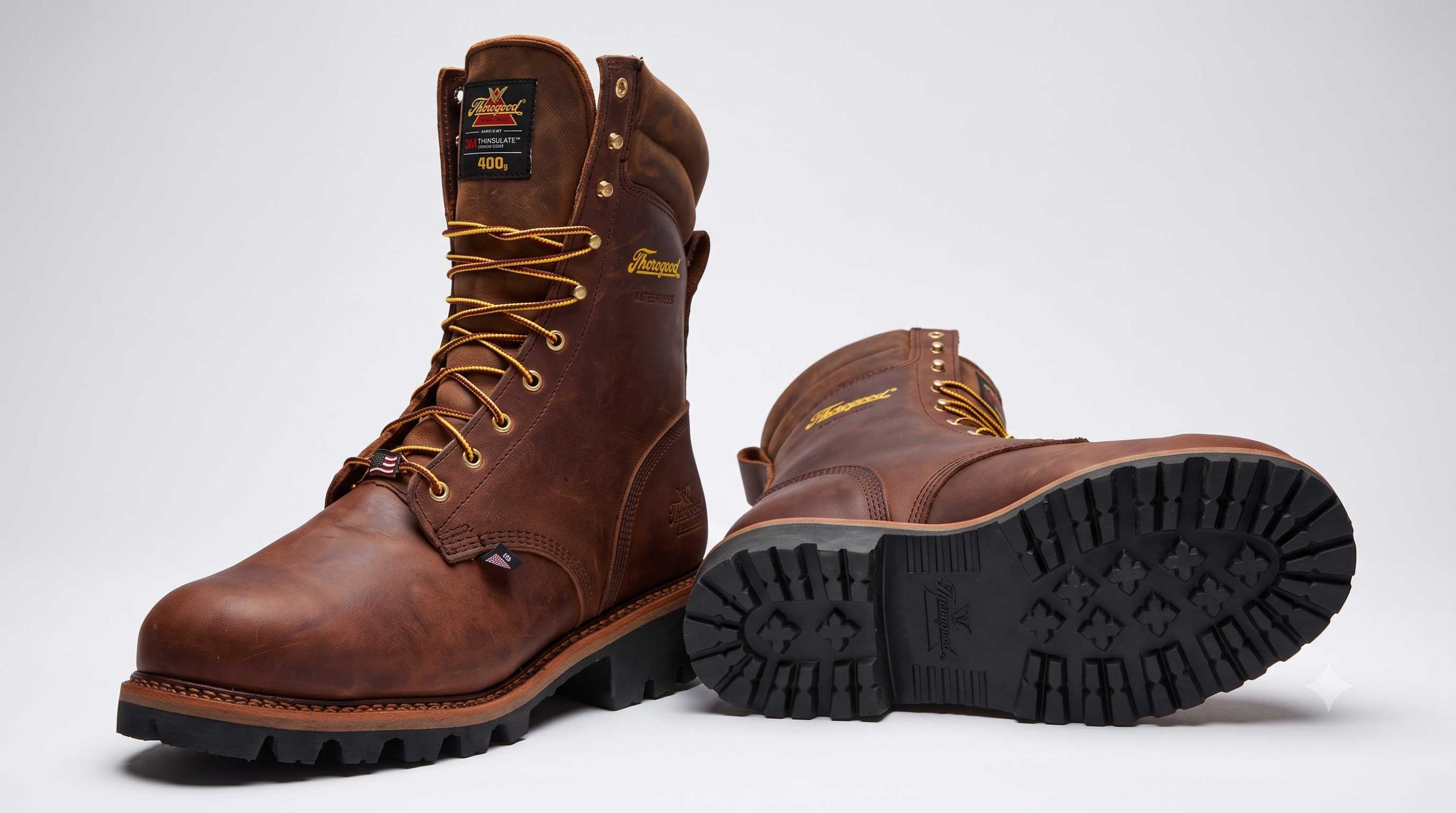
The Thorogood Logger Series 9” is a tall, heavy, insulated, waterproof steel-toe logger built on storm-welt construction with an aggressive lugged outsole and a raised logger heel — a cold-weather, rough-terrain work boot, not an everyday light-duty shoe.
Three misconceptions worth clearing up:
- “USA-made means bulletproof.” Owners love that it’s American- and union-made, but that badge does not guarantee a flawless pair — QC complaints exist right alongside the praise.
- “No break-in needed.” Some owners genuinely get zero break-in; others describe two-plus brutal weeks. It’s inconsistent enough that you should plan for break-in, not bank on skipping it.
- “The high heel is a gimmick.” That pronounced logger heel is functional for grip on slopes and ladders, but at least one owner returned the boot purely because the heel felt too tall and awkward for flat-ground walking. It’s a real trade-off, not marketing.
Key Specs That Actually Matter
- Steel safety toe + steel shank: The protection people buy loggers for. One owner in an auto shop took a 2500-series truck to the foot and walked away with a barely-dented toe cap and intact toes — the toe box does its job.
- 400g insulation: The reason winter workers pick this over an uninsulated boot. Owners repeatedly call out warm feet in snow, sub-zero felling, and Michigan/Massachusetts winters.
- Waterproof membrane: When it works, it works — owners report bone-dry socks through puddled truck yards and submersion to the lace hooks. When it fails early, it’s a headline complaint. This is the boot’s most bimodal feature.
- Vibram lugged outsole + logger heel: Praised for grip on mud, hillsides, and snow; noticeably worse on sheet ice. Great off-road, aggressive for smooth indoor floors.
- Leather upper: Thick, premium Trail Crazyhorse that owners rave about — though a few report the leather over the toe cap lifting or scratching more easily than expected.
- Weight: Heavy. Owners estimate close to four pounds each and say plainly: if you want light, look elsewhere.
- Lace hardware + stock insole: The two consistent weak points. Assume you’re replacing both.
An EH (electrical hazard) rating is referenced by owners and appears on retailer listings; the general performance requirements for protective footwear are defined by ASTM F2413, and if your site requires it, always verify the current spec against your employer’s PPE hazard assessment.
Sizing & Fit — What Owners Actually Report
Here’s the honest picture, because sizing is the number-one reason these get returned: feedback genuinely splits, and which camp you land in depends on what you’re comparing to.
- The “runs large / order down” camp: Several owners — especially those coming from EU-sized or regular sneakers — found these ran a half-size big and recommend sizing down half a size from your normal shoe.
- The “too snug, even in wide” camp: Just as many report the toebox running tight, including buyers who ordered 3E/EEE wide and still felt cramped across the toes. Longtime Thorogood wearers noted this pair felt tighter than older pairs in the same size.
- Width behavior: This is the tell. Multiple owners specifically recommend going up to the widest available width (3E/XX-Wide) because the high-grade leather doesn’t flex early. If your feet are wide, don’t order standard.
- Half-size guidance: For winter sock layering, a few cold-climate owners buy a half-size up on purpose to fit heavy socks.
Who the fit suits: Standard-to-wide feet who order the wide width and expect a firm, structured last. Who it fights: Narrow feet (heel slop and in-boot sliding show up), and anyone expecting a forgiving, sneaker-like toe box. For a foot-shape checklist before you commit, the work boot fit and sizing guide walks through the exact heel-slop and toe-room checks owners wish they’d run first.
Feature-by-Feature Breakdown (Truth vs Marketing)
| Feature | What the Marketing Suggests | What It Actually Means (Owner Experience) | Compared to Competitors |
|---|---|---|---|
| Waterproofing | Keeps you dry, period | Excellent on good pairs (submersion-level dry); a minority report it failing within the first wet season | More convincing than budget loggers; the failures echo complaints leveled at older Chippewa/Carolina pairs |
| 400g Insulation | Warmth without bulk | Consistently praised — real warmth in snow and sub-zero work | A genuine edge over uninsulated loggers for winter trades |
| Steel toe + shank | Jobsite protection | Delivers; one owner survived a truck rolling onto the toe | On par with premium steel-toe loggers |
| Leather upper | Premium, durable | Thick and beautiful; occasional reports of toe-cap leather lifting or scratching | Leather quality rivals or beats pricier boots when the pair is good |
| Outsole/heel | Slip-resistant traction | Grippy on mud/hills, weaker on ice; tall logger heel changes your gait | More aggressive than flat wedge work boots; not an ice specialist |
| Stock insole | Comfort footbed | Widely disliked — many swap immediately | A clear miss vs. boots with better out-of-box footbeds |
| Laces | — | Near-universally called cheap, short, and prone to stretching | A recurring, easily-fixed annoyance |
Real-World Owner Experience (Deep Pattern Analysis)
1. The Re-Buyer Paradox (the pattern owners obsess over)
In a nutshell: This boot has two loud crowds — devoted repeat buyers on pair three or four, and deeply burned one-timers — and the loyal crowd is large enough that the complaints don’t cancel it out.
Hidden strength: A striking number of owners are Chippewa Super Logger refugees who switched after Chippewa moved production overseas, and many now say they wish they’d switched years ago. When this boot lands right, it earns lifers.
Hidden weakness: The same premium price and USA badge that create loyalty also make failures feel like betrayals, which drives some multi-pair veterans to say “probably my last pair.” Loyalty here is earned per-pair, not guaranteed.
What to do about it: Treat your first pair as a trial. Inspect it hard inside the return window (see the reality check below) so you find out which camp your pair belongs to while you can still act.
2. Sole-Seam Separation, and When It Strikes (information gain)
In a nutshell: The single most alarming durability complaint is the sole separating at the seams — and it tends to hit within the first several months of hard use, not after years.
Hidden strength: Owners who make it past that early window often report the boot then holds up for multiple years, so early survival is a strong signal.
Hidden weakness: Several owners describe separation starting around the two-to-nine-month mark — after the return window has closed — and in at least one case a cobbler’s re-glue let go again in the next storm. That timing is the cruel part.
What to do about it: Flex-test the sole seam aggressively in your first weeks and monitor the welt. If the sole bond is going to fail, you want early evidence while a return or exchange is still on the table. For a resole or re-bond, consult a qualified cobbler or Thorogood’s repair service rather than field-gluing it.
3. The Break-In Lottery
In a nutshell: Break-in reports are all over the map — from “comfortable straight out of the box” to “two weeks of bruised feet.”
Hidden strength: When it breaks in fast, owners describe it as one of the most comfortable loggers they’ve ever worn, some wearing them off the clock by choice.
Hidden weakness: One thoughtful long-form reviewer flagged a counterintuitive trap: because the supple leather needs little break-in, it never fully molds to your foot — so it can start snug, loosen, and then let your foot slide and blister as the day goes on.
What to do about it: Dial fit with lacing before you decide it’s a lemon. A common owner fix is lacing loosely through the lower hooks and tight up top to kill ankle pressure and heel movement.
4. Insole and Lace Disappointment (near-universal)
In a nutshell: The two most agreed-upon complaints across the entire sample: the stock insoles are poor, and the laces are cheap, short, and stretchy.
Hidden strength: Both are cheap, fast fixes — this is the rare “flaw” you can fully solve for pocket change.
Hidden weakness: On a $300 boot, owners resent having to spend another $50 to make it right, and some describe the flat heel-to-ball plane of the footbed actually changing their gait until they swap it.
What to do about it: Budget for an aftermarket insole and quality waxed laces from the start. Treat it as part of the purchase price, not an optional upgrade.
5. The Time-Machine Effect (loyalty anchored to older pairs)
In a nutshell: A recurring subtext is longtime buyers grading current production against boots they wore for 7–12 years, and a subset feeling recent pairs have slipped.
Hidden strength: Even skeptics often admit current pairs are still among the better loggers available, especially versus overseas competitors.
Hidden weakness: “American made with globally sourced material” comes up as a sore point for buyers who remember an all-USA supply chain, and a few feel QC consistency isn’t what it was.
What to do about it: Buy the boot in front of you on its own merits and inspect the actual pair — nostalgia won’t tell you whether this box is a good one.
The Good, The Bad & The Ugly
The Good (comfort, warmth, protection):
- Genuinely warm and waterproof on good pairs — a winter-trade favorite.
- Premium thick leather and a toe cap that survives serious impacts.
- Aggressive traction on mud, snow, and hillsides.
- A deep bench of multi-pair loyalists, many converted from other USA loggers.
The Bad (fit and out-of-box friction):
- Heavy; not for anyone chasing a light boot.
- Stock insoles and laces are consistently panned.
- Sizing and width run inconsistent enough to cause returns.
- Break-in is a coin flip.
The Ugly (when QC misses):
- Sole-seam separation and welt stitching backing out, sometimes just past the return window.
- Reports of mismatched sizes shipped, rippled under-insole rubber, or a single defective boot in the pair.
- Warranty/support experiences that range from a clean refund to being told “it’s been a year, nothing we can do.”
Mini Toolkit: Decide + Fix (Fast)
Issue-Tag Box: #sole-seam-separation · #welt-stitch-backout · #weak-stock-insole · #cheap-short-laces · #toebox-tight-in-wide · #heel-slop-narrow-feet
Fit Mini-Matrix:
| Foot type | Verdict |
|---|---|
| Narrow | Risky — watch for heel slop and in-boot sliding; lace-lock the ankle |
| Standard | Good fit; consider sizing down a half if coming from sneakers |
| Wide | Order the widest width (3E/XX-Wide); the stiff leather won’t stretch to save you |
Mini Decision Tree:
- If you work cold, wet, uneven ground → strong candidate.
- If you need light and nimble → skip it.
- If you have wide feet → order the widest width or pass.
- If you can’t risk QC roulette on a premium boot → consider a made-to-order alternative.
- If you’re an ex-Chippewa Super Logger owner → this is the most-recommended landing spot in the feedback.
Troubleshooting Quickflow (max 6 steps):
- Heel slipping or blisters? → Re-lace: loose through lower hooks, tight up top.
- Footbed feels off / gait changed? → Swap the stock insole first.
- Laces stretching loose midday? → Replace with waxed laces.
- Toe cramping? → Confirm you’re in a wide width; a wider size often fixes it.
- Sudden dampness inside? → Inspect the sole seam and welt immediately for early separation.
- Seam or welt actually opening? → Document it, act inside the return window, and see a cobbler or Thorogood repair for anything structural.
Mini Return-Window Reality Check
Before your return window closes, actually stress-test the pair:
- Flex the sole seam hard and bend the boot repeatedly — early sole-bond weakness is your top failure risk here.
- Soak-test the waterproofing in real water to the lace line and check for damp socks, since early leaks are a known minority complaint.
- Inspect the welt stitching up close for any stitches already backing out or missing.
- Wear each boot a full day to catch a single stiff or ill-fitting boot in the pair (mismatched/defective singles do happen).
- Confirm both boots are the same size and the under-insole rubber lies flat and un-rippled.
If a test fails, don’t rationalize it — a premium boot should pass all of these new. For how these checks fit into the wider category, the logger boot buyer’s deep-dive puts each test in context against rival loggers.
Sizing & Insider Tips (Realistic)
- Coming from regular sneakers or EU sizing? Try a half-size down — multiple owners found these ran large that way.
- Wide feet? Go to the widest width offered; the crazyhorse leather does not flex early to rescue a tight toe box.
- Layering winter socks? Some cold-weather owners deliberately buy a half-size up for sock room.
- Swap the stock insole on day one — it’s the single highest-impact comfort fix owners report.
- Replace the laces with longer waxed laces; the stock ones are short and stretch loose as the day goes.
- Fighting ankle pressure or heel slop? Lace loosely through the lower hooks, then tight through the top — a repeated owner fix.
- Add heavy cushioned socks if the flat heel-to-ball footbed plane bothers your gait until you re-insole.
- Don’t over-scuff or aggressively bend a fresh pair outdoors before you’ve verified the sole seam — you want the boot pristine if you need to return it.
- Monitor the sole bond and welt through the first few months; that’s the window where structural failures surface.
- Traction is strong on mud and slopes but weaker on ice — plan footing accordingly.
- For anything past basic care — resoling, welt repair, hardware replacement — use a qualified cobbler or Thorogood’s repair service, and verify slip or hazard concerns against your employer’s PPE assessment.
- For safe, low-risk ways to speed up break-in, the work boot break-in shortcuts cover techniques owners actually use without wrecking the leather.
Owner Stories
The stories below are composite scenarios reflecting repeated patterns across owner feedback.
- The happy re-buyer (winter logger/sawmill): Switched from a discontinued USA logger, ordered the wide width, swapped the insole and laces immediately, and is now on a second warm, dry, grippy pair he wears felling trees on frozen hillsides. Verdict: worth every penny — for his exact job.
- The wrong-job mismatch (all-day flat concrete): Loved the leather and looks but found the heavy boot, flat footbed plane, and tall heel punishing on hard indoor floors, and went back to a lighter or differently-lasted boot after the novelty wore off.
- The wrong-width returner (wide feet, standard size): Ordered his usual size expecting true-to-size, got a cramped toe box even though the boot is “wide,” and returned it — a fix that ordering the widest width up front would likely have prevented.
SEE MORE OWNER FEEDBACK ON AMAZON
Who This Is For (and Who Should Skip It)
Buy it if…
- You work cold, wet, and rough — snow, mud, hillsides, sawmill, diesel, or line work.
- You want real insulation and waterproofing in one USA-made boot.
- You have standard-to-wide feet and will order the correct width.
- You’re happy to swap the insole and laces to unlock the comfort.
- You want a boot that, on a good pair, can last multiple years.
Skip it if…
- You need light, nimble footwear.
- You want guaranteed out-of-box comfort with no fiddling.
- You have narrow feet and hate heel slop.
- You can’t stomach quality-control variability at this price.
- You mostly stand on flat, smooth indoor floors all day.
If you’re comparing options, start here: Top Logger Boot Picks.
Alternatives (Quick Comparisons)
- If waterproofing is your single biggest worry: Cross-shop the field in the best waterproof work boots roundup, since early-leak reports are this boot’s most divisive trait.
- If weight is a dealbreaker: This logger is heavy by design; lighter options live in the lightweight work boots guide.
- If deep winter is the whole job: Compare insulation and traction head-to-head in the winter work boots guide.
- If you want the broad logger landscape first: The best logger boots guide frames where Thorogood sits against rivals owners keep naming.
Deep-Dive FAQ
What should I test immediately after delivery?
Flex the sole seam hard, soak-test the waterproofing to the lace line, and inspect the welt stitching — all before the return window closes. These three tests target the exact early failures owners report (seam separation, leaks, and welt stitches backing out), so you learn whether your specific pair is a good one while you can still return it.
What are the most common problems and fixes?
The most common issues are weak stock insoles, cheap short laces, and — more seriously — sole-seam separation. The insoles and laces are cheap, fast swaps; the seam separation is not, so flex-test and monitor the sole bond early and act inside the return window if it starts to go.
Will these work with my foot type and my job?
They’re best for standard-to-wide feet in cold, wet, rough-terrain trades. Narrow feet often get heel slop, and even some wide-footed buyers find the toe box tight, so ordering the widest available width is the safest move; flat-floor indoor workers may find the weight and heel tiring.
How long do they really last?
It’s genuinely bimodal. Pairs that survive the first few months often go multiple years — some owners cite three years or more of hard use and re-buy repeatedly — while a minority see sole or stitching failures within the first months, so early durability is the signal to watch.
Are they actually waterproof?
On a good pair, yes — owners report bone-dry socks through puddles and even brief submersion to the lace hooks. But a repeated minority report the waterproofing failing within the first wet season, which is exactly why the soak-test matters before your return window closes.
Thorogood Logger vs Chippewa Super Logger — which should I get?
For most buyers today, the Thorogood is the more available and more recommended pick, largely because it’s still USA-made while the classic Chippewa Super Logger many owners loved was discontinued or moved overseas. A large share of Thorogood’s most loyal owners are former Chippewa wearers who switched and say they’d do it sooner — though a few still insist their old Chippewas fit or lasted better.
Is the tall logger heel a problem?
For rough terrain, ladders, and slopes, the raised heel is a functional plus that owners appreciate. But on flat ground it changes your gait, and at least one owner returned the boot solely because the heel felt too tall and awkward — so if you’re mostly on level floors, factor that in.
Final Verdict
The Thorogood Logger Series 9” is a boot with a split personality, and knowing which half you’ll meet is the whole game. Buy it if you work cold, wet, and rugged, have standard-to-wide feet, and you’ll cheerfully swap the insole and laces to unlock the comfort its loyalists rave about — that buyer gets a warm, waterproof, USA-made logger that can run for years and earn a re-buy. Skip it if you need light weight, guaranteed out-of-box fit, or zero tolerance for quality-control variance at a premium price. Inspect your actual pair hard inside the return window, and let that pair — not the badge or the nostalgia — tell you the verdict.