Danner Acadia 8″ Review: Sizing, Durability & Who Should Skip It
Last updated: July 2026
- Re-checked the durability signal against the newest owner feedback (early-to-mid 2026); the “resole-and-run-it-for-decades” pattern is still the loudest theme among long-term owners.
- Re-verified the sizing story across a fresh batch of reviews: the “runs long, runs narrow, size down a half” advice holds up almost universally.
- Re-examined the GORE-TEX complaints and confirmed the leak reports still cluster around older, heavily-used pairs rather than fresh ones.
- Confirmed the “no real insole in the box” frustration is still one of the single most repeated first-impression gripes.
Affiliate disclosure: SturdyBoot.com is reader-supported. If you buy through links on this page, we may earn a small Amazon commission at no extra cost to you. It never changes what we recommend or how we read owner feedback.
A Great Boot That Fights the Wrong Feet
If you’ve ever stood a 12-hour shift on concrete, walked a beat, or worked a courthouse floor, you already know the quiet dread of buying “duty boots” that die in eight months. The Danner Acadia sits at the opposite end of that spectrum — and that’s exactly what makes it confusing. It’s a premium-priced, made-in-USA, stitchdown, GORE-TEX boot with a cult following of cops, EMS crews, firefighters, and mail carriers who resole the same pair for a decade. Yet a real slice of buyers open the box and feel ripped off within a week.
Is the Danner Acadia worth it? For narrow-to-standard feet in law enforcement, EMS, security, or all-day standing work, yes — it’s a resole-forever boot that earns its price over years. Wide feet and heavy-labor buyers should think twice.
That gap between “best boot I’ve ever owned” and “worst boot I’ve ever worn” isn’t random noise. It maps almost perfectly onto foot width, job type, and one packaging surprise that catches nearly everyone. This review is a synthesis of real owner experience, not spec-sheet marketing. If you want the wider category view first, our logger and heavy-duty boot buying guide lays out how construction and fit map to jobsite risk before you commit to any single pair.
How this review was built (so you can trust it)
- Roughly 150 individual owner reviews read. I analyzed a sample of about 150 distinct verified-purchase and text reviews for the Acadia 8″ — not the listing’s headline rating count. For context, the listing shows 861 global ratings at a 4.6-star average, but that big number is not what I read; I worked from the actual written reviews in front of me.
- Time window: roughly 2011 through mid-2026. That’s a wide span, which matters here. Longtime fans openly compare current pairs to boots they bought a decade or two ago, so some “quality went downhill” complaints are really comparisons to older production — worth separating from genuine defects.
- Synthesis method. I tagged feedback into buckets: comfort/fit, sizing accuracy, width, waterproofing (GORE-TEX), sole and stitchdown durability, the missing-insole issue, break-in, weight, warranty/support experience, and repeatable defects. Then I separated use/fit-driven complaints (wrong width, wrong job, standing all day with the stock insert) from likely product issues (seam fraying, sole separation, leaking liners on old pairs).
- Important limitations:
- Reviews skew to extremes — thrilled repeat buyers and furious returners both write more than the quiet middle.
- Wear intensity is wildly different: a retired guy walking his property is not the same test as a mail carrier logging miles daily.
- I prioritized patterns that recurred across many owners over dramatic one-off lemons.
Before you commit, it’s worth cross-checking your specific role against the full police boots buying guide, which frames the duty-boot trade-offs the Acadia lives and dies by.
Quick Verdict (TL;DR)
Best for:
- Law enforcement, EMS, security, and uniformed jobs that need a polishable boot that lasts years.
- Narrow to standard feet (this boot loves a slim foot).
- Buyers who plan to resole and keep a boot for the long haul rather than replace it yearly.
Not for:
- Genuinely wide or flat feet — even the wide widths run snug for many.
- Heavy-labor trades expecting all-day cushioning straight out of the box.
- Anyone who wants a comfortable boot on day one with no break-in and no insole shopping.
Standout win:
- Long-term durability and Danner’s recrafting/resole path — many owners run the same pair for 5, 7, even 20-plus years.
Watch-outs:
- It ships with a hard plastic half-insert, not a real cushioned insole — plan to buy one.
- Sizing runs long and narrow; most owners size down and go wide.
Confidence Score: 8.5 / 10 🥾 This is a buyer-usefulness score — how confidently I can tell you WHO should buy this, not a reliability statistic. It’s high because the owner signal is unusually consistent: the durability upside and the fit/insole downsides both repeat over and over across years of feedback. It’s not a perfect 10 only because comfort is genuinely polarized — the same boot that molds to one owner’s foot punishes another’s, mostly along width lines.
What This Boot Is (and What It Isn’t)
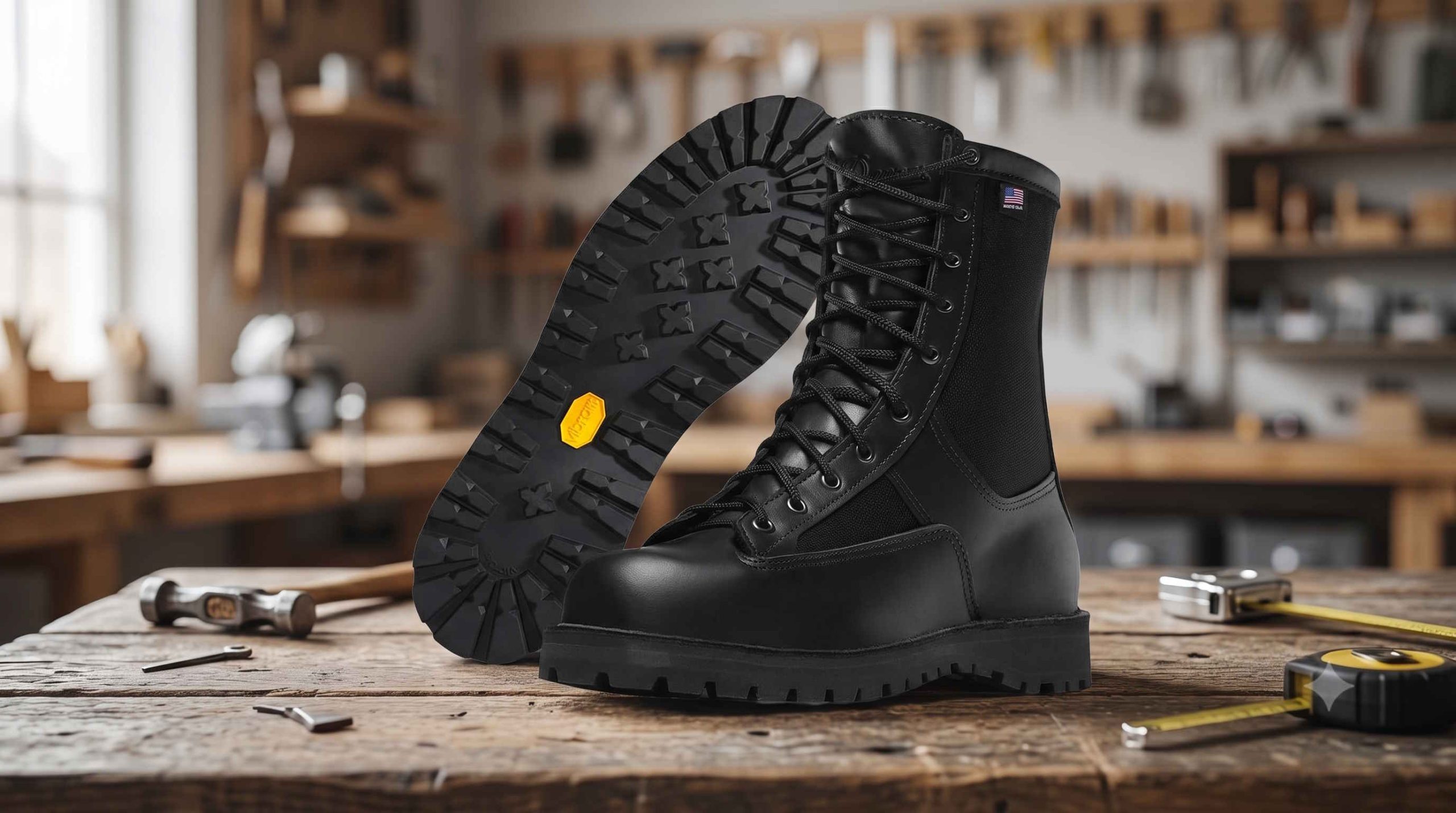
The Danner Acadia 8″ is a made-in-USA, stitchdown-construction uniform boot with a full-grain leather and 1000-denier nylon upper, a GORE-TEX waterproof liner, and a low-lug Vibram outsole built on Danner’s narrow 650 last. In plain terms: a tall, polishable, resoleable duty boot designed to be repaired rather than replaced.
Three misconceptions worth clearing up:
- It’s not a plush, pre-cushioned comfort boot. Owners consistently describe a firm, stiff platform that demands break-in and a real insole. That’s the design, not a defect.
- It’s not a wide-foot boot. Danner itself builds it on a narrow last, and owner feedback confirms even the wide sizes fight truly wide feet.
- It’s not a “grab your normal size” purchase. It runs long. Ordering your usual size is the single most common sizing mistake in the feedback.
Key Specs That Actually Matter
- Stitchdown construction: This is why the Acadia is resoleable. Owners repeatedly send pairs back to be recrafted and keep running them for years. On the job, that means a boot you repair, not landfill.
- GORE-TEX liner: Keeps feet dry in mud, snow, and shallow standing water when the boot is healthy. The catch: several long-term owners report the liner eventually leaks on heavily-used pairs.
- Narrow 650 last: The defining fit trait. It suits narrow feet beautifully and frustrates wide feet — more on this below.
- Full-grain leather + nylon upper: Polishable to a sharp shine, which is exactly why uniformed buyers love it.
- Low-lug Vibram outsole: Great for pavement, courthouses, patrol, and standing work. A recurring minority note: it’s not aggressively slip-resistant on truly slick surfaces.
- No cushioned insole included: The boot ships with a hard plastic half-insert. Treat “buy an insole” as part of the purchase, not an accessory.
On the safety side, remember the Acadia is a duty boot, not a rated safety-toe boot. If your jobsite hazard assessment calls for impact/compression protection, that’s governed by OSHA’s foot protection standard, 29 CFR 1910.136, and the toe-cap performance it points to is defined by ASTM F2413 – the Acadia’s appeal is duty comfort and longevity, not a stamped safety toe.
Sizing & Fit — What Owners Actually Report
The Acadia runs long and narrow. Most owners size down a half size and order a wide. This is the most consistent single message across the entire body of feedback.
- Length: Reports of “at least a half inch too long” and “size down a half or full” are everywhere. Order your normal size and you’ll likely swim in the toe box.
- Width: The narrow 650 last means standard-width buyers often find the regular too tight and the wide about right. Wide-footed buyers frequently report that even EE — and sometimes EEEE — still isn’t enough. Multiple owners flatly say: if your foot is truly 4E, this boot may never work for you.
- The paradox: Because it runs long, buyers instinctively size down for length, which then pinches width. The fix most happy owners land on is: size down for length, size up in width.
Who the fit suits: narrow and standard feet, especially people who want a snug, supportive, dress-able boot. Who it fights: wide feet, flat feet, high-volume feet, and anyone needing a roomy toe box. For a deeper walkthrough of matching last shape to foot shape, the work boot fit and sizing guide covers exactly these heel-slop and toe-box traps.
Feature-by-Feature Breakdown (Truth vs Marketing)
| Feature | What the Manufacturer Says | What It Actually Means (Owner Experience) | Compared to Competitors |
|---|---|---|---|
| Stitchdown / recraftable | “Superior durability, can be recrafted” | Largely true — owners genuinely resole and run these for many years, though recraft cost is high enough that some walk away | A real edge over cheaper cemented-sole boots that can’t be rebuilt |
| GORE-TEX waterproof | “100% waterproof, keeps feet dry” | True when healthy; a recurring group of heavy-use owners report the liner eventually leaks on one boot | On par with other GORE-TEX duty boots; leaks track with age and mileage |
| Narrow 650 last | “Sleek profile, order EE if wider” | Accurate warning, but under-communicated at checkout — width confusion drives a lot of returns | Runs noticeably narrower than many mainstream work boots |
| Comfort / footbed | “Comfort and durability” | Divisive — the stock hard insert is widely disliked; comfort arrives after break-in and an insole swap | Loses to boots that ship comfortable out of the box |
| Polishable leather | “Full-grain, polishable” | Strongly confirmed — uniformed owners love the shine | A clear win for law enforcement and dress-code jobs |
Real-World Owner Experience (Deep Pattern Analysis)
1. The Re-Buyer Paradox (the pattern that defines this boot)
In a nutshell: The Acadia’s most striking signal is how many owners complain and re-buy anyway — often for the third, fourth, sixth pair. People call them the most uncomfortable boots they’ve worn, then admit they’d buy them again.
Hidden strength: That contradiction is actually the verdict. When buyers who criticize the insole, the break-in, and the narrow fit still come back after 5–10 years, it tells you the durability payoff outweighs the day-one friction for the right foot.
Hidden weakness: It also means the negatives are real, not imagined. The boot genuinely tests your patience before it rewards you.
What to do about it: Go in expecting to invest — an insole, a break-in period, and the right size — rather than expecting instant love. What most reviews won’t tell you: the Acadia is a boot you commit to, not one you try out.
2. The Missing-Insole Shock (the most repeated first impression)
In a nutshell: An enormous number of owners are blindsided that a premium boot ships with a hard plastic half-insert instead of a real cushioned insole. Some pairs arrive with no insert at all.
Hidden strength: The empty volume inside is intentional — it leaves room for the aftermarket or custom insole most serious owners end up preferring anyway.
Hidden weakness: Nobody warns you at checkout, so your first wear is often on a bare, hard footbed — which fuels a lot of the “these hurt” and “no arch support” complaints.
What to do about it: Budget for a quality insole from day one. Many owners report the boot transforms once they add a proper footbed. If you have arch or plantar-fasciitis needs, plan the insole before the first shift, not after.
3. Failure Timing & Sequence: Watch the Seam and the Liner
In a nutshell: When the Acadia does fail structurally, owners describe a recognizable order — a seam frays or the sole stitching lets go, or a GORE-TEX liner starts leaking, usually on heavily-used or older pairs rather than fresh ones.
Hidden strength: Because the failure is often a single seam or one boot’s liner, it’s frequently repairable through recrafting rather than a total loss.
Hidden weakness: Here’s the return-window trap: some owners notice a developing seam or leak after the return window and warranty period have closed, then discover Danner won’t cover it — especially if the boots came through a third-party or unauthorized seller. What most reviews won’t tell you: where you buy matters for warranty support, and a slow-developing defect can quietly cross the coverage line before you act.
What to do about it: Stress-test early (see the Return-Window section). If you spot a fraying seam or a damp sock, act immediately — inside the window is a return; outside it, you’re paying for a recraft. For anything beyond basic care, consult a cobbler or qualified repair, or verify against your employer’s PPE hazard assessment.
4. The Time-Machine Effect: “Not the Danner I remember”
In a nutshell: A distinct cluster of long-loyal owners feel current pairs don’t match the boots they bought years ago — describing materials that feel “glued in” rather than stitched, or thinner liners than older pairs.
Hidden strength: Even many of these skeptics still rate the boot highly relative to the competition — their bar is just extremely high.
Hidden weakness: If your expectations are set by a beloved decade-old pair, a new one may feel like a small step down.
What to do about it: Judge the boot against today’s alternatives, not your memory. And if long-term construction integrity is your priority, our work boot anatomy and construction guide explains what stitchdown should and shouldn’t feel like.
5. Use-Case Threshold: Standing vs. Sitting, Narrow vs. Wide
In a nutshell: The clearest line between happy and unhappy owners is the job. Officers who sit in patrol cars and walk moderate miles rave; people who stand motionless 8–10 hours a day on hard floors more often struggle without a serious insole upgrade.
Hidden strength: For mixed-mobility duty work — some walking, some standing, some driving — the Acadia is in its element.
Hidden weakness: For static, all-day standing, the firm platform and stock insert can leave feet aching until you dial in cushioning.
What to do about it: If your day is mostly standing still on concrete, prioritize an aggressive aftermarket insole and expect a break-in. If your day is patrol-style movement, you’re the target buyer.
6. Break-In Reality: Weeks, Not Days
In a nutshell: This is a stiff boot. Owners describe break-in windows from a couple of weeks to “72–80 hours” of wear before it molds to the foot — and once it does, many call it glove-like.
What to do about it: Don’t judge it on day one, and don’t start a demanding shift in a brand-new pair. For a faster, safer break-in routine, the break-in tips guide beats the “just tough it out” approach owners regret.
The Good, The Bad & The Ugly
The Good (durability & duty-fit):
- Genuinely long-lived; resoleable for years via recrafting.
- Polishes to a sharp, uniform-ready shine.
- Excellent support and stability once broken in.
- Waterproof and reliable in wet, mud, and snow when healthy.
The Bad (comfort & convenience):
- Ships with a hard plastic half-insert, not a real insole.
- Stiff, multi-week break-in.
- Firm underfoot for all-day static standing.
- Not aggressively slip-resistant on truly slick surfaces.
The Ugly (fit & support edge cases):
- Runs long and narrow — a genuine trap for wide/flat feet even in wide widths.
- Slow-developing seam or liner issues can surface after the return/warranty window.
- Warranty support can get complicated when boots come from unauthorized third-party sellers.
Mini Toolkit: Decide + Fix (Fast)
Issue-Tag Box: #runs-long · #runs-narrow · #missing-insole · #stiff-break-in · #seam-fray · #liner-leak-old-pairs
Fit Mini-Matrix:
| Foot type | Verdict |
|---|---|
| Narrow | Ideal — this is the boot’s home turf |
| Standard | Good — consider the wide, size down a half for length |
| Wide / flat | Risky — even EE/EEEE runs snug; try in person or look elsewhere |
Mini Decision Tree:
- If you’re LE/EMS/security with narrow-standard feet → strong buy.
- If you stand still all day on concrete → buy only with a serious insole plan.
- If your feet are truly wide or flat → skip, or test in person first.
- If you want comfort out of the box with no break-in → skip.
- If you’ll resole and keep a boot for years → this is built for you.
Troubleshooting Quickflow (feet hurt early):
- Confirm length isn’t too long (heel slipping = downsize).
- Confirm width isn’t pinching the toe box (go wider).
- Replace the hard plastic insert with a real cushioned/arch insole.
- Give it a proper multi-week break-in before final judgment.
- If pain persists after all of the above, the last shape likely doesn’t match your foot — return while you still can.
- For structural fixes (resole, hardware), consult a cobbler or qualified repair.
Mini Return-Window Reality Check
Before your return window closes, run these:
- Soak/wet test the GORE-TEX early — a short walk in wet grass or a shallow puddle — so a leaking liner shows up while you can still return.
- Flex and inspect the sole seam and the vamp stitching on both boots; the fraying seam issue often starts on just one.
- Wear them on your actual work surface (concrete, ladder, patrol) for a few shifts, not just around the house.
- Test with your intended insole in place, since the stock insert isn’t the one you’ll keep.
- Verify seller and warranty path — confirm you bought from an authorized source before the window closes, since support hinges on it.
For a fuller pre-purchase framework across duty models, the police boots buying guide lays out how to weigh fit against long-haul value.
Sizing & Insider Tips (Realistic)
- Size down a half (sometimes a full) size for length — the single most repeated fix.
- Order the wide if you’re standard width; regular often pinches on the narrow last.
- If you’re truly wide/flat, try before you buy — even the widest widths disappoint some 4E feet.
- Buy a real insole before your first shift, not after your feet already hurt.
- Use a 3/4-length insole if a full one crowds your toes — a trick owners use to keep the toe box from going too tight.
- Expect a multi-week break-in and don’t debut them on a demanding day.
- Longtime owners: judge against today’s boots, not your old pair to avoid the “downhill” letdown.
- Buy from an authorized seller so warranty support stays open if a seam or liner fails.
- Monitor the sole bond and seams over time; catch a fray early and recraft beats replace.
- For slick floors, add traction awareness — the low-lug outsole isn’t its strongest suit; for anything safety-critical, verify against your employer’s PPE hazard assessment.
- For resole and hardware work, use a cobbler or Danner’s recrafting rather than DIY.
Owner Stories
The stories below are composite scenarios reflecting repeated patterns across owner feedback.
- The happy re-buyer (narrow foot, LE): A patrol officer on his fourth pair in two-plus decades. He sizes down, orders wide, drops in his own insole, and shines them to a mirror. He’s had pairs resoled multiple times and considers them the cheapest boots he owns on a cost-per-year basis.
- The wrong-job mismatch (all-day standing): A courthouse security worker on his feet 8–10 hours straight. Great build, but the firm platform and stock insert leave his feet aching. He’s happier only after chasing down the right aftermarket insole — and wishes someone had warned him.
- The wrong-width returner (wide/flat foot): Orders his usual size, finds them long and narrow, sizes down and up in width, and still can’t get the toe box right. Length feels fine, width never does. He returns them and looks for a roomier boot.
SEE MORE OWNER FEEDBACK ON AMAZON
Who This Is For (and Who Should Skip It)
Buy it if…
- You’re in LE, EMS, fire, security, or a uniformed role needing a polishable, long-lasting boot.
- You have narrow to standard feet.
- You’ll resole and keep a boot for years rather than replacing yearly.
- Your day mixes walking, driving, and moderate standing.
- You’re willing to add an insole and break them in.
Skip it if…
- You have genuinely wide or flat feet.
- You need out-of-the-box comfort with zero break-in.
- You stand motionless on concrete all day and won’t upgrade the insole.
- You want an aggressively slip-resistant sole for greasy floors.
- You want the cheapest boot that gets you through this season.
If you’re comparing options, start here: Top Work Boot Picks
Alternatives (Quick Comparisons)
- If you need a wider, roomier fit: The Acadia’s narrow last is its biggest limiter. Wide and flat feet are usually happier in a boot built on a broader platform — our best work boots for wide and standard feet roundup is the place to start.
- If waterproofing is your #1 priority: Plenty of duty and work boots offer GORE-TEX or equivalent without the narrow last — see the best waterproof work boots.
- If all-day standing comfort matters most: Consider boots that ship comfortable out of the box; browse the most comfortable work boots.
- If you want lighter weight: Several owners call the Acadia heavy; the best lightweight work boots guide covers trimmer options.
Deep-Dive FAQ
What should I test immediately after delivery?
Wet-test the GORE-TEX and inspect both boots’ seams and stitching right away. Do a short walk on wet grass or through a shallow puddle to catch a leaking liner, check the vamp and sole seams on each boot for any fraying, and confirm the length isn’t running long. Do this while your return window is open, because the boot’s slow-developing issues are exactly the ones that surface too late.
What are the most common problems and fixes?
The top three are the missing real insole, the long-and-narrow sizing, and a stiff break-in — all fixable before you commit. Add a quality cushioned insole (many owners use a 3/4-length one to protect the toe box), size down a half and go wide, and give the boot a multi-week break-in. Rarer but more serious are seam fraying and eventual liner leaks on old pairs, which point toward recrafting rather than a quick fix.
Will these work with my foot type and my job?
Narrow and standard feet in duty/uniform jobs: almost certainly yes. Wide or flat feet: proceed with real caution. The Acadia is built on a narrow last, so wide-footed buyers often struggle even in EE or EEEE. Job-wise, it shines for LE, EMS, security, and mixed walking/driving work, and struggles most for people standing dead-still on concrete all day without an insole upgrade.
How long do they really last?
For the right foot and reasonable care, many owners report years of service — commonly 5–10 years, with some far longer thanks to resoling. The defining feature is that stitchdown construction lets you recraft the same pair repeatedly, which is why so many owners are on their third, fourth, or sixth pair over decades. Lifespan depends heavily on mileage and whether you resole before the uppers give out.
Danner Acadia vs. Red Wing or Irish Setter — which should I pick?
Choose the Acadia if you want a narrow, polishable, made-in-USA duty boot you’ll resole for years; look elsewhere if you need a wider fit out of the gate. Some long-term Acadia owners specifically prefer it over other big-name brands on longevity and recraftability, while wide-footed buyers often land on roomier competitors. If brand warranty terms weigh on your decision, our Red Wing warranty explainer is a useful contrast to Danner’s recraft-based model.
Do they really run narrow, or is that exaggerated?
It’s real and repeated across years of feedback. Danner builds the Acadia on a narrow last, and even wide widths run snug for many buyers. If you have any doubt about width, order the wide — and if your foot is truly extra-wide or flat, try before you buy.
Is the GORE-TEX actually waterproof?
Yes, when the boot is healthy — owners report dry feet through mud, muck, and snow. The caveat is that a subset of heavy-use owners find the liner eventually leaks on older pairs, sometimes on just one boot. Catch it early, and Danner’s recraft/reline service can restore it.
Final Verdict
The Danner Acadia 8″ is a specialist, not a crowd-pleaser — and that’s the whole point. It rewards a specific buyer: narrow-to-standard feet in law enforcement, EMS, fire, security, or all-day uniformed work, someone willing to add a real insole, break the boot in over a few weeks, and keep it alive with resoling for years. For that person, the cost-per-year math is hard to beat and the loyalty in the feedback is remarkable.
If your feet are wide or flat, if you need instant comfort, or if you want a bargain boot for one season, this isn’t your boot — and there’s no shame in walking away. But if you’re the target buyer, the Acadia is one of the most genuinely re-buyable duty boots out there.