CAT Threshold Waterproof Steel Toe Review (2026): Is It Worth It?
Last updated: June 2026
- Re-checked the sole-separation and “splits at the toe-cap seam” complaints against the happy long-term owners — the split runs almost entirely along the stitch line where the toe cover meets the upper.
- Re-verified where the waterproofing actually fails: not the lace area most buyers blame, but the outsole cracking and the toe-cap seam after roughly the half-year mark.
- Re-counted the lace-hardware failures (eye loops / hooks / rivets popping) because it turned out to be the single most repeated mechanical complaint, often happening while simply tying the boot.
- Re-examined the sizing notes to separate “runs big/loose” reports from “this one pair came tight” reports.
Affiliate disclosure: SturdyBoot is reader-supported. If you buy through links on this page, we may earn an Amazon affiliate commission at no extra cost to you. It doesn’t change what owners reported or what we write.
The short version
I went deep into real owner feedback on the CAT Threshold, and here’s the blunt take: it’s a comfortable, sharp-looking, budget-priced steel-toe that many people genuinely love for the first several months — but a large share of owners see the lace hardware, soles, or toe-cap seam give out before the one-year mark. Worth it as a low-cost, light-duty or short-rotation boot; risky as your only daily heavy-duty pair.
This is a synthesis of real-world owner experience, not a spec-sheet rewrite or a one-week first-impression. If you want the wider category view before you commit, our waterproof work boot buyer’s walkthrough lays out how membranes, seams, and outsoles tend to fail so you can read these patterns with the right expectations. For the bigger picture on how boot features map to jobsite hazards, the Work Boots 101 primer is a good first stop.
The Threshold creates a specific kind of confusion: the reviews are sharply split, and both camps are telling the truth. One person’s “third pair, never fails me” sits right next to another’s “fell apart in two months.” That’s not random — it tracks closely with how hard and how wet the job is. This review is about decoding which camp you’d land in.
How this review was built (so you can trust it)
- What I analyzed: I read a sample of roughly 130 verified-purchase owner reviews — about 60 from the critical filter and about 75 from the positive filter. To be clear, 130 is the number I actually read, not the listing’s total rating count.
- Time window: The reviews I went through cluster from roughly October 2025 through late June 2026, so this reflects recent production. A handful of longtime owners compare this pair to older CAT boots they felt were built better, which is worth keeping in mind.
- How I synthesized it: I tagged each review into buckets — comfort/fit, sizing, waterproofing, sole and construction durability, lace hardware, weight, heat, traction, and warranty/support — then separated use- and fit-driven complaints (wrong width, wrong climate, wrong job) from likely product or design issues (toe-cap seam splitting, sole cracking, lace hooks snapping). Filtering out the wrong-use noise actually paints a clearer picture than the raw star average does.
- Important limitations:
- Reviews skew toward extremes — thrilled or furious — so the quiet middle is underrepresented.
- Wear intensity varies wildly: a hobby welder doing 100 hours a year and a dock worker doing 50 hours a week are both in here, and they will not get the same lifespan.
- I prioritized recurring patterns over one-off lemons (a single “arrived used” complaint is a fulfillment issue, not a design verdict).
For broader context on how to weigh durability complaints across the whole category, the waterproof boot buyer’s walkthrough is the companion piece to this review.
Quick Verdict (TL;DR)
Best for:
- Light-to-medium duty: warehouse, freight, yard work, hobby builds, occasional-wear backup pair.
- Buyers who want a comfortable, good-looking steel toe at a budget price and don’t expect multi-year life.
- People who plan to rotate two pairs or treat boots as semi-disposable.
Not for:
- Heavy-duty trades exposed to constant water, sparks, sharp debris, or all-day concrete (where the sole and seams fail fastest).
- Anyone who needs reliable slip resistance on oily, wet, or metal surfaces.
- Buyers expecting true all-day, all-season waterproofing a year in.
Standout win: Out-of-the-box comfort with little or no break-in, at a price that repeatedly surprises owners.
Watch-outs: Lace eye loops/hooks popping off (often while tying), and waterproofing that fades as the outsole cracks or the toe-cap seam splits — frequently right around or just after the return window closes.
Confidence Score: 🟢 8/10 (for buyer-fit guidance) This score reflects how confidently I can tell you who this boot fits — not a lab reliability stat. It’s an 8 because the comfort signal is remarkably consistent and the failure patterns are specific and repeated (lace hardware, sole, toe-cap seam), so the fit profile is clear. It’s not a 10 because durability is polarized — great for some jobs, short-lived for others — so the boot’s lifespan stays genuinely uncertain even when its fit profile isn’t.
👉 CHECK TODAY’S PRICE ON AMAZON
What This Boot Is (and What It Isn’t)
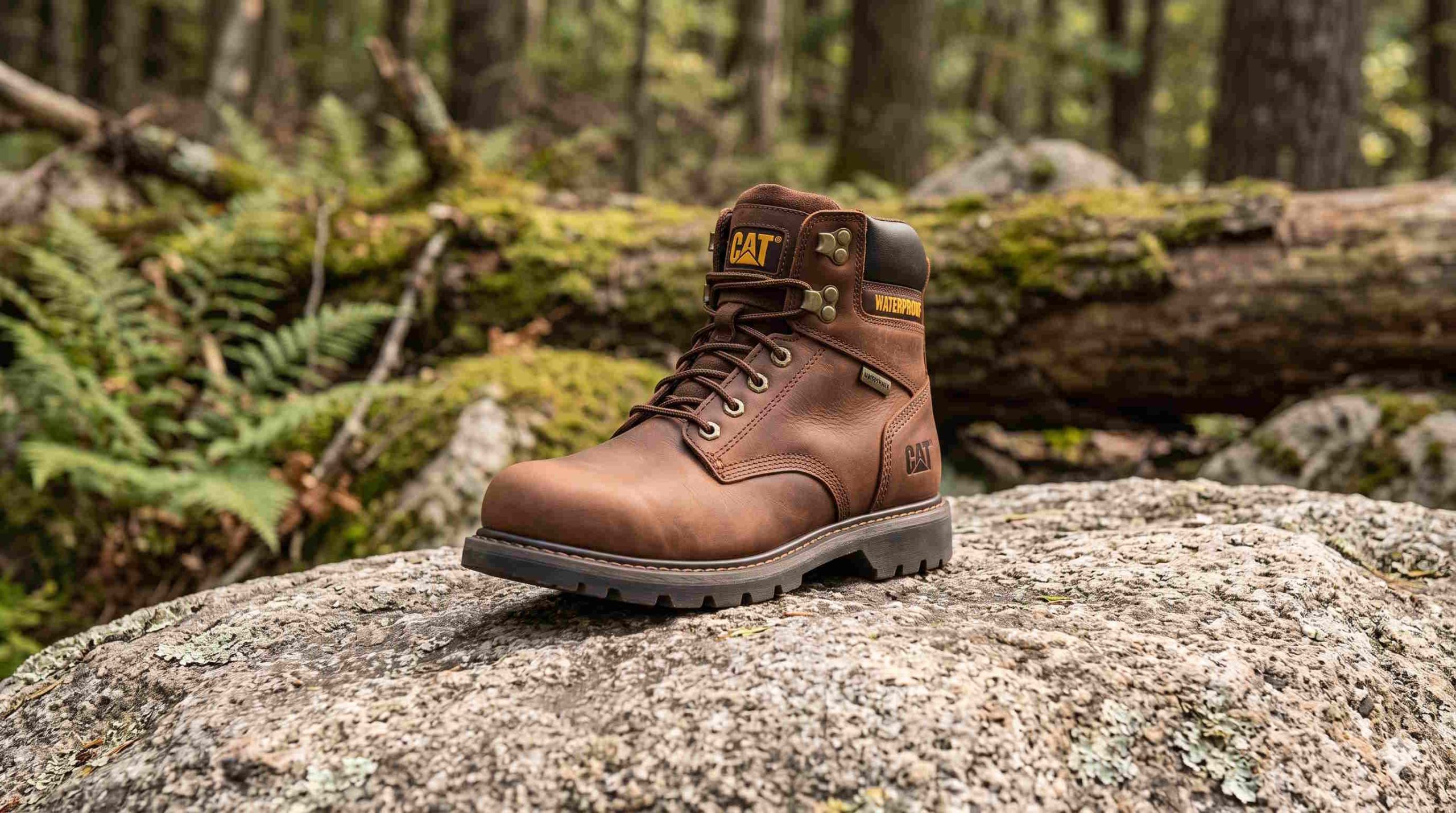
The CAT Threshold is a leather, steel-toe, waterproof-membrane work boot built to a budget price point, with a soft cushioned feel out of the box and a rubber toe guard. It’s a comfort-first, value-tier safety boot — not a heavy-duty, multi-year tank.
Three misconceptions worth clearing up:
- “Waterproof” means permanently dry. In practice many owners describe it as water-resistant that holds up well when new and fades over months — one detailed reviewer flat-out reframed it as “water resistant, not waterproof.” It’s not built to keep you dry standing in puddles a year later.
- Steel toe means heavy and stiff. Several owners expected a brick and were pleasantly surprised by the comfort and modest weight — though a meaningful minority still call it heavy and “runs hot.”
- CAT branding means built-for-life durability. This is a budget line. Longtime CAT fans repeatedly note it doesn’t feel like the heavier-built CAT boots they remember.
Key Specs That Actually Matter
- Steel toe: Real protection — one owner credits it with saving his foot from a steel beam — but a few report the toe edge digging in or the steel setting off metal detectors (it does contain metal, so skip it if your site requires non-metallic). To understand what that steel toe is actually rated to do, our breakdown of the ASTM F2413-24 safety standard explains the toe-cap performance behind the label.
- Waterproof membrane + leather upper: Good when new; the weak points owners hit are the outsole cracking and the toe-cap stitch seam splitting, both of which let water in.
- Cushioned, soft footbed: The big reason for the “comfortable out of the box, little break-in” praise — but also why some swap insoles for more arch support.
- Outsole: Comfortable, but repeatedly flagged as weak on slip resistance (especially oily/wet/metal) and prone to wearing down or cracking. Our guide to work boot soles helps you read tread and compound trade-offs.
- Lace hardware (eye loops/hooks/rivets): The single most-repeated mechanical failure. Watch this closely.
Sizing & Fit — What Owners Actually Report
Bottom line: most owners call it true-to-size, with a recurring minority saying it runs slightly large/loose. A few report a single pair arriving tight or small, but “order your normal size” is the dominant advice, and a couple of owners specifically suggest sizing down a half or adding insoles for a snugger fit.
- Width: Available in standard and wide. Wide-foot owners generally do fine, though one long-time buyer hit a single pair that ran tight even in extra-wide — a consistency wobble, not the norm.
- Half-size guidance: If you’re between sizes or like a snug fit, several owners tuck the laces or add insoles rather than upsizing. One owner who’s a 10.5 found a 10 still felt loose.
- Who it suits: Standard and wide feet that want a roomy, cushioned toe box.
- Who it fights: Narrow feet (a few call the toe a touch narrow) and anyone sensitive to the steel toe edge.
If you want to avoid the heel-slop and “too loose” complaints, our work boot fit and sizing guide walks through the foot-shape checks that prevent most return-worthy fit misses.
Feature-by-Feature Breakdown (Truth vs Marketing)
| Feature | What the Marketing Implies | What It Actually Means (Owner Experience) | Compared to Competitors |
|---|---|---|---|
| Waterproofing | Keeps feet dry | Solid when new; fades over months as outsole cracks or toe seam splits. Better thought of as water-resistant long-term | Owners who switch to Wolverine/Timberland/Keen often cite longer-lasting water protection |
| Steel toe | Job-site protection | Genuine protection; occasionally digs into the big toe; contains metal (detector issue) | On par with other budget steel toes; comfort is a relative win |
| Comfort | All-day wear | A real strength — minimal break-in, soft footbed; some add insoles for arch support | Frequently beats pricier boots on out-of-box comfort |
| Durability | Tough work boot | Polarized: many fail before 12 months (sole, seams, hardware); some get a year-plus in lighter use | Budget brands and even cheaper boots sometimes outlast it in harsh use |
| Lace hardware | Secure lacing | Weakest link — eye loops/hooks pop off, sometimes in the first weeks, often while tying | A standout weakness versus better-riveted competitors |
| Traction | Work-ready grip | Repeatedly called poor on oily, wet, and metal surfaces | A clear weak point; dedicated slip-resistant boots do better |
Real-World Owner Experience (Deep Pattern Analysis)
Pattern 1: The lace hardware is the thing that fails first (and most)
In a nutshell: More owners complain about eye loops, hooks, and rivets snapping off than almost anything else — and it frequently happens while tying the boot, sometimes within the first few weeks.
Hidden strength: When the hardware holds, the lacing system gets praise; there are multiple eyelets and a handy rear pull loop.
Hidden weakness: This is the clearest “what most reviews won’t tell you” insight — the hardware often fails before the sole or the waterproofing does, and it can strike a brand-new pair. Several repeat buyers report the same part failing on the replacement pair, which points to a design/consistency issue rather than bad luck.
What to do about it: Stress-test every eye loop and hook hard in the first week while you can still return it. Tie firmly, tug each hook. If one feels loose or flexes, send them back before the window closes. Replacing rivets/hooks yourself is fiddly — for that, consult a cobbler rather than improvising.
Pattern 2: Waterproofing fails on a predictable timeline — and the sole tells you first
In a nutshell: Lots of owners love the dry feet early on, then report soaked socks somewhere around the 5–9 month range.
Hidden strength: When new, water protection genuinely satisfies most people.
Hidden weakness: The failure sequence matters: a sudden leak is often the second symptom, not the first. Owners describe the outsole cracking or the toe-cap seam splitting first, and the water intrusion follows. So if you see sole cracks or a gap at the toe stitch line, treat it as an early warning that dry feet are about to end.
What to do about it: Within the return window, do a soak test (more below) and inspect the toe-cap stitch line and outsole for any cracking. If you work in genuinely wet conditions all day, treat this as a water-resistant boot and plan accordingly.
Pattern 3: The re-buyer paradox — people who criticize it still come back
In a nutshell: A striking number of owners gripe about a real flaw (hardware, soles, water) and then say they’ve bought their second, third, or even fourth/fifth pair.
Hidden strength: The comfort-plus-price combo is sticky enough that people forgive the lifespan. Several treat it as a semi-disposable boot: cheap enough to replace yearly and still come out ahead.
Hidden weakness: That paradox can lull you. “I keep re-buying” sometimes means “it keeps wearing out and I keep replacing it.” Read those as a verdict on price-to-comfort, not on durability.
What to do about it: Decide up front which buyer you are. If you’re happy replacing a comfortable, cheap boot every several months, the math works. If you want one pair to last, look elsewhere.
Pattern 4: The use-case threshold that splits happy from unhappy
In a nutshell: The dividing line is job intensity and wetness. Warehouse, freight, yard work, and hobby use → frequently happy, with year-plus lifespans. Construction, dock work, constant-water, spark/abrasion → frequently short-lived (often 3–6 months).
Hidden strength: For light-to-medium duty, this boot punches above its price and stays comfortable the whole time.
Hidden weakness: Filter out the wrong-job complaints and you still see real product failures — but a big chunk of the one-star reviews come from people running a budget boot through punishing conditions it wasn’t built for.
What to do about it: Match the boot to the job honestly. If you’re a roofer, welder around sparks, or in standing water daily, this isn’t your daily driver. For matching boots to trades, our work boots by job type guide is the cleanest way to check fit-for-purpose.
The Good, The Bad & The Ugly
The Good (comfort & value)
- Comfortable out of the box with minimal break-in — the most consistent praise in the entire dataset.
- Surprisingly light for a steel toe, per many owners (though not all agree).
- Sharp, slightly tactical looks; available in Real Brown and Black.
- Genuinely budget-friendly; repeat buyers cite the price as the reason they keep coming back.
- Real steel-toe protection that owners credit with saving their feet.
The Bad (durability & fit quirks)
- Soles wear, crack, or “imprint” within months for heavier users.
- Runs hot / not very breathable due to solid leather.
- Slip resistance is weak on oily, wet, and metal surfaces.
- Some find the steel toe edge digs in; a minority get tight or inconsistent pairs.
The Ugly (the failure cluster)
- Lace eye loops/hooks/rivets snapping off — sometimes in the first weeks, sometimes on the replacement pair too.
- Toe-cap seam splitting and outsole cracking, leading to water intrusion, often right around the 6–10 month mark.
- A handful of fulfillment complaints (used/returned pairs shipped as new) — not a design fault, but worth inspecting on arrival.
Mini Toolkit: Decide + Fix (Fast)
Issue-Tag Box: #lace-hook-snap · #sole-crack · #toe-seam-split · #runs-hot · #weak-traction · #waterproof-fade
Fit Mini-Matrix
| Foot type | Verdict |
|---|---|
| Narrow | Caution — toe can feel a touch narrow; try snug lacing before sizing tricks |
| Standard | Best match — true to size, roomy cushioned toe box |
| Wide | Good — order the wide; generally roomy, occasional tight pair reported |
Mini Decision Tree
- If your job is warehouse/yard/light-duty → likely a strong value buy.
- If you’re in constant water or sparks all day → skip it; pick a heavier-duty boot.
- If you need certified non-metallic toe → skip it; this has metal.
- If you want slip resistance on oil/metal → skip it or add aftermarket traction.
- If you’re fine replacing a cheap comfy boot yearly → buy with eyes open.
Troubleshooting Quickflow
- Boot arrives → inspect for “used/returned” signs and toe-cap stitching.
- Day 1–3 → stress every lace hook/loop by tying firmly.
- Day 3–7 → soak-test the waterproofing; check outsole for cracks.
- Notice a sole crack or toe-seam gap → expect water intrusion soon; decide on return.
- Hardware feels loose → return now, don’t wait.
- All good past a week → monitor the sole bond monthly.
Mini Return-Window Reality Check
Before your return window closes, run these boot-specific checks:
- Stress the lace hardware: Tie firmly and tug each eye loop/hook. This is the most common early failure, so provoke it now.
- Soak-test the waterproofing: Wet the boots thoroughly (or wear them in real rain) and check for damp socks — don’t assume “waterproof” on the box.
- Inspect the toe-cap seam: Look hard at the stitch line where the toe cover meets the upper; any gap or loose thread predicts later splitting and leaks.
- Flex the sole seam: Bend the boot and watch the outsole-to-upper bond and the outsole itself for cracks or separation.
- Check for “not new” signs: A few owners received clearly used pairs — look for sole imprinting and wear.
If you’d rather compare against the field before committing, our waterproof work boot buyer’s walkthrough shows what “good” looks like at this price.
Sizing & Setup Tips (Realistic)
- Order your normal size; if you like it snug, several owners tuck laces or add insoles rather than upsizing.
- If you run between sizes and want a tight fit, consider sizing down a half — one owner found his true size felt loose.
- Add an arch-support insole if you’re on concrete all day; the stock footbed is soft but light on arch support.
- Expect them to run hot — choose moisture-wicking socks, and wear socks a bit higher since the collar can rub bare skin.
- Don’t rely on the traction for oily/metal/wet surfaces; slow down or add aftermarket grip.
- Monitor the sole bond monthly — early cracking is your waterproofing warning sign.
- If you need a non-metallic toe for metal detectors, this isn’t it.
- Break-in is minimal, but a few report first-week blisters at the heel — moleskin handles it.
- For anything beyond basic care — resoling, hardware replacement, or slip-hazard fixes — consult a cobbler or qualified repair, and verify against your employer’s PPE hazard assessment.
See It in Action: Visual Reality Check
A spec sheet can’t show you how the toe-cap seam sits or how beefy the lace hooks really are — seeing the boot on a real foot fills that gap.
What to look for in this video (based on owner patterns):
- Sole-bond check: Watch the outsole-to-upper seam — this is where cracking and separation start.
- Lace-hook check: Are the hooks and eye loops beefy and well-riveted, or thin? This is the #1 failure point.
- Toe-seam check: Look at the stitch line where the toe cover meets the body; that’s where splits and leaks begin.
- Weight cue: Notice how substantial the toe looks — it’ll tell you whether “heavy” or “surprisingly light” applies to you.
- Upper material: Spot how solid the leather is — that’s why it protects well but runs hot.
Keep in mind this shows a fresh pair at its best — it won’t show the lace-hook snap or the toe-seam split some owners report months in.
Owner Stories (The Human Side)
The stories below are composite scenarios reflecting repeated patterns across owner feedback.
- The happy re-buyer (warehouse/freight): Works on his feet all day in a freight role, uses an aftermarket insole, and gets a comfortable year-plus out of each pair. Notices some interior wear but never feels it. Just ordered his third pair and considers it the best value he’s found.
- The wrong-job mismatch (construction/wet): A painter or dock worker runs them through constant water, abrasion, and long concrete days. The soles crack and the toe seam splits around month four; socks get soaked; he concludes a cheaper boot lasted longer. The boot wasn’t wrong — the job was too harsh for this tier.
- The hardware-snag returner: Loves the fit and look, then an eye loop pops off while tying in the first couple of weeks. Gets a replacement; a hook on the new pair loosens too. Frustrated by a great-feeling boot undone by one weak part.
👉 SEE MORE OWNER FEEDBACK ON AMAZON
Who This Is For (and Who Should Skip It)
Buy it if…
- You’re in warehouse, freight, yard work, light construction, or hobby builds.
- You want out-of-box comfort and a steel toe without paying premium prices.
- You’re comfortable rotating two pairs or replacing a cheap boot periodically.
- You like a roomy, cushioned toe box and standard/wide fit.
- You value looks and want a discreet, tactical-leaning style.
Skip it if…
- You’re in constant water, sparks, or heavy abrasion all day.
- You need dependable slip resistance on oil, water, or metal.
- You require a certified non-metallic safety toe.
- You want one pair to last multiple years of hard use.
- You’re very hard on lace hardware and can’t tolerate a hook failing.
👉 CHECK TODAY’S PRICE ON AMAZON
If you’re comparing options, start here: Top Waterproof Work Boot Picks.
Alternatives (Quick Comparisons)
- If you need genuine all-day waterproofing for wet trades: Look at dedicated waterproof work boots built for standing water — several owners who outgrew the Threshold moved to longer-lasting options for exactly this reason.
- If comfort over long shifts is the priority: Browse the most comfortable work boots — the Threshold competes well here, but it’s worth seeing what else delivers all-day comfort with more durability.
- If you want the lightest option for high-mileage days: The lightweight work boots roundup is the better starting point, since “heavy/runs hot” is a recurring Threshold gripe.
- If cold and snow are your real problem: A purpose-built winter work boot will beat this — several owners found it surprisingly cold and not warm enough for winter.
Deep-Dive FAQ
What should I test immediately after delivery?
Stress the lace hooks and eye loops, soak-test the waterproofing, and inspect the toe-cap stitch line and outsole for any gaps or cracks. These are the exact spots owners report failing first, so provoke them while you can still return the boots. Also check for “used/returned” signs, since a few buyers received non-new pairs.
What are the most common problems and fixes?
The top three are lace hardware popping off, outsole cracking, and the toe-cap seam splitting (which causes leaks). There’s no reliable home fix for snapped rivets or a split seam — that’s a return or a cobbler job. For soft arch support, an aftermarket insole helps; for weak traction, slow down or add grip, and verify against your employer’s PPE hazard assessment if slips are a real risk. Our work boot troubleshooting guide covers these failure modes in depth.
Will these work with my foot type and my job?
Standard and wide feet generally do great; narrow feet may find the toe a touch snug. For the job: excellent for warehouse, freight, yard, and light-duty; poor for constant-water, spark, or heavy-abrasion trades where the soles and seams fail fast. Match honestly and you’ll likely be happy.
How long do they really last?
It’s polarized. In light-to-medium use, many owners report a year or more; in heavy or wet trades, failures cluster around 3–6 months, often just after the return window. Owners themselves describe lifespans anywhere from a couple of months (hard use) to a couple of years (lighter use). Treat ~6–12 months as a realistic middle expectation for steady wear.
Are they actually waterproof?
When new, yes for most owners — but it fades. One detailed reviewer reframed it as “water resistant, not waterproof,” and many report wet socks once the outsole cracks or the toe seam splits, often after several months. If you stand in water all day, plan for a dedicated waterproof or PVC option.
CAT Threshold vs Wolverine/Timberland: which should I pick?
Pick the Threshold for comfort and price in light-to-medium duty; lean toward a Wolverine or Timberland if your main need is longer-lasting waterproofing and durability in harder conditions. Multiple Threshold owners who got soaked or saw early sole failures specifically named those brands as where they went next for longevity. The trade-off is real: the Threshold often wins out-of-box comfort and value, but rivals tend to win the long game.
Is the steel toe worth it, or should I get composite?
The steel toe offers genuine protection and several owners credit it with preventing injuries — but it contains metal (it can trigger detectors) and a minority feel the edge dig in. If your worksite needs non-metallic safety, choose a composite-toe boot instead; one owner specifically wished for a composite version of this exact model.
Final Verdict
The CAT Threshold is a comfortable, sharp-looking, budget steel-toe that genuinely delights a lot of owners — right up until the lace hardware, sole, or toe-cap seam decides it’s done, which for harder jobs tends to happen before a year. The cleanest way to think about it: this is a high-value, comfort-first boot for light-to-medium duty and short rotations, not a multi-year heavy-duty workhorse. If you’re a warehouse, freight, yard, or hobby user who likes out-of-box comfort and a price you can replace without flinching, you’ll probably be one of the happy repeat buyers. If you live in standing water and sparks, your money is better spent elsewhere.
Match it to the right job, stress-test the hardware in week one, and you’ll know fast which camp you’re in.
👉 CHECK TODAY’S PRICE ON AMAZON