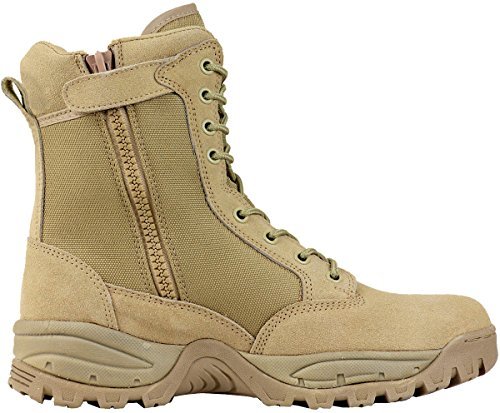
Bates Tactical Sport 2 Tall Zip Boots Review: The Zipper Truth Owners Learned (2026)
Last updated: July 2026
- Re-checked the newest owner feedback (spring–summer 2026) and confirmed the side-zipper failure pattern is still the dominant complaint on current-production pairs — not an older, resolved issue.
- Re-verified the “return-window trap” timing: a striking number of failures land just past the ~30-day Amazon return window, often in the 2–4 month range.
- Cross-checked the loyalty signal: long-time buyers on their 3rd, 4th, even 5th pair still coexist in the same feedback pool as furious one-and-done buyers. That paradox drives this review.
Affiliate disclosure: SturdyBoot.com is reader-supported. If you buy through links on this page, we may earn a small commission from Amazon at no extra cost to you. It never changes what we report — the patterns below come straight from real owner feedback.
Is the Bates Tactical Sport 2 Worth It? The Short Answer
A comfortable, lightweight, budget-friendly side-zip duty boot that many owners genuinely love — but the side zipper is a real, recurring weak point that often fails just after the return window closes.
If you’re a cop, EMT, firefighter, security guard, or corrections officer who’s stood on concrete all shift wishing your boots were lighter and easier to get on and off, the Tactical Sport 2 (the E03180, successor to the beloved Bates Ultra-Lites) is built for exactly that itch. The problem isn’t comfort. It’s whether the zipper survives long enough to matter. This review is a synthesis of real, verified-purchase owner experience — not a spec sheet regurgitation — and it leads with the one thing owners will not stop talking about.
How I Built This Review (and Why You Can Trust It)
I went deep into real owner feedback to write this, and here’s exactly how:
- Sample analyzed: I read a sample of roughly 180 verified-purchase text reviews — a mix of glowing and scathing — pulled from both the positive and critical sides of the listing. That’s a hand-read sample, not the listing’s global rating tally (the product shows well over a thousand ratings total; I’m not passing that number off as reviews I read).
- Time window: Feedback spans roughly late 2023 through mid-2026, with heavy weight on 2025–2026. That recency matters here: many long-time fans are explicitly comparing current pairs to older, discontinued Bates (the Ultra-Lites / E05150 and USA-made pairs), so some “it got worse” sentiment reflects a production-era shift, not a single bad batch.
- Synthesis method: I tagged every review into buckets — comfort/fit, sizing, zipper/hardware durability, sole & stitching construction, squeak/noise, weight, warranty/support, and brand-decline sentiment — then separated use- or fit-driven complaints (wrong width, wrong climate, wrong expectations) from likely product/design issues (side-zipper failure, sole separation). Filtering the noise out is what reveals the true weak point.
- Important limitations:
- Reviews skew toward extremes — the delighted and the furious write more than the neutral middle.
- Wear intensity is wildly different across owners (a 3/2 patrol rotation is not weed-whacking a Georgia mountainside), so lifespan reports vary hugely.
- I prioritized patterns that repeat across many owners over dramatic one-off lemons.
For a safety-first overview of how duty-boot features map to real jobsite hazards, the Work Boots 101 primer is a solid starting point, and if you’re weighing several models, the police boot buyer’s rundown frames the whole category.
Quick Verdict (TL;DR)
Best for:
- Officers, EMS, firefighters, and security who prize all-day comfort and fast on/off over maximum durability
- Wide and extra-wide feet (the 4E toe box is a genuine standout owners rave about)
- Budget-conscious buyers who’d rather replace a sub-$110 boot yearly than pay triple for one pair
Not for:
- Anyone who needs a boot to survive hard, wet, multi-year abuse without babying the zipper
- Buyers expecting the old made-in-USA Bates Ultra-Lite quality
- Cold-weather or deep-water use (owners report they’re neither insulated nor reliably waterproof)
Standout win: Sneaker-light comfort with a real wide-foot toe box, plus a side zip that makes on/off genuinely effortless.
Watch-outs: The side zipper is the near-universal failure point, and it tends to go right after the return window closes. A persistent squeak also drives some owners nuts.
Confidence Score: 7.5/10 🎯 — This reflects how confidently I can tell you who this boot fits, not a reliability guarantee. The comfort signal is remarkably consistent (high confidence). The durability signal is sharply polarized — the same owner will praise the fit and condemn the zipper — which is actually clarifying, not confusing: it tells you precisely what to inspect and when. Points come off because the failure mode is common enough that “it’s worth it” genuinely depends on your tolerance for a mid-life zipper replacement.
What This Boot Is (and What It Isn’t)
The Bates Tactical Sport 2 Tall Zip is a soft-toe, side-zip tactical/duty boot — a tall leather-and-textile upper with a lace front and a full-length YKK-style side zipper for quick entry, built on a lightweight, sneaker-like platform. It’s the current successor to the discontinued Bates Ultra-Lite line that a generation of law-enforcement and EMS folks wore for decades.
Three misconceptions worth clearing up:
- It isn’t a safety-toe boot. Owner feedback describes no protective toe cap. If your job’s hazard assessment calls for impact/compression protection, this isn’t your boot — more on standards below.
- It isn’t a rugged, waterproof, cold-weather workhorse. Several owners specifically note it’s not reliably waterproof and transfers cold and heat from the ground. It’s a comfort-first duty boot, not a logger.
- It isn’t the old Ultra-Lite, even when it looks like it. Multiple longtime buyers who “reordered” what they thought was their old model received the Tactical Sport 2 and felt the difference immediately.
Key Specs and Features That Actually Change Your Day
Here’s what owners say actually matters on shift — no invented numbers, just the features their feedback keeps circling back to:
- Side zipper (the headline feature — and the headline flaw): Makes on/off effortless and is beloved for that. It’s also the single most-reported failure point. You’re buying the convenience and accepting the risk in the same purchase.
- Lightweight, sneaker-like build: The most consistent praise across every trade. Owners compare the feel to running shoes and report low fatigue on 10–14 hour shifts.
- Wide / extra-wide toe box (up to 4E): A genuine differentiator. Wide-footed owners who struggle everywhere else consistently find their fit here.
- Firm, minimal footbed: Repeatedly called stiff. The near-universal owner move is to swap in an aftermarket insole. Budget for that.
- Front laces + side zip combo: You still lace them; the zip is for entry. A few owners are surprised they can’t just zip and go.
- Leather/textile upper that takes a modest shine: Fine for most duty looks, but owners needing a high parade gloss note the textured leather won’t take a bright shine.
Because this is a soft-toe boot, it’s worth knowing where the safety line sits. OSHA’s foot-protection standard, 29 CFR 1910.136, requires protective footwear wherever a hazard assessment finds impact, compression, or puncture risk — and it points to consensus standards like ASTM F2413 for what “protective toe cap footwear” actually means. The Tactical Sport 2 is a comfort/duty boot, not certified safety-toe PPE, so verify it against your employer’s hazard assessment before relying on it where those risks exist.
Sizing and Fit: What Owners Actually Report
The consensus: this boot runs slightly large / true-to-size for most, with a genuinely roomy toe box — and it’s a haven for wide and extra-wide feet. A meaningful cluster of owners specifically say “runs big” and suggest ordering a half size down.
Digging into the pattern:
- Standard-width feet: Most report true-to-size to slightly large. Several recommend going half a size down, especially if you’re between sizes.
- Wide / extra-wide feet: This is where the boot shines. Owners with “Fred Flintstone feet,” bunions, and 13EE-type sizing repeatedly say it’s one of the few boots that actually fits — the 4E toe box is a standout.
- A twist worth knowing: A few owners report the coyote/tan colorway runs smaller than the black, and needed a half size up versus their long-worn black pair. If you’re switching colors, don’t assume identical fit.
- Fulfillment hiccup: Some ordered X-Wide and were shipped standard width more than once. Check the width on the box before you commit.
Heel slop isn’t a major theme here — the bigger fit issue is the firm footbed, which is why so many owners insole-swap. For a foot-shape checklist that helps you dial the right size before it ships, the fit and sizing walkthrough is worth two minutes.
Feature-by-Feature Breakdown: Truth vs. Marketing
| Feature | The Marketing Angle | What It Actually Means (Owner Experience) | Compared to Competitors |
|---|---|---|---|
| Side zipper | Fast, convenient on/off | True and loved — but the most common failure point, often 2–4 months in | Rivals like the 5.11 side-zips draw fewer zipper-failure complaints in owner feedback; several ex-fans say they’re switching to 5.11 |
| Lightweight comfort | All-day tactical comfort | The strongest, most consistent praise; sneaker-like feel on long shifts | Beats many heavier duty boots on comfort; that’s the core reason people re-buy |
| Durability | Built for tactical use | Polarized: comfort lasts, hardware and sometimes soles don’t | Owners say older Bates and some pricier rivals outlast it |
| Toe box / width | Roomy tactical fit | Genuinely excellent for wide/4E feet | A real edge over narrow-lasted competitors |
| Footbed / support | Supportive platform | Firm and thin; most owners add an insole | Common in budget duty boots; expect the swap |
| Waterproofing | Weather-ready | Owners report it’s not reliably waterproof | Dedicated waterproof boots clearly outperform here |
Real-World Owner Experience: The Deep Pattern Analysis
This is where the sample earns its keep. I’ll lead with the pattern owners obsess over most.
Pattern 1: The Return-Window Trap (the failure-timing insight most reviews won’t tell you)
In a nutshell: The side zipper doesn’t just fail — it fails on a schedule that’s almost cruel. Over and over, owners report the zipper giving out at the 2-, 3-, or 4-month mark, just past the roughly 30-day Amazon return window. One owner reported it lasting “exactly 31 days… one day past the return window.” Another was one week past when it went.
Hidden strength: When the zipper holds, the rest of the boot often has plenty of life left — owners lament that they’d happily keep wearing them if not for the zip.
Hidden weakness: The timing means the failure lands squarely in the gap between “return it” and “warranty it,” and several owners report the Amazon-purchase warranty path is a dead end (told they bought from an “unauthorized dealer,” or bounced to the manufacturer).
What to do about it: Treat the first 30 days as an active stress test (see the return-window check below). Zip and unzip aggressively, wear them hard, and if anything about the zipper feels rough, gritty, or misaligned, return immediately — don’t wait for it to “settle in.”
Pattern 2: The Re-Buyer Paradox (the verdict hiding in plain sight)
In a nutshell: Here’s what makes this boot fascinating. The same feedback pool contains furious “never again” owners and loyalists on their 3rd, 4th, even 5th pair who buy a fresh set every single year. “I buy 1 pair of these every year… I love these boots” sits inches from “complete and utter trash.”
Hidden strength: That paradox is the real verdict — for a large group of buyers, the comfort-per-dollar is so good that they’ve mentally priced in replacing the boot annually and consider it a bargain anyway.
Hidden weakness: It also means “lots of people love it” and “the zipper is unreliable” are both true at once. Don’t let the loyalists talk you out of inspecting your pair, and don’t let the ragers talk you out of a boot that might fit your exact use case.
What to do about it: Decide up front which camp you’re in. If you’d re-buy a comfy sub-$110 boot yearly, this paradox works in your favor. If you need one pair to last years, it’s a warning.
Pattern 3: The “Time-Machine” Brand-Decline Signal (Wolverine-era comparisons)
In a nutshell: A recurring, specific complaint: longtime Bates wearers — many with 15, 20, even 30 years of loyalty — say quality dropped after the brand changed hands (owners repeatedly name Wolverine and the loss of USA production). They’re not comparing to other brands; they’re comparing to their own older Bates.
Hidden strength: These are credible witnesses. Their praise of the comfort still holds — which is why they keep trying.
Hidden weakness: Their disappointment is anchored to a version of the boot you may not be able to buy anymore, so some of the fury is grief for a discontinued pair as much as a verdict on this one.
What to do about it: Calibrate expectations to today’s boot, not the legend. If you never owned the old Ultra-Lites, you may be perfectly happy; if you did, know you’re buying a different animal that shares the silhouette.
Pattern 4: The Squeak (the low-stakes complaint that still drives people out)
In a nutshell: After the zipper, the loudest theme is literally loudness. A large group reports a persistent, embarrassing squeak — owners joke about sounding “like SpongeBob,” getting “New boots, eh?” ribbing on the job.
Hidden strength: It’s cosmetic/acoustic, not structural — plenty of owners live with it happily.
Hidden weakness: For anyone working quiet or secure environments, a boot that announces every step is a real problem, and owners report it rarely fully goes away.
What to do about it: Owners report some success with baby powder at the tongue/contact points and lacing one eyelet below the top. It’s a manage-it, not a cure-it.
Pattern 5: The Secondary Failure Sequence (leak/sole after the zipper)
In a nutshell: Where owners push past the zipper, a secondary construction pattern appears: sole-to-upper separation, tread separating at the heel first, and stitching letting go — often on the same right boot several owners flag.
What to do about it: If your soles or stitching start separating, that’s beyond basic care. Consult a cobbler or qualified repair rather than field-gluing, and if it’s a duty boot, verify the pair still meets your employer’s PPE hazard assessment before relying on it.
Loved for Comfort, Doubted for the Zipper: The Good, The Bad, and The Ugly
The Good
- Sneaker-light, low-fatigue comfort that owners across LE, EMS, fire, security, and warehouse work praise
- Outstanding wide / 4E toe box for hard-to-fit feet
- Fast, effortless on/off from the side zip
- Budget-friendly enough that annual replacement still pencils out for many
The Bad
- Firm, thin footbed most owners end up swapping out
- Persistent squeak that rarely fully quits
- Not reliably waterproof; poor cold/heat isolation
The Ugly
- Side-zipper failure clustered just past the return window, with a warranty path many owners found unhelpful — the defining risk of this boot
Mini Toolkit: Decide and Fix (Fast)
Issue-Tag Box — the boot-specific patterns to watch: #side-zipper-failure · #return-window-trap · #runs-hot-squeak · #firm-footbed · #sole-separation · #not-waterproof
Fit Mini-Matrix
| Foot type | Verdict |
|---|---|
| Narrow | Likely too roomy — consider a half size down or look elsewhere |
| Standard | Good, often slightly large; half-size-down if between sizes |
| Wide / Extra-wide (4E) | Best-in-class fit — this is the boot’s sweet spot |
Mini Decision Tree
- If you need a safety toe or waterproof boot → skip this; it’s neither.
- If you have wide/4E feet and want all-day comfort → strong candidate.
- If you need one pair to last years → weigh the zipper risk hard.
- If you’ll happily re-buy a comfy boot yearly → the value works for you.
- If you work a quiet/secure post → factor in the squeak.
Troubleshooting Quickflow (squeak + zipper longevity)
- New pair? Aggressively zip/unzip and hard-wear within 30 days.
- Zipper feels gritty or misaligned early? Return now, don’t wait.
- Squeaking? Dust baby powder at the tongue/contact points.
- Still loud? Lace one eyelet below the top, looser.
- Firm underfoot? Add a quality aftermarket insole.
- Sole/stitching separating? Stop — see a cobbler and re-check PPE compliance.
Mini Return-Window Reality Check
Because the zipper so often fails just after returns close, use your first ~30 days deliberately:
- Stress the zipper daily — full up-and-down, both boots, hard tugs. Weakness usually shows early if it’s there.
- Wear them the way you’ll actually work — full shifts, not gentle around-the-house breaking-in — to surface real failures while you can still return.
- Inspect the zipper stop and bottom teeth — several owners report the metal clasp/stop at the base failing first.
- Check sole and toe seams — flex the boot and look for any early separation at the heel or toe.
- Confirm you got the width you ordered — X-Wide mis-ships happen.
If any of that raises a flag, return before the window closes. For a fuller framework on stress-testing duty boots before you commit, the police boot buyer’s guide lays out the full protocol.
Sizing and Insider Tips (Realistic)
Each of these ties to a real owner pattern, not generic advice:
- Order a half size down if you’re standard-width and between sizes — “runs big” is a repeated refrain.
- Wide/4E feet: order the X-Wide with confidence — this is the boot’s genuine strength.
- Switching black ↔ coyote? Recheck your size — owners report the coyote runs smaller than the black.
- Budget for an aftermarket insole from day one — the stock footbed is firm and thin by near-universal account.
- Fight the squeak with baby powder at the tongue and contact points; it’s the most-reported owner fix.
- Lace one eyelet below the very top, slightly loose — a specific trick owners use to quiet the top-of-boot squeak.
- Treat the first 30 days as a zipper audit, not a gentle break-in — surface failures while you can still return.
- Don’t count on them for water or cold — owners say they’re not reliably waterproof and transfer ground temperature.
- Replace the laces early if you’re hard on them — a few owners note the stock laces stretch or wear faster than aftermarket ones.
- Monitor the heel tread and sole bond over time — separation there is the secondary failure to catch early. Anything beyond basic care (resoling, hardware replacement) should go to a cobbler or qualified repair, and for duty use, re-verify against your employer’s PPE hazard assessment.
Owner Stories
These are composite scenarios built from recurring owner patterns — not direct quotes from any one person.
- The happy annual re-buyer: A patrol officer on his fourth pair. He knows the zipper is the weak link, but the comfort on a 12-hour shift and the sub-$110 price mean he just orders a fresh pair each year and calls it even. For him, the math works.
- The wrong-job mismatch: A tradesperson doing genuinely rough, wet, physical work expected tactical durability and got a comfort boot. The zipper blew inside a few months under abuse it was never built for. The boot wasn’t lying about comfort — he was buying it for the wrong hazard profile.
- The return-window returner: A first-time buyer who wore them gently for the first month, loved them, then watched the zipper separate at month three — one step past the window, with a warranty path that went nowhere. Had he stress-tested them hard in week one, he’d have caught it in time.
Who This Is For (and Who Should Skip It)
Buy it if…
- You have wide or extra-wide feet and struggle to find comfort elsewhere
- You want sneaker-light comfort for long LE, EMS, fire, or security shifts
- You value fast side-zip on/off and will inspect it early
- You’re happy to add an insole and, if needed, re-buy periodically
- Sub-$110 comfort beats one-pair longevity for your budget
Skip it if…
- You need certified safety-toe or reliable waterproof protection
- You expect the old made-in-USA Bates Ultra-Lite durability
- You need a single pair to survive years of hard, wet abuse
- You work a quiet post where a squeak is a dealbreaker
- You won’t stress-test the zipper inside the return window
If you’re comparing options, start here: Top Police Boot Picks.
Alternatives (Quick Comparisons)
- If durability is your priority over comfort: Several ex-Bates owners explicitly say they’re moving to the 5.11 line after repeat zipper failures — worth a look if you’ll trade a bit of plushness for hardware you trust. Browse sturdy options in the best police boots roundup.
- If you want the lightest possible duty boot: Comfort is this boot’s whole identity, but if you’re chasing feathery weight specifically, compare against the field in the lightweight work boot guide.
- If waterproofing is non-negotiable: This isn’t the boot — start with dedicated options in the waterproof work boot guide.
- If overall comfort is the deciding factor: For a broader shortlist ranked on all-day wearability, the most comfortable work boots list is the right next stop.
Deep-Dive FAQ
What’s the first thing I should do the day these arrive?
Stress-test the side zipper immediately and wear them hard for real. Zip and unzip both boots aggressively, work a full shift in them, and inspect the zipper’s bottom stop and the sole seams. Because failures so often land just past the ~30-day return window, your goal is to force any weakness to show while you can still send them back.
What’s the most common problem, and can I fix it?
The side zipper failing is by far the most-reported issue, and it’s largely a design weak point rather than a user fix. You can’t reliably prevent it, but you can catch it early (stress-test in the return window) and manage the second most common complaint — the squeak — with baby powder at the tongue and by lacing one eyelet below the top. Sole or stitching separation is a cobbler job, not a field fix.
Will these fit my foot and my job?
If you have wide or extra-wide feet and a comfort-first duty role — patrol, EMS, fire, security, hospital, warehouse — this boot fits beautifully; the 4E toe box is a genuine standout. If you have narrow feet, need a safety toe, or work wet/rough/cold conditions, it’s a poor match. Standard-width buyers should consider a half size down since it runs slightly large.
How long do they actually last?
Realistically, owner reports cluster around under a year to about a year of daily hard use, with the zipper usually deciding the lifespan — many failures hit in the 2–4 month range, while loyalists who baby the zip or rotate pairs report a year or more, and a lucky older-pair minority mention multiple years. Treat “about a year, zipper permitting” as the honest planning number.
Bates Tactical Sport 2 vs. the old Bates Ultra-Lite — is it really worse?
Qualitatively, longtime owners say yes: the Tactical Sport 2 (E03180) is the successor to the discontinued Ultra-Lite (E05150), and a large group of decades-loyal buyers report the newer, post-Wolverine, no-longer-USA-made version feels stiffer, squeakier, and less durable — even when it looks nearly identical. Comfort is still praised; the complaints center on hardware and construction longevity versus their memory of the old pair.
Are they waterproof or good in the cold?
No, not reliably. Multiple owners specifically report they aren’t dependably waterproof and that cold and heat transfer through from ground contact, so treat them as a fair-weather / indoor-and-moderate-climate duty boot, not a wet or winter workhorse.
Is the warranty worth counting on if I buy on Amazon?
Owner feedback says don’t count on it. Several buyers who tried to claim the manufacturer warranty after an Amazon purchase were told they’d bought from an unauthorized dealer or were bounced back to Amazon’s ~30-day policy. Assume you’re protected mainly by the return window, which is exactly why stress-testing early matters so much.
Note: sizing, comfort, and durability experiences vary by individual, trade, and production run — use this as pattern guidance, not a guarantee, and verify any safety-critical use against your employer’s PPE hazard assessment.
Final Verdict
The Bates Tactical Sport 2 Tall Zip is a genuinely comfortable, wide-foot-friendly, budget duty boot with one loud asterisk: the side zipper is a recurring weak point that tends to fail just after you can no longer return it. If you’re a wide-footed officer, EMT, firefighter, or security worker who values sneaker-light comfort and easy on/off — and you’re either willing to re-buy periodically or diligent about stress-testing the zipper in your first 30 days — this boot earns its place and its loyal following. If you need certified protection, waterproofing, or one pair that lasts for years, look elsewhere. Know exactly which buyer you are, and this becomes an easy call.