Under Armour Charged Valsetz Zip Review (2026)
Last updated: July 2026
- Rechecked recent owner feedback through July 2026, including both enthusiastic repeat buyers and early-failure reports.
- Reassessed the recurring forefoot-tear, sole-separation, lace-loop, and zipper complaints by failure timing.
- Reverified the current Under Armour specifications, including the regular fit, side zipper, Vibram outsole, and ASTM slip-resistance rating.
- Clarified the difference between this standard ventilated model and the separate Valsetz Waterproof Zip.
Affiliate disclosure: SturdyBoot may earn a commission if you purchase through our Amazon links. This does not affect the price you pay or our verdict.
Long shifts expose the difference between a boot that merely feels good in the living room and one that remains tolerable after hours of standing, walking, climbing stairs, driving, or responding on foot. The Under Armour Charged Valsetz Zip creates an unusual buying dilemma because owners are exceptionally consistent about its immediate comfort—but sharply divided about how long the upper and sole construction will last.
Is it worth it? Yes for hot, dry patrol and indoor duty where lightweight comfort matters most—but not for wide feet, sustained wet exposure, or punishing industrial work.
The best feedback comes from police officers, corrections staff, security workers, EMTs, paramedics, and other users who want something closer to a cushioned athletic shoe than a traditional rigid duty boot. The most serious complaints come from owners who expected heavy-work-boot durability, needed a genuinely waterproof boot, or repeatedly flexed the upper during high-mileage shifts.
For a wider view of comparable models, start with our best police boots comparison before deciding whether the Valsetz’s comfort-first design matches your assignment.
How this review was built (so you can trust it)
I analyzed 200 individual text reviews—100 positive and 100 critical—covering approximately March 2024 through July 2026. That time window mostly reflects the current Charged Valsetz Zip generation, although some longtime Under Armour buyers compare it with older Valsetz boots that reportedly aged differently.
I categorized the feedback by:
- Immediate and long-shift comfort
- Length and width behavior
- Toe-box pressure and foot swelling
- Heat and breathability
- Rain and wet-surface performance
- Sole bond and outsole wear
- Forefoot fabric tearing
- Lace-loop, zipper, and heel-lining failures
- Police, corrections, EMS, security, and light-duty use
- Replacement-pair and repeat-purchase behavior
I also separated complaints caused mainly by a poor job or fit match from likely product failures such as repeated seam tearing, sole separation, missing hardware, or a zipper breaking under ordinary wear. The clearest recurring patterns appear in both the favorable and critical feedback sets.
Important limitations
- Owners with unusually good or bad experiences are more likely to leave detailed feedback.
- A corrections officer walking and running through extended shifts stresses a boot differently from someone working mainly indoors.
- Some marketplace feedback appears to blur the standard Valsetz Zip with waterproof Valsetz variants.
- Recurring patterns carry more weight in this review than isolated packaging, delivery, or one-off defect complaints.
Quick Verdict: Under Armour Charged Valsetz Zip
Best for
- Police patrol, corrections, security, EMT, and paramedic shifts in mainly dry conditions
- Indoor duty, vehicle-heavy assignments, hospital floors, schools, casinos, and mixed pavement
- Buyers prioritizing low weight, cushioning, breathability, and minimal break-in
Not for
- Jobs requiring an ASTM F2413 safety toe
- Wide or high-volume forefeet without a confirmed wide option
- Construction, demolition, abrasive industrial work, or prolonged standing in water
Standout win
- One of the strongest immediate-comfort signals I have seen in owner feedback for a tactical boot
- Light and flexible enough that many owners compare the feel with an athletic shoe
Watch-outs
- Repeated forefoot tearing and upper-to-rubber separation, sometimes within the first several months
- Narrow-toe complaints coexist with a smaller number of reports that the boot runs long or large
Confidence Score: 🟢 8.5/10
This score measures how confidently I can identify the right buyer, not the probability that every pair will last.
The comfort, weight, and hot-weather signals are highly consistent. The durability picture is more polarized: many owners get acceptable duty life, while a repeated minority reports strikingly similar failures at the flex point or sole edge. Fit is predictable for standard feet but materially less predictable for broad forefeet.
What This Boot Is—and What It Isn’t
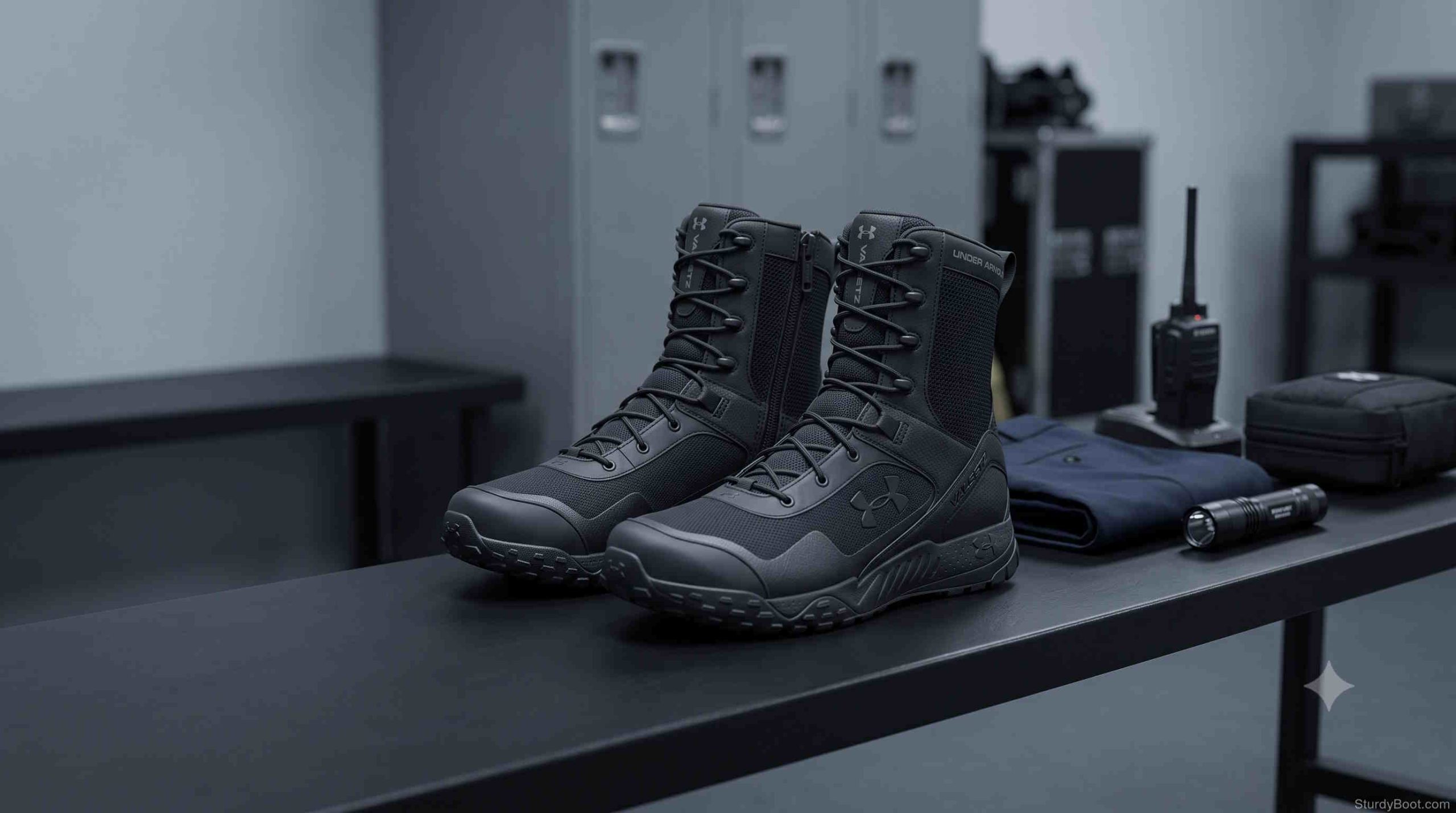
The Under Armour Charged Valsetz Zip is an 8-inch, regular-fit, side-zip tactical boot built around a breathable synthetic upper, cushioned footbed, flexible midsole, and Vibram outsole.
Under Armour currently identifies the model as the UA Valsetz Zip, style 3027383. The company lists a synthetic upper with abrasion-area overlays, medial zipper, molded Contoura support footbed, Charged Cushioning midsole, Vibram XS Trek outsole, and an ASTM F3445-21 slip-resistance rating. UA labels the fit “Regular” rather than wide. (Under Armour)
What it is not
It is not a safety-toe work boot. Under Armour confirms that this model does not have a steel toe, and it is not presented as ASTM F2413 protective-toe footwear.
It is not the waterproof Valsetz Zip. Under Armour sells a separate model specifically identified as the Valsetz Waterproof Zip. The regular boot reviewed here should not be purchased on the assumption that it will keep feet dry through standing water or prolonged rain.
It is not a traditional heavy-duty leather duty boot. Its appeal comes from reducing stiffness and weight. That same flexible, athletic construction creates the main durability trade-off.
OSHA requires hazard-appropriate protective footwear when falling objects, puncture hazards, or certain electrical hazards are present. A comfortable tactical boot does not automatically satisfy that requirement. Consult your employer’s PPE assessment before using this model in a safety-toe environment. OSHA’s foot-protection standard explains when protective footwear is required. (OSHA)
Key Specs That Actually Matter
- Regular fit: Most standard-foot owners report a good athletic-shoe-like fit, but the regular profile can become restrictive across a broad forefoot.
- Breathable synthetic upper: Helps reduce heat and weight during indoor, warm-weather, and vehicle-heavy duty. It is less substantial than leather in high-abrasion work.
- PU overlays in abrasion areas: Add localized reinforcement, but owner failures repeatedly appear where the flexible cloth portion meets firmer rubber or overlay material.
- Medial side zipper: Useful once the laces have been adjusted correctly, although some owners still need to loosen or untie the boot.
- Molded Contoura support footbed: A major part of the strong out-of-box comfort signal.
- Full-length Charged Cushioning midsole: Gives the boot its soft, shock-absorbing, sneaker-like ride.
- Vibram XS Trek outsole: Flexible and intended to provide wet traction, with an ASTM F3445-21 slip-resistance rating.
- Standard laces and fabric loops: Easy to adjust, but lace-loop breakage appears as a recurring long-term weak point.
- Listed weight of 16.9 ounces: Consistent with the repeated owner description of the boot as unusually light.
- No marketed protective toe: Do not confuse the exterior toe reinforcement with certified impact or compression protection.
For a breakdown of how upper materials, midsoles, overlays, and attachment methods influence longevity, our work-boot anatomy and construction guide provides the broader context.
Sizing and Fit: What Owners Actually Report
Overall sizing verdict
Most standard-foot owners should begin with their normal athletic-shoe size.
True-to-size comments appear repeatedly among satisfied owners, including users wearing the boot through long police, EMS, and security shifts. However, sizing feedback is not perfectly uniform. A smaller group reports that the boot runs approximately half a size long, while others describe a painfully narrow toe box.
That apparent contradiction makes sense when length and volume are separated:
- The boot may have adequate or slightly generous length.
- The forefoot can still feel narrow from side to side.
- Sizing up for width may create excess length or heel movement.
- Feet that feel fine in the morning may become crowded after hours of swelling.
Width behavior
Narrow feet: Usually a favorable match. The upper tends to wrap securely without requiring aggressive lacing.
Standard feet: The most consistently successful group. Start with your usual athletic-shoe size and test the toe crease carefully.
Wide feet: The highest-risk group. Some owners with only moderately wide feet found the toe box restrictive enough to abandon the boot.
Half-size guidance
Do not automatically order a half size larger simply because the toe box feels narrow. Increasing length does not necessarily create enough forefoot width.
A better approach is:
- Start with your normal athletic-shoe size for a standard-width foot.
- Try the boots with your actual duty socks.
- Test them later in the day, when your feet are naturally fuller.
- Walk, crouch, climb stairs, and remain standing long enough to reveal toe pressure.
- If the forefoot is compressed, choose a genuinely wider model rather than adding unnecessary length.
CCOHS recommends trying work footwear around midday, allowing adequate toe room, wearing the socks or supports used at work, and checking that the heel and ankle remain snug when laced. Its safety-footwear fit guidance supports testing real working conditions rather than relying only on the marked size. (CCOHS)
For a more detailed fitting sequence, use the work-boot fit and sizing guide before wearing the boots outdoors.
Feature-by-Feature Breakdown: Truth vs Marketing
| Feature | What the Manufacturer Says | What It Actually Means in Owner Use | Compared With Competitors |
|---|---|---|---|
| Charged Cushioning | Lightweight, shock-absorbing comfort | The strongest feature. Many owners report minimal break-in and less end-of-shift foot fatigue. | Softer and more athletic than many traditional leather duty boots |
| Breathable synthetic upper | Light and ventilated | Works especially well in hot, dry climates and indoor duty; offers less confidence in abrasive work | Cooler than many waterproof or heavily lined boots |
| Side zipper | Quick on and off | Convenient after the laces are dialed in, but not every foot can exit through the zipper opening alone | Similar concept to other side-zip duty boots, with a softer upper |
| Vibram XS Trek outsole | Flexible traction on unpredictable terrain | Generally good on pavement, hospitals, and ordinary wet transitions, but not immune to slipping on wet tile, oily surfaces, or mud | More flexible than many lugged work-boot outsoles |
| PU abrasion overlays | Added protection and durability | Helpful in reinforced areas, yet the transition into flexible fabric becomes a recurring tear location | Lower weight, but less continuous protection than a leather forefoot |
| Regular fit | Standard profile | Good for narrow-to-standard feet; risky for broad forefeet during long shifts | Less accommodating than a purpose-built 2E or 4E tactical boot |
| 8-inch shaft | Coverage and support | Most owners like the ankle security, but some feel the shaft or zipper rubs the ankle | Supportive without the stiffness of many traditional 8-inch boots |
| Slip-resistance rating | ASTM F3445-21 rated | A meaningful credential, not a promise that every contaminated floor is safe | Stronger evidence than vague “grippy outsole” marketing |
Real-World Owner Experience: Deep Pattern Analysis
1. The comfort-versus-durability paradox defines this boot
In a nutshell: The Valsetz Zip earns unusually strong praise for comfort, even from owners who later reject it because of durability.
Owners repeatedly describe:
- Little or no break-in
- Soft underfoot cushioning
- Reduced aching after extended shifts
- Enough flexibility for running or rapid movement
- Less fatigue than heavier tactical boots
The contradiction is that some of the harshest durability reviews begin by calling the boot the most comfortable pair the owner has worn.
Hidden strength: Comfort is not merely a first-impression advantage. Police, corrections, EMS, security, and indoor-duty users report wearing the boots through extended shifts with less foot fatigue.
Hidden weakness: The soft construction that creates that comfort does not behave like a heavy leather work boot. Buyers who interpret “tactical” as “industrial-strength” are likely to overestimate it.
What to do about it: Match the boot to patrol, corrections, EMS, hospital, security, school, casino, driving, and similar light-to-moderate duty. Do not choose it for grinding, demolition, sharp debris, hot work, or repeated abrasive contact.
2. What most reviews won’t tell you: the forefoot crease can predict the failure sequence
The most useful durability insight is not simply that “the boot can tear.” It is where and how the failure often progresses.
A repeated sequence appears in the owner feedback:
- The boot flexes at the ball of the foot.
- A visible crease forms where softer fabric meets firmer rubber or overlay material.
- Fraying, a small split, or separation begins along that boundary.
- The opening grows into a hole or wider upper-to-rubber separation.
Some owners report this within roughly one to four months. Others reach six months or longer. A smaller number report about a year of daily work use before a lace loop or other component fails.
Hidden strength: Owners who avoid extreme mileage or abrasive work may get acceptable service life.
Hidden weakness: The concentration of failures around the same flex area suggests more than random abuse.
What to do about it: During the return period, repeatedly flex the boot indoors and inspect both sides of each forefoot under bright light. After purchase, check weekly for lifting edges, white stress lines, loose threads, or widening gaps.
3. Repeat-pair failures suggest a design-sensitive wear point
One owner reported two pairs tearing in the same forefoot location under normal use. Another longtime Valsetz buyer said an older pair lasted much longer, while the newer version began separating within months.
That does not prove every pair will fail, but repeat defects at the same point are more informative than a single isolated tear.
Hidden strength: The issue is easy to monitor because the vulnerable area is visible.
Hidden weakness: Replacing a failed pair with the identical model may reproduce the same result if your gait, job, and flex pattern load that location heavily.
What to do about it: If one pair tears at the forefoot crease, do not assume a replacement will automatically solve the problem. Compare the failure position with your walking mechanics and consider a boot with a more continuous leather or reinforced forefoot.
4. The re-buyer paradox reveals the real verdict
Some owners replace the Valsetz Zip even after a defect. One corrections worker reported that a first pair lasted about a year before a lace loop failed, then ordered another pair. Another owner bought a second pair because the comfort remained compelling despite a shorter-than-expected lifespan.
This matters because it reveals the boot’s true value proposition:
People are not necessarily rebuying because it is exceptionally durable. They are rebuying because the daily comfort is difficult to replace.
That trade can make sense when:
- An employer provides a footwear allowance
- The user expects annual replacement
- The assignment is low-abrasion
- Foot fatigue is the main problem being solved
It makes much less sense when the buyer expects several years of hard service from one pair.
5. There is a clear job threshold
The happiest use cases cluster around:
- Patrol and corrections
- Ambulance and hospital work
- Security and public-safety assignments
- Indoor concrete, carpet, or tile
- Driving mixed with moderate walking
- Hot and dry climates
The weakest use cases include:
- Construction and heavy industrial work
- Constant outdoor saturation
- Repeated deep flexing through very high walking mileage
- Sharp, abrasive, or debris-heavy terrain
- Jobs requiring a certified protective toe
A particularly revealing positive review explicitly warned that the boot should be treated as a light-duty patrol boot rather than a construction boot. That distinction aligns closely with the wider durability pattern.
6. The zipper is useful, but “side zip” does not always mean instant removal
Several owners love being able to set the laces once and use the zipper thereafter. This is valuable for shift changes, emergency callouts, hand discomfort, or anyone who dislikes relacing an 8-inch boot.
However, other users still need to unzip and loosen or untie the laces. The result depends on:
- Ankle circumference
- Instep height
- Sock thickness
- How tightly the forefoot is laced
- Whether the zipper opening clears the heel
A smaller number reported a missing zipper, early zipper breakage, stiffness, or ankle rubbing.
Practical verdict: Treat the zipper as a convenience feature, not a guarantee of hands-free entry and removal.
7. The regular model is breathable—not reliably waterproof
Some owners handle light rain or brief wet transitions without a problem. A police officer specifically reported choosing the non-waterproof version for lower weight and better breathability, while acknowledging that standing in a puddle would wet the foot.
Other owners report soaked socks after sustained rain.
The confusing part is that a few marketplace reviews describe the boot as waterproof. Under Armour sells a separate model named the Valsetz Waterproof Zip, so those comments should not be treated as reliable evidence for the standard boot.
Practical verdict: The regular Charged Valsetz Zip is best for dry and occasionally damp conditions. Choose the explicitly waterproof version for repeated rain, snow, standing water, or wet roadside work.
8. Slip performance is good overall, but surface-specific
Many EMT, police, and indoor-duty owners like the grip while entering ambulances, crossing wet pavement, or working on ordinary hard floors. Under Armour lists the model as ASTM F3445-21 slip-resistant rated. (Under Armour)
A minority still reports slipping or reduced confidence on:
- Very smooth wet floors
- Mud
- Contaminated surfaces
- Certain tile or polished indoor flooring
Do not sand, cut, or intentionally abrade a rated outsole to stop squeaking. That could alter the tread and traction behavior. Clean the sole, remove trapped residue, let it dry fully, and return or exchange the pair if loud squeaking or unstable grip persists.
The Good, the Bad, and the Ugly
The good: comfort and mobility
- Strong cushioning immediately out of the box
- Unusually light for an 8-inch duty boot
- Breathable enough for hot and dry assignments
- Flexible for walking, stairs, driving, and short bursts of running
- Side zipper can simplify daily entry and removal
- Supportive feel without traditional heavy-boot stiffness
- Good appearance for many patrol and security uniforms
The bad: fit and environmental limits
- Toe box may compress wider feet
- Some feet cannot exit without loosening the laces
- Standard model is not dependable for prolonged wet exposure
- Mud and highly polished wet floors can expose traction limits
- Synthetic forefoot is less abrasion-tolerant than heavier leather
The ugly: recurring construction failures
- Forefoot fabric splitting near the flex crease
- Upper separating from the rubber edge
- Sole bond lifting after weeks or months
- Lace loops breaking
- Zipper breakage or malformed pairs
- Heel lining wearing through in some pairs
- Loud outsole squeaking on hard floors
- A few failures appearing only after the easiest return period has passed
Mini Toolkit: Decide and Fix Fast
Issue-Tag Box
#forefoot-crease-tear#sole-edge-separation#narrow-toe-box#lace-loop-break#hard-floor-squeak#not-standard-waterproof
Fit Mini-Matrix
| Foot type | Verdict | Best first move |
|---|---|---|
| Narrow | Strong match | Begin with normal athletic-shoe size |
| Standard | Usually favorable | Test later in the day with duty socks |
| Wide | High return risk | Choose a genuine wide tactical model rather than adding length |
Mini Decision Tree
- If you work mainly indoors, in vehicles, or on dry patrol, then the Valsetz Zip is a strong comfort-first candidate.
- If your forefoot is wide or swells heavily, then prioritize a wide-fit alternative.
- If you routinely stand in rain, snow, or pooled water, then choose the Waterproof Zip or another membrane boot.
- If your job requires a safety toe, then skip this model and verify the exact ASTM marking.
- If you destroy fabric uppers at the toe crease, then choose a more continuously reinforced forefoot.
Troubleshooting Quickflow
Discomfort or early defect → stop outdoor wear → verify size and sock volume → inspect toe crease, zipper, loops, and sole edge → compare both boots for asymmetry → return or exchange if the defect persists.
For wider diagnostic help, the complete work-boot troubleshooting guide separates fit problems from construction failures.
Mini Return-Window Reality Check
Before scuffing the boots outdoors:
- Confirm that both boots have the correct side zipper, footbed, lace loops, and matching construction.
- Zip and unzip each boot repeatedly while supporting the zipper—not pulling sideways on the slider.
- Flex both forefeet and inspect where the fabric meets the rubber or overlay.
- Walk on clean indoor tile to identify persistent squeaking or abnormal traction differences.
- Wear them through an extended indoor trial late in the day to expose toe pressure as your feet swell.
- Test only with light surface moisture unless the exact purchased model is explicitly labeled waterproof.
Do not attempt structural gluing, zipper replacement, sole modification, or aggressive tread alteration during the trial period. For repairs after the return window, consult a qualified cobbler or verify the footwear against your employer’s PPE hazard assessment.
Sizing and Insider Tips
- Use your athletic-shoe size as the starting point. That produced the most consistent success among standard-foot owners.
- Test width, not just toe length. A thumb-width of space in front does not help if the forefoot is being squeezed from the sides.
- Try the boots late in the day. Long-shift complaints often appear after feet swell, not during a quick morning fitting.
- Wear your actual duty socks. Thick socks can turn a borderline toe box into a painful one.
- Set the laces before judging the zipper. Find a secure tension that prevents heel movement while still allowing the zipper to work.
- Do not overtighten the lower laces to stop heel slip. That can increase forefoot pressure and concentrate flexing at the toe crease.
- Inspect both forefoot seams weekly. Catching early separation helps you document a defect before it becomes a large opening.
- Watch the lace loops. If a loop begins fraying, stop pulling harder through it. A cobbler may be able to reinforce it, but confirm that repair is appropriate for your duty requirements.
- Keep the standard version out of standing water. Light rain exposure is not the same as waterproof construction.
- Clean the Vibram outsole rather than sanding it. Embedded residue can contribute to noise or inconsistent traction.
- Do not use it as a substitute for certified safety footwear. The comfort and exterior toe reinforcement do not establish ASTM F2413 protection. ASTM describes F2413-24 as the performance specification for protective safety-toe footwear and warns that modifications can invalidate compliant footwear markings. ASTM’s F2413-24 overview explains the standard’s scope. (ASTM Store)
- Retire a badly separating pair. A widening sole or upper gap can become a trip, contamination, or water-entry problem. Consult a cobbler or qualified repair service rather than relying on a temporary jobsite glue fix.
For more detail on outsole compounds, tread wear, and sole attachment, see our work-boot soles explanation.
See It in Action: Visual Reality Check
A walkthrough can show the shaft flexibility, zipper placement, toe profile, and how the boot bends on a real foot more clearly than specifications alone.
What to look for in the video
- How sharply the upper folds at the ball of the foot
- Whether the toe box appears tapered or roomy
- How much the laces must loosen before the zipper works
- The amount of ankle padding around the zipper
- Whether the sole looks flexible enough for your assignment
- How much fabric is exposed between reinforced sections
Keep in mind that a fresh pair shown at its best will not reveal the forefoot tearing, lace-loop wear, or sole-edge separation that some owners report after repeated use.
Owner Stories
The stories below are composite scenarios reflecting repeated patterns across owner feedback.
The hot-weather paramedic
A paramedic spends extended shifts moving between the ambulance, hospital, pavement, and indoor floors in a hot, dry region. Traditional duty boots leave the feet heavy and sore. The Valsetz feels immediately lighter, remains breathable, and reduces end-of-shift fatigue.
This is the strongest match for the boot: high time-on-foot, moderate surfaces, warm climate, and no safety-toe or standing-water requirement.
The corrections officer who buys another pair
A corrections employee wears the boots almost every workday. The first pair remains comfortable through roughly a year, then a lace loop fails. Despite the defect, the owner buys another pair because the boot’s lightness and cushioning matter more than achieving multi-year service life.
This is the re-buyer paradox in practical form. The boot can still provide good value when annual replacement is acceptable.
The wide-foot patrol return
An officer orders the normal size and initially likes the cushioning. After several hours, the forefoot swells and the toe box becomes restrictive. Sizing up adds unwanted length but does not adequately solve the width problem.
This buyer should return the boot while it is still clean and move to a true wide-fit duty model.
SEE MORE OWNER FEEDBACK ON AMAZON
Who This Is For—and Who Should Skip It
Buy it if
- Your primary need is all-day cushioning rather than maximum abrasion resistance.
- You work patrol, corrections, EMS, security, hospital, school, or indoor public-safety duty.
- Your feet are narrow to standard width.
- Your climate or assignment is mainly warm and dry.
- You prefer a flexible, athletic ride over a rigid traditional boot.
- Replacing duty footwear approximately annually would be acceptable.
Skip it if
- Your employer requires ASTM F2413 protective-toe footwear.
- You have a broad forefoot and cannot obtain an appropriate wide size.
- You work in construction, demolition, metalwork, or debris-heavy industrial conditions.
- You routinely stand in water or work through prolonged rain and snow.
- You need a polishable leather toe for strict uniform requirements.
- A recurring fabric crease has destroyed previous lightweight boots.
If you are comparing several models, start here: Top Police Boot Picks.
Alternatives: Quick Comparisons
5.11 ATAC 2.0 8-Inch Side Zip
Choose the 5.11 when you want a more traditional public-safety boot with a full-grain leather toe, nylon upper, polishable surface, YKK side zipper, and firmer duty-boot character.
Choose the Valsetz when cushioning, flexibility, low weight, and hot-weather comfort matter more than a polishable leather forefoot. The 5.11 design is positioned more directly around traditional public-safety construction, while the Valsetz feels more athletic. (5.11 Tactical)
Danner Tachyon
Consider the Tachyon when you want a very lightweight patrol or training boot but prefer a conventional lace-up configuration. It is a logical alternative for buyers who do not trust side zippers or who want a different forefoot construction.
Under Armour Valsetz Waterproof Zip
Choose the Waterproof Zip when repeated wet exposure is more important than maximum ventilation. Expect a warmer feel than the standard breathable version.
A true wide-fit tactical boot
For wide or swelling feet, a dedicated 2E or 4E model is generally safer than buying the regular Valsetz longer. The best lightweight work boots guide includes broader comfort-first options.
Deep-Dive FAQ
What should I test immediately after delivery?
Check the two boots for matching zippers, footbeds, lace loops, sole attachment, and toe-flex construction before wearing them outdoors.
Then perform an extended indoor fit test. Walk, crouch, climb stairs, and remain standing long enough for your feet to warm and expand. Flex the forefoot repeatedly and inspect the material boundary for early lifting or stress marks.
What are the most common problems and fixes?
The most common recurring problems are forefoot tearing, sole-edge separation, narrow-toe pressure, broken lace loops, zipper issues, and hard-floor squeaking.
Fit pressure should be solved through a different width or model—not by hoping the upper will stretch substantially. Clean a squeaking sole rather than sanding it. Return pairs with early separation, missing components, or zipper defects. For later structural repair, consult a cobbler or qualified repair service.
Will these work with my foot type and my job?
They work best for narrow-to-standard feet in patrol, corrections, EMS, security, and other light-to-moderate duty. They are a poor match for broad forefeet and heavy industrial hazards.
Standard-foot owners commonly report true-to-size success. Wide-foot owners face a meaningful risk of toe compression, especially after hours of swelling.
How long do they really last?
Owner-reported lifespan ranges from only weeks in defective pairs to about a year or longer in successful light-duty use. The concerning cluster is around three to six months for forefoot or sole failures.
That is not a guaranteed lifespan. Job intensity, gait, moisture, flex frequency, terrain, and pair-to-pair manufacturing differences all matter. The most important inspection point is where the upper bends against the firmer toe or sole structure.
Are the Under Armour Charged Valsetz Zip boots waterproof?
No—do not treat the standard Valsetz Zip as a waterproof boot.
It may tolerate brief light rain, but owners report water entry during sustained wet exposure. Under Armour sells a separately named Waterproof Zip model for that use.
Are these safety-toe boots?
No. This model is not marketed as ASTM F2413 safety-toe footwear.
The boot’s reinforced appearance and slip-resistance rating do not establish impact or compression protection. Use footwear approved by your employer’s hazard assessment when protective toes are required.
Under Armour Charged Valsetz Zip vs 5.11 ATAC 2.0: Which is better?
The Valsetz Zip is better for sneaker-like cushioning, low weight, and hot, dry patrol. The 5.11 ATAC 2.0 is the stronger choice for a more traditional leather-and-nylon duty-boot structure and polishable toe.
The Valsetz has the clearer comfort advantage in the owner feedback analyzed here. The 5.11 is more appropriate for buyers whose uniform or assignment favors a conventional public-safety upper.
Final Verdict
The Under Armour Charged Valsetz Zip is worth buying when your job involves long hours on your feet but does not expose you to safety-toe hazards, sustained water, or extreme abrasion.
Its competitive advantage is easy to understand: it provides the shaft coverage and appearance of a tactical boot while feeling much closer to a cushioned athletic shoe. Police officers, corrections staff, EMTs, paramedics, security workers, and other light-duty users repeatedly praise the low weight, ventilation, flexibility, and immediate comfort.
The compromise is equally clear. The forefoot crease, upper-to-rubber boundary, sole edge, lace loops, and zipper deserve more scrutiny than they would on a heavily built leather boot. Wide-foot buyers should be particularly cautious.
Buy it for comfort-first, hot-weather patrol and indoor public-safety duty. Skip it when durability, waterproofing, wide fit, polishability, or certified toe protection outranks cushioning.